The X-Men face Terminus in the ruins of the Savage Land but not all is as it seems.
X-Men Annual #12
1st story: Resurrection!
Writer: Chris Claremont
Penciler: Art Adams
Inker: Bob Wiacek
Colorist: Glynis Oliver
Letterer: Tom Orzechowski
Editor: Bob Harras
Chief: Tom DeFalco
The X-Men are drawn to the ruins of the Savage Land where they encounter the High Evolutionary as he seeks to restore it and what appears to be the destructive alien robot Terminus. Teaming up with the Land's survivors they defeat the robot and discover its true nature. En route Colossus meets an old friend and her young son.
This is a rather odd entry in The Evolutionary War. The Evolutionary's aim to restore the Savage Land ultimately succeeds but it's never made clear just why he's seeking this. Nor do we get conventional conflict even though he is working with the Savage Land's Mutates who have some plans of their own. The encounter with the Fall People is also convoluted from a modern perspective as it draws heavily on events only seen in the pages of Classic X-Men.
Classic X-Men is now one of the most obscure sources of Marvel continuity of all (perhaps only rivalled by scenes and revelations set in the main reality that appeared in the pages of What If...?). This series reprinted most of the first 100+ issues of the series and in the early years it expanded out the page count with extra scenes and back-up stories. But in general these have been ignored with other reprints omitting the extra pages and guides generally not stopping to include details. However in 1988 things would have been very different and for many readers Classic X-Men would have been how most regular readers of the series would have known the early years of the New X-Men if at all. So drawing heavily on material that had only appeared in Classic X-Men made sense in 1988 but less so when reading issues in later reprint runs.
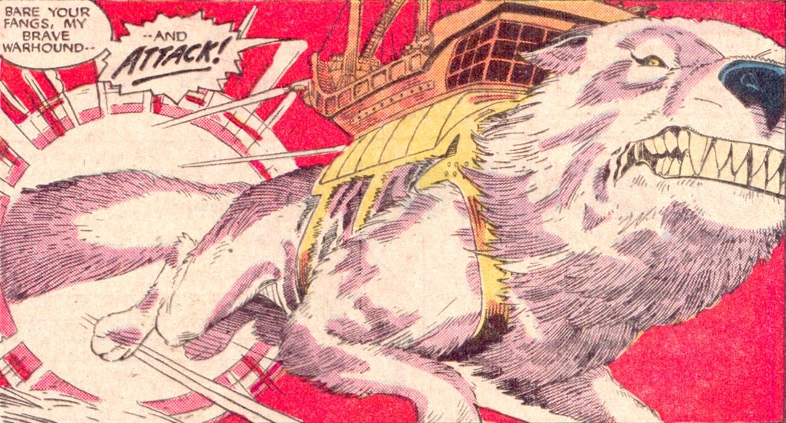
So characters like M'Rin, the chief of the surviving Fall People, and C'Jime, the giant flying fox with a ship on his back (no really) are introduced as familiar to Storm and readers but confuse later readers. It's also clear that Colossus and the Fall woman Nereel had a brief relationship on his previous visit with her son Peter being the product but she declines to tell him and he doesn't realise this despite so many clues including her son having the same name as him. Also treated poorly in this story is Dazzler who spends a lot of time first crying about Longshot's disappearance and then worrying when Rogue absorbs his power and realises this means she's also going to find out how Longshot feels about Dazzler. This trend of treating the character as a ditz is prominent in both X-Men stories in this annual and won't end here. This is a far cry from the confident young woman trying to pursue her career and handle her powers who held her own series for several years.
There's also a resort to undoing a lot in this story. The Savage Land had been destroyed for several years in real time, a change that lasted surprisingly long, but is now returned to its traditional form. The true foe is brought back from the dead along with convoluted revelations that neither the Terminus seen here nor the one who destroyed the Savage Land are the real one. And at the end of the story Psylocke mindwipes all the inhabitants to cover up the X-Men's involvement. The accusation that around this time Marvel wanted to "end innovation" has been made elsewhere and disputed in other places but it's hard to deny that this story is one massive reset switch.
All in all this is a rather disappointing tale with the plot stretched out more than it needs be and some of the characters treated as idiots. However Art Adams's art does a lot to rescue it but it can't hide the feeling that this crossover was regarded as an unwanted intruder on the series.
2nd story: I want my X-Men!
(No specific credits are printed. All the listings I've seen online credit exactly the same team as the first story.)
This is a satire on trends in the comics and more general media industry as Mojo reacts to the apparent death of the X-Men with fury... because their adventures are his top rated show. So he sets out to find some new stars and auditions numerous variant X-Men until along come the X-Babies who evade execution and rapidly prove a ratings hit.
As a protracted satirical piece there's more emphasis on humour than plot with some fun scenes such as Mojo's discussion with his "Brains Trust" who are drawn as the creative team (though the one who should be Glynis Oliver looks more like former editor Ann Nocenti to the point online guides are divided over who she is; confusingly Nocenti is also the basis for the returning character Ricochet Rita) with Chris Claremont taking a stand for quality over quantity and getting firmly told just who owns the property or the auditions of just about every conceivable alternative form of the X-Men imaginable - ones we see include a sex swapped team, a version as Transformers (now there's some ideas for Hasbro), a "naughty" team in more sexually revealing outfits (predicting one particular 1990s comics trend), a version of the team as animals, numerous more only mentioned and finally a version as young children. This parodied the trend to do versions of cartoons reimagining the characters as children that started with Muppet Babies and had already spawned The Flintstone Kids and The New Archies with A Pup Named Scooby-Doo about to debut that autumn.
Being more comedy than story this is a nice fun tale though it does continue the trend of making Dazzler ever more ditzy - here her child self spends several pages obsessing over Longshot when he gets turned into a picture by an angry Mojo. Otherwise the younger versions are generally in character albeit with some magnified traits such as Wolverine's naughtiness. The digs at the way the industry works in finding spin-off material are surprisingly prescient given the way the comics industry and especially the X-Men titles were already starting to go. This is a good fun piece.
3rd story: The High Evolutionary: Demon Night
Story: Mark Gruenwald
Pencils: Ron Lim
Inks: Tony DeZuniga
Letters: Ken Lopez
Colors: Gregory Wright
Editor: Ralph Macchio
Editor-in-Chief: Tom DeFalco
We come to one of the most retconned pieces of Marvel history - the birth of the Scarlet Witch and Quicksilver. I have lost count of just how many times this has been revisited over the years and just how many different parents they've been given. But back in 1988 there were *only* three couples who at one point or another had been assumed to be their parents and this retelling will take multiple chapters to work through them. This chapter tells how a heavily pregnant woman called Magda came to Mount Wundagore and gave birth to twins the night the demon Cthon arose but was driven off by a combination of the High Evolutionary's New Men and the sorcerer Magnus. But as the end of the chapter tells us Cthon had formed a link with the Scarlet Witch that would come to fruition decades later.
Some time has clearly passed since the previous chapter but exactly how much is never specified beyond a period of "over a decade" in which Herbert Edgar Wyndham has continued the genetic transformation of animals into humanoids and Magnus has trained them as knights. This would mean that Magnus has been occupying the body of Jonathan Drew for a long time but it's not clarified if Drew is dead or has been suppressed all this time. As Wyndham refuses to accept the claim that his friend's body is possessed by a sixth century sorcerer the point is not elaborated on. There is also no mention at all of the Second World War even though the length of time given indicates we should be at least midway through it by now. Perhaps Mark Gruenwald saw wisdom in not using the Evolutionary to explain anything either from the Golden Age itself or how particular characters had lived all the way up to the present day which was getting ever further from the war.
It's difficult to tell the story of a monumental battle in a mere two pages but given how much history there still is to wade through it's not clear what could have been dropped for a foe who hadn't actually appeared in that many stories at this point. Nor is the father of Magda's children explicitly identified at this stage, replicating the way it was originally left to fans to guess and marry up information from different series but given his significance in the Marvel Universe it's a surprising omission and it must be remembered that this chapter was going to read by more than just regular Uncanny X-Men readers. The chapter stops before reaching the other two pairs of parents but otherwise shows the backstory to one of the more memorable Avengers stories.
There are no pin-ups or other features in the annual. All in all it's a mixed affair with the lead story serving more as an excuse to restore one of the traditional settings of the Marvel Universe than a tale to develop either the lead characters or the crossover event. The saga chapter also shows the strain of having to retell and co-ordinate so much history in one go. However the X-Babies story is a wonderful piece of comedy and worth the price of admission alone.
Showing posts with label Arthur Adams. Show all posts
Wednesday, 13 October 2021
Friday, 6 November 2015
Essential X-Men volume 10 - creator labels
Once again there's a volume with a lot of creators so here's the separate labels post.Friday, 4 September 2015
Essential X-Men volume 8
Essential X-Men volume 8 consists of Uncanny X-Men #229 to #243 & Annual #12 plus X-Factor #36 to #39. Bonus material includes adverts for "Inferno" plus the cover of the trade paperback which combines elements from the covers of issues #240 & #242. All the Uncanny X-Men issues, including the annual, are written by Chris Claremont and all the X-Factor issues by Louise Simonson. The Uncanny X-Men issues are drawn by Marc Silvestri and Rick Leonardi with the annual by Arthur Adams and the X-Factor issues by Walter Simonson.This is an unusual volume in that everything in it was released in a single calendar year, 1988 (though due to cover dates being four months ahead and the newstands being slower than the direct market there are listings out there that place "Inferno" in 1989). This year saw the series go twice monthly in the early summer months, participate in an crossover even larger than any that had come before and also saw the annual take part in the first ever line-wide annual crossover. That's a lot in a short time (and a large assault on reader's wallets - the start of the year also saw the price rise by 25% for not just this book but all of the mutant titles and for that matter four other series that also took part in "Inferno") so it comes as a surprise that this is also an era that set out a very distinct status quo for the team, setting them apart from much of the wider Marvel universe.
That status quo is established at the outset of the volume. Following the X-Men's seeming death at the end of the previous volume they wind in up in an abandoned town in the Australian outback where they battle the Reavers and defeat them. Then they take over the town and the advanced systems beneath it. The mysterious Roma casts a spell that will make them invisible to any electronic scanning device bar their own, whilst the mysterious Aboriginal mutant dubbed Gateway will teleport them to places all over the world. And so the scene is set for the outback era of the series in which the team operate as secretly as possible, seeking to uphold and implement Xavier's dream.
This is quite a bold change from before, with several clear effects. The membership of the team is absolutely consistent throughout the entirety of the volume, comprising Storm, Wolverine, Colossus, Rogue, Psylocke, Dazzler, Longshot and Havok. The supporting cast of Madelyne Pryor and Gateway are consistent too at least until the final storyline in the volume. As a result, there's clear character development that isn't messed around or interrupted by membership turnover. However, the set-up does come with some potential loopholes. Though it's not acknowledged here, this volume coincides with the period when Wolverine received his own solo series and it's none too clear how he's simultaneously hiding in Australia invisible to all electronic sensors whilst also operating out of Madripoor. There are a lot of times when the X-Men's involvement has to be hidden and Psylocke resorts to using her powers to alter memories with little regard for the ethics of such actions. And Gateway feels all too convenient a plot device, somehow always knowing when his powers are needed despite never saying a word. On the other hand the electronic invisibility is handled well and sometimes it proves a disadvantage, such as when Rogue and Wolverine try to infiltrate a prison on Genosha in disguise but find their absence from the monitor screens gives them away. Being dead to the world means they cannot contact their families and this leads to Colossus having to pretend he is merely his own spirit conjured up to help his sister Illyana when he goes to see if she is okay and finds her in battle with the witch Baba Yaga in the realm of Limbo. It's a heart wrenching moment to see how cut off the siblings are. By contrast Madelyne has been deserted by her husband and continues to search for her son discretely.
The stories range from a light-hearted Christmas issue (originally on sale in, erm, February) through to the darkness of the Genosha storyline, followed by the "Inferno" crossover. In general the world the X-Men inhabit feels ever darker than before and they find themselves reacting accordingly, finding themselves becoming ever more ruthless and increasingly willing to kill opponents. There's another storyline with the Brood who have possessed a group of mutants in Denver and this story sees the darkness increasing as both Wolverine and Havok find themselves having to kill the aliens.
Some lighter moments come in the annual, which is part of "The Evolutionary War" crossover. Here the X-Men and the High Evolutionary tangle with the alien Terminus in the wasteland that was once the Savage Land and meet with the remains of the tribespeople. It's a so-so story that undoes the needless destruction of the Savage Land, though this didn't take place in Uncanny X-Men at all, but it's utterly unclear just how this ties in with the Evolutionary's masterplan and this frankly could have been a standalone annual with a guest star for all the difference that it makes. A back-up story is more fun as it sees Mojo seek to find television stars to replace the X-Men now that they're presumed dead. After lengthy auditions that parody the practice of finding suspiciously similar characters and gimmick variations, he finally discovers the X-Babies, very young versions of the team but independent characters rather than simply the originals in a de-aged format. And then audience demand overtakes his plans and hopes. Whilst the idea of junior clones of the X-Men should be a disaster waiting to happen, this story actually holds up quite well and offers a fun take on the concept. It would be completely wrong to have them take over the regular series but they have clear potential for side projects here and there.
The first main epic is a four-part tale that introduces the island nation of Genosha, a society built upon mutant slave labour and the use of genetic engineering to convert mutants and alter their powers so they become near zombie slaves who will serve the needs of the state and the economy. The state employs brutal security forces who go out into the wider world and crack down on Genoshans who have escaped the island, refusing to recognise any other legal rights. It's easy to see the parallels with South Africa, then still under apartheid, even though Genosha proclaims itself to be a country of racial harmony. The Magistrates who go out and kidnap emigrants are clearly inspired by the South African security services of the era. On a more mundane level some of the technology is fantastic such the Magistrates sending their kidnap victims to Genosha via a combination of a teleporter and modem. I wonder just how many science fiction and fantasy writers in the period actually understood the capacity of contemporary modems. The X-Men are drawn in when Madelyne is kidnapped alongside a flying doctor who had escaped from Genosha but is now recaptured. They engage in detective work to discover the distinction and head in on a rescue mission. The story has a strong human element as the son of the genetic engineer discovers that his fiancé, the doctor, is actually a mutant and has been converted by his father. This forces the son to go on a journey of discovery to find out just what his country is really like and then to embark upon a mission to educate his fellow humans, albeit initially from abroad whilst the X-Men only rescue their own and leave, albeit after Wolverine and Rogue have temporarily had their powers cancelled by the mutant Wipeout. This causes Wolverine to nearly succumb to his altered body chemistry whilst on the mental level Rogue must confront the traces of all the personas she has absorbed into her. But with the X-Men only rescuing and not actively seeking regime change the overall message of the story seems to be that a discriminatory regime will only be liberated from within when the "superior" people are enlightened, and there's not much the outside world can do about this. It's a very downbeat and depressing state of affairs that suggests oppressive countries should be left to eventually sort themselves out, even if this was not the actual intention.
The biggest story in the volume is "Inferno" which is steadily built up to in the earlier issues as we see S'ym preparing to retake Limbo whilst Madelyne experiences dreams that convince her ever more that for her husband she was only ever a substitute for Jean Grey and was rapidly cast aside when she was found to be alive. In what she thinks are still her dreams she accepts the temptation of S'ym and chooses to seek vengeance on all those who have made her life what it is. At the same time she and Havok have been drawn to each other and begin an affair in spite of him being her brother in law. But it's here that confusion starts to be sewn when S'ym's role is largely taken over by another demon, N'Astirh, who secretly communicates with Madelyne over subsequent issues. It's not particularly clear in the issues included in this volume just what the relationship between S'ym and N'Astirh actually is, though as the alternative would presumably involve including the three New Mutants issues of Inferno (one of which is double-sized) and the four-part limited series X-Terminators then this was probably an inevitable omission in the collection.
"Inferno" itself is a sprawling saga that sees the long-awaited first meeting of the X-Men and X-Factor. It's trying to cram a lot in and the result is that the actual demon invasion of New York is largely rendered a backdrop in the core issues included here apart from the final confrontation with N'Astirh. The dark magic does, however, bring changes to the various X-Men that extenuate their characters in different directions such as extenuating Dazzler's vanity whilst others become more bloodthirsty in their dealings with both the demons and the Marauders. But the real focus is upon Madelyne Pryor who has become twisted into the "Goblin Queen", seeking revenge on Cyclops, Marvel Girl, the X-Men and Mr Sinister all at once. The story sets out to explain both Madelyne's background and the wider manipulations by Mr Sinister over the years, and then to sort out some of the awkward mess caused by the resurrection of Jean Grey and the creation of X-Factor. Overall it does it well but it succumbs to the mess of a newish villain - this is in fact Mr Sinister's first significant storyline - being revealed as the force behind events and confusion going back many years before their debut. The story is also a homage to the Dark Phoenix Saga as once again a copy of Jean Grey acquires great power and is corrupted beyond redemption. But it feels as though it's more of an X-Factor saga than an X-Men one. Yes they may be the original X-Men and the saga doubles as the twenty-fifth anniversary of the X-Men and the 150th issue of the New X-Men (#243 to be precise), but issue #242 is in fact the first time the original team have all appeared in the title since way back in issue #66. The two teams are very different in their standing and approach and so whatever the merits of the crossover for the mutant books as a whole, it does feel a bit underwhelming for the X-Men specifically.
That's pretty much the pattern for this volume as a whole. There are some strong and original issues but they're let down by an underwhelming execution combined with the team not always winning out or being at the forefront. It's a pity as the overall set-up is certainly quite novel but the full package is less than effective.
Friday, 14 August 2015
Essential X-Men volume 7
Essential X-Men volume 7 comprises Uncanny X-Men #214 to #228, Annuals #10 to #11 and the limited series Fantastic Four Vs the X-Men. Bonus material includes an article from Marvel Age about the "Fall of the Mutants" and a special promotional card for a competition linked to the crossover. Everything is written by Chris Claremont with the regular series drawn mostly by Marc Silvestri with individual issues by Barry Windsor-Smith, Alan Davis, Jackson Guice, Bret Blevins, Kerry Gammill and Rick Leonardi. The annuals are drawn by Arthur Adams and Alan Davis and the limited series by Jon Bogdanove.This volume covers a somewhat odd period in the X-Men's history as they try to cope with the fallout from the "Mutant Massacre" and really stumble around more than anything else until the next big event, "Fall of the Mutants" (a pun that doesn't translate well). The lack of direction is extenuated by some vague questioning as to what the overall purpose of the team is, but it doesn't really get very far. Significantly, this is the first volume to be completely devoid of any of the original team, leaving the long-term continuity in the hands of Havok and, to a surprising but small degree, Magneto. But the Master of Magnetism makes rather fewer appearances in the regular issues than one would expect. Instead his main contribution comes in the limited series.
The "Vs" limited series was a curious phenomenon in the 1980s whereby characters from two titles would meet for a special story but one told in its own release rather than as a crossover between the two regular titles. It has the advantage of allowing a single writer and artist to handle the project (at least under normal circumstances) but it can also wind up dancing on the periphery of the regular series, trying to adapt to ongoing developments whilst also telling its own story. From the perspective of this volume Fantastic Four Vs the X-Men is fortunate in this regard as it is written by the regular Uncanny X-Men writer and comes at a time when not too much is happening in the main title. However it has to leap through some hoops in order to include She-Hulk amongst the Fantastic Four's line-up, a point commented on in-story. The series seeks to justify its place by resolving the worst of Shadowcat's injuries that have left her trapped in her intangible form and slowly dissipating, but does so amidst a struggle of mind games between Doctor Doom and Reed Richards. This limited series is actually quite a good Fantastic Four tale that delves into one of the biggest question marks surrounding the four's origin and looks at Reed Richards's approach to those around him and Doctor Doom's ultimate goal in their struggle. But amidst all this the X-Men are something of a bolt on to provide recurring conflict. Any group and problem could have served their purpose in the story and it wouldn't have made much difference. Even Shadowcat's recovery is not immediate and as she doesn't return to active duty with the team before the end of the volume it doesn't have much of an impact on the story. The one notable feature is the continuing rehabilitation of Magneto, with the Fantastic Four slowly coming to accept him, but in the battles which break out too easily his magnetic powers prove more dangerous than helpful when he accidentally nearly costs Kitty her last hope. Overall this is good Fantastic Four, and in the very long run a good audition piece for Claremont eventually taking up the main series in the late 1990s, but rather forgettable and inessential X-Men.
The two annuals both feel somewhat superfluous to the main narrative beyond the first one introducing Longshot, previously seen in his own limited series, to the regular series. But it does so in a very awkward way by giving him amnesia and then comes with some awkward continuity as the presence of Shadowcat, Nightcrawler and Colossus implies it takes place before the "Mutant Massacre" in the previous volume yet this doesn't explain why Longshot is then absent for several issues of the regular series and both his amnesia and ongoing culture shock goes against the idea that he has been exploring the world around him. Otherwise the annual sees the X-Men's first encounter with Mono and the wackiness of the "Mojoverse" but it's never been a very good fit with the more gritty style of the X-Men's adventures and just feels like silliness for the sake of it. Amidst this comes a piece of role reversal as the New Mutants temporarily step up to the role of being the senior team, complete with individualised costumes intended for when they graduate. Meanwhile the X-Men are reduced in age in one of the examples of babyfication that was all the rage following the Muppet Babies, becoming cute toddler versions of themselves. Were it not for Longshot and later appearances by Mojo, this annual could be so easily forgotten. The other annual is also trying to incorporate elements from other series into the mainstream Marvel universe with guest appearances by Captain Britain and his girlfriend Meggan, even though neither is essential for the story told. In it the X-Men and guests are captured by Horde, a never before seen alien, and taken to a strange citadel to secure a crystal of incredible power, in one of the most generic plots going. Whilst making their way through the citadel the group gets picked off one by one and offered their hearts' desires by the citadel itself. It's a minor character study that doesn't leave much of an impact beyond the scene where Wolverine is killed by Horde but his whole body regrows itself from a single drop of blood, aided by the power of the crystal. The whole group gets returned home to exactly when they left with memories fading, making the whole thing no more significant than an obscure dream.
Over in the regular issues the team continues to develop. Injuries meant that both Shadowcat and Nightcrawler are off the active roster and stay that way when big changes come though Colossus has returned to the team just in time. He's not quite the same Peter of old as his injuries have left his armoured form as the default norm with a great deal of effort required to turn to his human self. Also rejoining the team is Havok, who finds himself in the curious position of being the earliest member of the X-Men yet is treated by the others as an untested member. Returning to the team after Polaris is possessed by Malice and joins the Marauders, Havok finds himself in the horrific situation of having to either let her go to harm others or else stop her permanently - and winds up releasing a plasma blast though Malice/Polaris manages to block it and escape. Alex is somewhat taken aback by what the X-Men have become, particularly their alliance with Magneto, but doesn't really have the long-term history with the team that allows him to perform the role of keeper of the original aims. Nevertheless he stays around, particularly to help protect his sister-in-law Madelyne Pryor who has had her husband walk out on her, all records of her past erased and who is now being hunted by the Marauders. There are signs of an attraction between them but they're not developed just yet.
The other new addition to the team is also driven to them by the actions of Malice. Since the end of her own series Dazzler has been trying to rebuild her career, starting out as a backing artiste but both her own ambitions and the interference by Malice soon put paid to this. Alison soon accepts the protection of the X-Men and undergoes training to refine and enhance her light powers, putting especial emphasis on being able to use them as a laser, but there's an ongoing tension between her role as an X-Men and her ambitions to be a singing star, making for an especially tense confrontation with one fan, none other than the Juggernaut. Also causing tensions is the presence of her old enemy Rogue, with Alison making it clear she hasn't forgiven the past enmity until another battle with the Marauders where she risks her all to save Rogue from drowning. At this stage Dazzler is still the only member of the team to have had her own series and as well as her past battles with Rogue the series is also echoed by the return of O.Z. and Cerberus in a tale about a mutant drug dealer.
The old ways also come up in another fashion when Storm is kidnapped by the Crimson Commando, Stonewall and Super Sabre, a trio of old heroes fighting against the values of the modern world. They take Storm and another girl and release them to be hunted in the wilderness. Later on they're captured and agree to join Freedom Force, which continues to skate the line between a government sanctioned team of mutants and a group with its own agenda. The hunt also puts both Storm and Wolverine to the test as the former faces up to the fact she may well need to adopt her comrade's ethics of kill or be killed whilst the latter struggles to retain his humanity as he faces confusion all around him. The threat level is also raised by the introduction of the Marauders' master, Mr Sinister, but for now he remains a dark force on the edge of things.
A lengthy storyline sees Storm searching for Forge in the hope that he can restore her powers, helped by Forge's shaman mentor Naze. In the process she also finds it in herself to forgive him but also discovers the presence of a demon known as "the Adversary". Meanwhile Destiny of Freedom Force has a vision of the X-Men all dying in the near future. The storylines merge and climax in the "Fall of the Mutants" issues, #225 to #227. This was an unusual crossover between the three mutant titles as they shared a theme of big status quo changing events, rather than a single storyline running across them all. The X-Men find themselves first battling Freedom Force and then facing the end of the world due to the magic of the Adversary and the past mistakes of Forge. In full view of a camera broadcasting to the world, the X-Men set out to risk their all to build a better world. It's a dark moment for them but a great one for mutantkind, setting up a new position for the future. However we don't get to see that in this volume as the last issue has all the feel of a standby fill-in being pressed into service, hastily turned into a flashback.
Overall this volume isn't a particularly great period for the X-Men. It's a time of stumbling more than anything else, with no great sense of purpose or direction. The newer members of the team help to keep the cast fresh but rarely bring any particularly exciting story elements with them. Overall this volume shows the team going from one big event to the next with not too much of note happening in between.
Friday, 7 August 2015
Essential X-Factor volume 4 - creator labels
Once again, we have a volume with a large number of creators so here is a separate post for some of the labels.
Friday, 20 February 2015
Essential X-Men volume 6 - creator labels
Yes this volume has a lot of creators so this is the standard extra post.Friday, 23 January 2015
Essential X-Factor volume 3
Essential X-Factor volume 3 contains issues #36 to #50 & Annual #3 plus Uncanny X-Men #242 & #243 which form part of the "Inferno" crossover. Bonus material includes Official Handbook of the Marvel Universe entries for Mister Sinister and Madelyne Prior. All the X-Factor issues are written by Louise Simonson bar one that is both written and drawn by Kieron Dwyer whilst Chris Claremont writes the Uncanny X-Men issues. The art is by a mixture of Walter Simonson, Arthur Adams, and Paul Smith with individual issues by Dwyer, Rob Liefeld, Rich Buckler and Terry Shoemaker, who also does the main story in the annual. A back up in the annual is drawn by Tom Artis. The Uncanny X-Men issues are drawn by Marc Silvestri.The first item in this collection is the annual and its inclusion here is a bit of a mess. It features the Beast before his furry form returned, and was originally released between issues #30 & #31. It probably should have been included in the previous volume but it's not immediately obvious where it should have been placed; a sign of the problems annuals often bring even when, as here, they're scripted by the series's regular writer. The lead story is the first part of "The Evolutionary War", a story that ran in just about all the Marvel annuals in 1988. However it's fairly easy to read this part in isolation from the rest with the separate strands of X-Factor battling agents of the High Evolutionary called the Purifiers who seek to exterminate the Subterranean race as part of cleansing the Earth before accelerated evolution whilst the Evolutionary himself is attacked by Apocalypse with a battle over their different approaches of intelligent design against natural selection as the way forward for the human race. To be frank this is a so-so X-Factor story but a very uninteresting start to a large and expensive crossover. The back up chapter detailing the history of the High Evolutionary has not been included but it's no real loss. What is included though is a short piece in which the various kids on Ship learn about the history of the X-Factor team from their earliest days in the X-Men through to their recent surge of popularity. With the exception of the Beast's form this little story comes at a very handy moment as it recaps some key points including Jean's replacement by the Phoenix and Scott's marriage to Jean's lookalike Madelyne Pryor. This is perfect timing for what comes next.
"Inferno" was the big Marvel crossover of late 1988 and X-Factor has a strong claim to be the primary title, having been building up the storylines over several issues and containing some of the key conflicts. But oddly the storyline can feel a little confused upon entering issue #36, partially because the build-up in the preceding three issues was included in volume 2, originally released almost three years earlier, but also because some of the storyline was set up in the X-Terminators limited series which isn't included here despite starring the youngsters X-Factor have rescued. Perhaps this is because X-Terminators leads more directly into New Mutants, with the former team soon merging into the latter. The two Uncanny X-Men issues plus four X-Factor issues had been previously reprinted in Essential X-Men volume 8 but some duplication with crossovers is unavoidable and here the Uncanny X-Men issues have been kept to the minimum of only those once the two teams actually meet up.
Once it gets past the general scenes of Manhattan being transformed by demons, the story reaches some of its main focuses. This is not some casual event crossover where some enemy comes from out of the blue only to get defeated and everything goes back to normal. Instead, there are several big developments and some long awaited moments. The biggest one is the first meeting between X-Factor and the X-Men, which now seems amazing considering X-Factor had by this stage been around for three years and this is no less than the third crossover between the mutant titles that both have taken part in. But the meeting isn't smooth as there's a lot of distrust between the two, in part because of X-Factor's historic role of posing as mutant hunters but also because of the presence of Scott's estranged wife Madelyne Prior, who has become the Goblin Queen.
This is very much the story of Scott and Jean and Madelyne as several years' worth of mysteries are finally addressed and further steps are taken to retroactively clean up some of the mess created when the series was launched. We now learn just what Madelyne is and how she has been just a gene substitute for Mr Sinister and a Jean substitute for Scott. The confrontation between husband and wife is ugly, with it becoming all too clear which woman Scott prefers. But this is not a popular choice with his brother Alex turning on him in fury. In real life many a divorce and/or custody case has seen the relatives of one partner/parent support the other and Alex's fury is believable as he hammers home how Scott has gone against his vows and abandoned his wife. For Jean there's a horror of once again having a replacement going mad with great power, and worse still the Phoenix force has made Madelyne even more a part of her than before. At the heart of all this is a child, called "Christopher" by his father and "Nathan" by his mother, who is to be sacrificed both for revenge on his father but also to create a bridge between Earth and the realm of Limbo.
The demon side of "Inferno" isn't as interesting, with the lead demon N'Astirh a fairly confused character though it's possible that much of his story is in parts of the crossover not included here. Nor is it too clear just what the realm of Limbo actually is, since the name has been used several times by Marvel and also has the connotations of the religious realm. All of this provides a backdrop and some nice visuals, as well as the return to the team of Warren, who adopts the name of Archangel in the epilogue issue.
But the real showdown is less about demons than about Scott's past as we discover just how much he has been manipulated over the years by Mr Sinister, right from his days in the orphanage. We get an explanation for just where Scott got his first ruby quartz spectacles that could contain his force beams but more pertinently how Madelyne was created and manipulated. Wisely the story doesn't directly retcon Scott leaving Madelyne as merely the manipulation of Mr Sinister, but he was responsible for her and Nathan Christopher's subsequent disappearance that prevented reconciliation. Instead Scott's redemption comes variously in saving his son from Madelyne and then in facing down Sinister in an act of catharsis. It's a dramatic conclusion that does its best to resolve some of the chaos and baggage caused by both Jean's death and return. The abandonment at the start of the series is simply too big a problem to resolve but otherwise there's a strong sense of resolution and closure.
Issue #40 is a minor milestone as the first ever Marvel work by Rob Liefeld. It may lack some of what would become his regular themes but it's got several features that have recurred in his work including awkward poses such as Cyclops appearing to have two left arms, the Beast walking at an angle where he's almost falling over, many characters doing strange things with their feet as though they're dancing instructors giving a frozen demonstration and numerous marks and lines on faces. Fortunately the main villain is one that it's hard to draw badly, as Nanny is just an egg with a voice and limbs. It's not the wildest piece of work but it's a style that's quite different from before and it's amazing that Liefeld went on to enjoy the sales and success that he did. He's far from the only reason the comics industry developed the way it did over the next several years (and I often feel that some of the criticisms of him are really proxies for dislike of industry developments and corporate decisions for which he was the easiest target) but it's an unfortunate development nonetheless.
"Inferno" may have forced itself into numerous other titles but the reverse is resisted here when it comes to "Acts of Vengeance" with issues #49 & #50 making it clear their primary purpose is to finish off the title's own "Judgement War" storyline and confining the crossover to two standalone pages in the former issue and a six page back up in the latter. This may be one of the earliest signs of "writing for the trade", and indeed I'm informed that the Acts of Vengeance Crossovers Omnibus edition only reprints these eight pages rather than the full issues, though here it's the crossover rather than the book's own plots that are confined to the easy to remove pages. It almost feels as though Apocalypse is expressing not only his own thoughts but those of an irritated Louise Simonson (though one could reasonably point out that she wrote all the core "Inferno" issues bar the Uncanny X-Men ones and that crossover had also intruded on an awful lot of titles). Apocalypse observes the events and comments on how some of the villains are bafflingly "out of character" and actually calls the whole thing an "absurdity" and "already a failure" as he rather bluntly declines an invitation to join the leadership of the villains' alliance. Looking at the basic premise of the crossover is probably best left to a review of a more central part of the event, but it's hard to deny that it requires some basic leaps in goals by villains. For a genocidal tyrant who seeks to advance the strongest in the human race to team up with a group including, amongst others, a New York crimelord would be a very strange move even though having its main villain in the alliance's leadership would have raised the profile of X-Factor as a series and couldn't have been more illogical than having a Holocaust survivor and a Nazi war criminal working together. Still the encounter means the Essential volume is bookended by Apocalypse engaged in both a physical and philosophical battle with the lead villain in a major crossover.
Nestled between "Inferno" and "Judgement War" is a curious two-parter which introduces Alchemy, a mutant created by the winner of a contest. As the name implies Alchemy has a Midas Touch and a curious group called Troll Associates who plan to use him to destroy the British economy by creating so much gold as to make it worthless and then return the country to the days of magic. It's odd to encounter traditional monsters engaged in economic warfare and the story is also bizarre for the way Jean insists on taking Christopher, a mere baby, on the mission with them despite the all too clear danger.
Midway through "Judgement War" the series confesses to missing its deadlines and runs a fill-in from file, complete with an extra page at the start to allow for a random flashback to completely unrelated events. We get a solo tale of Archangel as he reflects on how life is now so much more complicated and it's no longer so easy to tell good from evil, whilst a priest is running a home for young mutants but uses the "Children of Heaven" for street crime. It's a so-so piece, as most fill-ins are, but during the original publication it must have been frustrating to readers for such a long take to be stretched out even further by interruptions. (The cover dates can confuse as steps were taken to reduce them from four months ahead of publication to two, with a couple of issues cover dated "Mid" month to absorb the difference.)
As for "Judgement War" itself, there are some good ideas but the emphasis is all wrong and the storyline way too long. In the course of the story we learn the true origin of Ship and discover that the events of "Inferno" have left the personalities of both Madelyne and the Phoenix in Jean's mind. But these elements are very much side-shows in a tale of an unnamed planet full of mutants where a technologically advanced but culturally medieval society has settled into a rigid structure of castes including the Chosen, the Rejects and the Dualers, and those who reject it all, the Beginagains. X-Factor, Christopher and Ship are scattered across the various factions and find themselves caught in power struggles and burdening revolutions, whilst the Celestials are coming to judge whether or not the civilisation and world is worthy of continued existence. Frankly the planet's internal politics are boring and attempts to draw an analogy with the situation on Earth is limited. Of much more interest is the struggle within Jean as the Madelyne and Phoenix personalities struggle to assert themselves, whilst Jean gets a chance to atone for the Phoenix's greatest crime, yet this is underplayed. Overall this storyline feels stretched out of all proportion and probably could have been cut by at least two parts. This may not have resulted in an especially good "Acts of Vengeance" crossover but it would certainly have cut some of the tedium at the end of the volume.
This is another volume that mixes the strong and the weak. The best stuff is at the front with "Inferno" proving a strong resolution to a number of long running threads as well as a dramatic showdown in its own right. The rest of the volume is mixed with a number of odd moments but no especially awful moments even if the main storyline runs on for too long.
Labels:
Arthur Adams,
Chris Claremont,
Kieron Dwyer,
Louise Simonson,
Marc Silvestri,
Paul Smith,
Rich Buckler,
Rob Liefeld,
Terry Shoemaker,
Tom Artis,
Walter Simonson,
X-Factor,
X-Men
Wednesday, 18 July 2012
Essential Web of Spider-Man volume 1 - creator labels
Yet again we have a volume with a lot of creators, so here's a separate post to carry the labels for some of them.
Subscribe to:
Posts (Atom)