Showing posts with label Glenn Herdling. Show all posts

Wednesday, 27 February 2019

What If... 31 - Acts of Vengeance

What If... Spider-Man had kept his cosmic powers?

A common feature of What If... was to do a story where a major crossover event turned out differently. The first issue of the relaunched regular series asked "What If... the Avengers lost the Evolutionary War?" and later issues offered alternate outcomes for events such as "Secret Wars" (#114), "Fall of the Mutants" (#101), "Inferno" (#6 and #37), "Atlantis Attacks" (#25), "Infinity Gauntlet" (#49 and #104), "Operation Galactic Storm" (#55 & #56), "Age of Apocalypse" (#77 and #81) and the Spider-Man "Clone Saga" (#86). It's thus a surprise to see there wasn't one focused on the core of "Acts of Vengeance" and we only get a look at an alternate ending to the story of Spider-Man's cosmic powers.

What If... #31

Writer: Glenn Alan Herdling
Penciler: Scott Alan McDaniel
Inkers: Col. Sanders III & Sam Delarosa
Letterer: Ken Bruzenak
Colourists: Tom Vincent and Co.
Editor: Craig Anderson
Chief: Tom DeFalco

The opening scene with Captain Universe possessing the dog Casey features Glenn Herdling proposing to Laura - she said yes both here and in real life though I don't know which way round the proposals came. This scene helps the Watcher to (re)introduce the Uni-Power of Captain Universe and how it came to Spider-Man before explaining how in the regular reality the Uni-Power went on to mainly possess children and animals, leaving unexplored the potential of the power being held long-term by "a powerful, intelligent host. At least not in your reality...!" This story shows that potential.

The divergent point is straightforward - the power stays with Spider-Man after his battle with the Tri-Sentinel and as a result this story doesn't have to wade through retelling loads of existing comics. The only story I can spot from elsewhere is when Spider-Man teamed up with Avengers to fight Nebula, which is here handled in two panels as his powers provide both speedy resolution and concern for Thor and Captain America.

The theme is of the conflict between "With absolute power there comes absolute responsibility" and "absolute power corrupts absolutely". Over the course of this issue we see how cosmic Spider-Man steadily seeks to solve ever greater problems in the world, but things don't always go well. There's an early encounter with the Hobgoblin who, rarely for this era of Marvel, is presented as quite a serious threat, or at least he would be if not for Spider-Man's power level. Spidey tries to remove the physical changes made by demons, but only succeeds to turn Hobgoblin's face into Peter Parker's! (An existing spell by Doctor Strange means Hobgoblin thought he had a normal face and now thinks he has a monstrous one.) There's also a quick fight with Venom (who interestingly is drawn as he looked at the time of Acts of Vengeance rather than with the modifications Erik Larsen had made in the intervening two years), who is persuaded to reform and take Spider-Man's place as a street level crime fighter. This came over a year before the Lethal Protector phase of the character began, showing how many an idea was prefigured by What If... (but also perhaps that's where some ideas should have been left).

However Spider-Man taking on the role of the world's protector is bringing personal changes, with both Mary Jane and Venom's alien symbiote no longer recognising the man they once knew so well. This brings a very poorly handled moment when Aunt May inadvertently discovers Peter's secret. Although the cosmic powers are more shocking than just being Spider-Man, it's become a bit too much of a cliché that upon learning her nephew's secret she would suffer a heart attack. Even before this he has been neglecting Mary Jane terribly and the marriage nearly collapses but eventually proves to be more durable.

In the original stories Spider-Man did wonder if he could have used his powers to stop Gaddafi and end apartheid. However this dated quickly as in the two years between then and this story the world had moved on a bit with South Africa now clearly in the process of dismantling apartheid (one of the key steps, the National Peace Accord, was signed only a few days before the issue went on sale) and Gaddafi had been surpassed as the west's main target in the Arab world. As is so often the case in comics, the actual names of leaders and countries are not used but the area is explicitly identified as the "Persian Gulf" and as Spider-Man soars into a capital city and locates the bunker the dictator is hiding in with his "Republican Guard" the artwork doesn't fail to disguise and instead gives us the wonderful image of Spider-Man capturing Saddam Hussein.

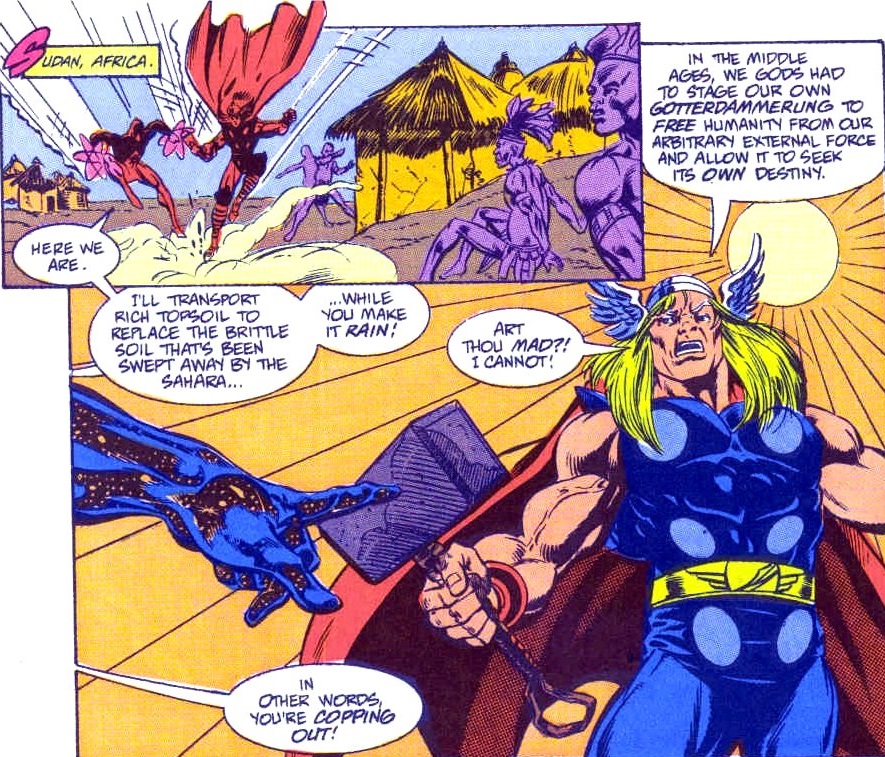
Spidey eventually tries to solve the problem of drought in the Sudan, forcibly recruiting Thor and this leads to a confrontation between the two about whether gods should allow people to seek their own destiny or intervene all the time. For a story exploring the real-world implications of having beings with such great powers, it's good to also get a realistic explanation as to why they don't set out to wipe out famine and the likes in the real world.

The finale brings a confrontation with Doctor Doom, who brings a hostage, Captain Ray Coffin who was the original wielder of the Captain Universe power. And Spider-Man doesn't hold back, leading to Doom snapping Coffin's neck, triggering the eventual confrontation between Peter's true side and Captain Universe, fought out as energy forms before bringing revelations about both Doom and what must truly be done with the Uni-Power. Thus he makes the final sacrifice by using Doom's weapon to release the power, creating a moment of universal unity, linking all minds together.

This obviously isn't a substitute for "What If... the Avengers lost Acts of Vengeance" but it was never meant to be and so shouldn't be approached in that way. Instead it's a good What If... that takes the basic concept from a storyline and shows what more could have been done but also why the regular Marvel universe couldn't go there. Unlike a lot of What If... stories it doesn't wind up with the gratuitous killing of characters for the sake of it or else being so tame as to produce a simplified alternative where a few identities, costumes and/or team memberships have changed but otherwise things are much the same. Instead it gives us a good exploration of the fundamental philosophical concept behind Spider-Man, turned up to the absolute degree.

What If... #31  has been reprinted in:
  • Nowhere at all it seems.

Friday, 1 January 2016

Wednesday, 9 September 2015

Essential Official Handbook of the Marvel Universe Master Edition volume 3

Essential Official Handbook of the Marvel Universe Master Edition volume 3 collects the entries for Professor Power through to Zzzax from across the thirty-six issue run of the series. Additionally it includes another printing of the single page guide to power levels, the single page special glossary and an index to which issue each entry originally appeared in. Once again the entries are mainly drawn by Keith Pollard and researched & written by Len Kaminski, Jamie Tost, Mark Gruenwald, Glenn Herdling, Murray Ward and Peter Sanderson. The whole thing is edited successively by Mark Gruenwald, Kelly Corvese and Tom Brevoort.

The standard entry for a character has a full-page shot of the character from the front, side and rear. Then there's a page of text with the following pro forma:
  • Biographical Data
  • Real name
  • Other current aliases
  • Former aliases
  • Dual identity
  • Current occupation
  • Former occupation
  • Citizenship
  • Legal status
  • Place of birth
  • Marital status
  • Known relatives
  • Known confidants
  • Known allies
  • Major enemies
  • Usual base of operations
  • Former base of operations
  • Current group membership
  • Former group membership
  • Extent of occupation
  • Physical Description
  • Height
  • Weight
  • Eyes
  • Hair
  • Other distinguishing features
  • Powers and Abilities
  • Intelligence
  • Strength
  • Speed
  • Stamina
  • Durability
  • Agility
  • Reflexes
  • Fighting skills
  • Special skills and abilities
  • Superhuman physical powers
  • Superhuman mental powers
  • Special limitations
  • Source of superhuman powers
  • Paraphernalia
  • Costume specifications
  • Personal weaponry
  • Special weaponry
  • Other accessories
  • Transportation
  • Design and manufacture of paraphernalia
  • Bibliography
  • First appearance
  • Origin issue
  • Significant issues
Occasionally a section will be followed by a "Note", clarifying some point or other. Sometimes there is no space left for "Significant issues". The entries and art are all printed in landscape format. The first appearances for characters who originated in the Golden or Atlas Ages include both a "historical" and "modern" entry. A few characters get second entries with new looks and updated information, including Sabretooth, whose entries show just how much more of his past was revealed in such a short space of time, and Wolverine, whose ones show how it was all much the same.

Usually the entries are in the correct order give or take some errors such as placing Union Jack III before the combined entry for Union Jack I & II. However there are some odd placements with characters who have no codename and are listed by surname. Thus "Rahn, Tamara" is listed under T but "Stone, Tyler" is listed under S. Some high profile heroes such as She-Hulk get a second page with brief entries for the supporting casts, with the image page showing the hero in action. Spider-Man's cast is so big that he gets a third, with the image page nominally devoted to his webshooters in action. The entries for each cast member list:
  • [Name]
  • Current occupation
  • Relationship [to the hero]
  • First appearance
As ever the Punisher is different and his second page is instead given over to his arsenal in the following format:
  • [Type of gun]
  • [Name of gun]
  • Caliber
  • Action
  • Capacity
  • Weight
  • Note
There are a small number of entries for races such as the Skrulls, presented in the following format:
  • Home world
  • Origin world
  • Habitat
  • Gravity
  • Atmosphere
  • Physical characteristics
  • Type
  • Eyes
  • Fingers
  • Skin color
  • Average height
  • Special adaptations
  • Unusual physical characteristics
  • Superhumanoid powers
  • Intelligence
  • Strength
  • Speed
  • Stamina
  • Durability
  • Agility
  • Reflexes
  • Society
  • Population
  • Government
  • Technology level
  • Cultural traits
  • Leaders
  • Names of other representatives
  • Major allies
  • Major enemies
  • Bibliography
  • First appearance
  • Origin issue
  • Significant issues
Groups and organisations are listed differently with this pro forma:
  • Organization
  • Full name
  • Purpose
  • Modus operandi
  • Extent of operations
  • Relationship to conventional authorities
  • Base of operations
  • Former bases of operations
  • Major funding
  • Known enemies
  • Known allies
  • Membership
  • Number of active members
  • Number of reserve members
  • Organizational structure
  • Known officers
  • Known current members
  • Known former members
  • Known special agents
  • Membership requirements
  • History
  • Founder
  • Other leaders
  • Previous purpose or goals
  • Major campaigns or accomplishments
  • Major setbacks
  • Technology and paraphernalia
  • Level of technology
  • Transportation
  • Standard uniforms
  • Standard weaponry
  • Standard accessories
  • Bibliography
  • First appearance
  • Origin issue
  • Significant issues
The big name teams such as the X-Men have a Membership Roster running over multiple additional sheets that detail each member's time with the team as follows:
  • [Identity]
  • Real name
  • Current status
  • Membership record
  • Note
The index at the back isn't the most useful as the entries are not reproduced in their original issue packs and an alphabetical ordering makes it redundant, with the small number of placement errors just adding to the problem. Otherwise this volume just comes to an end with no reproduction of the concluding editorials that instead appeared in the first volume.

It has become incredibly repetitive to state just how boring and inessential these volumes are but the reproduction of no less than three incarnations of the Handbook has been repetitive in and of itself. The Master Edition is thinnest on actual narrative information and feels like an overblown set of trading cards with the format of landscapes and static images just failing to inspire. There is a clear advantage in having the sheets collected in the intended order but this just doesn't outweigh the fact that in the internet era where it's easy to produce a regularly updated encyclopaedia of characters a paper series from many years ago just doesn't need to be collected at all. These volumes are easily the least essential of all the Essentials.

Wednesday, 29 July 2015

Essential Official Handbook of the Marvel Universe Master Edition volume 2

Essential Official Handbook of the Marvel Universe Master Edition volume 2 collects the entries for Garokk through to Proctor from across the thirty-six issue run of the series. The only addition material is another printing of the single page guide to power levels. Once again the entries are mainly drawn by Keith Pollard and researched & written by Len Kaminski, Jamie Tost, Mark Gruenwald, Glenn Herdling, Murray Ward and Peter Sanderson. The whole thing is edited successively by Mark Gruenwald, Kelly Corvese and Tom Brevoort.

The standard entry for a character has a full-page shot of the character from the front, side and rear. Then there's a page of text with the following pro forma:
  • Biographical Data
  • Real name
  • Other current aliases
  • Former aliases
  • Dual identity
  • Current occupation
  • Former occupation
  • Citizenship
  • Legal status
  • Place of birth
  • Marital status
  • Known relatives
  • Known confidants
  • Known allies
  • Major enemies
  • Usual base of operations
  • Former base of operations
  • Current group membership
  • Former group membership
  • Extent of occupation
  • Physical Description 
  • Height
  • Weight
  • Eyes
  • Hair
  • Other distinguishing features
  • Powers and Abilities
  • Intelligence
  • Strength
  • Speed
  • Stamina
  • Durability
  • Agility
  • Reflexes
  • Fighting skills
  • Special skills and abilities
  • Superhuman physical powers
  • Superhuman mental powers
  • Special limitations
  • Source of superhuman powers
  • Paraphernalia
  • Costume specifications
  • Personal weaponry
  • Special weaponry
  • Other accessories
  • Transportation
  • Design and manufacture of paraphernalia
  • Bibliography
  • First appearance
  • Origin issue
  • Significant issues

Occasionally a section will be followed by a "Note", clarifying some point or other. Sometimes there is no space left for "Significant issues". The entries and art are all printed in landscape format. The first appearances for characters who originated in the Golden or Atlas Ages include both a "historical" and "modern" entry.

There are a small number of entries for races, presented in the following format:
  • Home world
  • Origin world
  • Habitat
  • Gravity
  • Atmosphere
  • Physical characteristics
  • Type
  • Eyes
  • Fingers
  • Skin color
  • Average height
  • Special adaptations
  • Unusual physical characteristics
  • Superhumanoid powers
  • Intelligence
  • Strength
  • Speed
  • Stamina
  • Durability
  • Agility
  • Reflexes
  • Society
  • Population
  • Government
  • Technology level
  • Cultural traits
  • Leaders
  • Names of other representatives
  • Major allies
  • Major enemies
  • Bibliography
  • First appearance
  • Origin issue
  • Significant issues

Such entries are very rare,

Groups and organisations are listed differently with this pro forma:
  • Organization
  • Full name
  • Purpose
  • Modus operandi
  • Extent of operations
  • Relationship to conventional authorities
  • Base of operations
  • Former bases of operations
  • Major funding
  • Known enemies
  • Known allies
  • Membership
  • Number of active members
  • Number of reserve members
  • Organizational structure
  • Known officers
  • Known current members
  • Known former members
  • Known special agents
  • Membership requirements
  • History
  • Founder
  • Other leaders
  • Previous purpose or goals
  • Major campaigns or accomplishments
  • Major setbacks
  • Technology and paraphernalia
  • Level of technology
  • Transportation
  • Standard uniforms
  • Standard weaponry
  • Standard accessories
  • Bibliography
  • First appearance
  • Origin issue
  • Significant issues

None of the teams included in this volume have a Membership Roster that details each member's time with the team.

Some high profile heroes such as Ghost Rider get a second page with brief entries for the supporting casts, with the image page showing the hero in action. The entries for each cast member list:
  • [Name]
  • Current occupation
  • Relationship [to the hero]
  • First appearance

The format gives limited opportunity to establish too much information but occasionally an entry will surprise. It's nice to see Marvel Boy I's entry (under his traditional name instead of "Crusader") acknowledge his membership of the 1950s Avengers when the team had then only been seen in an issue of What If? that was of uncertain canonicity. More odd is that the entries for both Hellstorm and Mephisto suggest that the latter is the father of the Son of Satan, just reopening the mess surrounding all the different depictions of the Devil. Otherwise some entries make reference to confused details as mistakes such as the question of Mordred's parentage or whether or not Karnak has hair.

Once again there are some errors of ordering with Grizzly II appearing before Grizzly I and the same thing happens with Nova II & Nova I whilst "Guardian" (Heather Hudson) precedes "Guardian I" (James Hudson). It's also all too clear when some entries were written - the two Guardian entries come from very different periods of Alpha Flight whilst the Goddess's entry stops halfway through the events of Infinity Crusade, Proctor's entry only goes part of the way through the Gatherers storyline in Avengers and so reflects how much of a mystery he remained right up until the end whilst the entries for the Human Torch II (Johnny Storm) and Lyja are notably out of sync. The Bibliography is also often cut short, such as the Green Goblin's career seeming to cut out on only his second appearance.

Second entries for a character are rare and limited to cases where the subject received a new costume after their original entry appeared; characters so blessed include Hercules, Iron Man, Jack of Hearts and Nebula. At the other end of the scale there are some rather random cases getting even a first entry such as the Kangaroo, a forgettable Spider-Man foe who only made a couple of appearances before dying.

The images can get repetitive after a while so it's a relief when some variation comes along such as Lord Chaos or Master Order who each have just a head and we're given them only face on and in profile. One character who could benefit from some variation is the Living Tribunal, whose image doesn't depict the little-seen rear of his head very well.

Because of the way these volumes have been assembled it's hard to track any changing policies throughout the series's original release run. Once again we get all the entries in alphabetical rather than release order and it's good to see both the original and updated entries where relevant. But this is still awkward to read due to the landscape format of the entries, whilst the text doesn't contain a great deal of substance and it's all timelocked to the early 1990s. This volume continues the trend of the Handbooks being far from essential to reprint.

Wednesday, 17 June 2015

Essential Official Handbook of the Marvel Universe Master Edition volume 1

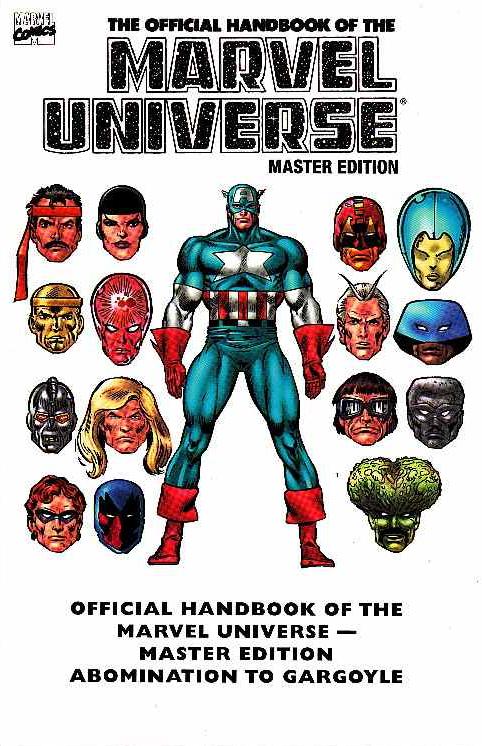
Essential Official Handbook of the Marvel Universe Master Edition volume 1 collects... entries in a different manner from before. The Master Edition opted for a loose-leaf partwork format with individual issues containing entries to be inserted into a binder in alphabetical order. For this collected edition, the entries from across all thirty-six editions have been included for the Abomination through to the Gargoyle. Where relevant the volume also includes the action sheet and supporting cast page for big name characters and team action sheets that were included in later issues. Also included in this volume are the covers of all thirty-six issues plus some of the original introductions. The entries are mainly drawn by Keith Pollard and researched & written by Len Kaminski, Jamie Tost, Mark Gruenwald, Glenn Herdling, Murray Ward and Peter Sanderson. The whole thing is edited successively by Mark Gruenwald, Kelly Corvese and Tom Brevoort.

The standard entry for a character has a full-page shot of the character from the front, side and rear. Then there's a page of text with the following pro forma:
  • Biographical Data
  • Real name
  • Other current aliases
  • Former aliases
  • Dual identity
  • Current occupation
  • Former occupation
  • Citizenship
  • Legal status
  • Place of birth
  • Marital status
  • Known relatives
  • Known confidants
  • Known allies
  • Major enemies
  • Usual base of operations
  • Former base of operations
  • Current group membership
  • Former group membership
  • Extent of occupation
  • Physical Description
  • Height
  • Weight
  • Eyes
  • Hair
  • Other distinguishing features
  • Powers and Abilities
  • Intelligence
  • Strength
  • Air speed
  • Stamina
  • Durability
  • Agility
  • Reflexes
  • Fighting skills
  • Special skills and abilities
  • Superhuman physical powers
  • Superhuman mental powers
  • Special limitations
  • Source of superhuman powers
  • Paraphernalia
  • Costume specifications
  • Personal weaponry
  • Special weaponry
  • Other accessories
  • Transportation
  • Design and manufacture of paraphernalia
  • Bibliography
  • First appearance
  • Origin issue
  • Significant issues
Occasionally a section will be followed by a "Note", clarifying some point or other. Sometimes there is no space left for "Significant issues". The entries and art are all printed in landscape format. The first appearances for characters who originated in the Golden or Atlas Ages include both a "historical" and "modern" entry.

The partwork nature of the original means that from time to time the order is wrong. Most notably the entry for Deathlok III precedes that of Deathlok I. Sometimes a character gets two entries such as Crystal, who changed her costume during the original release run. Each entry displays a different costume and the later one adds in a few recent key issues but otherwise the two are much of a muchness, with errors repeated such as listing Quicksilver as her "cousin by marriage" instead of as her husband.

Groups and organisations are listed differently with this pro forma:
  • Organization
  • Full name
  • Purpose
  • Modus operandi
  • Extent of operations
  • Relationship to conventional authorities
  • Base of operations
  • Former bases of operations
  • Major funding
  • Known enemies
  • Known allies
  • Membership
  • Number of active members
  • Number of reserve members
  • Organizational structure
  • Known officers
  • Known current members
  • Known former members
  • Known special agents
  • Membership requirements
  • History
  • Founder
  • Other leaders
  • Previous purpose or goals
  • Major campaigns or accomplishments
  • Major setbacks
  • Technology and paraphernalia
  • Level of technology
  • Transportation
  • Standard uniforms
  • Standard weaponry
  • Standard accessories
  • Bibliography
  • First appearance
  • Origin issue
  • Significant issues
Teams usually have a Membership Roster that details each member's time with the team as follows:
  • [Identity]
  • Real name
  • Current status
  • Membership record
  • Note
The entries for the Avengers and the Avengers West Coast operate on the principle that the New York based team are THE Avengers and the Los Angeles based team is a spin-off rather than the alternate position that they were respectively the east coast and west coast branches of the organisation on an equal footing. The exact status of the west coast team in relation to the east coast was a live issue for many years but here the Handbook comes down on the side that effectively dismisses the west coast team as inessential.

As well as the teams there are also occasional entries for the supporting casts of high profile characters such as Daredevil or Captain America, with the image page showing the hero in action. The entries for each cast member list:
  • [Name]
  • Current occupation
  • Relationship [to the hero]
  • First appearance
Some of the entries stop short in covering a character's history, such as the one for Captain Marvel II. The significant issues listed only covers the first few years of her career and feels the need to include a Marvel Team-Up story which left her temporarily trapped in her energy form, but conspicuously absent are the issues covering her tenure as chairperson of the Avengers, her massive energy loss in battle and her subsequent recovery with altered powers. It's as if a longer list was prepared but it became clear there was insufficient space for all of it and so it was simply chopped short rather than carefully edited down. Another odd case is Dazzled, whose early battles with Lightmaster and the Hulk wind up as being presented as more significant than Dazzler: The Movie. At the other end of the scale some characters have such brief entries for the rest of the form such that it makes Fandral appear to be the most active character included here.

There's still the occasional attempt to use entries to "correct" information given in stories such as the declaration that Ego the Living Planet does not meet the criteria of the Elders of the Universe and thus cannot be considered to be one of them despite having been shown to be part of one of the most exclusive groups in all the Marvel universe.

At the rear of the volume is a collection of covers, introductions and guide pages. Some of the introductions use the same text and the pages chosen seem to be used only because some of the credits are reused. The single page guide to power levels and the single page special glossary are both useful but would have been better place at the start of the volume. Otherwise the introductions talk about the philosophy and vision of the series, addressing a number of comments from readers. Big debates were held about whether the covers should also be printed on durable pagestock for binding; eventually they were but at the expense of a character sheet in each issue. The action shots proved unpopular for being out of line with the project and were dropped. Otherwise the later introductions also carry a number of corrections, plus a few extended bibliographies for characters whose entries ran short.

"Its modular nature will enable us to update this indefinitely without having to start all over from the beginning of the alphabet" claims the first introduction. It's clear the project had vision to go on for a long time with regular updates but after thirty-six issues it was cancelled due to low sales and the introductions admit as much.

This edition of the Handbook has the best format for mapping an ongoing fictional universe prior to the growth of the internet with online updates for encyclopaedias and downloadable updates for file based ones. It's a sensible move to reprint it in alphabetical order rather than recreating the disparate order of thirty-six separate packs. However the format has some failings. To read this the volume has to be turned on its side and there's an emphasis on lots of art and brief information at the expense of extended detailing of the story. In a way it's very representative of some of the worst trends in early 1990s comics. The Master Edition is now timelocked to the early 1990s and so it is no longer current; nor does it have the benefit of being a historical curiosity that the original is. With very few of the Essential series having reached this period there is little need for a supporting guide from the era. Once again it is hardly necessary to reprint.