Friday, 30 May 2014

Essential X-Men volume 5

Essential X-Men volume 5 initially contained X-Men #180 to #198 and Annuals #7 & #8. Later editions have transferred Annual #7 to volume 4 and added the mini-series X-Men and Alpha Flight. Everything is written by Chris Claremont with the art mainly by John Romita Jr and a couple of fill-in issues drawn & co-plotted by Barry Windsor-Smith. Annual #7 is drawn by Michael Golden and Bret Blevins and #8 by Steve Leialoha. The mini-series is drawn by Paul Smith.

Unfortunately this volume represents the start of a period where the series begins to rather complicated and confusing, with a mixture of long running subplots and the curse of crossovers and tie-in titles. But this series alone can't be solely blamed for a worrying trend that began at Marvel in the mid 1980s whereby it becomes increasingly hard to follow an individual series without having to pick up multiple additional titles. The first obvious sign is when most of the X-Men are taken away to fight in Secret Wars and come back with new costumes that generally don't last very long and accompanied by a female dragon who grows in size. And the X-Men's account of their experience with the dragon on the alien world isn't exactly what gets shown in Secret Wars itself; a sign of the problem in creating a gap in the narrative and only filling it in afterwards. Meanwhile Kitty comes to grief whilst investigating the Massachusetts Academy but this storyline is told in the pages of the New Mutants and subsequent issues see various New Mutants appear without the greatest of introductions; it's not even clear if Rachel's arrival is partially told in that series. Later on a two part tale ties in with the battle against the Dire Wraiths but if you're not familiar with the premise from the pages of Rom then it's not too clear what's going on. At around the same time two of the team members are briefly absent from the main series because they're co-starring in the mini-series Kitty Pryde and Wolverine, which isn't included here. Then there's a crossover with Power Pack, although the X-Men only appear in the issue from their own series and it's structured as such that it can be read without the Power Pack ones. Towards the end of the volume comes the first crossover with Secret Wars II and Magneto is suddenly hanging around with the X-Men. And to top it all off there are references to adventures in issues to come of Marvel Fanfare. Amidst all this the references to the graphic novel Dazzler: The Movie are easy to follow without that book itself. For what it's worth Panini's pocketbook reprints of this era, which are currently only up to issue #194, have included several of the New Mutants issues, so both Kitty's mission and some of the characters are more familiar when they pass through the Uncanny X-Men issues, but none of the others.

The Power Pack and Secret Wars II crossovers are adjacent to each other and show two extreme approaches to how to handle the concept. Issue #195 could almost be an issue of Power Pack with the X-Men guest starring, and indeed none of the title team actually appears before the tenth page. A non-completist reprint series could quite easily leave this issue out without it being too noticeable. By contrast issue #196 just sees the Beyonder, in his earliest days on Earth, wandering through the events of the issue and observing, with few noticing his presence and none of the events are driven by his presence.

Also somewhat surplus to requirements are issues #190-191, which feature what is ultimately a brief alternate universe until the reset switch is hit. A decade later this approach would consume the entire franchise across twice as many months, but here we get a two part sequel to an old issue of Marvel Team-Up as Kulan Gath returns and transforms Manhattan into a Hyborian Age city. There are guest appearances by the New Mutants, the Avengers, Spider-Man and Doctor Strange, but at times it's less than clear just who the primary stars are. The climax sees many familiar characters killed off in the final battle but then Doctor Strange and Illyana combine their magic to undo the whole thing, rendering it non-consequential and not even the few characters who retain their memories mention it again in the volume. This story would probably have been better placed as a mini-series or one-shot that could have been more broad ranged in its cast. Here it feels like another intruder on the general flow of events, even if in the reset timeline Gath's transformation is stopped by the arrival of new X-Men foe Nimrod.

The other major side-shows are the two annuals. Annual #7 is a particularly oddball issue but the final page reveals all - it came out during Assistant Editor's Month, when the regular editors were away at a convention, leaving the assistants in charge. In the regular title the month was marked solely by a one page story in place of the letters page, and this wasn't included in Essential X-Men volume 4 so it was easy to mix. However the annual more than makes up for it, putting the X-Men through a bizarre adventure as the Impossible Man goes rampaging through the Marvel universe, stealing a bizarre collection of items for a scavenger hunt and the X-Men seek to stop him, with the chase even going through the Marvel Bullpen. It's a pity that the cover doesn't explicitly warn the readers that it's part of the event, but it falls perfectly into the spirit of it. The Impossible Man is one of those creatures that it's very easy to get wrong, but when done in the right context the result can be good tongue in cheek fun. Unfortunately Annual #8 is one of the worst issues in the whole series. It's a science fiction fairy tale told by Illyana to the X-Men and New Mutants around a campfire, with Lockheed and Kitty in starring roles. Presumably Kitty's earlier fairy tale had proved popular at the time and so led to this follow-up, but the story is weak, inconsequential and has ridiculously cartoony art. It just hits all the wrong buttons and simply doesn't work.

 A much more serious side comes in the regular issues. Although there have been signs of it in individual stories in recent volumes, it's here that the theme of anti-mutant hatred becomes ever more prevalent, starting with the introduction in Congress of a Mutant Affairs Control Bill. Fear and hostility are widespread throughout the story, with bigots everywhere, ranging from the students who try to kill Professor X to the government agents commissioning and deploying weapons designed to strip a mutant of their powers. It's an ever more hostile world where casual fear and racism is rampant, to the point that even mugging victims are scared to be saved by the X-Men. The shadow of the dark world seen in Days of Future Past returns with the arrival in the present day of Rachel Summers and later Nimrod. Rachel may have landed in an alternate timeline from her own, but that doesn't make the danger any less real. Nor does it negate her memories of just what she did in her past.

We soon see the horror of Rachel's past through flashbacks to her days as a "hound", drugged and manipulated by the authorities who used her to track down other mutants. It's a chilling idea but fortunately it's established fairly quickly. By contrast there's an increasing presence of characters with mysterious backgrounds - not only do we have Wolverine but Rogue's past is coming through in dribs and drabs with the complication of Carol Danvers's memories confusing her and those around her. And then there's Nimrod, a robotic mutant hunter from the future that carves out a reputation in the present day as a popular vigilante.

Some characters go through journeys, with Professor X suffering a major assault by bigots, including some of the students on the university course he now teaches, and struggling to regain full control of his telepathic powers. Meanwhile Magneto's path to redemption continues as Xavier brings him in to help the X-Men, leading to the amazing but understated moment when a bullet is sent the way of a murderous bigot and it's only the master of magnetism who prevents it reaching its target. Storm goes through her own hell when in trying to save Rogue she's hit by a blast that strips her of her powers. As she recovers she falls for her rescuer Forge, a mutant Native American inventor, only to discover that he created the weapon. Subsequently she drifts through the world, slowly coming to terms with how everything has changed - even basics as adapting to the temperature around her are new. However her non-mutant skills are shown to the fore and she eventually returns to Kenya where she discovers her purpose in life in bridging the divide between cultures, in a quite philosophical issue that rounds out the volume. Storm's absence creates a vacuum of leadership, with Professor X's attempts at more fieldwork falling away and Nightcrawler finding himself a worried leader also facing religious conflict as he struggles to reconcile the existence of the Beyonder with his faith. In his temporary absence it's Kitty who comes to the fore as the best strategist. Her relationship with Colossus ends when she discovers he found another whilst away on the Beyonder's planet, and other X-Men such as Wolverine and Nightcrawler feel that Peter has been a jerk (another slight discontinuity with Wolverine's conclusions in Secret Wars itself that Colossus's feelings for the healer Zsaji were a by-product of how her alien power worked). Eventually he and Kitty settle as just friends.

The conflicts themselves are getting a bit repetitive with multiple encounters with the Juggernaut, even if the second involves Nimrod, the Hellfire Club and the Morlocks, even if some individual characters are being added such as Selene. There's also yet another return of Arcade, again in seeming conflict with Doctor Doom. There are some foes brought in from other series, such as the Dire Wraiths from Rom, Magus, the father of Warlock in the New Mutants (nothing to do with Adam Warlock or the Magus) or the Hellions from the New Mutants, including the revenge seeking younger brother of the original Thunderbird. That team now also include the first appearance in comics of Firestar, with her appearance ending in a sign that she's on the road to becoming a fully fledged hero.

The most recent editions of this volume have added the mini-series X-Men and Alpha Flight. Consisting of two giant sized issues they tell the story of "The Gift" as Loki seeks favour with Asgardian deities by giving humanity an amazing fountain that can grant them powers and transform them into perfect beings, offering the prospect of creating a utopia on Earth and ending all the problems. But it comes at a price as magical beings are slowly killed by it whilst the transformed humans are denied imagination. The X-Men and Alpha Flight jointly investigate the area and discover the stark choice of whether to accept such a solution or whether to retain what it is to be human; a question that divides the teams amongst themselves. Eventually they reject the gift but it's a painful outcome. This is doubly so for Rachel who would give anything to prevent the dark future she comes from, yet at the same time she discovers her own future is ever less likely to come to pass as her mother is already dead and her father's wife is pregnant but with a boy, not the only child she is. The story sees her first encounter with Cyclops, but it's ambiguous as to whether he's guessed that he is her father. The story is suitably epic for this kind of mini-series but without too much familiarity with the current status quo of Alpha Flight it can at times be confusing to follow some of their own troubles and dilemmas. Still it's good to see the story has at last been included here.

But overall this volume represents a series that is getting too complex for its own good and spawning too much of a franchise. It's a little hard to fault X-Men for the reproduction problems that have reported prevented any Essential New Mutants volumes, or the volumes for not carrying numerous limited series and crossovers that only have a partial bearing on the series. But for the contemporary reader it was necessary to purchase an ever increasing number of additional comics to stay abreast of everything, whilst at the same time continuity was getting over burdensome, with repetition and subplots dragging on forever. This volume represents the series taking a decisive turn for the worse.

Friday, 23 May 2014

Essential X-Men volume 4

The original edition of Essential X-Men volume 4 consists of Uncanny X-Men #162 to #179 and Annual #6. Later editions have transferred Annual #6 to volume 3 and added both annual #7 (which I'll look at with volume 5) and Marvel Graphic Novel #5 entitled "God Loves, Man Kills". The writing is all by Chris Claremont. The art on the regular issues sees the end of Dave Cockrum's second run, then a run by Paul Smith followed by the start of a run by John Romita Jr. Annual #6 is drawn by Bill Sienkiewicz. The graphic novel is drawn by Brent Anderson.

The high octane excitement continues in this volume, with adventures ranging from an outer space battle with the Brood to smaller scale, more personal adventures such as Rogue's quest to join the X-Men to control her powers that are making her lie impossible. There aren't too many additions to the ever growing extended cast of allies and foes - the most significant are Madelyne Prior, Lockheed the alien dragon and the Morlocks, who include the likes of Callisto, Leech, Plague, Masque, Sunder and Healer. But rather than quantity the series focuses on quality, with each of the new arrivals making an impact in their own way. At the same time there's quite a lot of development of the existing characters.

At one extreme is Cyclops, who is establishing roots in multiple directions. Having already discovered that Corsair is his father, he now discovers his grandparents and in the process meets a surprising woman. Madelyne Pryor is a cargo pilot for his grandparents' company in Alaska - and the spitting image of Jean Grey. More amazingly she was the sole survivor of a plane crash at the very moment that Jean died. At this stage it's never cleared up whether Madelyne is somehow Jean reincarnated or if this just an amazing coincidence, but she and Scott rapidly fall for each other. Within just seven issues of meeting they get married and Scott both leaves the X-Men and declines his father's invitation to go off into space on adventures with the Starjammers. Instead he seemingly retires, flying off with Madelyne to enjoy a happily ever after.

Meanwhile Storm undergoes developments of her own, including temporarily bonding with a young Acanti, a giant fish that flies through space. Subsequently Storm seems to be losing her refinement of her powers and then she decides to change her look, adopting a very 1980s leather costume and mohawk, to Kitty's horror. Kitty herself is continuing to grow and acting on her feelings for Colossus. At times she is highly suggestive to him, a rather disturbing point considering she is only fourteen years old and fortunately Colossus goes no further than kissing. However Kitty gains an affectionate companion of a different kind when she encounters a small alien dragon on another planet; subsequently the dragon comes to Earth and is dubbed "Lockheed", regularly staying by her side and deploying his laser power to help her.

But the biggest developments come with Carol Danvers and Rogue. Carol has been hanging around with the X-Men ever since Rogue stole her powers, but now the Brood subject her to accelerated evolution and hybrid nature results in her gaining the powers of a star as the being Binary. It's a major step forward but not long afterwards she departs for space and so there's little opportunity for further development as she continues to grow her emotions once more. However before she goes she briefly confronts Rogue once more when the latter turns up at the mansion seeking help. Rogue is now portrayed as much younger than in her earlier appearances and very much has the feel of a young, vulnerable woman trying to come to terms with herself and to evade being used by others. This leads to an early fight with Mystique and the Brotherhood of Evil Mutants, but Rogue makes clear what her free will is. She also has a rapid baptism of fire when she and Wolverine are the only available X-Men to evade the effects of poison in Japan and Rogue puts her life on the line to save Wolverine, who in turn lends her his healing power. Later on she again risks her own life to help save Colossus and the other X-Men come to accept her. Meanwhile Professor Xavier undergoes a major transformation when his body is destroyed by the Brood but his mind is transferred into a cloned one with fully functioning legs. Although his mind and powers take time to adjust, it seems he will now be able to play a much more active role in future adventures.

This volume comes from the period when the series began to spawn a number of spin-offs. The most obvious ongoing one was the New Mutants, founded whilst the X-Men were away in space, but in general the two teams manage to stay out of the way of each other's adventures apart from a brief fight when the X-Men return from space and discover strangers in the mansion. Beyond that and an issue where Kitty is briefly set to be transferred to the New Mutants until she demonstrates how far she's already come (with the New Mutants themselves noticeably absent), plus the occasional mention and cameo, the New Mutants are almost as distant from these issues as the Defenders. More noticeable was the rise of the limited series, with both Wolverine and Magik (Illyana - Colossus's sister) receiving one. Neither is included here but both are referenced. In particular the Wolverine limited series is followed up on in issues #172-173 which feel almost as though they should have been part of the limited series (and are sometimes collected with it) but it ran out of space. Given the practice in more recent volumes - Essential Defenders volume 7 springs most readily to mind - I wonder if the limited series would have been included had this volume come out in more recent years. (Although there have been some modifications to the contents of the Essential X-Men volumes for new editions, there may not have been enough space to crowbar in a whole extra four issues as well as the graphic novel.) Consequently Wolverine doesn't get as much good material as usual, but both his desperate solo flight from the Brood and his wedding where his bride jilts him, having been convinced he is not worthy, both give him depth on either side of the series. The Magik limited series is rather less noticeable by its absence and seems to cover her missing years in Limbo that are alluded to here.

There are other signs of wider developments at Marvel impacting on the series here. Issue #167 contains one of the oddest scenes in the whole volume as Lilandra learns of events in Fantastic Four where Reed Richards saved Galactus's life and immediately transmits a warning that he will be prosecuted for the subsequent destruction of any known inhabited planet. This isn't remotely relevant to current events in Uncanny X-Men, and hardly a pressing matter for Lilandra who is at this stage a deposed monarch in exile and, as she admits herself, in no position to be rushing around issuing warnings in the name of intergalactic war. It just feels like a gratuitous snipe by Chris Claremont at his former collaborator John Byrne. I was surprised to see that this scene had originally seen print several months before Byrne's better known snipe in Fantastic Four when he declared an earlier Uncanny X-Men appearance by Doctor Doom to have been a slightly out of character Doombot that the real Doom casually disposed of. In the normal retellings of the feud and how it impacted on the comics themselves it's usually Byrne who gets depicted as the proactive antagonistic one, beginning with the Doombot incident, but here is a sign that it seems to have started even earlier and possibly with Claremont.

What is getting a little annoying are the constant references to Phoenix, especially as it's now a few years since her death. They come in multiple forms, especially with Madelyne's resemblance to Jean Grey, but the most blatant come when Storm sees what looks like the image of the Phoenix force in an explosion, and even more so when Mastermind manipulates Madelyne into impersonating a resurrected Phoenix. However the resolution proves crucial as Cyclops saves Madelyne and fully comes to accept Jean is gone, saying a final goodbye at her grave before going on to marry Madelyne. Hopefully this will bode well for future volumes. But just as one irritation seems to be on the way out another is looming with the continued teases about just what Nightcrawler's connection to Mystique is. It was first raised back at the end of volume 2 but is now becoming a never ending subplot with a seemingly obvious solution that she is in fact his real mother. It's one thing to have something never explicitly stated, but the way this is played it feels more like eternally unfinished business.

Included at the end of the original edition of this volume is annual #6, but it feels extremely inconsequential to the series, and its initial absence from volume 3 (and catch-up placement here) has not been noticeable in the slightest. The story sees the return of Dracula and his final showdown with Rachel van Helsing, with Dracula's daughter Lilith thrown in for good measure. It may be resolving leftover matters from the Tomb of Dracula and also following up on Dracula's earlier appearance in X-Men, but the X-Men themselves feel rather out of place in a rather confused storyline focused on vengeance and possession. Still as an annual it's easy to overlook this awkward tale and move onwards.

Also potentially easy to overlook is an addition to recent editions, Marvel Graphic Novel #5, entitled "God Loves, Man Kills". Released at about the same time as issue #167, it shows signs of having been created much earlier, not least because Kitty is here using the codename "Ariel" that she in fact rejected in the regular series, and also wearing a different costume from the norm. The story focuses heavily on anti-mutant prejudice as a zealous preacher declares them unholy and launches a crusade to purify the human race, using Professor Xavier's powers. In the struggle the X-Men find themselves allying with Magneto despite their differences. The world depicted in this tale is much darker than the comics, with the preacher's "Purifiers" seemingly unstoppable as they go about their mission. It's a world of dark alleys, of gangs who try to rape Kitty as payment for protecting her, where people get shot and bleed, where two little children are chased to a playground and murdered, and where a well-connected charismatic speaker can easily sway the crowds. It's one of the better examples of what the graphic novel format can do, presenting a deeper story free of the shackles of the Comics Code Authority, but also keeping it sufficiently standalone that it was not necessary for contemporary readers to pay out almost ten times the price of a regular issue, or for readers then and now to have to track down a harder to find format.

Regardless of the rotating nature of the annuals and graphic novel across different editions of this volume, the regular issues remain strong and solid, showing both diversity of new creation and a willingness to build on existing successful elements. The team's line-up is kept reasonably intact with only Cyclops retiring and Rogue coming on board, allowing for the character development that can only really happen when there's a stable cast. Although some individual elements may irritate they don't detract from the overall thrust of the series that keeps moving forward, offering exciting adventures but also always making the reader care about each and every one of the characters. Nor is there much requirement to obtain additional comics just to know what’s going on, with the spin-off New Mutants title wisely concentrating on a separate line-up of characters, though Wolverine's limited series could have been better explained, especially as it's followed up on but not included here. But overall this volume maintains the series's strong momentum that has been running since the revival, a astonishing achievement after so many years.

Friday, 16 May 2014

Essential X-Men volume 3

Essential X-Men volume 3 first contained Uncanny X-Men #145 to #161 and Annuals #3 to #5. Later editions have seen Annuals #3 & #4 transferred to volume 2; Annual #6 transferred from volume #4 (where I'll look at it) and the addition of Avengers Annual #10. The writing is all by Chris Claremont and most of the art by Dave Cockrum; other issues are drawn by Jim Sherman, Bob McLeod, Bill Sienkiewicz and Brent Anderson. The annuals are drawn by George Pérez, John Romita Jr and Brent Anderson. The Avengers annual is drawn by Michael Golden.

This is predominantly a volume of consolidation and development rather than creation, with very few significant first appearances. Dave Cockrum returns to the series and there's some more space opera with the Shi’Ar but otherwise there's a continued focus on the core characters within a world that is growing steadily more hostile to mutants. There are very few changes to the team - Angel storms out in protest over Wolverine's presence and Cyclops comes back on, but otherwise it's a period of stability for the line-up. We get more use of past X-Men in the form of reservists, with Ice-Man, Polaris and Havok all pressed into service for one adventure whilst Banshee appears more and more in a supporting staff role; his powers not having restored themselves. Another supporting character comes in the form of Carol Danvers, now depowered following events in Avengers annual #10, who hangs around with and helps the X-Men for the time being.

However we get a number of character developments, with Cyclops and Sprite especially benefiting from strong focuses. Within these issues Cyclops and Corsair of the Starjammers finally discover that they are son and father, leading to the inevitable confrontation about why Corsair never came after his son in the orphanage. It's a tense situation at first but soon Scott accepts that his father naturally believed both Scott and Alex had died when their parachute caught fire, whilst the horrific treatment and death of their mother had further distanced Corsair from Earth. The family reunion is handled well and helps add to Scott's character growth as he becomes ever more a strong individual, unfettered by the trauma of his childhood or the loss of Jean. The early issues see him marooned on an island with Lee Forrester, the captain of the ship he signed aboard before they were swept out to sea. Although the island scenario itself drags on for a few too many issues, it shows Scott slowly discovering another woman and moving onwards.

Also growing rapidly is Kitty Pryde, though she retains her youthful optimism and role as the team's little sister. Her crush on Colossus is becoming a relationship, with surprisingly nothing said about their different ages. Otherwise she shows enthusiasm and at times is at the core of a plot's resolution. However one thing that is off-putting is her constantly changing costumes in an attempt to get more individuality than the original style X-Men outfit she is given pre-graduation. At one point she comes up with an outfit that may have resembled early 1980s sparkly fashions but looks hideous and is mercifully subdued by the black and white. On another level she is growing ever closer to both Storm and her dance teacher Stevie Hunter. Issue #148 sees the three on a girls' night out, together with guest stars Jessica Drew/Spider-Woman and the Dazzler, which is interrupted by the introduction of the lonely mutant Caliban who comes searching for company, causing panic and chaos but also making Kitty realise how some mutants like Nightcrawler cannot help their strange appearance and she shouldn't be so uncomfortable around them.

But the biggest developments come for one of the X-Men's greatest foes. Issue #150 brings some of the strongest material yet for Magneto, with further enhancements in a flashback in issue #161. We get the clearest statement yet that he sees himself as a warrior defending his people, the mutants, making him a Malcolm X figure much more so than before. His background is also filled out with the exploration of his drive coming from the horrors he endured in the Holocaust. Rejecting Xavier's vision of mutant-human co-existence as unrealistic, he instead seeks to bring about mutant superiority, securing peace through security. Although there have been hints of this in some of his earlier appearances, we now have a clearly rounded vision of the character that moves him away from the run of the mill would-be world conquering supervillains and into a much more complex character. Yet the same issue also starts him down a new path when he thinks he's killed Sprite. Earlier he had no regrets about sinking a Soviet nuclear submarine that had fired upon his island, yet now that he thinks he's killed a child, he realises he's become like the monsters of his childhood, the guards at Auschwitz who joked as they herded people to their deaths, their lives meaning nothing to them. The horror that he has become a monster to the innocents he sought to protect and the very thing he hated and despised is a striking moment for the character. Was it also meant to be a subtle wider comment about events in the real world? Whatever the external intentions, there is a hint that he changed forever though it is not followed up on within these pages.

Magneto's shift comes not long after the X-Men's first encounter with another world-conquering villain from the early Silver Age. It's quite a surprise that the X-Men haven't clashed with Doctor Doom before now, given how much he's appeared all over the Marvel universe over the years. Here he seems rather subdued, being in exile from his kingdom and operating in a strange alliance with Arcade, with the gamesmaster also Doom's prisoner. Though there's a brief scene with Storm that sees the two slightly drawn towards each other, overall it's a rather disappointing use of such a major foe. Equally weakly handled is Dracula, who shows up for a single issue when he tries to take Storm as a mate, but there's none of the awe and majesty from the character's own series.

The Shi’Ar epic brings the first appearance of the Sidri, a monstrous gestalt alien species, and the fearsome insect race the Brood, as well as Deathbird, previously seen in Ms. Marvel, the sister of Lilandra. She's not the only foe of Carol's to come over, with Rogue also appearing, following on from the Avengers annual. Meanwhile a flashback to the younger days of Professor X and Magneto shows their struggle with Baron von Strucker and a nascent Hydra, giving Magneto his first encounter with leftover Nazi villains. An adventure into a magical realm brings the team into conflict with Belasco, previous seen in Ka-Zar, and new demon S'ym. It's a dark place in which the X-Men find time does not function as normal, bringing them into conflict with older versions of themselves. At the end Colossus's sister Illyanna is briefly lost for what is only seconds for the X-Men but a whole seven years for her. Having gone from six to thirteen, losing much of her childhood in that realm, must be a horrific experience and will hopefully be explored further in later volumes.

One aspect of the series that is slightly stating to irritate are the long drawn out subplots, especially as some of them keep overlapping on multiple Essential volumes and so take an age. Cyclops spends half a year lost on a desert island and then later the conflict with the Brood is stretched out with Professor X mentally wounded for many months. He is cured in the final issue in the volume but then Deathbird and the Brood return in a cliffhanger, with the latter planning to use the mutants as hosts for breeding. Unfortunately the remaining space is then taken up with other, less consequential material.

Lurking at the back of the volume (at least in the original edition) are three annuals. With #1 & #2 having been all-reprint specials in the wilderness years, these are the first original specials for the X-Men and show a variety of foes and guest stars. Two of them feature Arkon, first as an enemy, albeit with noble motives seeking to restore his world, and later as an ally when the Badoon invade; the Fantastic Four also guest star in the latter story. Meanwhile the other one features a trip into what is supposedly Hell, resembling the depiction in Dante's Inferno, with Doctor Strange guest starring and a fight with Minos, a being from Dante's poem. Reading all three annuals back to back, as per the original edition's presentation, it's easy to see why the whole format is so often dismissed and/or overlooked, including sometimes by collected editions. (Not only had Essential X-Men volume 2 left out two annuals, but at about the same time that this volume was making up for this omission, Essential Spider-Man volume 3 was missing out another pair.) None is drawn by the regular series artist of the day and none of the events are mentioned in the regular title. The middle annual may explore some of Nightcrawler's past and reveal his current girlfriend to be his adoptive sister and childhood sweetheart in disguise but it's still easy to blink and miss it. Nor is there any connection with the hint in the previous volume that he and Mystique are related. Placed at the rear of this volume, like an obligatory appendix, they feel like they were almost forced upon it and are being sidelined as much as possible. None feels like a typical, if extended, adventure of the type seen in the contemporary regular series so the annuals don't even work as one-off introductory specials. Of course the same charge can be levelled at many, many annuals for many other series, but it's rare to get three all at once and so the problem stands out the more. Worse still having so many at once has restricted the number of regular issues contained in this volume and possibly increased the necessity of ending on a cliffhanger, one that would be left hanging for nearly three years before volume 4 came along.

Later editions of this volume have also included Avengers annual #10 and it's easy to see why given that both Carol Danvers and Rogue go on to make significant appearances in the regular issues in both this volume and later ones. I've never been too clear as to how much of the issue reflects Claremont's original plans for Ms. Marvel and just when he conceived his plans for Rogue, but here we get a conclusion to Carol's conflict with Mystique that had been building and building and building and building in her own series (Claremont's long-running subplots have not been confined to the X-Men titles). Ms. Marvel gets put through the wringer once more as her powers and mind are absorbed by Rogue; with Professor X's help she regains some of the latter but is left a broken woman trying to put her life back together. The epilogue allows both her and Claremont to confront the Avengers and their writers about how callous they were when she was kidnapped and raped, but otherwise the bulk of the annual is given over to introducing a new foe who takes down the most powerful Avengers quite quickly. Other than the epilogue wouldn't it perhaps have been better to tell this story with the X-Men in their own annual? It would certainly have made a far stronger and more memorable offering than that year's team-up with the Fantastic Four against the Badoon, and the subsequent use of both Carol and Rogue in the regular series would have given the annual a lasting significance. Still that error of placing has now been corrected with its inclusion here.

Although more run of the mill than the two previous Essential X-Men volumes, and limited by the need to include the various annuals, this volume continues to show a series based strongly on character development and a distinct scenario. It takes in a diverse range of locations and threats but manages to stay consistent and true to its core characters, continuing to make them feel real and worth caring about. This is a series that has settled in a clear permanent role for the long run.

Friday, 9 May 2014

Essential X-Men volume 2

Essential X-Men volume 2 originally contained X-Men #120-144. (The adjective Uncanny was formally added to the series's legal title from #142 onwards; however it had been present in the cover logo since #114 apart from the odd issue that skipped it, a practice that continued for many years afterwards.) Later editions have transferred Annuals #3-4 over from volume 3; however I'll continue the practice of looking at such material where it originally appeared. Chris Claremont scripts the entire volume with John Byrne drawing and co-plotting all but the final issue which is by Brent Anderson.

It's impossible to ignore the significance of the stories in this volume, representing the period when the X-Men broke out of being a niche cult title and became one of Marvel's biggest sellers. Much has been written about the "Dark Phoenix saga", which dominates all the different covers used for this volume, whilst this month sees the release of a movie version of "Days of Future Past". But there's a lot more than just those two tales within these pages. It's also a run in which there are a number of introductions, including a few that would go on to have their own series.

The volume kicks off with the debut of Alpha Flight, as the Canadian government (Pierre Trudeau appears on panel delivering orders to the now renamed Vindicator) tries to recover Wolverine through the deployment of its own team of superheroes. The team isn't explored in any great detail, but they show potential for future use, although how they explain the failure of their specially designed prison van to contain Wolverine isn't shown. Earlier they force the jet carrying the X-Men to Calgary, allowing John Byrne to draw his home city and show Canada as it really is, rather than cliched US stereotypes. Right at the end of the volume Alpha Flight (well half of them) reappear as Wolverine returns to Canada, with Nightcrawler in tow, in the hope of putting an end to their pursuit of him. They all battle the Wendigo in the northern Canadian wilderness - when has any hero gone there and not found the Wendigo? - before departing on good terms with Vindicator promising to get Wolverine's resignation accepted by the government. However upon returning to Ottawa, Vindicator is told by Trudeau that Department H and Alpha Flight are being disbanded, due to both costs and fears about superheroes. This serves as both closure to Wolverine's fugitive status but also opens up the possibility to use Alpha Flight as an independent team. (I'm also surprised that the comic managed to show Trudeau in person on this occasion as it was published just a couple of months after his surprise return to power. Imagine the mess if they'd drawn Joe Clark instead.)

Dazzler is introduced in issue #130 and I don't know whose idea it was to make her a mutant but it seems clear there was very little background developed for her beyond "singer who can project light" and her appearance here does little to flesh her out apart from establishing her as a mutant. It's not exactly a debut to set the world on fire. The preceding issue is more significant for the series in the long term as it introduces Kitty Pryde, an intelligent thirteen year old who is discovering the ability to become intangible. A young kid sidekick can go spectacularly wrong but here she brings a degree of optimism to the team as well as helping to restate principles as she learns them. However one problem comes from not nailing down a single standard name for her from the outset - she rejects the name "Ariel" (and so denies the opportunity to make endless jokes about washing powder) and instead adopts "Sprite" but she's just as likely to be called "Kitty Pryde" as anything else and the result can limit her ability to stay memorable. Still she is a breath of fresh air that reminds us of the ongoing mission to find and train mutants. Otherwise the cast broadly stays the same throughout these issues bar the formalisation of Phoenix's return and her subsequent death, the retirement of Banshee due to a throat injury, and Cyclops's decision to leave the team following Phoenix's death, though the final issue in the volume shows his continuous movements.

At the start the cast are still split, with Professor X, Phoenix and the Beast believing the others died in Antarctica and vice versa, and it takes several issues before they all finally discover they've all survived. In the meantime Cyclops is steadily coming into his own and also becoming more at ease with women, briefly dating Colleen Wing but when Scott and Jean discover each other is alive this doesn't cause too many problems. In the interim though I'm surprised Colleen puts up with Scott talking a lot about his ex, or for that matter she's one of several girlfriends captured by Arcade. The other romantic interests are less developed, with Colossus's feelings for Storm toned down to the level of adopted siblings, but Kitty develops a crush on him and in a glimpse of the future they are shown as married. At another level Professor Xavier and Lilandra find themselves on opposite sides when aliens from across the universe assemble to tackle the Dark Phoenix, and although it isn't spelt out they seem to have effectively separated.

Guest appearances are surprisingly limited here, and mainly confined to those from either previous Claremont-Byrne collaborations or earlier issues of the X-Men. Cyclops may briefly date Colleen Wing from Power Man and Iron Fist but otherwise there are few of note. Spider-Man turns up at the start of an issue to try and warn the X-Men that Arcade is back, having clashed with him during the Claremont-Byrne run on Marvel Team-Up, and the final issue, post-Byrne, sees an appearance by the Man-Thing, whose last solo stories had been scripted by Claremont. Meanwhile the Beast, Havok and Lorna Dane all show up for the duration of the Proteus storyline, and later the Angel gets caught up in the Dark Phoenix saga and never quite leaves. Ice-Man's sole appearance is at Jean's funeral.

With more epic length story telling the foes battled in this volume are limited but usually either new to the series or assembled in a new grouping. Early on the team battle Proteus, Moria MacTaggert's mutant son who can warp reality and take over bodies whenever his current one burns out, and then later they come up against the Hellfire Club, a fictionalised version of the real world club Its "Inner Circle" includes various foes including new ones such as Sebastian Shaw and Emma Frost and returning ones such as Mastermind, under his real name of Jason Wyngarde. Later on the X-Men fight a new incarnation of the Brotherhood of Evil Mutants. Led by Mystique, previously seen in Ms. Marvel, the team includes the Blob and three new mutants - Destiny, Pyro and Avalanche. Mystique offers further mystery when Nightcrawler finds her familiar but she just tells him to ask his mother. There's a couple of foes from other series, with both Arcade and D'Spayre brought over from the pages of Marvel Team-Up where they'd been introduced by the same creative team. And then there's Senator Robert Kelly, a potential Presidential candidate who is pushing towards legislation that would introduce controls on mutants, with the horrifying prospect of where that could lead. It's a reminder that not all threats come in costumed action form.

Nor do they always come from the opposite side. For by far the best known storyline in this volume involves one of the X-Men going rogue. The "Dark Phoenix saga" has been referenced many times and adapted for both television and film. It's easy to see why - it's a tale of an ordinary(ish) person gaining ultimate power and eventually going out of control with devastating consequences. At the time there hadn't been that much exploration of the ultimate danger inherent from superheroes but here we get a tale of corruption, redemption and sacrifice. The storyline is steadily built up with Jean slowly corrupted by the power of Mastermind, who has no idea of what he's unleashing. The resulting Dark Phoenix is a scary demonstration of all the worst potential, going on a destructive course, lashing out at those closest to her and even casually destroying a whole solar system. And just when it seems as though Jean has been saved and the Phoenix side of her locked away, the wider universe come to execute her, forcing the X-Men into a duel with the Imperial Guard in which it becomes clear that Phoenix is not as confined as thought. Ultimately Jean does the only thing she can to permanently end the threat and commits suicide, showing humanity triumphing over the corruption of power. She was by no means the first comic character to be killed off, but in the past this had usually happened at the end of a title's run or else when a character had been confined to limbo for years. To kill off such a key part of the team, one who'd been around almost continuously since the team began seventeen years earlier, was an incredible move. The impact on the rest of the cast is shown in subsequent issues as characters' thoughts frequently turn to Jean/Phoenix. In the wider industry it helped to put X-Men firmly on the map.

However it's "Days of Future Past" which is inevitably the storyline that will attract the most attention at this precise time. It follows the classic time-travel plot of going back in time to alter the future for the better. But here we get a dark vision of the future that in 1980 was much closer to reality than many may now realise. The United States has become a brutal police state, with most technology breaking down and civilisation slowly sinking into brutal primitivism. The population has been brutally classified into multiple groups, with strict controls on breeding. Mutants are set apart, mostly confined to designated areas, and are forced to endure terrible suffering. This may have been presented as a world 33 years into the future, but it has clear similarities to the contemporary situation in apartheid South Africa. The brief history that Kate Pryde tells the X-Men reinforces the metaphor with a number of subtle parallels to the history of how apartheid was steadily introduced and "justified" as a response to whipped up fear. The scenes really personalise the impact with moments such as a row of gravestones with familiar names, the desperate struggle of recognisable albeit aged faces, and the horror as they are rapidly cut down. And whilst Kate's mission was successful in preventing the assassination that is believed to have started the chain if events, we're never actually shown what the resulting future now is, just a single page in the present suggesting that the Sentinels will be revived and deployed anyway. That helps to reinforce the uncertainty and fear for the long term and helps to reinforce the elements of bigotry and oppression that have hitherto been underused in the series.

The following issue, #143, also feels like the inspiration behind a film, albeit a very different one. A decade before Kevin McCallister found himself Home Alone and had to fight off intruders in the house at Christmas, Kitty Pryde had to do exactly the same thing. The issue also feels like a homage to Alien with the N’Garai demon resembling the alien whilst Kitty herself resembles a young Sigourney Weaver, desperately racing through the mansion to find some way, any way to defeat the creature. In the process she causes no end of expensive damage, but it's a key rite of passage for the character.

And this volume represents a major passage for the series. Between the dynamic art of John Byrne and the intense, thoughtful scripts of Chris Claremont, the result is a complex series that maintains strong, well-defined characters at its core and puts them through a complex and varied set of situations that try and test them immensely. Some of the storylines are better known than others, but taken together they show good ongoing development, in which all the characters are steadily built up. Not all their pasts are revealed at once - in particular elements about Wolverine such as his adamantium skeleton and revelations from his past are only dropped in as and when they come up - but the overall result is that all the X-Men continue to feel like real people and the reader wants to keep reading to find out what happens to them. By the end of the volume Claremont has been scripting the series for fifty issues, a surprising achievement already, even before one considers how long he would go on for. Such long runs often give a title a good degree of stability that help to refine it when the original take on the concept has floundered or got lost in a sea of ever changing creative teams who each try to change everything before moving on. Here it works wonders and so finally X-Men was a title that was here to stay for the long run.

Thursday, 8 May 2014

Guest appearance omissions: Transformers #3

Today is the 30th anniversary of the launch of the Transformers. So let's take a look at the first time their path crossed with Spider-Man's...

For a particular group of fans, one of Spider-Man's best-known guest appearances was in the early issues of the original Marvel Transformers series. However it's very unlikely to ever appear in the Essentials, not least because a different company now hold the licence to the title property. But it has had several other reprints in this century, including Transformers: Beginnings from Titan Books a decade ago and more recently in the second edition of The Transformers Classics: Volume 1 from IDW Publishing.

(Unfortunately the vagaries of copyright and licensing have meant it hasn't always been possible to include it in Transformers reprint series. The Titan volume of about a decade ago had no problems, but IDW were initially unable to secure licences for Marvel-owned characters and so had to replace the issues with text summaries in their first edition.)

Back in 1984 the Transformers were a new toyline with Marvel the first to portray their adventures. A four-issue limited series was commissioned; however it proved so popular it rapidly converted to an ongoing series without even resetting the numbering and eventually ran for a total of eighty issues plus a few spin-off limited series. (Over here Marvel UK ran their own series, reprinting the US stories but in order to fill the faster schedule many new adventures were produced that weaved in and out of the continuity. There were also reprints of other Marvel series as "back-up strips"; one of these reprinted Amazing Spider-Man annual #19 albeit rebranded as Iron Man of 2020, reflecting the more prominent role of the guest star.) The third issue of the limited series saw a guest appearance to help boost the franchise's profile.


Transformers #3, written by Jim Salicrup and drawn by Frank Springer

(Although Salicrup is credited as the writer on this issue, by all accounts it was a very difficult series for writers to get to grips with, going through three writers in four issues and editor Bob Budiansky had to outline it all. When the ongoing series began he switched to become the regular credited writer; however he was effectively the uncredited co-writer of the earlier issues and deviser of much of the basic franchise mythology.)

This issue picks up on the kidnapping of human mechanic Sparkplug Witwicky by the evil Decepticons, who hope he can convert Earth fuel into a form the robots from Cybertron can use. Sparkplug is tortured into agreement. Meanwhile the presence of giant robots on Earth attracts the attention of both the army and the media, including Peter Parker. Changing into Spider-Man he discovers the heroic Autobot Gears who convinces him of the Autobots' good intentions. Spider-Man and the Autobots work together to first penetrate the military cordon around the Decepticons' fortress and then whilst the bulk of the Autobots create a diversionary attack, Spider-Man and Gears sneak into the fortress and take the remain Decepticons inside by surprise, rescuing Sparkplug. With a plane to catch, Spider-Man takes his leave as Gears reveals Megatron got what he wanted from Sparkplug...

On reflection this is one of the fastest paced issues of the original Transformers limited series, with the emphasis very much on action whether the battles between the Decepticons and the military or the Decepticons and the Autobots, or the desperate rescue mission. It's an odd choice to pick Gears as the Autobot Spider-Man spends most time with - true Gears is one of the few who can fly but he's also one of the smaller Autobots and not one of the strongest, making him an unlikely winner of the physical fights here, plus he's got a grumpy personality and a dislike of humans which doesn't make for the best of banter. Would it have been too much to use one of the more chatty Autobots like Bluestreak? Or for one-on-one physical combat a better choice for the rescue might have been Brawn. But the most logical choice overall would have been to have Spider-Man team up with the Autobots' leader, Optimus Prime. Gears and Spider-Man manage to overcome the Decepticons they encounter rather too easily for my liking, including encasing the Decepticon leader Megatron in webbing. This really does feel like a set of extremely unlikely victories, even if they do have surprise on their hands.

Spider-Man is written in classic form, though it's easy to envisage this story without his involvement. For this issue he was put back in his alien costume despite having relinquished it a few months earlier in his own titles - apparently this was to appease the Transformers' toy company Hasbro who were concerned about an appearance by a character whose toy was produced by a rival so they used the costume that the Mattel  Spider-Man Secret Wars toy didn't have. The need to win over Hasbro to include him probably explains why it's easy to imagine this story without his involvement. However he brings a sense of both fun and the wider Marvel universe to the series (and let's just ignore the continuity problems that Transformers would later brush over on this point). Spider-Man is also drawn well, but the Transformers suffer from a lot of art and colouring problems (yet another reason for a black & white reprint).

Broadly there are two ways to draw the Transformers - either as poseable versions of the toys or as stylised versions called "character models" devised for their fictional appearances that don't always resemble the toys too closely. This issue sees a big step towards the comics using the character models exclusively but some of the characters have been drawn or coloured using earlier versions of the models - Megatron's appearance on the cover is the most obvious example - and a few such as Frenzy and Rumble have moments when they look more like their toys. A lot of the characters are also drawn awkwardly with weird and variable proportions plus some over heavy inking. There are also many times when the colours are at variance with the most familiar versions even within the comics themselves, making it sometimes difficult to recognise which character is which. Just to add to the problems some of the characters would be consistently coloured with a different scheme from the toys and/or the cartoon - Ratchet, Skywarp, Soundwave, and Starscream are all noticeably off-colour sufficiently consistently in the issue for it to not be a colourist's error. Ratchet and Starscream would eventually switch to more familiar colours (although it took Starscream some years) but the other two would keep theirs, presumably because of the problems of printing black as a colour under Marvel US's system forcing a much greater use of blue than on the toys. And there's the earliest example of a background appearance of a character who shouldn't be there when Shockwave appears in a couple of panels.

Overall this is a good, if superfluous, Spider-Man appearance and a pretty fast paced Transformers story but it's rather let down by the poor rendering of most of the Transformers and the inability to keep the colours consistent on some of them.

Dick Ayers (1924-2014)

Artist Dick Ayers died this week. He had just turned 90.


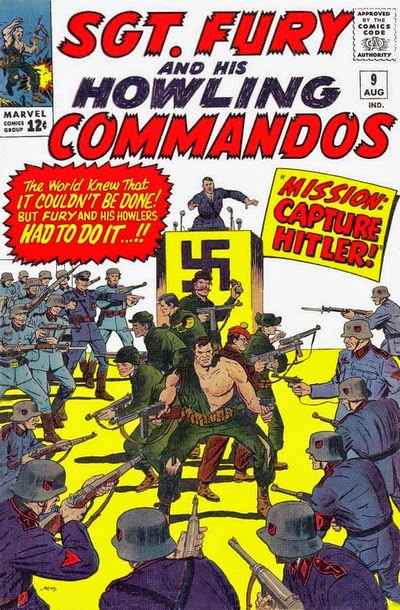
As well as often inking, most notably over Jack Kirby, he pencilled many issues of many different titles over many decades. His greatest work was probably Sgt. Fury and his Howling Commandos, which Corporal Ayers drew for ten years.
Reviews of various volumes containing his work can be found on the Dick Ayers tag.

Friday, 2 May 2014

Essential X-Men volume 1

This month sees the release of X-Men: Days of Future Past and so it's time for an extended look at the X-Men's most acclaimed era...

Essential X-Men volume 1 collects Giant-Size X-Men #1 and X-Men #94-119, featuring the early days of the X-Men's mid 1970s relaunch as the All-New, All-Different X-Men. (As we've already seen, issues #1-93 have since been covered by Essential Uncanny/Classic X-Men volumes 1, 2 & 3.) The initial Giant-Size issue is written by Len Wein and drawn by Dave Cockrum. Both carry forward onto the regular series but almost immediately Chris Claremont takes over the writing and continues for the rest of the volume (and over a decade more after that) with a few issues seeing Bill Mantlo give plot assistance. Midway through Cockrum is succeeded by John Byrne. There are a couple of fill-ins drawn by Bob Brown and Tony DeZuniga. The reprint of the Giant-Size issue includes three reprints of back-up features profiling Cyclops, Ice-Man and Marvel Girl written by Roy Thomas, Arnold Drake and Linda Fite respectively and all drawn by Werner Roth.

(It's a little known point but Giant-Size X-Men had a second issue as well, published some four months later. However by this stage the Giant-Size line had switched to all-reprint titles before being eventually phased out a couple of months afterwards. Giant-Size X-Men #2 reprinted X-Men #57-59.)

This was the very first Essential volume to be released back in 1996 and unsurprisingly it does several things differently from its successors. Most obviously it starts reprinting the X-Men from the 1975 relaunch rather than the original 1960s series; later Essential runs such as Doctor Strange, Man-Thing or Silver Surfer have started from the original series and collected subsequent revivals under the same banner. The cliffhanger ending from issue #119 was left out of the original printing but restored early on. And the reprinted material in Giant-Size X-Men #1 has been included whereas most subsequent Essentials have left out reprints unless they've been directly incorporated into the narrative. (On a much more minor note the first editions of the original 1996 volumes - this plus Essential Spider-Man volume 1 and Essential Wolverine volume 1 - have the name on the spine running upwards whereas all later volumes and editions use the more conventional downwards.)

Giant-Size X-Men #1 is one of the most reprinted of all Marvel issues and quite possibly the post-Silver Age record holder. (Mike's Amazing World of Comics lists ten complete reprints plus one truncated, and that's just in the North American market. Discounting one as a cover variant that's still an amazing haul and several reprints ahead of obvious rival contenders such as the first appearances of Thanos, the Punisher, Wolverine or Venom.) The story is to the point, if a bit low key, but does manage to successfully introduce all the new characters. Not much has changed since the ending of the earlier run bar the Beast going out into the world and Havok and Lorna Dane now being an integrated part of the original team and more clearly an item now. Otherwise things are pretty much where they were left. Wisely the story places the emphasis on the new characters and reintroduces the premise through them as Professor X takes an interesting journey around the world, recruiting both new and old characters to assemble a replacement team. With fourteen characters and just thirty-six pages there's not much space to detail them all, but it soon becomes clear that the team has some dysfunctionality. Oddly in light of where he'd go, Wolverine is rather subdued and it's Sunfire who fulfils the angry loner role. I do also find Banshee's dialogue to be overstereotyped and keep wondering when he's going to start getting drunk and rambling on about little people just to complete the role. All in all the issue succeeds in injecting new blood into the series but doesn't offer a great deal of excitement to suggest an ongoing series would be more dynamic than the last time around. That would come later.

The new X-Men are an interesting mixture of both existing and new creations, with a strong international mix. It takes some time for all their powers to be explicitly identified and highlighted and their backgrounds to be filled in, but the diversity is clear from the outset. We have Nightcrawler, a German circus performer with blue fur who can climb walls, teleport and even disappear in the shadows. A few of these elements are familiar from the portrayal of the Beast, but Nightcrawler comes with a very different personality, combining fun loving with great insight and loneliness. Storm is introduced as a Kenyan goddess who can control the weather but we subsequently learn of her upbringing from being the daughter of a transatlantic middle class marriage to being an orphaned street thief in Cairo to her long journey on foot to Kenya. Colossus is a Russian farm boy, loyal to his family, both his birth one and his new adopted one. Banshee had previously appeared as a villain in the series's original run but here the Irishman follows in the footsteps of the Mimic and becomes another to find redemption; despite being older than the rest of the team he still fits in. Wolverine is something of a cipher at first and only slowly is his background revealed; we know from the outset that he's a Canadian government agent from his battle with the Hulk but only gradually do we learn other things about him such as that his claws are part of his body and he has learnt to speak Japanese well, but there's no exploration of his family life and past the way there is with so many others. Sunfire doesn't last long though he pops up again at the end of the volume; his background had been sketched at the end of the original run where we saw a young Japanese man torn between his father and uncle representing the debate on the country's post war direction. Finally Thunderbird is a brash, self-confident Native American Apache who resents the direction his people have taken and seeks to prove himself as a tough fighter in the old tradition.

The X-Men's adventures continue from issue #94 onwards with new material rather than a brand new issue #1, a reminder of how the older practice of retaining numbering wherever possible was still prevalent. However the series rapidly puts itself in a forward direction, starting with the departure of all the original team bar Cyclops, leaving an almost all-new, all-different team. With Sunfire also leaving, having only ever agreed to perform a single mission and Thunderbird killed off at the end of issue #95, the team is reduced to a manageable six field members plus Professor X guiding and mentoring them; a size that allows for the individual characters to be developed and focused upon at a time when the series was bimonthly and had as little as seventeen pages an issue. The Beast, Havok and Lorna Dane (now using the codename Polaris) all make brief reappearances in subsequent stories (presumably the Angel and Ice-Man were too busy with the Champions of Los Angeles) and on two separate occasions the new X-Men face what appear to be the original team members, right down to the Beast's original look, but they are in fact constructs of one kind or another.

However it's Cyclops who is the one classic member to stay around though Marvel Girl drifts back into the team. Cyclops is very much his traditional self but gets some development as well, with his powers enhanced (most clearly symbolised by a new and larger visor) then later more of his past is revealed as we learn how he was orphaned and the revelation that Corsair of the Starjammers is his father, though Scott only guesses at this after their initial meeting is over. There are also steps forward in his relationship with Marvel Girl but then comes her great transformation that also changes how he relates to her such that when he believes her dead there is no great mourning. Marvel Girl's transformation into the Phoenix after she pilots a space shuttle back to Earth and acquires enhanced powers is one of the best remembered moments during the run and there are already signs of how the excess power is changing Jean Grey in multiple ways, making her the most powerful member of the team but also distancing her a little. Professor X also comes to believe his students have perished and this sends him into deep grief but at the same time he and the alien Shi'Ar princess Lilandra are developing their feelings. We also get more of Xavier's past as we learn of his youthful romance with Moira MacTaggart and then his travels around the world as he discovered not all mutants use their power for good. Whether new or old, every member of the team gets given some strong material that fleshes them out and makes the reader care about what happens to them.

The series has ambition, as shown with the Shi'Ar storyline that takes the team into outer space and introduces a large number of characters, but the emphasis is very much on characterisation. Combined with dynamic art that starts well with Dave Cockrum and hits amazing heights with John Byrne, the scripting by Chris Claremont brings to life each character, makes them distinct from one another but also makes the reader care about what happens to them. It's easy to see why the title soon became a cult favourite even if it wasn't engaging in the big crowd pleasers that could draw in a wider audience. Other than the Shi'Ar storyline most of the foes encountered by the X-Men are either return appearances or fairly mundane foes. Except for the Beast briefly returning to his roots there are no significant guest stars. And there's also less of the two big themes that have dominated X-Men in most other eras with only limited attention devoted to how society reacts to mutants whilst the school element is either downplayed or confined to off-panel events as Professor X and Cyclops work to mould the group into a coherent team who function together - a necessity driven home in their second encounter with Magneto when initially every charges in as an individual and gets beaten down in likewise manner.

These battles bring in a variety of foes amidst a period of creativity. The old foe list includes the likes of Magneto, the Sentinels (under a new controller), the Juggernaut, Sauron, Mesmero and Count Nefaria, all from the earlier X-Men issues. There's also the Ani-Men (from Daredevil), Firelord (from Thor), Warhawk (from Iron Fist), Garokk and Zaladane (both from Ka-Zar's strip in Astonishing Tales) and Moses Magnum (from Giant-Size Spider-Man). Amongst new creations are Black Tom Cassidy, Banshee's brother now working with the Juggernaut, the Entity, Professor X's dark side, and Kierrok the Damned and the N'Garai night demons. The Canadian agency Department H makes its first appearance as it dispatches Weapon Alpha (later the Vindicator then Guardian) to try to retrieve Wolverine. The Shi'Ar story introduces a variety of characters including foes such as the Emperor D'Ken, a new wearer of the Eric the Red costume and the Soul Drinker. And there's the Imperial Guard, a thinly disguised homage to the Legion of Super-Heroes (who had been drawn by Cockrum whilst at DC) and the interstellar pirates the Starjammers. These issues must have been a nightmare to drawn with so many new characters, and even more so as Byrne took over from Cockrum mid story.

The series may be highly dynamic but there are, however, some areas where the series feels dated, particularly some of the dialogue that exaggerates accents with Banshee suffering particularly badly though others got caught up as well, including a cameo by Jimmy Carter. The portrayal of Ireland also raised my eyebrows with everything from a post office sporting the crown symbol to passenger steam trains in the late 1970s and I kept expecting someone to start going on about the little people. Then a bunch of leprechauns showed up.

In spite of these odd moments the volume as a whole represents a triumphant return to form for the X-Men. Rather than merely bringing back the existing team for more of the same, a bold move was taken to transform the team for a new generation of readers and it works. Given strong characterisation and dynamic art and the result is a strong series that just grows and grows. This is a very strong volume and (leaving aside the issue of jumping over the Silver Age run) it's truly worthy of having been the very first Essential volume to have been released.

Friday, 25 April 2014

Essential Hulk volume 6

Essential Hulk volume 6 consists of the Incredible Hulk #201-225 & Annual #6. Bonus material includes Official Handbook of the Marvel Universe entries for Jarella and the Constrictor. The writing on the regular series sees the end of Len Wein's run and the start of Roger Stern's plus scripting contributions by Gerry Conway and Chris Claremont and plots from Herb Trimpe and Jim Starlin. The art is mainly by Sal Buscema with individual contributions by Herb Trimpe, George Tuska, Keith Pollard and Jim Starlin. The annual is written by David Anthony Kraft and drawn by Herb Trimpe.

When going through the previous Essential Hulk volumes I had concluded that Herb Trimpe is the best Hulk artist yet, but here Sal Buscema more than gives him a run for his money and I may have to reassess the accolade after seeing the rest of the latter's run. As well as handling the ever diverse cast and settings with ease, Buscema captures the full range of the Hulk's emotions from angry brute to kindly, sympathetic child. The Hulk is a tormented soul, often just trying to find peace and tranquillity, and he can be very kind and caring to those he had befriended. It's a tricky task to depict the diverse characterisation of him but Buscema achieves it quite well. The writing is on an upswing, bringing a number of adventures that give both Bruce and the Hulk some strong character moments as well as providing excitement and action.

The greatest tragedy comes early on when the Hulk and Jarella are finally reunited, first in her world where they're set to be married. However they then get transported back to Earth and the slide now containing the atom upon which Jarella's world is located is destroyed. The couple seem set for a life of happiness on Earth, with Jarella used to the transformations between Bruce and the Hulk, and the monster in turn more responsive. But it's not to be as in a battle with the Crypto-Man Jarella dies saving a young child's life. This sends the Hulk into an even more angry rampage than usual, leading to a fight with his fellow Defenders, before Doctor Strange tries and fails to restore Jarella to life. In spite of the comfort offered by the other Defenders, the Hulk has never seemed more alone as he walks away crying.

Whether as Bruce or the Hulk, subsequent encounters with women fail to fill the gap left. Bruce tries to settle some more permanent roots by renting a flat in New York where he attracts the attention of his flirtatious landlady April Sommers who helps him find a job in construction. However April gets ever more suspicious of Bruce, with the complication of the return of the flat's previous tenant, magician Kropotkin the Great. Eventually Jim reveals that Bruce is the Hulk, but April is nearly won over by Bruce's assurances that he has the Hulk under control - until the transformation is triggered. Elsewhere the Hulk encounters a group of circus performers who have escaped the Circus of Crime, and especially befriends a sea nymph called Meriam; however she cannot survive long out of water and eventually he agrees to return her to the sea. It seems that the Hulk will never get the peace and companionship he desires.

And another couple find that the ever after isn't always so happy. Glenn Talbot has now had his mind restored but is a changed man who feels guilty about the grief he's brought to Betty and wishes to find himself. Consequently he and Betty split and go away separately. She decides the time has come to step out of the shadow of the various men in her life and to establish herself as her own woman, settling in a distant unnamed city and undergoing an extreme makeover. Meanwhile her father continues his military work, aware of how often things have gone round and round with the Hulk and other monsters, but still persisting in his mission.

The series has a rather odd time travel story in issue #204 where Bruce's attempt to cure himself of the Hulk results in his being sent back in time, seemingly taking the place of his younger self. This time he made it to a protective shield and so escaped the gamma bomb, going on to a life married to Betty - but Rick died in the blast and Bruce is haunted by both this memory and his time as the Hulk. Eventually his guilt overwhelms him to the point where he opts to go back in time and restore things to how they were. As with many time travel stories there are huge questions over just how the process works and just what memories of the past are retained. Early in the story Bruce and Jarella seem to be under the impression they will still be together in spite of removing the Hulk, but this doesn't come to pass in the resultant future. Nor is it clear whether Bruce has possessed his younger self's body, Quantum Leap style, or if he's somehow removed his younger self from the picture. And as in many a tale, the time traveller retains his memory of the original timeline when he arrives in an altered future. The whole story feels like a rushed filler, which it may well be as it's drawn by a returning Trimpe instead of the regular Buscema, and doesn't really reinforce the long term concept that Bruce will sometimes accept that getting rid of the Hulk isn't always the most important goal. Indeed at the end of the volume when it seems Bruce has been cured purely by means of a natural burn off of his body's gamma radiation, it's Doctor Samson who ultimately turns Bruce back into the Hulk to fight the leader, rather than Bruce himself succumbing to the argument for this course of action. However Samson may come to regret both this and his calling the monster stupid to provoke the right reaction as the very last panel of the volume shows, now that now the Leader is seemingly destroyed, an angry Hulk turns on Samson.

There's a good mixture of foes throughout this volume with some new creations. Although only one has had much impact in the Marvel universe, another may have had an influence elsewhere. The new foes start off with Kronak the Barbarian, a thinly disguised knock-off of Conan the Barbarian, the ruler of a sub-atomic world the Hulk passes through en route to Jarella's world. Then there's the Quintronic Man, a giant robot controlled by five different men (maybe the forerunner of the Transformers Special Teams). And there's a horrific encounter with "Billy", a human child mutated by radioactive waste into a cannibal, who lives in a cave with his brother and sister and consumes other humans. But the biggest new creation is the Constrictor, another in the long line of supervillains with a battle suit and a gimmick weapon, here the use of electrically charged adamantium cables. 

As well as the new creations, there is a horde of foes from other series, starting with Dragonus, a warlock previously seen in Werewolf by Night. The Crypto-Man had made just one previous appearance in Thor and so it seems rather unworthy that such an obscure foe should be the one to (indirectly) cause Jarella's death. A team-up with Doctor Druid brings conflict with Maha Yogi, previously the "Merlin" who fought both Thor and the X-Men in the Silver Age; this story also affords the opportunity to establish him as a phoney who impersonated the real Merlin. Maha Yogi is now accompanied by his henchman the cosmic gladiator Mongu, previously seen in Fear. Later at sea the ship Bruce is on is attacked by the pirate Captain Barracuda, first seen in the Human Torch's strip in Strange Tales. And of course there are return appearances by established foes such as Psyklop, the Absorbing Man, the Rhino and the Leader. There are also encounters with other heroes, albeit from the less well-known end of the Marvel universe. As well as the Defenders, consisting of Nighthawk, Valkyrie, the Red Guardian and Doctor Strange, and Doctor Druid already mentioned, there are appearances by both the Jack of Hearts and Stingray. Meanwhile the annual brings a one to one team-up with Doctor Strange to battle the Hive, originally seen in Fantastic Four, and their new creation Paragon, a product of the same cocoon that birthed Adam Warlock.

Although the writing shows an uptick in maintaining excitement and momentum, there's also the curse of the long running subplot that takes forever to be resolved. In issue #208 an ill and amnesiac man is found in the desert near the now-renamed Gamma Base. Over subsequent issues he fails to recover his memory but instead sneaks into a key laboratory. It's not until issue #223 that the man is revealed to be the Leader, infiltrating the base in order to launch his plan to conquer the world. Though the story itself is strong and makes for an exciting climax to the volume, the subplot drags on for far too long given just how much actual development it contains and tellingly is not actually resolved until a new writer has taken over.

The last handful of issues in this volume coincided with the launch of The Incredible Hulk television series, Marvel's first, and to date the longest lasting success with live action television. Running for five seasons and then three latter day "reunion" television movies, plus no end of reruns, The Incredible Hulk brought the character to much wider public attention for many, many years, However there were some notable changes to the origin, the character's name and the absence of his traditional supporting cast. The television series did have a slight impact on the comics by spurring the creation of She-Hulk, whose debut issue showed signs of the television influence, but in the main series there's no sign at this stage of any changes to match the screen - no change of the name to "David Banner" or any appearance by Jack McGee, although the reporter's quest simply wouldn't work in a comic book series where Bruce's survival and identity as the Hulk is publicly known. Nor is there any sign of the classic line "don't make me angry. You wouldn't like me when I'm angry."

At this stage the main sign in the comics world of the Hulk's growing profile would come in ever more appearances on the newstand, thanks to a mixture of his second title Rampaging Hulk (although its launch predated the television series by some months) plus appearances in Defenders, Marvel Team-Up (where he occasionally displaced Spider-Man as the lead star), Marvel Two-in-One (where the Thing was luckier) and the occasional Marvel Treasury Edition, plus various reprints. He wouldn't be the first or last character to be spread all over the racks, but rather than the multiple ongoing current titles Spider-Man now had, the Hulk was diversified with past set series, team appearances, guest appearances and one-offs. Consequently the character was not being excessively used in the same way as the wallcrawler and so a single creative team controlled his direction and fate.

And one development is a slight uptick in the Hulk's intelligence level, remembering more names and forming more complete sentences in order to better interact with those he encounters. It's to the comic series's credit that it didn't mimic its television counterpart and switch to an inarticulate version of the monster, but instead developed him a little more to open up the story possibilities. It's a subtle process with no great event causing a transformation, but the result is definitely an improvement for the better. So too is the general trend of the series, as ever putting the Hulk through a wide variety of situations but also emphasising the character in both human and monstrous form. The result is one of the better Essential Hulk volumes.

Friday, 18 April 2014

Essential Hulk volume 5

Essential Hulk volume 5 contains the Incredible Hulk #171-200 & Annual #5. The first eight issues are written by a mixture of Roy Thomas, Gerry Conway and Tony Isabella, before Len Wein begins a lengthy run, also plotting the annual with Chris Claremont scripting. The art covers the end of Herb Trimpe's long run and the start of Sal Buscema's, with the latter drawing the annual. Bonus materal includes the Official Handbook of the Marvel Universe entry for Hammer and Anvil, and an early version of issue #174's cover.

The series has by now settled into a clear pattern for the long run with a string of generally rather flat adventures as the Hulk wanders from location to location, with occasional exceptions either because of a particularly strong situation or antagonist, or else because of a good ongoing storyline, usually involving Thunderbolt Ross and/or Betty. This volume features some spectacular highs but also some more turgid moments. It also shows an ever greater use of the wider Marvel universe.

There are quite a number of guest appearances by both heroes and foes from other series, as well as some big developments for a few of them. Early on, the Hulk briefly teams up with the Juggernaut and crosses path with Professor X, Cyclops and Marvel Girl as they search for the missing X-Men. Then in an story actually entitled "Anybody Out There Remember... The Cobalt Man?" a long forgotten X-Men foe reappears before the series moves on to another encounter with the Inhumans. Following that, issues #176-178 are the conclusion to the first Warlock saga, another example of using the Hulk's series to resolve storylines from cancelled titles, but one consequence is that the Hulk himself feels like a guest star in his own series, a situation not really changed by a few pages showing the continuation of one of his subplots or by issue #175 setting up his return trip to Counter-Earth. However, it does contain a surprising moment when, in a storyline culminating in an issue cover dated August 1974, two intrepid individuals investigate corruption in the White House. At the end an unassuming man finds himself President, an office he did not seek and having to both prove himself and bring hope to the nation. Soon life imitated art. Meanwhile the Hulk returns to our Earth and soon has probably the best known encounter in this volume.

Issues #180-181 see the Hulk in the Canadian wilderness, once more fighting the Wendigo at a time when it had not yet become a cliché that this is all that ever seems to happen in the Canadian wilderness. But then at the end of issue #180 comes a new combatant, Canada's first superhero - Wolverine. Reading his appearance here I'm amazed that he went on to such fame as there's not much sign of the character traits that would make him so popular. Rather he's just a plucky little fighter who holds his own with his skills and agility against two giant forces of nature.

The Hulk goes on to encounter some of the foes from Marvel's pre-Silver Age "Atlas" monster era, beginning with Kaa, a warlord from a parallel dimension previously seen in Strange Tales who now briefly possesses the Hulk's shadow. Later on the annual sees duplicates of Diablo (from Tales of Suspense), an alien made of smoke, Taboo (from Strange Tales), a monster made of muck and mud, Groot (from Tales to Astonish), a being comprised of living wood, Goom (also from Tales of Suspense), a renegade alien from Planet X, and Blip (also from Tales to Astonish), a being comprised of electricity. Also present is the real Xemnu, first seen in Journey into Mystery. Between the regular series and the annual we get one of the first clear incorporations of the Atlas monster era into the regular Marvel canon. Meanwhile S.H.I.E.L.D. make increasingly frequent appearances in the series, culminating in the assignment of Agent Clay Quartermain as a permanent liaison to the Hulkbuster Base. Elsewhere the Hulk encounters the angelic Glorian from the Fantastic Four, the Locust, another forgotten foe from the early days of the X-Men, then meets both the old Avengers foe the Collector and the Man-Thing.

New foes are slighter on the ground but include Hammer and Anvil, two escaped convicts bound together by an alien, with the added tension that one is a racist white and the other a black man. Then there's the Devastator, a Soviet agent of the renegade Gremlin, but he gets killed off in his first full appearance. The Gremlin has a less human agent in the form of Droog, his pet monster. On a smaller scale is Jaimie Macawber, a Scottish laird trying to protect a beast in the local loch because of the tourist income it brings, but in the end both he and the monster are turned to stone and continue to generate the income.

Issues #184 to #186 are partially familiar to me from an aborted reprint run in Marvel UK's The Incredible Hulk Presents back in 1989. This weekly series was a courageous attempt at an anthology and combined 1970s Hulk stories (as well as these, #133 & #134 were also reprinted) with an adaptation of Indiana Jones and the Last Crusade then Indy's Marvel US series, Action Force/G.I. Joe the Action Force reprints from G.I. Joe Special Missions, and brand new adventures of Doctor Who. I guess the series must have made sense to someone at the time but looking back it was a very odd combination of strips, coming out as Doctor Who was about to go off the air for an extended period (and rather than trying to lure in the Doctor Who Magazine readership, the plan was instead to reprint the Hulk adventures there until the DWM editor vetoed this as he felt the stories were the wrong tone and would interfere with attempts to give the DWM strip its own direction), whilst Marvel UK seemed to run Action Force in so many different places it was as if they'd were stuck with a licence that was either so over-expensive that they needed every chance to recoup their money or else on that mandated a quantity of toy promoting appearances that the market just couldn't support. The adaptation of a hit adventure movie should have been a strong selling point for the series but it was given rather less publicity than one might expect, leaving the title with a rather limited appeal and poor publicity drive. It only lasted twelve issues, ending partway through the reprint of #186. Consequently readers were left with a cliffhanger of the Devastator about to go into action, and it took over two decades to see the resolution.

The main storyline the issues show part of is rather long winded, starting back in the previous volume and not being fully resolved until the final issue in this one. Major Glenn Talbot had been lost in the Soviet Union when on a mission to rescue Thunderbolt Ross, but subsequently escapes and makes it back to the States. Everything seems fine except Colonel Armbruster thinks something is wrong and eventually discovers the truth - Talbot is a living bomb sent to assassinate the visiting President. Armbruster dies and Hulkbuster Base is subsequently destroyed by the Devastator, but then it's discovered that Talbot's body was an impostor with a mind transfer. The real Talbot is recovered in a further mission into the Soviet Union but has the mind of the Soviet agent whose body was used for the aborted assassination. The Gremlin destroy the mind and so Talbot returns home catatonic, his mind seemingly lost forever. Eventually it's restored by probing his brain to destroy a mental block in one of the silliest issues of all in the volume.

Issue #200 starts with the encephalo-helmet, which is one of the biggest plot conveniences imaginable. It simply appears in the series as a way for Bruce's mind to control the Hulk, with no prior mention. As it gets destroyed midway through its first appearance it cannot disguise its purpose as a narrative shortcut rather than an actual plot development that will allow for Bruce to control the Hulk. The issue is a very weak ending to the volume as the Hulk is sent into Glenn Talbot's brain to remove a mental block and restore his mind. By this point the saga of Talbot has well and truly worn out its welcome and it's a relief just to see it finally resolved in any way at all, but the ideas involved seem ludicrous. The mental block is manifested as a physical creature inside Talbot's brain, with antibodies forming themselves as copies of various past foes and tense allies. Being both the 200th issue (even though it's in number only) and the fourteenth anniversary of the Hulk's debut, there's an attempted celebration of the whole run, also shown by the cover which is used for this volume as a whole. But the pseudo-appearances are so fleeting that they become little more than name checks. This issue came out a couple of years before Marvel began the practice of increasing the size of anniversary and/or special issues, and so there are just eighteen pages to accommodate everything. Perhaps it was simply too ambitious in trying to pack so much into such a small amount of space, but the result is deeply unsatisfactory.

Despite the dragged out and poor ending, the main parts of the storyline are amongst the best issues in the volume, showing how to do the Hulk well and they were a worthy choice for The Incredible Hulk Presents all those years later, regardless of that title's wider problems. Elsewhere there are less successful showcases for the series. The annual comes from 1976, a year that saw Marvel restore both the format and original material after some years of reprints and/or Giant-Size quarterlies. Unfortunately it shows all too well why many are critical of them. The story is completely inconsequential and forgettable, simply pitching the Hulk against a succession of five duplicates of Atlas era monsters before a showdown with the real Xemnu, also from the Atlas era but previously revived in the pages of Defenders. We get not much more than a series of fights in which each monster's weakness is quickly exposed. Both plotter Len Wein and scripter Chris Claremont have produced some fantastic material in their time but here is evidence that every great creator has some off days. Even Sal Buscema's art feels under par, despite normally producing magic no matter how pressing the deadline; this is perhaps a consequence of Jack Abel inking rather than the regular series's Joe Staton.

The Hulk himself has slightly evolved by this volume, retaining his classic childlike persona but showing a greater degree of innocence and willing to help those who have never threatened him. Throughout these issues he is shown to befriend and help a number of non-threatening individuals, either when he stumbles across them or else because they actively ask his help. This shows some signs of the character developing but at the same time he is restricted by his poor memory, having problems remembering in detail his past encounters with foes such as Xemnu or the Abomination. At the same time there's a sight softening of Thunderbolt Ross's attitude to the Hulk, realising that the monster has at times been of help and yet the military are still hostile to him, particularly Armbruster. However this only goes so far and Ross often finds himself in situations where there is no option but to take action.

All in all this is yet another middling volume, with occasional flashes of greatness amidst a more general continued run. I've said so many times what I think the core problem is so I won't repeat it, but it does show itself once more here. The main excitement comes in the middle of the volume and coincides with the early part of Len Wein's run, but the volume sinks back as that run continues, suggesting all the good ideas were used at once. The result is a rather average Hulk run.