 Here's a volume with a huge number of creators so it takes more than one separate post to fit all the labels in. There's another post as well.
Showing posts with label Dick Ayers. Show all posts
Showing posts with label Dick Ayers. Show all posts
Friday, 30 October 2015
Essential Tomb of Dracula volume 4 - creator labels 1
Here's a volume with a huge number of creators so it takes more than one separate post to fit all the labels in. There's another post as well.


Friday, 19 June 2015
Essential Fantastic Four volume 7 - creator labels
 Once again we have a volume with lots of creators so here's an extra post to carry the labels for some of them.
Thursday, 8 May 2014
Dick Ayers (1924-2014)
Artist Dick Ayers died this week. He had just turned 90.

As well as often inking, most notably over Jack Kirby, he pencilled many issues of many different titles over many decades. His greatest work was probably Sgt. Fury and his Howling Commandos, which Corporal Ayers drew for ten years.
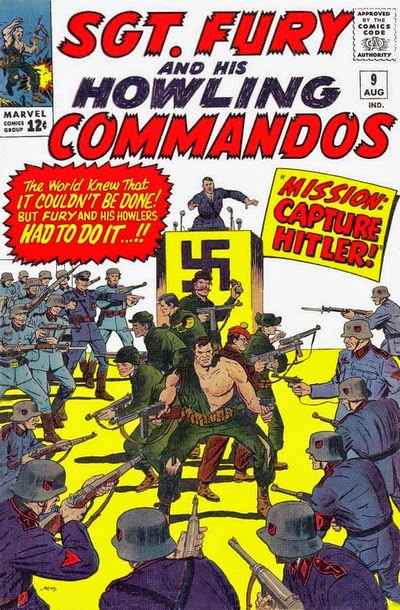 Reviews of various volumes containing his work can be found on the Dick Ayers tag.
As well as often inking, most notably over Jack Kirby, he pencilled many issues of many different titles over many decades. His greatest work was probably Sgt. Fury and his Howling Commandos, which Corporal Ayers drew for ten years.
Friday, 11 April 2014
Essential Hulk volume 4
 Essential Hulk volume 4 is made up of the Incredible Hulk #143-170. The writing is in a period of transition with the end of Roy Thomas's run, then runs by Archie Goodwin and Steve Englehart, with other issues plotted and/or scripted by Gary Friedrich, Len Wein, Gerry Conway, Steve Gerber and Chris Claremont. The art is mostly by Herb Trimpe with some contributions by Dick Ayers. Bonus material includes the Official Handbook of the Marvel Universe entry for the Shaper of Worlds.
Whilst the art throughout this volume continues to be strong, cementing Trimpe's reputation as one of the greatest Hulk artists, if not the greatest of all. However the writing meanders a lot, not helped by the high turnover of scripters, and the result is a somewhat turgid volume even though there are some developments. A key strand in the early issues is the Hulk's quest to be reunited with Jarella and they do briefly achieve it twice, first when she's transported to the full-size world and later when the Hulk journeys back to her world with the help of both an experimental version of Ant-Man's shrinking formula and the mysterious Shaper. This in turn helps drive a final wedge between Bruce Banner and Betty Ross, with the result she turns fully to Glenn Talbot and marries him. Betty and Talbot's wedding is a rare one in superhero comics in that it's not interrupted by villains and monsters. Instead it proceeds smoothly whilst the Hulk is on Counter-Earth, where his counterpart is married to Betty and they have a son. It's a glimpse at what might have been had Bruce made the trench and not been exposed to the gamma rays all those years ago.
Counter-Earth and Jarella's world are two of a number of locations visited by the Hulk on his travels throughout the volume. Others include the depths of the ocean, a city in the sky and Canada. The latter is depicted primarily as a wilderness in which a monstrous beast roams. Curiously it takes the strip a while to realise that sur Québec, la principale langue parlée est le français ni l'anglais. So the Mounties all speak English mais un groupe de bûcherons parlent français. Still it helps to emphasise that the Hulk is abroad.
Meanwhile back in the States there are a variety of developments surrounding Thunderbolt Ross and the military. A dedicated military base and unit is established for the purpose of tackling the Hulk. Initially named "Project: Greenskin" it is subsequently renamed "Hulkbuster". General Ross is generally a subdued rational man throughout the volume but can succumb to his own anger at times. But at other points he's realistic enough to realise the Hulk isn't always the greatest threat. Indeed at one point when both he and Bruce are captured it's Ross who realises that the only way to escape is for Banner to become the Hulk. However the plan only partially works as the Hulk hates Ross too much to stop to free him. As a consequence Ross is subsequently transported to the Soviet Union and only subsequently freed by a covert operation. However in the process Major Talbot is shot and assumed dead, though actually survives as a prisoner behind the Iron Curtain. His assumed death has a devastating impact on Betty, who believes she's gone from being a bride to a widow in the space of a mere month, and she succumbs to anger and more.
There's less material for Jim Wilson beyond a scene where his girlfriend confronts him about trying to hide the Hulk at her house and makes it clear she expects to be married to Jim, a level of commitment that he wasn't prepared for. It seems to be a way of phasing Jim out of the series but it does succumb to the cliché of depicting young women as just waiting to be married and only giving them independence in so far as they force the issue. Of the other supporting cast, Doc Samson is also phased out as loses the gamma radiation that has enhanced his body and strength. However another recurring character is introduced in the form of Colonel Armbruster, who takes over the command of Project: Greenskin during first the absence and then enforced vacation of Ross.
There are a number of new foes encountered in these pages but few have had much lasting impact. Amongst the less remembered are the Horusians, aliens who have replaced with champion conflict by giant creations on Earth and their creations include the Sphinx and a stone Colossus. Then there's Fialan, an assassin from Jarella's world sent after her to Earth by Visis, or the Inheritor, another of the High Evolutionary's creatures, this one having evolved from a cockroach. In an initially more human form is Senator Morton Clegstead, the main political backer of Project: Greenskin, who believes the Hulk's blood can cure his cancer but it instead mutates him into a gigantic blob. There's a surprising for its time (and writer) use of Soviets as enemies, although the strip does take subsequent steps to establish the main villains as rogue elements with the regular authorities only acting once their hands have been forced. The main rogue element is the Gremlin, the revenge-seeking son of the Hulk's very first foe, the Gargoyle. Out at sea the Hulk comes across Captain Omen and his gigantic submarine that is a self-contained world. The homage to Captain Nemo and the Nautilus in the Jules Verne novel Twenty Thousand Leagues Under the Sea is all too obvious. But there's an element of horror, both in the form of the half-man half-fish monster Aquon who has been created by Omen, but also in the fate of the second generation crew who have evolved to work at the deep pressures of the oceans' depths and who find their bodies exploding at the surface pressures. Elsewhere the Hulk fights Zzzax, a living energy being whilst a visit to Sky Island, the former home of the Bird People, leads to a clash with the Bi-Beast, a living monument left to commemorate the race now it has passed on. The final issue sees the Hulk and Betty on a strange island inhabited by giant aliens.
Amongst the foes who would have a more lasting impact is the Shaper (of Worlds), a being with the power to alter reality but without the imagination to create for itself who has instead given reality to the dreams of Nazi scientist Otto Kronsteig, giving a glimpse of a New York overrun by Nazis and where Kronsteig is eventually transformed into the Nazi ubermensch "Captain Axis". On another level is the Wendigo, the first fictional use of the beast from Algonquian legend who will go on to be a regular feature of many Marvel stories set in the Canadian wilderness. But by far the nastiest of foes is the Harpy, the mutated form of Betty Banner Talbot after she succumbs to anger at the apparent death of her husband, blaming both her father and Bruce Banner for the Major's death. She succumbs to the suggestions of Modok and is exposed to gamma radiation, transforming her into a vicious creature resembling the harpies of Greek legend. I forget just how many times the main romantic interest in a series has been transformed into a monster to fight the lead character, but here there's a real sense of hurt and pain driving the fight, and Bruce finds he has no choice but to sacrifice a chance to rid himself of the Hulk once and for all in favour of curing Betty.
There are also a few first appearances in this series by foes from elsewhere, most notably Doctor Doom who encounters the Hulk for the first time in the opening issue. Later the Hulk makes his first visit to Counter-Earth where he clashes with Kohbra, another of the High Evolutionary's creatures previously seen in the pages of Warlock. Back on Earth, he fights with Tiger Shark from the pages of Sub-Mariner. The series also sees return appearances by familiar foes such as the Leader, the Abomination, the Rhino, the Chameleon, Hydra, Visis, Modok and A.I.M.
There also a number of appearances by other heroes, including the aforementioned Ant-Man. When the Hulk is captured in New York, by a combination of Nick Fury and S.H.I.E.L.D., Captain America and the Fantastic Four, he is soon put on trial with his lawyer none other than Matt Murdock (Daredevil), with various Avengers called as witnesses and Mr Fantastic supplying what seems to be a way to turn the Hulk back into Bruce Banner so as to give evidence but which actually empowers the Hulk enough to escape. Issues #150 & #161 continue the practice of using the series to tie up loose ends from cancelled titles. The former issue spotlights Havok and Lorna Dane from X-Men as Havok discovers the hard way he needs more training for his powers whilst the romantic triangle between the pair and Ice-Man is seemingly settled in Havok's favour. It's a brief tale that manages to tie into the ongoing storyline as the Hulk's search for Jarella draws him to Lorna as a green-haired woman. Later on issue #161 is part of the Hulk's adventures in Canada and ties in with the conclusion to the Beast's exploits from Amazing Adventures, as the latter's journey northwards concludes with an encounter with the Mimic, whose powers are getting out of control.
But whilst other adventures are being wrapped up, the Hulk's are ongoing and the pattern for them has now been largely settled as he wanders the Earth, and occasionally the rest of the universe, in search of peace and tranquillity, whilst Bruce Banner searches for a way to cure his other self. The military search for the Hulk in an attempt to restrain or destroy him whilst various villains seek to use him for their own purposes. Looking at this more and more, I think the basic core problem is the over-simplistic nature of the Hulk's personality that results in some rather stilted interaction with those around him, whilst Bruce Banner's role is often minimalised either by the short period between transformations or by the limited resources around him. Consequently the series is often weak when it's unable to get much great action out of the Hulk himself. The problem is further compounded by the changing writers with the results that the character's motivation can change at times - he's willing to help save a woman's brother from the Wendigo because he doesn't want to be blamed for things he hasn't done, yet at other times he just doesn't care what the world around him thinks so long as he's left alone. His memory is weak such that he can't always recall the details of his past encounters with various foes. Add in the very child-like dialogue and the result is a character that's hard to enjoy at times. It would be much better to give the Hulk a strong degree of intelligence and memory, allowing for much greater character interaction and development, or else to shift the focus to the Hulkbusters' pursuit of him and present events through their eyes. Alternatively a sidekick who actually goes all over the place with him would allow for development to take place in another way. But the approach here of focusing on the Hulk in such an oversimplistic depictment just hampers the character and at times makes the series tough to wade through.
So in spite of having some developments amongst the Hulk's supporting cast, this volume is a return to what has been all too typical of the series so far - a great idea squandered by inconsistency and uncertainty as to how to depict and develop it in practice. And it's surprising just how easy it is to pinpoint the problem. There have been times when this can be made to work - so far the best has come under Roy Thomas - but it requires a dedicated writer who lasts for a good while. When left to a fast turnover of writers the result is all often too formulaic adventures that expose the problems inherent in the formula. This is not one of the best Essential volumes.
Friday, 14 February 2014
Essential Captain Marvel volume 1
 Essential Captain Marvel volume 1 contains the Captain Marvel strips from Marvel Super-Heroes #12-13 then Captain Marvel #1-21 and a bonus story from the comedy series Not Brand Echh #9. Marvel Super-Heroes was an anthology series, previously entitled Fantasy Masterpieces,
which variously combined try-out new material with reprints from the
Golden Age; later it would carry reprints of more recent material including a long run reprinting the Incredible Hulk. Stan Lee writes the first Marvel Super-Heroes and is then followed by Roy Thomas who writes up until issue #4 of the titled series and again from #17 and also the Not Brand Echh story. Arnold Drake and Gary Friedrich write most of the intervening issues, with one other by Archie Goodwin. Gene Colan draws as far as issue #4 and also the Not Brand Echh story, then the others are drawn by Don Heck, Dick Ayers, Frank Springer, Tom Sutton, Gil Kane and John Buscema.
Essential Captain Marvel volume 1 contains the Captain Marvel strips from Marvel Super-Heroes #12-13 then Captain Marvel #1-21 and a bonus story from the comedy series Not Brand Echh #9. Marvel Super-Heroes was an anthology series, previously entitled Fantasy Masterpieces,
which variously combined try-out new material with reprints from the
Golden Age; later it would carry reprints of more recent material including a long run reprinting the Incredible Hulk. Stan Lee writes the first Marvel Super-Heroes and is then followed by Roy Thomas who writes up until issue #4 of the titled series and again from #17 and also the Not Brand Echh story. Arnold Drake and Gary Friedrich write most of the intervening issues, with one other by Archie Goodwin. Gene Colan draws as far as issue #4 and also the Not Brand Echh story, then the others are drawn by Don Heck, Dick Ayers, Frank Springer, Tom Sutton, Gil Kane and John Buscema.Captain Marvel was not only one of the last Marvel Silver Age superhero features to get an Essential volume, but was also the last one to be created in that era. After the initial burst of creativity that produced everyone from the Fantastic Four to Daredevil, there was then a period in which the emphasis was on consolidation rather than expansion, giving pre-existing characters their own strips, and the debuts seemed to be done with. Then in 1967 came this new feature. Was he the product of a late surge of creativity that led to Stan Lee and his artists to come up with just one more character? Or did he serve some ulterior purpose?
Even without consulting wider comic histories it seems clear it was the ulterior purpose and it shows. Captain Marvel appears to be the first in a long line of Marvel characters created for the purpose of securing intellectual property rights. Often such characters get rushed into print before the idea has been thoroughly thought through, resulting in some rather confusing early years as the premise, powers and/or backstory get revised in order to work better, and eventually the character is given up with the codename transferred to a new hero, often one with no connection at all to the original. Unfortunately this pattern is all too clear with Captain Marvel. Over the course of this single volume we get a series that starts off as a tale of an alien military spy yet by the end he's become a cosmic powered hero fused with a human being. The series got its first cancellation during the course of this volume yet it was revived barely six months later as a bimonthly. The last regular issue in the volume ends with a note explaining this has been a try-out and "Now, his fate is in your hands -- you, the reader! We'll be waiting for your verdict!" But these two issues were just a try-out and the series did not continue for another two years. It's hard to disguise that the series had not been terribly successful and yet Marvel kept on trying to keep the name "Captain Marvel" on the newsstands.
The real purpose was clearly down to the "use it or lose it" requirements of trademark law that mean a company can't simply hold onto a name to prevent competitors from using it; they must regularly actively exploit the trademark. Exactly how frequently can vary, as can the precise means by which the mark is used, but one consequence is a particular code name can appear on the shelves repeatedly and for multiple characters simply because of the risk of otherwise losing it. This is why names like "Spider-Woman" have been used so many times and also why some of the various "Captain Marvel"s have no connection to each other whatsoever. The name "Captain Marvel" had been used before; first for a highly successful character published by Fawcett Comics in the 1940s & 1950s until DC brought a copyright suit, and then the name had been briefly used by M. F. Enterprises for a short-lived hero. Clearly the risk of rivals being able to publish comics with "Marvel" in the title was too great and so Marvel were clearly moving to tie up the trademark before yet another company printed a comic called "Captain Marvel". Indeed when the Marvel series was revived again in 1972 from issue #22, it came just a few months before DC revived the Fawcett Captain Marvel (since DC could hardly breach its own copyright). Had Marvel foreseen its rival's move and rushed to reinforce its mark? It just served to reinforce the pattern as a whole succession of Captain Marvels would be wheeled out over the years. (DC revived the Fawcett character but because Marvel had already got to the trademark, DC have been unable to sell their version under the logo of "Captain Marvel" - although this doesn't affect what the character is called inside the strip - leading to the use of alternatives such as "Shazam".) But in the process Marvel forget to create a particular exciting scenario and series, and eventually had to change just about everything other than the lead character's name.
The series starts by tapping into the contemporary fads of spies and space science fiction. We see Mar-Vell, a captain in the Kree armed forces, sent on a mission to Earth, though the precise details of his mission vary between revenge for earlier defeats and spying upon the world to determine the threat level. The original given mission is ridiculous for one man, even one as skilled as Mar-Vell, so it's no surprise that it gets changed early on under a different writer. However the new mission becomes equally silly because a Kree scout ship is hiding in orbit and observing Mar-Vell all the time - so why not just cut out the middle man and do the spying from orbit without the risk of arousing suspicions on Earth? A lot of the problem is that the real reason for sending Mar-Vell onto the planet is the jealousy of his superior, Colonel Yon-Rogg, for Mar-Vell's relationship with medic Una. Yon-Rogg belongs to a line of suitors who believe that simply disposing of a rival without even concealing their involvement or hatred will result in a woman falling into their arms. I don't have the real life statistics to hand to check just how many men have succeeded with this method of courting, but I suspect it's very few if that.
There's an attempt to make this a science-fiction romantic story with the regular complications of Yon-Rogg trying to get Mar-Vell either killed on his mission or executed as a traitor, but it rapidly becomes tiresome, even when an additional angle is added to the triangle in the form of human Carol Danvers (later Ms. Marvel then Binary then Warbird then Ms. Marvel again then yet another Captain Marvel - have I missed any out?). It's trying to give a sense of purpose and tragedy to the story but we don't see a great deal of Una and what we do see just doesn't make her a compelling character but instead a weeping wet blanket. It's hard to grasp just what Mar-Vell and Yon-Rogg see in her to the point that the Colonel is prepared to destroy one of his best officers in pursuit of her. The result is that the core motivation for the hatred between Mar-Vell and Yon-Rogg just doesn't convince and so we're left with an endless succession of adventures as Mar-Vell settles on Earth, assuming the guise of the dead Dr Walter Lawson, and finds himself torn between his orders and his realisation of the value of the planet. As a result he comes to the protection of humans multiple times, under the "Americanized" form of his name, Captain Marvel, and equally regularly has to justify his conduct as Yon-Rogg tries to get him prosecuted.
The idea of the noble enemy who comes to a society with orders to destroy it yet rebels when they discovers what the inhabitants are like had been done before with the Silver Surfer and no doubt with many earlier ones, but often it isn't too obvious just what they see in the society or how it is they always seem to meet the best examples. Here Mar-Vell spends most of his time around a missile base in Florida or at a nearby motel with a suspicious night clerk, interacting with a limited number of base personnel and townsfolk, and getting caught up in protecting humans from various alien incursions. At the base the main characters are the base commander General Bridges and the security chief Carol Danvers. Carol is presented as a clear potential romantic interest from the outset and we soon get the all too familiar scenario whereby she falls for the hero but is hostile to his secret identity. Eventually she and Mar-Vell share a kiss, to the delight of the watching Yon-Rogg and the horror of Una, but nothing really comes of it and Carol disappears when the series overhauls itself.
Mar-Vell battles a number of menaces ranging from a Kree sentry to the Super Skrull. The latter is, I think, the first time a Kree and a Skrull had faced off in a Marvel comic though we learn they've been enemies for centuries. Other existing Marvel foes include Quasimodo the living computer. There are new threats such as the Metazoid, a mutated being created by the Communists, or Solam, a solar energy creature drawn to Earth by accident, the Aakons, another alien race, the Organization, a criminal outfit, the Cybrex, a robot built by the real Walter Lawson, the Man-Slayer, a robot created by Communists and the Puppet Master (in a crossover with the Avengers and th Sub-Mariner, however only the Captain Marvel issue is included here). There are also the inevitable clashes with other heroes such as Namor the Sub-Mariner, Iron Man and, later on, the Hulk, though the Captain America depicted on the volume's cover (reused from issue #17) is in fact an illusion generated by Mar-Vell to draw Rick Jones in.
From issue #11 onwards the series starts to transform itself into something different and steadily ditches a lot of the baggage. Una is casually killed off by a stray shot in battle with the Aakons, and Mar-Vell boards a rocket which gets thrown into deep space where he meets an all-powerful being who gives him enhanced powers, including flight, casting illusions and teleportation. Subsequently we learn that Mar-Vell has long been manipulate by the Kree ministers Ronan the Accuser and Zarek as part of a planned coup against the Supreme Intelligence. Zarek is motivated by concerns about the Kree racial stock but fortunately for a black and white reprint this is about the only moment that touches upon the racial tensions within the Kree Empire whereby blue-skinned Kree have come to see themselves as the original pure stock and are hostile towards pink-skinned Kree such as Mar-Vell, seeing them as the result of mixing with lesser races. As a reward the Supreme Intelligence gives Mar-Vell yet further powers and a new costume, his most familiar one, but the hero is now cut off from the Kree. He is soon trapped in the Negative Zone and the only escape, however temporary, is through bonding with another being and regularly trading places with them. And so Rick Jones is lured into a cave in the desert.
When introduced in issue #17, Rick Jones seems several years younger than he's normally portrayed, looking almost like a child. Was this just an error by Gil Kane or was it a deliberate homage to Billy Batson, the original Fawcett Captain Marvel? There are other elements to his introduction that feel like a retread of how Billy was introduced to Shazam, and indeed in the pre-Crisis Fawcett & DC stories Captain Marvel and Billy were treated as separate personalities. But whatever the motivation, the result is that Captain Marvel now shares his existence with a mortal. After a final tidy-up with a showdown in which Yon-Rogg is killed and Carol saved, the series now embarks fully in its new direction.
However the last few issues are just strange. In one Rick finds himself caught up in a strange sociological experiment run by a scientist who uses a luxury block of flats as a giant laboratory. Then in the revived try-out Mar-Vell clashes with both the Hulk and the Rat Pack, a bunch of hi-tech looters. By the end of the series everything has changed beyond recognition and it's no longer clear at all just what it's all about.
Captain Marvel is a series that's quite well drawn and the individual issues flow quickly without any obvious stinkers. But the overall direction of the series is a total mess and the result is a rather meandering flow. The Not Brand Echh story included here plays on the fact that "Captain Marvin" can't remember what his mission is. Whether by accident or design it winds up parodying the series in more ways than one as it really doesn't know what its purpose is for. This was one of the earliest series whose sole reason for existing was legal rather than creative and its artificialness is all too easy to see.
Friday, 7 February 2014
Essential Tales of the Zombie volume 1
 Essential Tales of the Zombie volume 1 contains all ten issues of the magazine Tales of the Zombie plus a story from each of the first couple of issues of the magazine Dracula Lives! Bonus material consists of the cover of Annual #1, an all reprint issue. The early issues of Tales of the Zombie and one of Dracula Lives! also carried some reprints of stories from Marvel's earlier horror comics and these are included here; they come from the likes of Mystic, Menace, Journey into Mystery and Chamber of Darkness. Writers on the series include Roy Thomas, Steve Gerber, Kit Pearson, Marv Wolfman, Tom Sutton, Tony Isabella, Doug Moench, Gerry Conway, John Albano, Len Wein, Carl Wessler, Larry Lieber, David Anthony Kraft, Chris Claremont and John Warner. Artists include Sutton, John Buscema, Pablo Marcos, Win Mortimer, Vincente Alcazar, Enrique Badia, Rich Buckler, Vic Martin, Ron Wilson, Ernie Chan, Syd Shores, Dick Ayers, Frank Springer, Alfredo Alcala, Michael Kaluta, Virgilio Redondo, Yong Montano and Tony DeZuniga. Unfortunately some of the reprints predate the era of credited creators so there's a degree of omission and guess work (which invariably is better at identifying artists than writers) involved here. Identified creators include writers Stan Lee and Chuck Robinson, and artists Ayers, Gene Colan, Bill Everett, George Tuska, Ralph Reese, Tony Dipreta, Bill Walton and Russ Heath. One of the Dracula Lives! stories is a reprint drawn by Dipreta, the other is new and written by Thomas and drawn by Colan. That's a HUGE amount of credits so the labels have spilled over into three other posts, one and two for new work and a third for reprints.
One of the joys of the Essentials is to be shown glimpses of fads in popular culture that have otherwise been generally forgotten. Here is a strong reminder of early 1970s America's fad for all things Voodoo (and that's the spelling used throughout rather "Vodou" or "Vodun"), which is otherwise primarily preserved for modern audiences in the James Bond film Live and Let Die. (Issue #4 of the magazine even carried a rather critical review of that film by Don McGregor, reproduced here along with so many other text features. I had to suppress a chuckle at the text's comment about how actor David Hedison was probably one of the few glad that the film lacked the scene from the book where Felix Leiter is fed to a shark. But it took sixteen years before Licence to Kill dipped Hedison into a shark tank.) Voodoo magic, especially the walking dead, was fascinating many. The magazine format meant that Marvel could produce, or reproduce, material that wasn't bound by the shackles of the Comics Code Authority, starting with the series's very name as the lead character could be unambiguously presented as a "zombie" rather than a "zuvembie" or some other Code friendly spelling that takes away the impact and sheer horror associated with the word.
But this series wasn't the first time Marvel had dabbled with zombies. A number of their 1950s titles had featured them and several stories are reprinted here. Such was the impact of the original stories that one of them, simply entitled "Zombie!" from Menace #5, was selected and built upon to provide the main character and his daughter. Bill Everett thus emerged as the creator of an ongoing character some two decades after working upon the original strip and right at the end of his life. (An editorial in the first issue wishes Everett a speedy recovery but sadly it was not to be. Not included here is a tribute piece from the second issue.) Oddly the first issue doesn't credit Stan Lee's work on the story - maybe his infamously bad memory was at work and perhaps just once he failed to do what he semi-jokes he always does and take any credit that isn't nailed down. The original story is reprinted as the Zombie's chronological second appearance, but the twist at the end of the tale is now lost because of what is shown before it. However the newly created origin ties in well with the original story, though I don't know if the latter underwent any modifications from what was printed in the 1950s in order to match the new material. And the new material came in many different forms.
The magazines were more than just comics by another name. As well as several strips, both new and old, they also contained a number of features and the occasional text story. In several ways they remind me of London Editions Magazines/Fleetway Editions's Superman and Batman titles from c1988-1995 which had a similar strip and text feature approach and which were amongst my introduction to US superhero comics (if I remember and understand correctly, the earlier years of LEM's output was in an exceptionally rare period when the DC superheroes had a better presence on the British newsstands than the Marvel ones; Marvel UK at the time being primarily focused on licensed spin-off titles). These articles delve into a number of aspects relating to both zombies and Voodoo, ranging from the origins of the religion to some of the best books then available on the subject to the portrayal in movies to the culture clash in New York as the rituals of animal sacrifice met legislation barring them and the public's reaction to finding decapitated animals in the park. There are in-depth looks at a number of Voodoo and zombie movies, including some previews. Overall the tone of the articles is highly sympathetic to Voodoo, even though most of the authors appear to be atheists, noting that it has been distorted by media depictions but in fact is rather harmless. "In fact, with the exception of those rites involving animal sacrifice, Voodoo is probably as harmless as Presbyterianism, albeit more colorful," writes Chris Claremont in issue #7 before going on to point out "...there have been no Voodoo holy wars, no Voodoo inquisitions, and no Voodoo tax-exempt real estate holdings." In general the series sets out to portray Voodoo in a non-negative light despite also having to meet popular expectations. However it's not so clear about the differences between the Voodoo practised in Haiti, in west Africa and in Louisiana and in other parts of the United States, tending to present them all as one.
Within that we get a mixture of new and reprinted stories, some focusing upon the title character, others telling one-off tales of encounters with zombies and Voodoo. Whether original or reprinted, these back-up strips are often highly entertaining and at the same time quite dark. We see the fate of an butterfly collector as his son's wish that he'd stop capturing and sticking pins into the insects comes true, or four female prisoners escape and reach the isolated home of one of their aunts only to come to grief one by one. Then there's the white hunter in Dahomey (now Benin) who is searching for gold and his long lost brother, but his atrocious treatment of the locals backfires on him. There are tales of murder victims taking their own revenge or of families turning upon one another and more. The anthology format is now rarely seen amongst US comics but it's always good to allow creators the chance to come up with completely one-off stories and the results are a strong pleasing mix.
However the main attraction is the lead feature, telling the story of the zombie that was New Orleans businessman Simon Garth. Reading through these tales I found it absolutely astounding that there is an almost total lack of appearances by the wider Marvel universe. Simon Garth may have popped up in Dracula Lives! but only as a passing cameo when Dracula visits New Orleans. Indeed the story could easily have been left out but I guess somebody wanted this volume to be the definitive Zombie collection. (The story had already seen print in Essential Tomb of Dracula volume 4 so it wasn't as if people might assume a major team-up was missing.) Otherwise the only visitor from another series is Brother Voodoo in a couple of stories, one filling in for the lost Zombie tale. These stories are both fairly okay but fall into the realm of back-up strips and so aren't the main attractions. Still it's good to see Brother Voodoo operating without the constraints of the Comics Code Authority, even if he does still talk about "Zuvembies" instead of "Zombies". This restraint is probably the main reason why Simon Garth didn't get used in other Marvel comics at the time - significantly he didn't appear in either Marvel Team-Up or Marvel Two-in-One when virtually every other Marvel horror star did at some stage or other. This isolation works well, reflecting the lead character's own isolation but also allows the series to stand on its own feet instead of swamping things out with an endless stream of guest stars.
The first story introduces the main characters who recur throughout the series. Simon Garth is a ruthless businessman who has climbed to the top in the coffee industry but in the process he's lost much of his humanity. Arrogant and domineering in both the boardroom and the home, he has alienated his wife and tries to run his adult daughter Donna's life. He is also oblivious to the feelings of his secretary Layla. Then he is brought down when he dismisses the gardener Gyps for making unwanted advances on Donna but in retaliation Gyps kidnaps him and takes him to a Voodoo ceremony where the mambo (priestess) is Layla. She tries to free him but Gyps catches up with him and kills him, then forces Layla to bring Garth back as a zombie. Wearing the Amulet of Damballah which allows anyone holding its twin to control him, Garth now wanders the Earth as a stumbling corpse. However vestiges of his former life remain and he refuses Gyps's command to kidnap Donna, instead killing Gyps. He then spends much of the rest of the series wandering, occasionally coming under someone's control as the Amulet is successively found and lost, and otherwise surviving. The series doesn't pull its punches - the violence isn't gratuitous but it's also held back on and we see the impact on humans and animals as Garth takes action against them.
The setting shifts between Louisiana and Haiti and back again, with Garth a noble figure whose lack of speech and thought is compensated for by one of the few occasions when second person narration works. Over the course of his wanderings he encounters a number of bizarre situations, ranging from a mad scientist who briefly transforms Donna into a giant spider, to a house murder where members of a family are being picked off, to a New Orleans cult in association with a local crime lord, to a reclusive family looking after their deformed son. Garth is used and abused by a succession of individuals, most notably a group of "swingers" (party types rather than switchers) who use him to perform pranks on a number of people who've annoyed them, not realising just how dangerous this can be. Despite such abuses, Garth manages to maintain a degree of dignity throughout, helped by a part of the zombie curse that gives him a fast healing power. Midway through the series Garth is reunited with Layla, now an outcast after she tried to save him, yet tragically the swingers make him attack her for her past actions in the typing pool. However she survives long enough to give her soul to allow Garth to be restored to full life for twenty-four hours.
Issue #9 sees Garth now restored as he gets the chance to put right a lot of his past mistakes. He attends his daughter's wedding and reconciles with his ex-wife. He visits his business and apologises to his partner, then sells up and has the proceeds put into a fund for his ex-wife, his daughter and the deformed boy. And he takes action against the New Orleans crime lord and the cult who transformed him in the first place. Finally he returns to zombie form but retains enough control to use the Gris-Gris bottle Layla obtained that allows him to permanently die. The story may offer a sense of closure for Garth, but it wasn't intended that way. An editorial note at the start of issue #10 confesses how a story depicting his resurrection was written and drawn, but many of the pages were diverted in transit and ended up in Guam. It was rescheduled for issue #11 but then the series was cancelled, presumably as the Voodoo and zombie fad was now passing. Since there's nothing added after issue #10 it seems the story never saw print in any other series.
The format of the series means there aren't that many pages devoted to Simon Garth and so his story is much briefer than just about any other character with their own Essential volume. But it allows a much closer and personal story than is often the case, and shows how even the most obscure of characters from decades earlier can be put to great use. Meanwhile the other stories and features all work to give an enhanced experience. It's a pity that the magazine format will probably never be seen again as this volume offers a good look at how such a format can deliver so much.
Thursday, 28 November 2013
Essential Captain America volume 1
It's Thanksgiving Day in the United States so it's time for a look at the most American of heroes...


 Essential Captain America volume 1 contains the Captain America strips from Tales of Suspense (the anthology series which also featured Iron Man) #59-99 and then, following the 1968 expansion of the Marvel line, the series became a solo Captain America, with issues #100-102 included here. All but thirteen issues are drawn by Cap's co-creator Jack Kirby who provides layouts on another three, with finishes by George Tuska, Dick Ayers and John Romita. Tuska and Romita also draw a few issues as do Jack Sparling and Gil Kane. As a bonus is a story from the 1940s Captain America Comics drawn by Joe Simon, Cap's other co-creator. Everything is written by Stan Lee, bar one issue by Roy Thomas.
Looking back it's astonishing how long it took to revive Captain America in the Silver Age. A new version of the Human Torch was present from Fantastic Four #1 and the original Namor the Sub-Mariner was revived as early as Fantastic Four #4, but Captain America took longer to appear and was first given a try-out via an impostor in the Human Torch's strip in Strange Tales. Eventually he was resurrected in Avengers #4 but as a team member and it took several more months before he finally got a solo strip. By this point all the big name early Silver Age Marvel titles and characters had appeared, and so the Captain America strip comes from Marvel's second phase of the Age when the main burst of creation had now passed and the focus was upon consolidation and giving deserving existing characters their own strips. Captain America's came just a few months after the Hulk's strip had been restored, whilst some months later the Sub-Mariner would also swim forth in solo tales.
The early stories in this volume suggest part of the reason for this hesitation was down to Kirby and Lee simply not knowing what to do with the character. We get an initial four strips in which little is developed and instead there are three tales of Captain America simply fighting large numbers of foes and one where he goes to Vietnam (long before the US's presence there became controversial back home) and confronts an ex-Sumo wrestler turned general. The whole thing is still heavily tied into the Avengers with the first story starting at Avengers Mansion whilst the already established Jarvis and Rick Jones are the only supporting characters and Baron Zemo the only significant foe appearing.
Issue #63 sees a serious change of pace by retelling Captain America's origin, followed by further adventures from his war years. At the time war comics were still part of the landscape and as well as tapping into that vein this approach also allowed readers to see Cap's early years at a time when the originals would have been hard to access. Issue #65 even declares "we wrote it in the style of the 1940's because so many of you have wondered how these stories were written years ago". I'm not convinced the tale printed actually answers such curiosity and anyway at this point (early 1965) most of the glimpses of the Marvel Bullpen given in other comics had focused upon writers and artists brainstorming ideas rather than the nuts and bolts of whether the dialogue was written at the same time as the plot or after the pictures had been drawn. However it helps reinforce the nostalgic approach to this part of the series.
The sequence itself establishes some details, most obviously restating Cap's origin albeit in a condensed form, and then showing the importance of Bucky. Also revived in these strips is Sergeant Duffy, who routinely puts Private Steve Rogers through his paces at the army camp, little realising he's ordering Captain America around. There are a few other appearances of Golden Age characters, most notably both of the 1940s Red Skulls, with the precise relationship between the two restated, perhaps to see off any confusion if some of the original stories were to be reprinted. Issue #64 features an American female spy identified only as "Agent 13", but it's not clear if this was meant to be a deliberately unnamed Betsy Ross (to prevent confusion with the character in the Incredible Hulk strips), later the Golden Girl, from the Golden Age stories, or instead to be a new character, later expanded a little as Cap's wartime romance and the sister of S.H.I.E.L.D.'s modern day Agent 13, or if she's a completely one-off character and it's just a coincidence the code name was reused. I suspect she was most likely intended to be a new character to take the place of Betsy Ross in the modern telling of Captain America's war years - at this stage Marvel wasn't following exact continuity with its pre-1960s superhero titles (Captain America having been out of action since the end of the war being the most obvious example) and in as far as the point was actually considered this was a soft reboot of the character rather than retellings and new tales slotted around two decades-old comics that next to none of the 1960s readership were likely to have seen. However she isn't seen again in this run of war stories.
Otherwise the stories are broadly true to the spirit of the earlier tales, with Captain America and Bucky taking on a mixture of saboteurs at home, including a new take on the first ever appearance of the Red Skull, attempts to steal weapons and assassinate key officers, and taking on a scientist who has developed special weapons. This last one is probably the least likely to have appeared at the time as it focuses upon Nazi spies and traitors in the United Kingdom seeking to use rockets to destroy London, technology that came late in the war and probably wouldn't have been the focus of fiction at the time. The stories also give us the origin of the true Red Skull, setting him up for the future. Overall these tales are okay but beyond establishing some key points about Cap's past - something that later issues will do even better whilst staying in the present day - they don't really add much. It just reinforces the idea that Kirby and Lee just didn't know what to do with the hero. He served a strong role in the Avengers, to the point he was fast being recognised as the definitive member, but on his own he seemed an anachronism. Perhaps this is why in the strip itself in the present day we would often see Steve Rogers feeling the weight of the years and the curse of being a man out of his time. The gap between 1945 and the mid-1960s may not seem much from today's perspective, but a lot can change in twenty years. On the same scale, today is about the same distance from the end of the Cold War, the first Gulf War and major leaps in technology. There may have been a connected network of computers and portable telephones then, but nothing like the modern internet and the mass use of mobiles and smartphones of today. The number of channels available on the average television set has exploded. Global terrorism has soared as the great concern in world affairs. Fashions have changed a lot. Political ideas have risen and fallen. A person from the early 1990s who awakened today would find many things different and strange.
One thing that doesn't change so much is the concept of patriotism and loyalty to the flag. In many subsequent eras writers on Captain America would delve into the nature of this, at times exploring just what the flag and "America" actually symbolise, how Captain America could be loyal to the country yet opposed to the actions of the government of the day, just what his own vision of the American Dream is and how it squares with alternative visions, and the darker side of America. But here there's very little of that. One issue sees Captain America on a mission in Vietnam but it's the only time he goes there and there's not much overt propagandising in the story. Nor is there in another issue when Cap goes to a Far East Communist country to rescue an agent working under cover - it could be any hostile power for all the difference it makes. The retelling of the origin does state that Cap is "A new defender, born in an hour of need -- destined to be a living symbol of the glory that is America!" but that's about the fullest extent of it. Captain America may have a patriotic name and a costume based on the flag but here there's no actual development beyond this and he's just a big name superhero from the Second World War revived in the present day.
In the present day Cap frequently can't escape the shadow of the war. The return to the present kicks off with a multi-part story in which a giant robot built by the Red Skull and stored in three parts, called "Sleepers", emerges from hibernation after twenty years and tries to destroy the world. Later on the Red Skull is revived in the present day in issue #79 and over the next twenty-four issues he appears in no less than three multi-part stories. It's even more noticeable when bearing in mind that the half-length format of the strip until #99 means that this is the equivalent of just thirteen and a half full-length issues. Other foes include Batroc the Leaper, a French fighter with zees outrageous accent. Maybe he was a rare example of the influence of world politics at a time when the Americans (and many, many others) found de Gaulle to be a right pain. Cap also takes on a number of shadowy organisations, most of them already seen in the Nick Fury, Agent of S.H.I.E.L.D. strip over in Strange Tales. Amongst them are new group "Them", the nucleus of the existing A.I.M. (Advanced Idea Mechanics), who develop the Super Adaptoid. Meanwhile the wider A.I.M. creates the Cosmic Cube, which the Red Skull steals to gain incredible power, though he doesn't use much of it before he is defeated and the Cube lost. Later on A.I.M. appear again, led by their own creation, the genetically advanced Modok. Then there's the terrorist group Hydra. A trip to Wakanda and team-up with the Black Panther sees Cap at first think he's up against a resurrected Baron Zemo, but it turns out to be Zemo's ex-pilot taking on the mantle. Other one-off foes include the Swordsman and Power Man, both from the Avengers, who are both briefly used by the Skull, plus various assorted thugs or the Sniper, a top marksman.
At times the series seems to forget that Cap has spent most of the time since the war trapped in an iceberg, as we find him looking over old items such as the Red Skull's list of locations of the Sleepers, or old photographs including the mysterious woman who worked with the French Resistance who he fell for during the war. He wonders why she never tracked him down afterwards, as though he was around all the time to be found. He eventually finds a woman who resembles her, but she's too young to be the same woman. In fact, although Cap doesn't discover this on panel, she is his wartime sweetheart's younger sister (a point that has had to be retconned in recent years as the war grows ever further distant in time). "Agent 13" is never actually given a name in the series even though she already knows Cap's real one. The two find themselves drawn to each other without realising it and at one point Steve actually proposes to her, but she declines because of her duty to S.H.I.E.L.D. This leads to Steve briefly retiring as Cap, and actually admitting his identity to the world in the process, but he comes back after a succession of copycats come to grief. He and Agent 13 continue together and it's clear her skills make her a good partner for him.
On two occasions Cap faces foes who want to steal his shield to make use of the transistors Iron Man installed in it back in the pages of Avengers. The first time is in issue #62, not long after Cap has realised what a mistake this is and removed them, but issue #87 sees a similar plot years later, albeit from a fill-in writer, Roy Thomas. Perhaps this is a early example of a fill-in story being held in reserve for so long that by the time it was needed it was out of date?
Overall I felt this volume shows a series that's really treading water more than anything else. There's very little attempt to develop much, whether a civilian life for Steve Rogers or a substantial Rogues' Gallery. At times his connections to either the Avengers or Nick Fury provide him with some support and directions towards adventures, but there's not much that really gives the series its unique flavour. Nearly a fifth of the volume is taken up with wartime adventures, and many other issues also draw on those days, most obviously the encounters with the Red Skull and both the real and fake Baron Zemo. This limits somewhat the effect of showing the effects upon Cap of being a man out of time and adapting to life in this strange new world. Instead we have the "Living Legend of World War II" all too often trapped by other legends of World War II. Only Agent 13 represents any real sign of development for the future. Other strips in the anthology titles had managed to develop a lot within the confines of just ten to twelve pages a month so it's not as if the available length is an excuse. There just seems to be a lack of bold imagination and too great a willingness to wallow in the memory of the Golden Age.


 Essential Captain America volume 1 contains the Captain America strips from Tales of Suspense (the anthology series which also featured Iron Man) #59-99 and then, following the 1968 expansion of the Marvel line, the series became a solo Captain America, with issues #100-102 included here. All but thirteen issues are drawn by Cap's co-creator Jack Kirby who provides layouts on another three, with finishes by George Tuska, Dick Ayers and John Romita. Tuska and Romita also draw a few issues as do Jack Sparling and Gil Kane. As a bonus is a story from the 1940s Captain America Comics drawn by Joe Simon, Cap's other co-creator. Everything is written by Stan Lee, bar one issue by Roy Thomas.
Looking back it's astonishing how long it took to revive Captain America in the Silver Age. A new version of the Human Torch was present from Fantastic Four #1 and the original Namor the Sub-Mariner was revived as early as Fantastic Four #4, but Captain America took longer to appear and was first given a try-out via an impostor in the Human Torch's strip in Strange Tales. Eventually he was resurrected in Avengers #4 but as a team member and it took several more months before he finally got a solo strip. By this point all the big name early Silver Age Marvel titles and characters had appeared, and so the Captain America strip comes from Marvel's second phase of the Age when the main burst of creation had now passed and the focus was upon consolidation and giving deserving existing characters their own strips. Captain America's came just a few months after the Hulk's strip had been restored, whilst some months later the Sub-Mariner would also swim forth in solo tales.
The early stories in this volume suggest part of the reason for this hesitation was down to Kirby and Lee simply not knowing what to do with the character. We get an initial four strips in which little is developed and instead there are three tales of Captain America simply fighting large numbers of foes and one where he goes to Vietnam (long before the US's presence there became controversial back home) and confronts an ex-Sumo wrestler turned general. The whole thing is still heavily tied into the Avengers with the first story starting at Avengers Mansion whilst the already established Jarvis and Rick Jones are the only supporting characters and Baron Zemo the only significant foe appearing.
Issue #63 sees a serious change of pace by retelling Captain America's origin, followed by further adventures from his war years. At the time war comics were still part of the landscape and as well as tapping into that vein this approach also allowed readers to see Cap's early years at a time when the originals would have been hard to access. Issue #65 even declares "we wrote it in the style of the 1940's because so many of you have wondered how these stories were written years ago". I'm not convinced the tale printed actually answers such curiosity and anyway at this point (early 1965) most of the glimpses of the Marvel Bullpen given in other comics had focused upon writers and artists brainstorming ideas rather than the nuts and bolts of whether the dialogue was written at the same time as the plot or after the pictures had been drawn. However it helps reinforce the nostalgic approach to this part of the series.
The sequence itself establishes some details, most obviously restating Cap's origin albeit in a condensed form, and then showing the importance of Bucky. Also revived in these strips is Sergeant Duffy, who routinely puts Private Steve Rogers through his paces at the army camp, little realising he's ordering Captain America around. There are a few other appearances of Golden Age characters, most notably both of the 1940s Red Skulls, with the precise relationship between the two restated, perhaps to see off any confusion if some of the original stories were to be reprinted. Issue #64 features an American female spy identified only as "Agent 13", but it's not clear if this was meant to be a deliberately unnamed Betsy Ross (to prevent confusion with the character in the Incredible Hulk strips), later the Golden Girl, from the Golden Age stories, or instead to be a new character, later expanded a little as Cap's wartime romance and the sister of S.H.I.E.L.D.'s modern day Agent 13, or if she's a completely one-off character and it's just a coincidence the code name was reused. I suspect she was most likely intended to be a new character to take the place of Betsy Ross in the modern telling of Captain America's war years - at this stage Marvel wasn't following exact continuity with its pre-1960s superhero titles (Captain America having been out of action since the end of the war being the most obvious example) and in as far as the point was actually considered this was a soft reboot of the character rather than retellings and new tales slotted around two decades-old comics that next to none of the 1960s readership were likely to have seen. However she isn't seen again in this run of war stories.
Otherwise the stories are broadly true to the spirit of the earlier tales, with Captain America and Bucky taking on a mixture of saboteurs at home, including a new take on the first ever appearance of the Red Skull, attempts to steal weapons and assassinate key officers, and taking on a scientist who has developed special weapons. This last one is probably the least likely to have appeared at the time as it focuses upon Nazi spies and traitors in the United Kingdom seeking to use rockets to destroy London, technology that came late in the war and probably wouldn't have been the focus of fiction at the time. The stories also give us the origin of the true Red Skull, setting him up for the future. Overall these tales are okay but beyond establishing some key points about Cap's past - something that later issues will do even better whilst staying in the present day - they don't really add much. It just reinforces the idea that Kirby and Lee just didn't know what to do with the hero. He served a strong role in the Avengers, to the point he was fast being recognised as the definitive member, but on his own he seemed an anachronism. Perhaps this is why in the strip itself in the present day we would often see Steve Rogers feeling the weight of the years and the curse of being a man out of his time. The gap between 1945 and the mid-1960s may not seem much from today's perspective, but a lot can change in twenty years. On the same scale, today is about the same distance from the end of the Cold War, the first Gulf War and major leaps in technology. There may have been a connected network of computers and portable telephones then, but nothing like the modern internet and the mass use of mobiles and smartphones of today. The number of channels available on the average television set has exploded. Global terrorism has soared as the great concern in world affairs. Fashions have changed a lot. Political ideas have risen and fallen. A person from the early 1990s who awakened today would find many things different and strange.
One thing that doesn't change so much is the concept of patriotism and loyalty to the flag. In many subsequent eras writers on Captain America would delve into the nature of this, at times exploring just what the flag and "America" actually symbolise, how Captain America could be loyal to the country yet opposed to the actions of the government of the day, just what his own vision of the American Dream is and how it squares with alternative visions, and the darker side of America. But here there's very little of that. One issue sees Captain America on a mission in Vietnam but it's the only time he goes there and there's not much overt propagandising in the story. Nor is there in another issue when Cap goes to a Far East Communist country to rescue an agent working under cover - it could be any hostile power for all the difference it makes. The retelling of the origin does state that Cap is "A new defender, born in an hour of need -- destined to be a living symbol of the glory that is America!" but that's about the fullest extent of it. Captain America may have a patriotic name and a costume based on the flag but here there's no actual development beyond this and he's just a big name superhero from the Second World War revived in the present day.
In the present day Cap frequently can't escape the shadow of the war. The return to the present kicks off with a multi-part story in which a giant robot built by the Red Skull and stored in three parts, called "Sleepers", emerges from hibernation after twenty years and tries to destroy the world. Later on the Red Skull is revived in the present day in issue #79 and over the next twenty-four issues he appears in no less than three multi-part stories. It's even more noticeable when bearing in mind that the half-length format of the strip until #99 means that this is the equivalent of just thirteen and a half full-length issues. Other foes include Batroc the Leaper, a French fighter with zees outrageous accent. Maybe he was a rare example of the influence of world politics at a time when the Americans (and many, many others) found de Gaulle to be a right pain. Cap also takes on a number of shadowy organisations, most of them already seen in the Nick Fury, Agent of S.H.I.E.L.D. strip over in Strange Tales. Amongst them are new group "Them", the nucleus of the existing A.I.M. (Advanced Idea Mechanics), who develop the Super Adaptoid. Meanwhile the wider A.I.M. creates the Cosmic Cube, which the Red Skull steals to gain incredible power, though he doesn't use much of it before he is defeated and the Cube lost. Later on A.I.M. appear again, led by their own creation, the genetically advanced Modok. Then there's the terrorist group Hydra. A trip to Wakanda and team-up with the Black Panther sees Cap at first think he's up against a resurrected Baron Zemo, but it turns out to be Zemo's ex-pilot taking on the mantle. Other one-off foes include the Swordsman and Power Man, both from the Avengers, who are both briefly used by the Skull, plus various assorted thugs or the Sniper, a top marksman.
At times the series seems to forget that Cap has spent most of the time since the war trapped in an iceberg, as we find him looking over old items such as the Red Skull's list of locations of the Sleepers, or old photographs including the mysterious woman who worked with the French Resistance who he fell for during the war. He wonders why she never tracked him down afterwards, as though he was around all the time to be found. He eventually finds a woman who resembles her, but she's too young to be the same woman. In fact, although Cap doesn't discover this on panel, she is his wartime sweetheart's younger sister (a point that has had to be retconned in recent years as the war grows ever further distant in time). "Agent 13" is never actually given a name in the series even though she already knows Cap's real one. The two find themselves drawn to each other without realising it and at one point Steve actually proposes to her, but she declines because of her duty to S.H.I.E.L.D. This leads to Steve briefly retiring as Cap, and actually admitting his identity to the world in the process, but he comes back after a succession of copycats come to grief. He and Agent 13 continue together and it's clear her skills make her a good partner for him.
On two occasions Cap faces foes who want to steal his shield to make use of the transistors Iron Man installed in it back in the pages of Avengers. The first time is in issue #62, not long after Cap has realised what a mistake this is and removed them, but issue #87 sees a similar plot years later, albeit from a fill-in writer, Roy Thomas. Perhaps this is a early example of a fill-in story being held in reserve for so long that by the time it was needed it was out of date?
Overall I felt this volume shows a series that's really treading water more than anything else. There's very little attempt to develop much, whether a civilian life for Steve Rogers or a substantial Rogues' Gallery. At times his connections to either the Avengers or Nick Fury provide him with some support and directions towards adventures, but there's not much that really gives the series its unique flavour. Nearly a fifth of the volume is taken up with wartime adventures, and many other issues also draw on those days, most obviously the encounters with the Red Skull and both the real and fake Baron Zemo. This limits somewhat the effect of showing the effects upon Cap of being a man out of time and adapting to life in this strange new world. Instead we have the "Living Legend of World War II" all too often trapped by other legends of World War II. Only Agent 13 represents any real sign of development for the future. Other strips in the anthology titles had managed to develop a lot within the confines of just ten to twelve pages a month so it's not as if the available length is an excuse. There just seems to be a lack of bold imagination and too great a willingness to wallow in the memory of the Golden Age.
Friday, 23 August 2013
Essential Hulk volume 1

 Essential Hulk volume 1 contains, in the original edition, all six issues of the original Incredible Hulk series and then the Hulk strips from issues #60-91 of Tales to Astonish (the anthology series that also starred Ant-Man/Giant Man and which later featured Namor the Sub-Mariner). Everything in the volume is written by Stan Lee. Jack Kirby draws the first five issues before being succeeded by Steve Ditko who carries on into the early Tales to Astonish stories. Kirby then returns for a few issues before switching to do layouts which are finished by a mix of "Mickey Demeo" (Mike Esposito moonlighting whilst at DC), Bob Powell, Scott Edward, John Romita and Bill Everett, then issue #84 is credited to "Almost the whole blamed Bullpen". After this (and probably not coincidentally) we get full pencils from John Buscema and Gil Kane. Later editions have added the Hulk's guest appearance in the Giant-Man strip in Tales to Astonish #59 (written by Stan Lee and drawn by Dick Ayers) which served as a trailer for the Hulk's own strip. (This strip can also be found in Essential Ant-Man volume 1.)
 This is literally a volume of two halves albeit unequal ones. The first consists of the original Incredible Hulk series that lasted just six issues back in 1962-1963. Reports are divided as to whether it actually a poor seller or if it was just a victim of Marvel's limited number of titles due to its distribution deal and displaced by Sgt Fury and his Howling Commandos. But either way the result was that the Hulk soon lost his own title and was relegated to wandering through the pages of other books such as the Fantastic Four, the Avengers and even the Amazing Spider-Man. Then after about a year and a half without his own feature, he was given a slot in Tales to Astonish.
This disjoint in the early years has often affected how they've been viewed. The original six issues have been reprinted many times - a pocketbook reprint lent to me by a friend many yeas ago was the first time I read any Silver Age Marvel stories (but I honestly can't remember what colour the Hulk was in the first issue) - but there's been much less attention given to the Tales to Astonish strips. Indeed a note at the start of the original edition of this volume specifically states that many of them hadn't been reprinted "since... well, even Stan Lee can't remember when!" (The Masterworks didn't start on them until a few years later.) It's apologising for the variation in reprint quality due to the nature of the archival material, but it's also a reminder that the Hulk entered his first forgotten era earlier than almost any of his contemporaries.
(The reprint quality is more than passable though. Indeed the worst looking page in my edition is actually one with 1990s artwork! It's a divider page between the two series with the front and back cover art on either side. Unfortunately one side seems to have the images overlaid on each other, like a double exposure. Later editions have better reproduction and lack the note.)
The Hulk's origin story is mostly timeless but there's one element that has bcome dated. Scientist Bruce Banner develops a powerful bomb emitting a special kind of radiation but gets caught in the blast of an undelayed test whilst saving a teenager who has wandered onto the site for a bet, and the resulting energy causes him to change into a monster - that's pretty easy to map to any era. Yes there's a bit of silly science about the effect of the rays. The arms race may have been a more prominent factor of the Cold War but even today nuclear weapons are a live and argued issue and it doesn't matter if it fits current US weapons testing policies. It's the presence of a Communist agent amongst the test staff and the interest of the Soviets that makes the first issue a little dated, though one could reasonably airbrush Igor into being a generic foreign spy of an unnamed or fictitious country. (Making him an alien infiltrator in disguise might be simultaneously timeless and also true to the spirit of some of the era's science fiction but... well... "Yeeesh!") The origin is retold in issue #3, for no real purpose (unless it was to fill up the page count), but with all the spy elements removed.
There are some other aspects to the series that show the silliness of the time, most obviously the way that Bruce is able to obtain a lot of scientific equipment on the sly and easily assemble everything from a gamma machine to the door to the Hulk's underground prison, with a ten foot thick concrete slab held in place by a steel rod. Later on Rick Jones is able to obtain and install a replacement rod with no-one noticing. And there's one issue where Rick is able to charter a private plane at only a few minutes' notice to fly him and the Hulk to confront the latest villain.
One thing rapidly becomes clear that there didn't seem to be a strong sense of direction for the series. At first we get the tale of a man who transforms into a brutish monster at night - a latter day take on Dr Jekyll and Mr Hyde, or at least the popular impression of it. But this doesn't last and soon we shift towards the scenario of the Hulk being a mistrusted hero and Bruce controlling the transformation through a gamma ray machine. However issue #6 shows signs that the control is beginning to break down with delayed and incomplete transformations and then signs that the change can be brought on by extreme aggression. Issue #6 also sees the Hulk granted a Presidential pardon, suggesting a further shift in direction but the run ends before we can see where it goes. The Hulk's personality is initially that of a simple giant but midway through Bruce gains control of the monstrous form. However there are signs that either Bruce is losing control to the Hulk's personality or else he is changing with the power, as the Hulk becomes ever more brutish.
We also see the debut of the most prominent of the Hulk's supporting cast, with all of them introduced on the first few pages of the original issue. Rick Jones is a carefree orphaned teenager who sneaked onto the test site for a bet, but he rapidly becomes loyal to Bruce for saving his life. Rick is about the only teen sidekick in the early Silver Age Marvels - teenagers are otherwise the stars, full members of teams or absent altogether. But unlike many DC sidekicks, Rick largely helps away from fights, looking after Banner/the Hulk, obtaining equipment for him and so forth. At one stage a second accident temporarily results in the Hulk being under Rick's control, a very different arrangement from the norm. At the end of the series Rick and friends form the "Teen Brigade" (well it was 1963) of amateur radio operators across the country to help when needed. The slang was probably dated even at the time but it's good to see some independent organisational initiative. However the main romantic interest is a bit of a washout. Betty Ross at this stage is a rather weak Daddy's Girl who has fallen for Bruce and will defend him against her father's criticisms but otherwise seems to spend most of her time pining for Bruce, being scared by the Hulk or serving as a damsel in distress to be rescued. It's only in the very last few panels that she and Bruce step out together.
Betty's father becomes the Hulk's main foe. General "Thunderbolt" Ross rapidly decides the Hulk is a menace, in part because of Betty's fear of him. Most issues see him trying to capture or destroy the Hulk and sometimes the former is achieved but not for long. Although other military officers are shown with a sceptical view of the Hulk's attempts to do good, Ross believes the worst at all times and thinks others are tricked. The result is a tense backdrop as the Hulk is often on the run and in hiding.
The Hulk battles several other foes in these tales but it's surprising how obscure most of them have remained. The first issue features the Gargoyle, a man deformed by bomb tests who is now a genius working for the Soviets but wishing only to be normal again. He gets his wish in the issue and dies at the end. Death isn't normally an obstacle for a Marvel villain but as far as I'm aware he's never returned outside flashbacks. Issue #2 has that traditional type of enemy, an alien race seeking to invade Earth, though with the Toad Men we actually get an entire invasion armada, rather than just an advanced scoutship as is more normally the case. Issue #3 sees the first big name villains in the form of the Ringmaster and his Circus of Crime. And at this stage it's amazing they can get away with their trick - they turn up in a small town, hold a circus performance where they hypnotise the audience and make them hand over all their valuables before going round the rest of the town to do the same to the handful of inhabitants who didn't come. Then they leave for another. It's little surprise that the FBI soon spot the connection. Issue #4 sees an attack by Mongu "the Gladiator from Outer Space!" but he's just a Soviet agent in a giant suit trying to catch the Hulk and I don't think he's been seen since. The following issue introduces General Fang, a Chinese warlord, and Tyrannus, another underground ruler. Finally issue #6 sees the debut of the Metal Master, an alien with the power to control and change the atoms of all metal. Oddly, despite the tendency of Marvel to leave few ideas unmined, very few of these foes have made many return appearances. The Ringmaster and the Circus of Crime and Tyrannus are about the only ones who've popped up a lot but the rest have made few to none.
These early issues show a series in flux, not really sure whether it wants to be a monster saga or a superhero series. Elements of both genres are present but without a firm sense of direction and at some points such as issue #3 it feels as though the intention is to start again, retelling the origin and transforming the Hulk. Whereas later eras of the Hulk would make a virtue out of constant change, here it feels more like uncertainty. The result is a weak series that deserved a break and a chance to try again later.
Tales to Astonish #59 has been added to later editions and at the time it would have served as a mini recap of the Hulk's status quo. Giant-Man and the Wasp head to New Mexico in the hope of convincing the Hulk to rejoin the Avengers but interference by the Human Top results in Giant-Man and the Hulk battling it out. It's interesting to see some minor changes in the Hulk from his portrayal in his original series - now Bruce Banner changes when he gets stressed and the Hulk doesn't seem to have any of Bruce's mind in control (although he retains the memory that Giant-Man is after him). We're on the Hulk's initial stomping ground and both Betty and Thunderbolt Ross are reintroduced (Rick, however, is now hanging out with the Avengers and Captain America). It's a fairly straightforward tale that could be forgotten.
The revived series in Tales to Astonish picks up largely where things were left off, although Rick is initially away with the Avengers. Early on, we're introduced to the military base's new security chief Major Glenn Talbot, a further antagonist for both the Hulk and Bruce, and a rival for Betty's affections. Talbot is rather unlikeable for much of the run but towards the end he has temptation dropped in his lap when he takes a call clearing the Hulk and could delay relaying the news until it's too late, thus giving him a chance with Betty, but instead realises his duty is to pass on the message immediately.
Once the strip is restored, it rapidly establishes that Bruce transforms into the Hulk at moments of extreme stress and anger, the best known cause of change between the characters. Curiously it's also used to change him back to Bruce until issue #67 when calmness and rest now achieve this. Up until issue #66 the Hulk talks fluently, albeit in a slightly "gangster" manner, but then he starts speaking in the more primitive "Hulk smash!" speech pattern best associated with the character. Issue #70 sees Bruce's mind once more controlling the Hulk but steadily the latter's brutish nature takes over.
Issue #64 sees Rick confessing Bruce's secret to the President (not shown, either because the issue came out near election time or nobody wanted to repeat a notorious mistake Action Comics made when an issue went on sale featuring John F. Kennedy just after his assassination), feeling he will never betray it and can give help. From a modern perspective it's odd to see such reverence given to a mere elected politician. From at least Richard Nixon onwards the phrase "If you can't trust the President of the United States, who can you trust?" has had a very different meaning. The President makes a few further appearances with less reluctance to show him as Lyndon Johnson, but an executive order giving Ross the power to grant the Hulk an amnesty comes too late. Later on when the Hulk is believed to have been destroyed, Rick confesses the secret to Talbot in the hope of clearing Bruce of charges of being a traitor to his country. This has the effect of changing the long term dynamics of the series as Bruce will be ever more a fugitive, though at this stage he's able to hold off the army and prove his worth.
One reason why many of the stories appear to have had few reprints is the continuous serial nature of them. With only ten pages an issue the strip opted to tell an ongoing epic with each issue flowing into the next from issues #60 through to #79. This suits a continuous reprint format series perfectly, but isn't so good for pick 'n mix collections which is probably half the reason why so few had had recent reprints when this volume first came out. The early issues focus on an epic story involving the Leader, another human exposed to gamma rays but on this occasion his brain has been enhanced instead of his strength. The Leader has developed much technology, including his "Humanoid" minions, an artificial lifeform especially grown, and he is seeking to steal various forms of further technology to advance his goals and spots the potential for using the Hulk. This ultimately leads to his sending the Hulk to the home of the Watcher to obtain the "Ultimate Machine" - something that looks like a goldfish bowl but contains all the knowledge of the universe. Here the Leader's intelligence is his own downfall as the machine overloads his mind and kills him.
The Leader is by far the biggest foe introduced in these issues, though in the last few issues we also see the debut of the Abomination. Otherwise the new foes introduced are comparatively minor players for the Hulk, though some have played bigger parts elsewhere - the Amphibian, the Secret Empire and the Boomerang. We also get a handful of foes from other series including the Chameleon, the Executioner, the Mole Man and the Stranger. It's interesting to see a number of themes that would appear again during Peter David's epic run on the character. As well as a Hulk who seemingly fuses both his and Bruce's personalities, there's a trip to a dystopian future, and conflict between different sub-surface rulers (also a step towards tidying up some of the duplication in the early Marvel universe). In a way it suggests the Hulk was taken back to his roots, even if those roots were pretty obscure.
Towards the end of the volume there appear to be signs of the series meandering with some abrupt changes of direction. Issue #81 introduces the Secret Empire, a shadowy criminal organisation, and over the next few issues there's considerable build-up as we see the start of a power struggle. But then the Secret Empire abruptly disappears from the strip and the only acknowledgement comes a few issues later when Boomerang comments on how they've now been "smashed". Possibly this is a consequence of the art chaos as the crucial issue would have presumably been #84 which is drawn by "Almost the whole blamed Bullpen", suggesting a rush job to get the issue to the presses in which key plot points were lost. (Actually the Secret Empire was picked up in the other half of Tales to Astonish in the Sub-Mariner strip but there's nothing here to actually tell the reader of this.) Later on there's a report of an attempt on Betty's life but we never see it. The art situation also results in the last four issues here being some of the worst art in the entire volume. Gil Kane drew many great comics in his career but all artists can have their off moments and this is one of his. The art is far too cartoony, with both the Hulk and the Abomination looking especially silly, and it detracts from a crucial moment as for the first time the Hulk battles a super strong foe that is the product of gamma rays. Often the best foes for a hero are those who offer a dark reflection of them and the Abomination is the obvious candidate to serve that role with the Hulk. Unfortunately we get a rather limited clash here before the Stranger takes the Abomination away, and the art just lets it down completely.
In general the Tales to Astonish strips aren't really anything spectacular. When read together they flow quite quickly, but readers at the time must have found the ongoing stories took forever to complete. Although we get a couple of new foes with strong potential, one is killed off in his first storyline and the other taken away from Earth. Neither of these necessarily restrict a villain's use in the future but they can leave the series in a weakened state in the meantime. The chaos surrounding the Secret Empire is a real let down, especially as all the issues have the same scripter. Add in the repeated pursuit and conflict with the military, which can eventually tire, and it's all a bit of a letdown. Consequently this era of the Hulk somewhat deserves its obscurity.
Overall this volume shows that the Hulk is a great idea on paper but very difficult to realise in practice. The original series shows a complete uncertainty about what to do with the character and when revived later on he's let down by very long storylines, repetition with the military and some artistic confusion. Perhaps the original series had a mercy killing and there's not a great deal in the rest of the volume to suggest the best direction for the Hulk had yet been found.
Thursday, 15 August 2013
Essential Sgt. Fury and His Howling Commandos volume 1
Today is VJ Day so it's time for a look at Marvel's most prominent war comic.
 One of the few other Essential volumes to step outside the superhero genre (though, as we'll see, it keeps quite near) is Essential Sgt. Fury and His Howling Commandos volume 1, Marvel's first and main Silver Age war comic. This volume carries issues #1-23 and the first annual. All the stories are written by ex-Sergeant Stan Lee with the early issues drawn by ex-Infantryman Jack Kirby who is then succeeded by ex-Corporal Dick Ayers, though Kirby returns for one issue. In several of the issues the creators' former ranks are given. Sergeant Lee and Corporal Ayers even make a cameo in issue #22, working at an airstrip where the Howlers depart on a mission. The appearance keeps up the conceits from similar moments in other series that Marvel is retelling the adventures of actual people as told to the writers and artists, and that artists do not find Lee the easiest writer to work with.
At the core of the team are the First Attack Squad of commandos, or the "Howlers". This small unit is rough and ready, finding regimented discipline and formal parades a chore, but giving their all in action. The Howlers are loyal men who look out for each other and there are no egos or prejudices amongst them that could damage the squad's cohesiveness. This is briefly shaken when it appears that one of them has turned traitor, but the revelation that he was doing so under orders soon restores relations to normal. But the squad are also sufficiently open to accept new members who've proven themselves. This is shown vividly when Percival Pinkerton arrives and his handling of two tormentors quickly persuades the Howlers of his abilities.
Each of the Howlers is distinctive both visually and audibly, as well as in their skills. Heading the team is Sergeant Nick Fury, an all-American roughneck and what he lacks in grace more than makes up for with his bravery and skill. After many years of seeing an older Fury as the director of S.H.I.E.L.D. it's a surprise to see his young days as a field sergeant. His faithful number two is Corporal "Dum-Dum" Dugan, an ex-circus strong man who seems to prefer war to his wife and mother-in-law, and who provides the Howlers with much of the physical brute strength. The team's resident mechanic is Private Izzy Cohen, a Jew from Brooklyn. In the role of bugler is Private Gabriel Jones, a black musician from New York. Providing a touch of glamour and also translation in the field is Private Dino Manelli, an Italian-American serving under a fake name to disguise his movie career. Private "Rebel" Ralston is a hard edged Southern ex-jockey. The team's youngest member is Private "Junior" Juniper, fresh out of university but as brave as any man. Junior is killed in issue #4, being hit in a firefight as the Howlers escape. The death scene itself is surprisingly limited compared to the deaths of major characters in later years but it's a reminder of just how dangerous war is and how any one of the squad could suddenly be shot down. In the earlier issues Junior does not feel like a deliberately created piece of canon fodder just waiting to be killed off, but as rounded a character as any other. His replacement is Private Percival Pinkerton, an upper class British soldier who always carries an umbrella that proves a surprisingly effective multi-purpose tool and weapon. Why he calls his umbrella a "bumbershoot" - a piece of old fashioned American slang - is beyond me. The squad's commanding officer is Captain Sam Sawyer who has a good if tough relationship with Fury, defending him when needs be in the knowledge that the Howlers get the results needed.
Most war comics are first and foremost about telling exciting stories set against the backdrop of a recognisable war. They are rarely intended to be completely historically accurate, especially when it comes to particular fronts and famous officers. This is especially noticeable here with the Commandos' missions at first appearing to be set in 1944 when they ensure the security of plans for D-Day, but a subsequent issue takes them to North Africa where references to Tobruk, a general sense of pessimism and the presence of Rommel suggest it is 1942 before El Alamein - except that Rommel is known by Allied intelligence to be part of a plot to kill Hitler, which in reality Rommel was a late recruit to in mid 1944, after he had left Africa. Not long afterwards the Commandos are briefly redeployed to the Pacific in advance of the Battle of Okinawa which began in April 1945. Issue #22 explicitly dates itself to August 1st 1943 and Operation Tidal Wave. It's probably best to just overlook the disregard for chronology. Equally it's best not to ask if Commando units stationed near the English Channel and usually sent to France and Germany really were often deployed on one-off missions as far apart as Norway, Romania, North Africa, Okinawa or Burma (now Myanmar).
Sticking out rather more are the presentation of a number of historical and cultural factors. The Commandos themselves are an anachronism, being a mixed race unit at a time when the US Army was still segregated (a source of tension in some host countries like the United Kingdom). In issue #6 the squad has a temporary replacement member, George Stonewell, who turns out to be a bigot who is reluctant to share and serve alongside Jews and blacks. It would have been a bold move to address the subject of more general racism in the US Army during the war, but the story side-steps it by making the bigot a one-off. However whilst the squad may be a racially progressive portrayal the same cannot be said of some of the other races presented. Many of the Germans and Japanese seen conform to easy clichés, whilst issue #17 sees the squad encounter an African tribe, whose presentation could have stepped out of the Victorian era.
The series is also a little ambiguous when it comes to Italy. Issue #3 sees the squad deployed there but a reader could be mistaken for thinking that the country was conquered by the Germans and liberated, as opposed to being an ally until the pro-German regime collapsed and the Germans stepped in to control things directly. This also avoids questions about the loyalty of American soldiers of Italian descent, such as Dino, or for that matter it may have made it easier to sell to Italian American readers. Later on issue #12 touches on the issue more with radio calls for Allied soldiers of German and Italian descent to defect but Dino only fakes this under orders from Fury.
The series is also a little off in its portrayal of the United Kingdom. Stan Lee was neither the first nor last American writer to struggle with understanding British titles so it would be wrong to blame him alone, but there's something about the way Lord Hawley is introduced, and even more with his son being "Sir Percy" that feels off-key. The geography is surprising as well - the squad seem to be based near the Straits of Dover, the nearest point to the continent, yet in one issue they get a few hours leave and go to spend the evening Shakespeare's home town of Stratford-upon-Avon. Not even high speed rail would allow that! However in one regard the series is spot on by not succumbing to the lazy myth that the United States was solely responsible for victory in the Second World War, with the British presented as equal allies to the Americans.
Some of the dialogue also sounds a little strange, particularly Percival Pinkerton's which makes him sound a little too much the stereotypical upper-class buffoon. And contrary to the impression some movies may give, the Cockney accent is not widely heard outside the East End of London and is certainly not standard fare in pubs across the country. The Germans who can speak English tend to speak an Americanised English which is understandable given where the comic was created but still surprising given geography - for example "railroad flat cars" when the more natural translation for a German would be "flat railway trucks".
British Nurse Lady Pamela Hawley becomes Nick Fury's romantic interest from issue #4 onwards but, as a caption at the end of issue #10 states, the series is a war comic not a romance comic and so after her introduction she usually appears only briefly at the start and/or end of some adventures. She is killed off in issue #18, another reminder of the sudden personal cost of war and it comes suddenly - Fury has decided to propose to her upon his return from a mission and is so caught up in it he won't let anyone tell him critical news. Then he arrives at the Hawley home only to be told by her father that Pamela died helping the wounded in an air raid. Deaths don't always have to be shown on panel to have an impact and this one perhaps works the best this way, highlighting Fury's grief that he wasn't by her side when she died. Such an off-panel approach can work when handled well. It's also another case of the series being one of the first Silver Age Marvel titles to break new ground before the bigger named titles got there. So here is the start of the route that led to the deaths of the likes of Gwen Stacey, Karen Page and many other romantic interests.
Continuity is generally tight but there are occasional lapses. Issue #15 sees the Howlers sent to the Netherlands to disrupt the dikes and there's a mystery about the identity of Agent X with the hint that he could be Mayor Rooten, seemingly a collaborator. Wisely the thread is left dangling - in real life many a mission ends with not every thread resolves - but four issues later Fury is again in the Netherlands and goes straight to Rooten as though his identity was clear all along.
It would be natural to expect the series to take place in its own world, isolated from the rest of the Marvel universe. Instead links to that wider universe are established fairly early on. A young Reed Richards makes a brief guest appearance in issue #3 and in return Nick Fury made an appearance in the present day in Fantastic Four #21. Issue #8 ties in with the Avengers by making the villain a young Baron Zemo, albeit before his hood was fixed to his face. And Captain America and Bucky have a major guest appearance in issue #13.
The series develops only a few recurring antagonists, reflecting the nature of war and the squad's operations. Adolf Hitler shows up in person quite a bit but the primary antagonist is Baron von Strucker. Midway through the series he assembles the Blitzkrieg Squad to rival the Howlers, with the members consisting of various soldiers and thugs aiming to counter the Howlers. The names show a limited imagination when it comes to Germans - Ludwig, Fritz, Otto, Siegfried, Ernst and Manfred. The Blitzkrieg Squad appear a few times and it's surprising that they don't suffer much attrition either. Back home the squad's other main rival is Sergeant Bull McGiveney, head of the Second Attack Squad who frequently clash and fight with the Howlers but the two squads work effectively together when in the same combat zone in issue #22. A bit part is "the Skipper" who commands a submarine and often gets the Howlers in and out of enemy territory. He would later be given a name - Captain Savage - and his own series. The only other recurring character of note is Hans Rooten, a Dutch boy who believes his father has turned collaborator and so he leaves with the Howlers, becoming their mascot but doesn't go on any missions with them.
The annual sees the squad reunited in the Korean War. The story is even more propagandistic than the Second World War adventures, with few opportunities missed to paint the Communists in a bad light. This originally saw print in 1965 and it's hard to miss the obvious parallel with Vietnam in the year the American ground involvement began. At this stage US public opinion was largely in favour of the intervention and it was easy to show American forces in east Asia without risking a sales backlash. It would be interesting to see if this was sustained in later issues. The annual also serves to bridge some of the gap between the series and Fury's present day adventures - Nick Fury, Agent of S.H.I.E.L.D. which had just launched in Strange Tales (and which are the most prominent Silver Age absentee from the Essentials) - by showing how Fury was finally commissioned as an officer. But both the annual and the S.H.I.E.L.D. tales break a convention of fiction by showing us the heroes will live in the long run. A feature in the annual shows the current members of the squad and raises the prospect the membership will change in future issues, yet the annual cuts off the possibility of further deaths.
The earliest issues contain one page guides to aspects of the war. Most are "Weapons of War", showing the various different guns used by different countries in the war, but issue #3 has "America's World War II Shopping List!" showing various vehicles and equipment and how much each item cost, though I don't know if the prices are from the war itself or instead are the costs of such equipment in 1963. The "Weapons of War" feature briefly returns in issue #14 with a guide to the B-26 Martin Marauder bomber. The annual also adds a piece on Combat Arm and Hand Signals plus a guide to the base, now explicitly placed at Dover.
The series may offer a degree of realism by such information and by killing off regular characters, but a lot of the time it's a high octane adventure that skims over the gorier details like bodies and blood. The Howlers routinely survive against ridiculous odds and the German and Japanese armies seem to both be composed almost entirely of graduates of the Imperial Stormtrooper Marksmanship Academy. And some of the enemy plans seem to be a little fantastical - the idea that the Germans could devote huge resources during the war to building a tunnel under the Channel is a little hard to swallow but ultimately this series is meant to be more of an enjoyable romp rather than a gritty historical exploration of the war. As a result it bends chronology and location to allow its characters to go through a wide variety of scenarios. There's a strong sense that Lee, Kirby and Ayers were proud of the series. I don't know much about where they were deployed during the war so I'm not sure if these are fantastical embellishments of some of their own experiences or a substitute by ex-soldiers who found themselves deployed away from the front line, but there's a real sense of authenticity about the characters, even if the actual composition of the squad owes more to 1960s sensibilities than 1940s realities.
On top of everything else, this volume and Essential Rawhide Kid volume 1 both show the potential for releasing some of Marvel's non-superhero titles, something that DC's Showcase Presents volumes have been rather better at exploiting. So is anybody up for trying the ultimate step - Essential Millie the Model?
 One of the few other Essential volumes to step outside the superhero genre (though, as we'll see, it keeps quite near) is Essential Sgt. Fury and His Howling Commandos volume 1, Marvel's first and main Silver Age war comic. This volume carries issues #1-23 and the first annual. All the stories are written by ex-Sergeant Stan Lee with the early issues drawn by ex-Infantryman Jack Kirby who is then succeeded by ex-Corporal Dick Ayers, though Kirby returns for one issue. In several of the issues the creators' former ranks are given. Sergeant Lee and Corporal Ayers even make a cameo in issue #22, working at an airstrip where the Howlers depart on a mission. The appearance keeps up the conceits from similar moments in other series that Marvel is retelling the adventures of actual people as told to the writers and artists, and that artists do not find Lee the easiest writer to work with.
At the core of the team are the First Attack Squad of commandos, or the "Howlers". This small unit is rough and ready, finding regimented discipline and formal parades a chore, but giving their all in action. The Howlers are loyal men who look out for each other and there are no egos or prejudices amongst them that could damage the squad's cohesiveness. This is briefly shaken when it appears that one of them has turned traitor, but the revelation that he was doing so under orders soon restores relations to normal. But the squad are also sufficiently open to accept new members who've proven themselves. This is shown vividly when Percival Pinkerton arrives and his handling of two tormentors quickly persuades the Howlers of his abilities.
Each of the Howlers is distinctive both visually and audibly, as well as in their skills. Heading the team is Sergeant Nick Fury, an all-American roughneck and what he lacks in grace more than makes up for with his bravery and skill. After many years of seeing an older Fury as the director of S.H.I.E.L.D. it's a surprise to see his young days as a field sergeant. His faithful number two is Corporal "Dum-Dum" Dugan, an ex-circus strong man who seems to prefer war to his wife and mother-in-law, and who provides the Howlers with much of the physical brute strength. The team's resident mechanic is Private Izzy Cohen, a Jew from Brooklyn. In the role of bugler is Private Gabriel Jones, a black musician from New York. Providing a touch of glamour and also translation in the field is Private Dino Manelli, an Italian-American serving under a fake name to disguise his movie career. Private "Rebel" Ralston is a hard edged Southern ex-jockey. The team's youngest member is Private "Junior" Juniper, fresh out of university but as brave as any man. Junior is killed in issue #4, being hit in a firefight as the Howlers escape. The death scene itself is surprisingly limited compared to the deaths of major characters in later years but it's a reminder of just how dangerous war is and how any one of the squad could suddenly be shot down. In the earlier issues Junior does not feel like a deliberately created piece of canon fodder just waiting to be killed off, but as rounded a character as any other. His replacement is Private Percival Pinkerton, an upper class British soldier who always carries an umbrella that proves a surprisingly effective multi-purpose tool and weapon. Why he calls his umbrella a "bumbershoot" - a piece of old fashioned American slang - is beyond me. The squad's commanding officer is Captain Sam Sawyer who has a good if tough relationship with Fury, defending him when needs be in the knowledge that the Howlers get the results needed.
Most war comics are first and foremost about telling exciting stories set against the backdrop of a recognisable war. They are rarely intended to be completely historically accurate, especially when it comes to particular fronts and famous officers. This is especially noticeable here with the Commandos' missions at first appearing to be set in 1944 when they ensure the security of plans for D-Day, but a subsequent issue takes them to North Africa where references to Tobruk, a general sense of pessimism and the presence of Rommel suggest it is 1942 before El Alamein - except that Rommel is known by Allied intelligence to be part of a plot to kill Hitler, which in reality Rommel was a late recruit to in mid 1944, after he had left Africa. Not long afterwards the Commandos are briefly redeployed to the Pacific in advance of the Battle of Okinawa which began in April 1945. Issue #22 explicitly dates itself to August 1st 1943 and Operation Tidal Wave. It's probably best to just overlook the disregard for chronology. Equally it's best not to ask if Commando units stationed near the English Channel and usually sent to France and Germany really were often deployed on one-off missions as far apart as Norway, Romania, North Africa, Okinawa or Burma (now Myanmar).
Sticking out rather more are the presentation of a number of historical and cultural factors. The Commandos themselves are an anachronism, being a mixed race unit at a time when the US Army was still segregated (a source of tension in some host countries like the United Kingdom). In issue #6 the squad has a temporary replacement member, George Stonewell, who turns out to be a bigot who is reluctant to share and serve alongside Jews and blacks. It would have been a bold move to address the subject of more general racism in the US Army during the war, but the story side-steps it by making the bigot a one-off. However whilst the squad may be a racially progressive portrayal the same cannot be said of some of the other races presented. Many of the Germans and Japanese seen conform to easy clichés, whilst issue #17 sees the squad encounter an African tribe, whose presentation could have stepped out of the Victorian era.
The series is also a little ambiguous when it comes to Italy. Issue #3 sees the squad deployed there but a reader could be mistaken for thinking that the country was conquered by the Germans and liberated, as opposed to being an ally until the pro-German regime collapsed and the Germans stepped in to control things directly. This also avoids questions about the loyalty of American soldiers of Italian descent, such as Dino, or for that matter it may have made it easier to sell to Italian American readers. Later on issue #12 touches on the issue more with radio calls for Allied soldiers of German and Italian descent to defect but Dino only fakes this under orders from Fury.
The series is also a little off in its portrayal of the United Kingdom. Stan Lee was neither the first nor last American writer to struggle with understanding British titles so it would be wrong to blame him alone, but there's something about the way Lord Hawley is introduced, and even more with his son being "Sir Percy" that feels off-key. The geography is surprising as well - the squad seem to be based near the Straits of Dover, the nearest point to the continent, yet in one issue they get a few hours leave and go to spend the evening Shakespeare's home town of Stratford-upon-Avon. Not even high speed rail would allow that! However in one regard the series is spot on by not succumbing to the lazy myth that the United States was solely responsible for victory in the Second World War, with the British presented as equal allies to the Americans.
Some of the dialogue also sounds a little strange, particularly Percival Pinkerton's which makes him sound a little too much the stereotypical upper-class buffoon. And contrary to the impression some movies may give, the Cockney accent is not widely heard outside the East End of London and is certainly not standard fare in pubs across the country. The Germans who can speak English tend to speak an Americanised English which is understandable given where the comic was created but still surprising given geography - for example "railroad flat cars" when the more natural translation for a German would be "flat railway trucks".
British Nurse Lady Pamela Hawley becomes Nick Fury's romantic interest from issue #4 onwards but, as a caption at the end of issue #10 states, the series is a war comic not a romance comic and so after her introduction she usually appears only briefly at the start and/or end of some adventures. She is killed off in issue #18, another reminder of the sudden personal cost of war and it comes suddenly - Fury has decided to propose to her upon his return from a mission and is so caught up in it he won't let anyone tell him critical news. Then he arrives at the Hawley home only to be told by her father that Pamela died helping the wounded in an air raid. Deaths don't always have to be shown on panel to have an impact and this one perhaps works the best this way, highlighting Fury's grief that he wasn't by her side when she died. Such an off-panel approach can work when handled well. It's also another case of the series being one of the first Silver Age Marvel titles to break new ground before the bigger named titles got there. So here is the start of the route that led to the deaths of the likes of Gwen Stacey, Karen Page and many other romantic interests.
Continuity is generally tight but there are occasional lapses. Issue #15 sees the Howlers sent to the Netherlands to disrupt the dikes and there's a mystery about the identity of Agent X with the hint that he could be Mayor Rooten, seemingly a collaborator. Wisely the thread is left dangling - in real life many a mission ends with not every thread resolves - but four issues later Fury is again in the Netherlands and goes straight to Rooten as though his identity was clear all along.
It would be natural to expect the series to take place in its own world, isolated from the rest of the Marvel universe. Instead links to that wider universe are established fairly early on. A young Reed Richards makes a brief guest appearance in issue #3 and in return Nick Fury made an appearance in the present day in Fantastic Four #21. Issue #8 ties in with the Avengers by making the villain a young Baron Zemo, albeit before his hood was fixed to his face. And Captain America and Bucky have a major guest appearance in issue #13.
The series develops only a few recurring antagonists, reflecting the nature of war and the squad's operations. Adolf Hitler shows up in person quite a bit but the primary antagonist is Baron von Strucker. Midway through the series he assembles the Blitzkrieg Squad to rival the Howlers, with the members consisting of various soldiers and thugs aiming to counter the Howlers. The names show a limited imagination when it comes to Germans - Ludwig, Fritz, Otto, Siegfried, Ernst and Manfred. The Blitzkrieg Squad appear a few times and it's surprising that they don't suffer much attrition either. Back home the squad's other main rival is Sergeant Bull McGiveney, head of the Second Attack Squad who frequently clash and fight with the Howlers but the two squads work effectively together when in the same combat zone in issue #22. A bit part is "the Skipper" who commands a submarine and often gets the Howlers in and out of enemy territory. He would later be given a name - Captain Savage - and his own series. The only other recurring character of note is Hans Rooten, a Dutch boy who believes his father has turned collaborator and so he leaves with the Howlers, becoming their mascot but doesn't go on any missions with them.
The annual sees the squad reunited in the Korean War. The story is even more propagandistic than the Second World War adventures, with few opportunities missed to paint the Communists in a bad light. This originally saw print in 1965 and it's hard to miss the obvious parallel with Vietnam in the year the American ground involvement began. At this stage US public opinion was largely in favour of the intervention and it was easy to show American forces in east Asia without risking a sales backlash. It would be interesting to see if this was sustained in later issues. The annual also serves to bridge some of the gap between the series and Fury's present day adventures - Nick Fury, Agent of S.H.I.E.L.D. which had just launched in Strange Tales (and which are the most prominent Silver Age absentee from the Essentials) - by showing how Fury was finally commissioned as an officer. But both the annual and the S.H.I.E.L.D. tales break a convention of fiction by showing us the heroes will live in the long run. A feature in the annual shows the current members of the squad and raises the prospect the membership will change in future issues, yet the annual cuts off the possibility of further deaths.
The earliest issues contain one page guides to aspects of the war. Most are "Weapons of War", showing the various different guns used by different countries in the war, but issue #3 has "America's World War II Shopping List!" showing various vehicles and equipment and how much each item cost, though I don't know if the prices are from the war itself or instead are the costs of such equipment in 1963. The "Weapons of War" feature briefly returns in issue #14 with a guide to the B-26 Martin Marauder bomber. The annual also adds a piece on Combat Arm and Hand Signals plus a guide to the base, now explicitly placed at Dover.
The series may offer a degree of realism by such information and by killing off regular characters, but a lot of the time it's a high octane adventure that skims over the gorier details like bodies and blood. The Howlers routinely survive against ridiculous odds and the German and Japanese armies seem to both be composed almost entirely of graduates of the Imperial Stormtrooper Marksmanship Academy. And some of the enemy plans seem to be a little fantastical - the idea that the Germans could devote huge resources during the war to building a tunnel under the Channel is a little hard to swallow but ultimately this series is meant to be more of an enjoyable romp rather than a gritty historical exploration of the war. As a result it bends chronology and location to allow its characters to go through a wide variety of scenarios. There's a strong sense that Lee, Kirby and Ayers were proud of the series. I don't know much about where they were deployed during the war so I'm not sure if these are fantastical embellishments of some of their own experiences or a substitute by ex-soldiers who found themselves deployed away from the front line, but there's a real sense of authenticity about the characters, even if the actual composition of the squad owes more to 1960s sensibilities than 1940s realities.
On top of everything else, this volume and Essential Rawhide Kid volume 1 both show the potential for releasing some of Marvel's non-superhero titles, something that DC's Showcase Presents volumes have been rather better at exploiting. So is anybody up for trying the ultimate step - Essential Millie the Model?
Saturday, 29 June 2013
Essential Rawhide Kid volume 1
I originally prepared this post to appear a little later but here in London today it's Pride. In honour of that I thought I'd take a look at an Essential starring an LGBT character. However there haven't been that many with their own series, and none with runs that have been Essentialised so far, but there is one featuring the early days of a character who in recent years has been depicted as gay. And without further ado...
 Marvel hasn't always published just superheroes. Indeed there were times when they published no superheroes at all. They have long put out titles in many other genres and up until the early 1960s the company tended to follow the contemporary trends in the comics industry and wider American society. And one of those long running trends was the Western.
The company had previously published many Western titles as part of a large and diverse set of books until distribution problems in 1957 forced a massive scaling back of the line. Amongst the books was one called The Rawhide Kid which lasted just sixteen issues. Then in 1959 a new TV series began called simply Rawhide. The chanced to have a comic with that word in the name was too good an opportunity to miss and so the title was revived in 1960 with issue #17 - in those days the market had a very different attitude to numbering and preferred to continue existing sequences rather than have new issue #1s all the time. This was in spite of the series featuring a new and younger character (although in later years there would be attempts to make the previous Rawhide Kid an older version of this one to expand the supply of material for reprints).
Essential Rawhide Kid volume 1 contains issues #17 to #35. As bonus material we get a cover gallery of the first twenty-eight issues of the reprint series Mighty Marvel Western which featured the Rawhide Kid, Kid Colt, the Two-Gun Kid and Matt Slade. All the issues are written by Stan Lee and drawn by a mix of Jack Kirby, Don Heck, Dick Ayers, Gene Colan, Paul Reinman, Al Hartley, Jack Davis and Sol Brodsky. At least that's what the credits on the contents pages say, as this was still an era when crediting creators was far from standard, though a number of the stories are signed by the writer and the artist. However some other stories don't give away the name of their artists and so we're reliant on ancient files that may not always be complete and/or the assessment of latter day experts looking at the artwork and deducing who produced it.
The format of all these issues is pretty straightforward - about eighteen pages of the Rawhide Kid, divided into two or three stories with the longer tales sometimes divided into separate chapters. About five pages are given over to a non-Rawhide Kid story. And finally each issue carries a two-page text story. Annoyingly these were often spread across each issue and this volume doesn't always take the opportunity to reunite them. These tales again don't feature the Rawhide Kid and instead tell of the problems of a succession of one-off characters spread across the west, dealing with everything from water supply disputes to hunting on Indian lands to preventing the theft of gold. Going by the production numbers printed on them they appear to be reprints but I'm not sure where from. If I understand correctly they were included in order to qualify the comic book for a particular status by having some text pages (was it to do with discounted mailing for subscriptions?) but they don't add a great deal. It's easy to see why many readers, both of the original comics and of the Masterworks and Essential editions, have largely dismissed them. I'm guessing that by the time the Marvel Silver Age superheroes were launched either the rules were relaxed or things like the Bullpen Bulletins and letters pages qualified instead.
The issues also contain a non-Rawhide Kid strip story. Such stories could no doubt be prepared for and reprinted in any of Marvel's western titles, allowing for some flexibility. The stories are more general tales of the Old West but several feature a remarkable figure who is revealed at the end to be a famous real person. We meet the likes of Wild Bill Hickok, Kit Carson and Doc Holliday. The trick is also deployed in some Rawhide Kid stories such as one where he discovers his fellow stagecoach traveller is the local sheriff Pat Garrett or another sees him cross paths with Jesse James. The historic accuracy of these stories is suspect - for example Hickok is shown as the old sheriff of a town, whereas the real Hickok died aged 39. The Rawhide Kid's year of birth is normally given as 1850 and the tales start just after his eighteenth birthday, thus his adventures seen here take place in at most a few years from 1868 onwards, but Garrett didn't become a sheriff until 1880. And Doc Holliday never became a sheriff at all. But these stories weren't meant to be a history lesson, though I wonder if any children back in the day reproduced some of the dodgey history in their schoolwork. Not all the non-Rawhide Kid stories feature historic characters, with others featuring one-off characters in general western tales.
But as for the Rawhide Kid himself, his adventures offer an interesting glimpse at the earliest Marvel Silver Age. The first eight or so issues of the title are the oldest continuous Marvel material yet reprinted in the Essential programme, predating even the start of the Fantastic Four. We get some prototypes of what would become familiar concepts. The Rawhide Kid himself is Johnny Bart, an orphan raised by his uncle Ben, and the first story sees Ben's murder and the hero avenging him, then opting to use his skills to help others. Later in the first issue the Kid helps solve a cattle rustling affair, but when he outdraws the criminal an arriving sheriff accuses him of not giving a victim a chance and the Kid flees, to become an outlaw. Like Spider-Man it's his own haste and fear that lead him to flee mistaken authority rather than stay and clear his name (there's even a witness to the shooting who offers to help), but in subsequent stories his actions convince a number of sheriffs, bounty hunters and others that he's no killer.
But why doesn't this lead to his name being cleared? The first issue makes it clear that the Kid would be wandering the west helping fight crooks regardless of his own status so it's not as if being cleared or pardoned would have meant the series would have to end there and then. Of course it's one thing for a local lawman to decide the Kid is no criminal to spend time taking in, and another to go through the process of clearing up the charges. The prospect of a pardon does come up a few times though. In issue #20 a bogus marshal tells the Kid the governor has granted a pardon on the condition he hang up his guns, but later on the fakery is exposed. Issue #29 does see one sheriff offer to lobby the state governor for a pardon if the Kid can capture a particularly nasty outlaw. Unfortunately when he brings the outlaw in he learns the sheriff has died and left no record of the offer. Later in issue #33 a sheriff comes up to him but the Kid assumes he will be arrested and rides off. In fact the sheriff was going to take him to the governor to get a pardon, but fleeing puts paid to that. However wouldn't reports eventually filter through to the authorities and result in the Kid's name being cleared? But I guess such logic and strict continuity wasn't yet a permanent feature of comics at the time. In the same vein the Kid's sole companion in some stories is his horse, Nightwind but the horse isn't in every story and the Kid sometimes instead travels by stagecoach. Where Nightwind is and how the two are reunited after such long journeys is a subject left unaddressed. How easy is it to find the Kid? A story in issue #20, and a remarkably similar one in issue #35, looks at how tall tales have exagerrated reports of his description, allowing him to move about freely. But in many other stories he's quickly recognised in whatever town he comes to. And in issue #34 Mister Lightning has no difficulty in tracking him down by asking a sheriff for reports. Presumably there's no co-ordinated effort to deal with the Kid, but it would be remarkably easy for any bounty hunter, publicity seeker or revenge seeking foe to track him down. However overall we should be careful in expecting too much in the realms of continuity or strict logic. This was still an era when Superman repeatedly "proved" that he wasn't Clark Kent, only for Lois Lane and/or Lana Lang to try again in another story without having learned their lesson. It was supposed to be a timeless world where the status quo existed in perpetuity, allowing for the same type of stories to carry on regardless. Many comics, particularly those from Marvel, would eventually move on from the idea but it persists elsewhere - for example The Simpsons doesn't progress much.
Within the first year of the (relaunched) title there was some signs of good ideas beginning to run out. Issue #22 contains the story "Beware!! the Terrible Totem!!" which sees the series take a decidedly bizarre turn, featuring a living monstrous totem pole, an alien who has been long trapped underground until an illegally deep mine awakens him. It goes on a rampage until the Kid lures it to a cliff and pushes it into a bottomless canyon. This story is certainly different from the norm, but it's a bizarre step outside the whole western genre (and when it first appeared the Marvel universe hadn't even been created, let alone had it incorporated the non-superhero titles). The following issue contains a further sign the series is flagging by presenting a new telling of the Rawhide Kid's origin, drawn by the same penciller and inker as before. And it's exactly the same script as before with the only changes being the trimming of the odd speech bubble and caption, and one scene having an extra panel. It doesn't even add the details from the later story that saw the Kid become an outlaw. The opening page claims the story is appearing by popular demand, but it's still lazy to just redraw a story that had appeared a mere year earlier. I know the expectation back then was that a comic's readership would turn over every few years, but a single year seems rather too soon to present almost the same tale twice over. The story does, however, suggest that the "Marvel method" of plotting, drawing and then scripting a story was not yet universal even for Lee-Kirby collaborations.
There's repetition elsewhere with some issues carrying remarkably similar stories. Both issues #20 & #29 contain a tale where the Kid meets a father & son, and the son wants to be like him so the Kid pretends to be a brutish bully who gets driven off, with the son disillusioned to find out his hero is a bully and a coward but the father seeing through the ploy. Issue #33 has a similar tale where the Kid and a girl fall for each other, but when he's about to seek her hand in marriage it's brought home to him that all he can offer her is to be the wife of a hunted man. So once again he pretends to be a nasty character to get her to hate him. (It's another trait that would later be seen with Peter Parker both times when he broke off with Betty Brant.) On other occasions the Kid takes blame for the crimes of others so as to conceal the identity of masked foes such as the Bat and the Raven in order to protect their families, including women who have fallen for him.
Indeed on several occasions throughout this volume the Kid encounters a woman and there's mutual attraction - this was forty years before the MAX series that presented the Kid as gay. Here the phrase "slap leather" is used just as a call to draw guns. The Kid has no supporting cast or ongoing romance. Instead he's an example of the wandering hero who has no place to call home, no support and no ties. Sometimes this approach can restrict a series - I found the Punisher volumes weakened by their limited development but they're from a different age. Here it allows a degree of freshness and the very setting lends itself to this type of approach. The stories pit the Rawhide Kid against a succession of foes and problems out in the Wild West, dealing with rustlers, thieves, bullies, occasional Indians and other traditional problems in the west, and fortunately the series's dabblings with science fiction are limited to the Totem story, though another tale sees him tackle a master hypnotist. The Kid's skill with a gun is incredible but at least the origin story takes the time to establish he was trained by an expert. Only once does he waiver in his commitment to the righteous path of helping others, but he soon returns when he discovers the truth that Jesse James's gang are criminals rather than some latter day Robin Hood. Otherwise the series stays in the realms of traditional morality - that is the traditional morality of westerns.
Issue #30's non-Rawhide Kid story "This is -- a gun!" tells the story of an individual revolver and the many uses it is put to, ending with captions emphasising that a gun is just a device and it's humans who choose how to use it. There's no caption stating "That was a political broadcast on behalf of the National Rifle Association" but it does feel like a piece of anti-gun control propaganda. Other stories, both with and without the Kid, do skirt on the issue of guns and violence but justify it when used for the right purpose and are very much of the view that the problem is the person, give or take one story where a criminal family is supplying Indians with rifles. A western by definition is invariably a glorification of a life at the edge of rigid civilisation, where the individual often had to fend for themselves and the law was limited, and where it was often shoot-or-be-shot. But there isn't much in the stories themselves that emphasises whether the morality is specific to the setting or more generally appropriate. I doubt this crossed many people's minds at the time (although this is seriously off-topic, the US NRA was politically a very different body in the early 1960s from what it has since become - see How NRA's true believers converted a marksmanship group into a mighty gun lobby) and instead we just had a more conventional series, with the western accents and all.
It's quite surprising to see how some words are spelled in these stories, with the lettering at times putting a stronger emphasis on a phonetic rendition of the accents than on correct spellings. So the dialogue gives us the likes of "Yuh", "Yore", "Hoss", "Ree-ward", "Wuz", "Hisself", "Daid", "Figgered", "Mebbe", "Didja", "Heerd", "Leggo", "Injuns", "Muh" and "Git". And then there are other words with letters dropped - "g"s in particular, giving us the likes of "Capturin'", "Nothin'" or "Joinin'". Now there is a strong convention of emphasised accents in westerns and of literature trying to reproduce those accents. But there's also the issue of just who read the issues, and the way that comics can be a useful educational tool in helping children to first learn to read and then develop their spelling. Comics have always been read by all ages, even if some age groups in some countries have at times been reluctant to admit to it, but they've had a particularly strong following amongst children and this was even more the case in the early 1960s. To use spellings that would likely lose children marks if they repeat them in their schoolwork is a rather questionable decision. I don't have any children of my own, but would I be happy if my cousin's boys read these tales and reproduced these spellings when they go to school? On the other hand would "correct" spellings actually be more accurate and/or realistic? Writing is often more formal and correct than speech and so unless some really good transcribers made a study of speech patterns in the Old West we may never know for sure. But subsequent Marvel non-western titles generally use much more accurate spellings (or I've just not noticed much fancy dialogue beyond some emphasised southern and outrageous foreign accents) even though they were steadily pulling the audience's age upwards.
We don't know for sure who was reading the title at the time, but we can get an idea of how many they were. Issue #28 carried a "Statement required by the act of August 24, 1912, as amended by the acts of March 3, 1933, July 2, 1946 and June 11, 1960 (74 Stat. 208) showing the ownership, management and circulation of", or, as they are better known from later years, a "Statement of Ownership" for the title. Posted at the bottom of the issue's text story it includes the following paragraph:
We'll probably never know. But it doesn't matter too much - there have been some brilliant comics that sold very little and some total rubbish that sold many hundreds of thousands or even millions. Rawhide Kid shows its age in its format of multiple stories per issue, when the Marvel superhero comics launched just around the corner soon settled on a single story per issue or even multi-issue stories. It's also an example of the old style continuity, or rather the lack of it. There are no direct contradictions, although some very similar adventures, but there equally isn't much development. Instead we get a set of stories that could be told in almost any order. The simplicity of the approach and tales actually work to their advantage, and when combined with a likeable starring character the result is a series that's quite pleasant to read. It's also interesting to see the inclusion of both strip and text stories that don't feature the lead character (or any from a supporting cast, not that there is one here), again a sign of an older generation of comics. The earliest issues may be the oldest material so far reproduced in an Essential volume but they hold up well after all this time as a good, light fun read.
 Marvel hasn't always published just superheroes. Indeed there were times when they published no superheroes at all. They have long put out titles in many other genres and up until the early 1960s the company tended to follow the contemporary trends in the comics industry and wider American society. And one of those long running trends was the Western.
The company had previously published many Western titles as part of a large and diverse set of books until distribution problems in 1957 forced a massive scaling back of the line. Amongst the books was one called The Rawhide Kid which lasted just sixteen issues. Then in 1959 a new TV series began called simply Rawhide. The chanced to have a comic with that word in the name was too good an opportunity to miss and so the title was revived in 1960 with issue #17 - in those days the market had a very different attitude to numbering and preferred to continue existing sequences rather than have new issue #1s all the time. This was in spite of the series featuring a new and younger character (although in later years there would be attempts to make the previous Rawhide Kid an older version of this one to expand the supply of material for reprints).
Essential Rawhide Kid volume 1 contains issues #17 to #35. As bonus material we get a cover gallery of the first twenty-eight issues of the reprint series Mighty Marvel Western which featured the Rawhide Kid, Kid Colt, the Two-Gun Kid and Matt Slade. All the issues are written by Stan Lee and drawn by a mix of Jack Kirby, Don Heck, Dick Ayers, Gene Colan, Paul Reinman, Al Hartley, Jack Davis and Sol Brodsky. At least that's what the credits on the contents pages say, as this was still an era when crediting creators was far from standard, though a number of the stories are signed by the writer and the artist. However some other stories don't give away the name of their artists and so we're reliant on ancient files that may not always be complete and/or the assessment of latter day experts looking at the artwork and deducing who produced it.
The format of all these issues is pretty straightforward - about eighteen pages of the Rawhide Kid, divided into two or three stories with the longer tales sometimes divided into separate chapters. About five pages are given over to a non-Rawhide Kid story. And finally each issue carries a two-page text story. Annoyingly these were often spread across each issue and this volume doesn't always take the opportunity to reunite them. These tales again don't feature the Rawhide Kid and instead tell of the problems of a succession of one-off characters spread across the west, dealing with everything from water supply disputes to hunting on Indian lands to preventing the theft of gold. Going by the production numbers printed on them they appear to be reprints but I'm not sure where from. If I understand correctly they were included in order to qualify the comic book for a particular status by having some text pages (was it to do with discounted mailing for subscriptions?) but they don't add a great deal. It's easy to see why many readers, both of the original comics and of the Masterworks and Essential editions, have largely dismissed them. I'm guessing that by the time the Marvel Silver Age superheroes were launched either the rules were relaxed or things like the Bullpen Bulletins and letters pages qualified instead.
The issues also contain a non-Rawhide Kid strip story. Such stories could no doubt be prepared for and reprinted in any of Marvel's western titles, allowing for some flexibility. The stories are more general tales of the Old West but several feature a remarkable figure who is revealed at the end to be a famous real person. We meet the likes of Wild Bill Hickok, Kit Carson and Doc Holliday. The trick is also deployed in some Rawhide Kid stories such as one where he discovers his fellow stagecoach traveller is the local sheriff Pat Garrett or another sees him cross paths with Jesse James. The historic accuracy of these stories is suspect - for example Hickok is shown as the old sheriff of a town, whereas the real Hickok died aged 39. The Rawhide Kid's year of birth is normally given as 1850 and the tales start just after his eighteenth birthday, thus his adventures seen here take place in at most a few years from 1868 onwards, but Garrett didn't become a sheriff until 1880. And Doc Holliday never became a sheriff at all. But these stories weren't meant to be a history lesson, though I wonder if any children back in the day reproduced some of the dodgey history in their schoolwork. Not all the non-Rawhide Kid stories feature historic characters, with others featuring one-off characters in general western tales.
But as for the Rawhide Kid himself, his adventures offer an interesting glimpse at the earliest Marvel Silver Age. The first eight or so issues of the title are the oldest continuous Marvel material yet reprinted in the Essential programme, predating even the start of the Fantastic Four. We get some prototypes of what would become familiar concepts. The Rawhide Kid himself is Johnny Bart, an orphan raised by his uncle Ben, and the first story sees Ben's murder and the hero avenging him, then opting to use his skills to help others. Later in the first issue the Kid helps solve a cattle rustling affair, but when he outdraws the criminal an arriving sheriff accuses him of not giving a victim a chance and the Kid flees, to become an outlaw. Like Spider-Man it's his own haste and fear that lead him to flee mistaken authority rather than stay and clear his name (there's even a witness to the shooting who offers to help), but in subsequent stories his actions convince a number of sheriffs, bounty hunters and others that he's no killer.
But why doesn't this lead to his name being cleared? The first issue makes it clear that the Kid would be wandering the west helping fight crooks regardless of his own status so it's not as if being cleared or pardoned would have meant the series would have to end there and then. Of course it's one thing for a local lawman to decide the Kid is no criminal to spend time taking in, and another to go through the process of clearing up the charges. The prospect of a pardon does come up a few times though. In issue #20 a bogus marshal tells the Kid the governor has granted a pardon on the condition he hang up his guns, but later on the fakery is exposed. Issue #29 does see one sheriff offer to lobby the state governor for a pardon if the Kid can capture a particularly nasty outlaw. Unfortunately when he brings the outlaw in he learns the sheriff has died and left no record of the offer. Later in issue #33 a sheriff comes up to him but the Kid assumes he will be arrested and rides off. In fact the sheriff was going to take him to the governor to get a pardon, but fleeing puts paid to that. However wouldn't reports eventually filter through to the authorities and result in the Kid's name being cleared? But I guess such logic and strict continuity wasn't yet a permanent feature of comics at the time. In the same vein the Kid's sole companion in some stories is his horse, Nightwind but the horse isn't in every story and the Kid sometimes instead travels by stagecoach. Where Nightwind is and how the two are reunited after such long journeys is a subject left unaddressed. How easy is it to find the Kid? A story in issue #20, and a remarkably similar one in issue #35, looks at how tall tales have exagerrated reports of his description, allowing him to move about freely. But in many other stories he's quickly recognised in whatever town he comes to. And in issue #34 Mister Lightning has no difficulty in tracking him down by asking a sheriff for reports. Presumably there's no co-ordinated effort to deal with the Kid, but it would be remarkably easy for any bounty hunter, publicity seeker or revenge seeking foe to track him down. However overall we should be careful in expecting too much in the realms of continuity or strict logic. This was still an era when Superman repeatedly "proved" that he wasn't Clark Kent, only for Lois Lane and/or Lana Lang to try again in another story without having learned their lesson. It was supposed to be a timeless world where the status quo existed in perpetuity, allowing for the same type of stories to carry on regardless. Many comics, particularly those from Marvel, would eventually move on from the idea but it persists elsewhere - for example The Simpsons doesn't progress much.
Within the first year of the (relaunched) title there was some signs of good ideas beginning to run out. Issue #22 contains the story "Beware!! the Terrible Totem!!" which sees the series take a decidedly bizarre turn, featuring a living monstrous totem pole, an alien who has been long trapped underground until an illegally deep mine awakens him. It goes on a rampage until the Kid lures it to a cliff and pushes it into a bottomless canyon. This story is certainly different from the norm, but it's a bizarre step outside the whole western genre (and when it first appeared the Marvel universe hadn't even been created, let alone had it incorporated the non-superhero titles). The following issue contains a further sign the series is flagging by presenting a new telling of the Rawhide Kid's origin, drawn by the same penciller and inker as before. And it's exactly the same script as before with the only changes being the trimming of the odd speech bubble and caption, and one scene having an extra panel. It doesn't even add the details from the later story that saw the Kid become an outlaw. The opening page claims the story is appearing by popular demand, but it's still lazy to just redraw a story that had appeared a mere year earlier. I know the expectation back then was that a comic's readership would turn over every few years, but a single year seems rather too soon to present almost the same tale twice over. The story does, however, suggest that the "Marvel method" of plotting, drawing and then scripting a story was not yet universal even for Lee-Kirby collaborations.
There's repetition elsewhere with some issues carrying remarkably similar stories. Both issues #20 & #29 contain a tale where the Kid meets a father & son, and the son wants to be like him so the Kid pretends to be a brutish bully who gets driven off, with the son disillusioned to find out his hero is a bully and a coward but the father seeing through the ploy. Issue #33 has a similar tale where the Kid and a girl fall for each other, but when he's about to seek her hand in marriage it's brought home to him that all he can offer her is to be the wife of a hunted man. So once again he pretends to be a nasty character to get her to hate him. (It's another trait that would later be seen with Peter Parker both times when he broke off with Betty Brant.) On other occasions the Kid takes blame for the crimes of others so as to conceal the identity of masked foes such as the Bat and the Raven in order to protect their families, including women who have fallen for him.
Indeed on several occasions throughout this volume the Kid encounters a woman and there's mutual attraction - this was forty years before the MAX series that presented the Kid as gay. Here the phrase "slap leather" is used just as a call to draw guns. The Kid has no supporting cast or ongoing romance. Instead he's an example of the wandering hero who has no place to call home, no support and no ties. Sometimes this approach can restrict a series - I found the Punisher volumes weakened by their limited development but they're from a different age. Here it allows a degree of freshness and the very setting lends itself to this type of approach. The stories pit the Rawhide Kid against a succession of foes and problems out in the Wild West, dealing with rustlers, thieves, bullies, occasional Indians and other traditional problems in the west, and fortunately the series's dabblings with science fiction are limited to the Totem story, though another tale sees him tackle a master hypnotist. The Kid's skill with a gun is incredible but at least the origin story takes the time to establish he was trained by an expert. Only once does he waiver in his commitment to the righteous path of helping others, but he soon returns when he discovers the truth that Jesse James's gang are criminals rather than some latter day Robin Hood. Otherwise the series stays in the realms of traditional morality - that is the traditional morality of westerns.
Issue #30's non-Rawhide Kid story "This is -- a gun!" tells the story of an individual revolver and the many uses it is put to, ending with captions emphasising that a gun is just a device and it's humans who choose how to use it. There's no caption stating "That was a political broadcast on behalf of the National Rifle Association" but it does feel like a piece of anti-gun control propaganda. Other stories, both with and without the Kid, do skirt on the issue of guns and violence but justify it when used for the right purpose and are very much of the view that the problem is the person, give or take one story where a criminal family is supplying Indians with rifles. A western by definition is invariably a glorification of a life at the edge of rigid civilisation, where the individual often had to fend for themselves and the law was limited, and where it was often shoot-or-be-shot. But there isn't much in the stories themselves that emphasises whether the morality is specific to the setting or more generally appropriate. I doubt this crossed many people's minds at the time (although this is seriously off-topic, the US NRA was politically a very different body in the early 1960s from what it has since become - see How NRA's true believers converted a marksmanship group into a mighty gun lobby) and instead we just had a more conventional series, with the western accents and all.
It's quite surprising to see how some words are spelled in these stories, with the lettering at times putting a stronger emphasis on a phonetic rendition of the accents than on correct spellings. So the dialogue gives us the likes of "Yuh", "Yore", "Hoss", "Ree-ward", "Wuz", "Hisself", "Daid", "Figgered", "Mebbe", "Didja", "Heerd", "Leggo", "Injuns", "Muh" and "Git". And then there are other words with letters dropped - "g"s in particular, giving us the likes of "Capturin'", "Nothin'" or "Joinin'". Now there is a strong convention of emphasised accents in westerns and of literature trying to reproduce those accents. But there's also the issue of just who read the issues, and the way that comics can be a useful educational tool in helping children to first learn to read and then develop their spelling. Comics have always been read by all ages, even if some age groups in some countries have at times been reluctant to admit to it, but they've had a particularly strong following amongst children and this was even more the case in the early 1960s. To use spellings that would likely lose children marks if they repeat them in their schoolwork is a rather questionable decision. I don't have any children of my own, but would I be happy if my cousin's boys read these tales and reproduced these spellings when they go to school? On the other hand would "correct" spellings actually be more accurate and/or realistic? Writing is often more formal and correct than speech and so unless some really good transcribers made a study of speech patterns in the Old West we may never know for sure. But subsequent Marvel non-western titles generally use much more accurate spellings (or I've just not noticed much fancy dialogue beyond some emphasised southern and outrageous foreign accents) even though they were steadily pulling the audience's age upwards.
We don't know for sure who was reading the title at the time, but we can get an idea of how many they were. Issue #28 carried a "Statement required by the act of August 24, 1912, as amended by the acts of March 3, 1933, July 2, 1946 and June 11, 1960 (74 Stat. 208) showing the ownership, management and circulation of", or, as they are better known from later years, a "Statement of Ownership" for the title. Posted at the bottom of the issue's text story it includes the following paragraph:
5. The average number of copies of each issue of this publication sold or distributed, through the mails or otherwise, to paid subscribers during the 12 months preceding the date show above was: (This information is required by the act of June 11, 1960 to be included in all statements regardless of frequency of issue.) 150,162The precise wording is a little awkward and a literal reading implies the title had an average of 150,162 subscribers. I suspect this is a flaw in the wording and perhaps a case of publishers not quite grasping just what was being asked for or how to state it - this was just a year after the law was modified to require circulation figures to be included. (The main purpose of these statements is to identify the owners and publishers of periodicals, in order to maintain their mailing permits for subscriptions.) I would assume we're thus seeing actual recorded sales figures rather than the total print run including unsold returns from newsstands. 150,000 surprised me as I'd come to believe comics sales were much greater in the Silver Age. However there is a wonderful site called Comichron: The Comics Chronicles which has pulled together a lot of the available comics sales data, most notably the declarations from these Statements. The page for 1961 Comic Book Sales Figures shows that it's the sales on the best selling titles that get talked about the most and at this point Marvel was a long way from being an industry leader, though on the available data Rawhide Kid was its second best seller with Tales to Astonish only about thirty-five thousand ahead. Sales data for Marvel in this period is frustratingly incomplete, in part because it often took a few years to include Statements in new titles, but issue #33 carries another statement, this time giving the average sales as 131,183. Again fantastic by today's standards, but not exactly the huge figures of legend. Then according to 1963 Comic Book Sales Figures Rawhide Kid's average sales were up to 194,390, the highest selling Marvel title for which data is available (at least when I looked). For much of the rest of the 1960s it sold on average just over 200,000 copies, suggesting a loyal and dedicated readership. Was the 1962 figure perhaps an underestimate or a product of flawed data collection? Or did the series suffer a drop and then a rebound?
We'll probably never know. But it doesn't matter too much - there have been some brilliant comics that sold very little and some total rubbish that sold many hundreds of thousands or even millions. Rawhide Kid shows its age in its format of multiple stories per issue, when the Marvel superhero comics launched just around the corner soon settled on a single story per issue or even multi-issue stories. It's also an example of the old style continuity, or rather the lack of it. There are no direct contradictions, although some very similar adventures, but there equally isn't much development. Instead we get a set of stories that could be told in almost any order. The simplicity of the approach and tales actually work to their advantage, and when combined with a likeable starring character the result is a series that's quite pleasant to read. It's also interesting to see the inclusion of both strip and text stories that don't feature the lead character (or any from a supporting cast, not that there is one here), again a sign of an older generation of comics. The earliest issues may be the oldest material so far reproduced in an Essential volume but they hold up well after all this time as a good, light fun read.
Subscribe to:
Posts (Atom)