Monday, 11 October 2021
Fantastic Four Annual 21 - The Evolutionary War
As noted on Amazing Spider-Man Annual #22 that annual and this one have the lead and back-up features in opposite orders. So I'm publishing these post simultaneously to keep the sequences as clear as possible.
Fantastic Four Annual #21
1st story: Crystal Blue Persuasion
Story: Steve Englehart
Breakdowns: Kieron Dwyer
Finishes: Joe Sinnott
Letters: Lopez
Colors: Wright
Editor: Macchio
Chief: DeFalco
This annual comes from one of the more unusual periods of Fantastic Four history. Steve Englehart had shaken up the team by retiring Mr Fantastic and the Invisible Woman off to spend more time raising their son and in their placed added Crystal and the second Ms. Marvel (Sharon Ventura). Ms. Marvel had then been transformed into a female version of the Thing whilst the Thing (Ben Grimm) himself had been subject to an even further mutation into an almost pineapple form. And there were multiple tensions surrounding the Four. Not long before Englehart's run began the Human Torch (Johnny Storm) had married Alicia Masters, once Ben Grimm's long-term girlfriend. Now Johnny was on a team with his first true girlfriend Crystal, estranged from her husband Quicksilver (Pietro... his surname seems to wander between Maximoff, Magnus and Frank reflecting the numerous revelations and retcons about his parentage over the years) after an affair. It was quite a different set-up from before.
Whether it was more popular is disputed. The opening scene sees the Four's robotic receptionist Roberta hand the Thing fan mail and declare "I can't get over how popular the team has become since you revamped it!", a claim that is similarly reflected on Englehart's website. But others have pointed to the figures in the annual Statement of Ownership showing the title's sales were flatlining or even declining. And when at the start of 1988 Marvel introduced a two-tier pricing on their regular titles by raising the cover price on the nine top sellers, Fantastic Four was noticeably absent from the list. It wouldn't be the first or last time that the sales figures surrounding a controversial period are in dispute but it's unusual to find one side's claims so blatantly placed in the title itself.
(It will come as little surprise that the nine titles that had the price raised all have annuals in The Evolutionary War - the three Spider-Man titles, the three mutant books, Silver Surfer, Punisher and Avengers. Fantastic Four and West Coast Avengers - the third title written by Englehart at this time - were the only other two regular superhero series so blessed.)
And that's part of wider disputes that are partially well known because Englehart has put his side of the story out there including on his own website, though his editors' position is not so well known. Editor Ralph Macchio is interviewed by Tom DeFalco in the latter's Comics Creators on Fantastic Four (London; Titan Books, 2005) and is specifically asked about Englehart's eventual departure but just alludes to creative differences without being specific - "We had a part of the ways, creatively. I remember there was a storyline he embarked on and I knew right away that we were beginning to see the characters differently. There were stories that he wanted to do that just didn't work for me. I liked a lot of his run, but I didn't like the way he wanted to go so I made a change." (p.166) Englehart is not interviewed in the book but the-then regular artist (although not drawing the annual) Keith Pollard is. He doesn't comment on Englehart's departure directly but notes that he was told sales were up and fine but later heard a rumour third hand that he had been fired and discovered that Macchio wanted to bring back the traditional line up "in a bid to increase sales". (p.71)
It would appear that ultimately the problem was that Englehart had signed up for a run when Don Daley was Editor and Jim Shooter Editor-in-Chief but almost immediately they were replaced by Macchio and DeFalco respectively and once everyone was fully settled in disputes emerged over which way the series should go. It is not unusual for new management to not agree with or stick to what their predecessors had agreed and this has led to many a dispute. This is not the last time we'll be encountering Englehart's writing in a rather extended departure from Marvel and we'll see a number of effects of this departure as we go.
Here the main effect is the enforced writing out of Crystal from the team as her family, the Royal Family of the Inhumans, turn up and simply demand she return to her husband and family on the Moon. It is a very blunt assertion of authority perhaps reflecting the behind the scenes struggle and the result is a battle between the Four and the Royal Family. Meanwhile the High Evolutionary arrives on the Moon seeking to steal the mutagenic Terrigen Mist to advance his schemes. This leads to a brief encounter with Uatu the Watcher in which the whole event so far is recapped (hence why the disconnect between the order of the lead and back-up strips stands out) though a few errors appear in recapping the events of New Mutants Annual #4 and Amazing Spider-Man Annual #22. The battle between the Evolutionary's forces and the Inhumans is fierce with Quicksilver taking a leadership role and turning the tide, earning redemption amongst his in-laws. In the aftermath Black Bolt tries a new tactic with Crystal and actually talks her into staying. The rest of the Four depart for home.
This annual is firmly wedged between issues of the regular series and so references to a quest into the Negative Zone to find a race of aliens called the Beyonders can be a little confusing to the visiting reader, as is an appearance by a second Watcher who seems about to reveal where the Evolutionary and his forces have teleported away to until Uatu suddenly intervenes to stop him. But in general this story manages to work well as a big development for the team and stand alone sufficiently well. However as the first chapter of The Evolutionary War in which the High Evolutionary has taken an active role in the field it's a surprisingly low key encounter with the battle serving more to drive the character developments for Quicksilver than to seriously advance the lead villain's plans.
2nd story: Crystal
Story: Edward L. Norton
Breakdowns: Jackson Guice
Finishes: Jose Marzan
Letters: Ken Lopez
Colors: Gregory Wright
Editor: Ralph Macchio
Chief: Tom DeFalco
"Edward L. Norton" has a history of being used as a pseudonym in various Marvel issues. Here it hints at the dispute over the series. This is a very odd little story where the dialogue and pictures rarely seem to be singing from the same hymn sheet, suggesting a significant rewrite. It would appear that this story was meant to establish Crystal agreeing to go with the Fantastic Four to see out their quest with the Beyonders but was instead rewritten so that she stays permanently on the Moon with Quicksilver and the Inhumans. In story Crystal is even told that she is expected to look as though she likes living with her husband to set a public example. It's hard to not think of real life Royals also forced into such public displays of affection despite private strife even though this annual came out a few years before some of the most famous revelations.
Quicksilver had been on an odd character journey through the 1980s in large part because Englehart didn't agree with him being a hero and not always accepting other writers' attempts to row the character back. So at times he was written as mad and other times this was explained as the influence of the insane Inhuman Maximus the Mad only for later Englehart stories to revert the character to villainy. Here he's shown regaining his speed powers which had been temporarily constrained by a mental block but he's also shown acting suspiciously when at the end of the story he leaks details of the Fantastic Four's quest to none other than Doctor Doom. The dialogue has him stating that he wants revenge on Kristoff, the other Doom who is currently ruling Latveria, and that an empowered Doom is best placed to defeat him but this reads so oddly that it is almost certainly a rewrite of the script working against the dialogue.
As a result we're left with a short story that's trying to settle Crystal back into married life but it just doesn't hold together well because of all the conflicting forces pulling on it.
3rd story: The High Evolutionary: Silver and Crimson
Story: Mark Gruenwald
Pencils: Ron Lim
Inks: Tony DeZuniga
Letters: Ken Lopez & Joe Albelo
Colors: Gregory Wright
Editor: Ralph Macchio
Editor-in-Chief: Tom DeFalco
This is more of a straightforward single incident chapter as Herbert Edgar Wyndham finally encounters the Werewolf that killed Merriam Drew and creates his armour in order to protect himself in future encounters then captures it when it later invades the citadel. However it seems to have driven away the Moloids for good. The biggest developments come in side moments as we learn that Jonathan Drew has departed in grief, even though he has left his daughter behind in suspended animation, and that the uranium mine has generated enough wealth to buy the most advanced technology and expertise available.
It's a good attempt to explain just how a man from the 1930s could have come up with all the long-term technology the High Evolutionary has been shown to have over the years but it does ring a little hollow to suggest the solution was merely wealth. However the alternative would have required adding either another mysterious benefactor or some alien influence which doesn't quite fit with the character's outlook. Otherwise this chapter is straightforward and the only real problem is the out of sequence printing.
Other material includes a pin-up gallery by Keith Pollard and Joe Sinnott of the Fantastic Four and other key characters including the Invisible Woman (who expresses her surprise at some recent letters to the comic) and Crystal who declares "I'll never leave again!" with an editor's note explaining "this feature was compiled before the astounding events of this issue". It's another sign of the conflict over the direction of this series. Sadly this conflict means the annual as a whole is a rather disappointing package even though the lead story works well on its own.
Amazing Spider-Man Annual 22 - The Evolutionary War
Okay we've hit a publishing mistake here. The back-up feature "The High Evolutionary" has a strict chapter order and the next one should be Fantastic Four Annual #21. However the lead feature in that has the first recap of the event so far in chronological order and places it after this issue. So I've opted to publish these two posts simultaneously in lead feature order.
(And this is another annual with a lot of creators so some of the labels are in a separate post.)
Amazing Spider-Man Annual #22
1st story: Drug War Rages
By Tom DeFalco
As told to David Michelinie
Photos: Mark Bagley & Mike Esposito
R. Parker signs on
B. Sharen in the red
J. Salicrup indicted
T. DeFalco shrieks
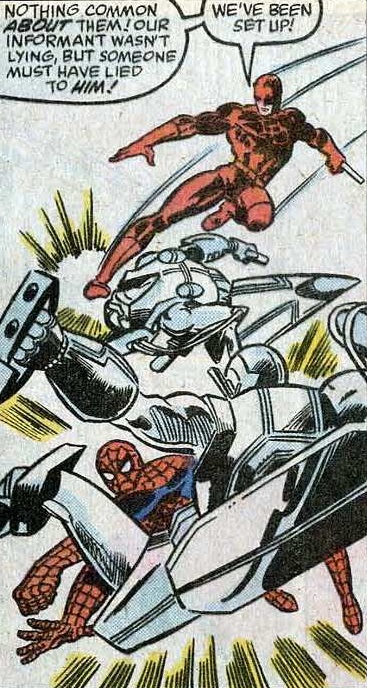
This is the first annual in The Evolutionary War to actually build on events earlier in the saga as New York deals with the consequences of the interruption of the drugs supply in Punisher Annual #1. Otherwise this annual feels quite traditional, perhaps in part because Tom DeFalco is plotting but also Mark Bagley adopts a very traditional approach to the artwork that stands in strong contrast to Todd McFarlane's contemporary work on the regular series at this time. It's a nice suitable retro feel for a story that also resorts to some traditional moves such as Spider-Man being falsely accused of a crime and J. Jonah Jameson being delighted at being proved right. There's a team-up with Daredevil and a good use of the Kingpin. But there's also the debut of a new superhero.
Speedball was the newest hero Marvel was about to launch in his own title and he's given a preview here. But it's not a very good one. There's no origin story, just a quick mention of an "accident" that gave him his powers, and the character comes across as a mess. When Robbie Baldwin encounters a force it triggers a kinetic power that sends him jumping all over the place which he tries to use to fight street level crime. There's a half decent idea in that and with some refinement to give him a degree of control that could at least all him to walk around without being terrified of brushing into anyone it might work. But the problem here is that we're given neither the origin of a new hero when he can be expected to have difficulty controlling his powers nor an appearance once he's fully come to terms with them. To add to the problems neither his creator Steve Ditko nor his regular scripter Roger Stern is working on this story and so Speedball is just thrown into this story to bounce around without contributing much that couldn't have been handled by either Spider-Man or Daredevil.
Overall this is a pretty good example of a traditional Spider-Man story with a double team-up thrown in for good measure. Spider-Man and Daredevil work well together and the menace is pitched at the right level for them. It's just unfortunate that space is devoted to introducing Speedball who really adds nothing to this tale and does not get a very impressive introduction.
2nd story: He who laughs...
Plotter & Penciler: Steve Ditko
Scripter: Roger Stern
Inking: Jackson Guice
Lettering: Rick Parker
Coloring: Tom Vincent
Editing: Jim Salicrup
Yes that's that Steve Ditko doing the plot and pencils. It's his first work on a Spider-Man book since 1966 - but he always refused to return to the main character and so is only drawing a back-up feature. Over the next few years he would appear in several more Spider-Man annuals in this way and so it's natural to wish he could have opted to return to the main character just one more time. Instead here is what was then his newest creation.
This could almost be from Speedball's own series which launched at this time and had almost exactly the same creative team at the start. One of the curiosities of the series is how many issues have multiple stories. There were a number of anthology titles around this time - examples include Strange Tales, Marvel Comics Presents, Solo Avengers and, over at DC, Action Comics Weekly - that offered multiple shorter stories but headed titles tended to have a single story each issue or at most a back-up story that focused on some of the other cast members in a separate story strand. Doing an ongoing headed series with multiple tales of the title character(s) was an extremely retro step.
And this story feels very retro. It's about thwarted ambition fuelling false revenge as an unsuccessful ex actor tries to murder Speedball's mother, believing she turned a director against him and so he failed to get a key break part. Now working as a janitor in a theatre he plans to attack her when she visits a friend there but first has to dispose of her son. This results in Speedball (who doesn't actually call himself by that name yet; instead he thinks of himself as "The Masked Marvel", his book's subtitle) bouncing around trying to distract and knock out the would-be killer before his mother can see him.
It's a rather weak story that's constrained by the need to have Speedball's powers triggered at key moments to advance the plot. The villain's motivation is believable but his attempts get sillier and sillier. Nor is it even resolved by the hero. Again this is not a good advert for Speedball and his series.
3rd story: The High Evolutionary: Kindred Spirits
Story: Mark Gruenwald
Pencils: Ron Lim
Inks: Tony DeZuniga
Letters: Ken Lopez
Colors: Gregory Wright
Editor: Ralph Macchio
Editor-in-Chief: Tom DeFalco
This is another info dump heavy chapter that rushes through the introduction of the New Men, with Bova, perhaps their best known member, being shown being genetically accelerated from a Guernsey cow, then more explanation about the nature of the Werewolf, though the High Evolutionary remains sceptical about the supernatural explanations, before the body of Jonathan Drew returns animated by a sixth century ghost called Magnus to explain how the spirit of the demon Cthon has been bound to Mount Wundagore and could be awakened by the Evolutionary's work. That's a lot to take in in just six pages but it does once again reinforce just how Marvel had let Wundagore get overused in far too many characters' histories so as to produce this mix of technology and magic and even Mark Gruenwald was starting to struggle to make it all seem consistent.
One thing that does stand out is that Gruenwald (or Macchio) isn't always writing the Evolutionary's dialogue consistently as an interwar British scientist. So some of his dialogue includes stereotypical upper class phrases like "old girl" whilst he also uses the American dating format for recording his experiments. More consistent is the way the way Herbert Edgar Wyndham is now wearing his armour full time as a sign of how he is retreating ever more from the outside world into a shell. The character is portrayed consistently as a rational scientist refusing to believe tales of magic even though he admits he does not understand the Werewolf. Although the amount of backstory to wade through can be overwhelming at times this saga so far has done a good job of building up the lead character.
Other material includes the plans for Peter and Mary Jane's apartment plus two unused covers by Larry Lieber & Jack Abel and Bob Layton from the black costume era and a plug for the Spider-Man newspaper strip. This annual may not be the best example of its series at the time as the latter was in quite a bold experimental phase but it's good traditional Spider-Man and a good introduction to crossover visitors as well as making good use of the event to tell a strong story. It's just a pity that it's had a new hero thrown in to poorly promote.
Wednesday, 12 September 2018
Dr Strange Sorcerer Supreme 13 - Acts of Vengeance
Dr Strange: Sorcerer Supreme #13
Writer: Roy Thomas (all)
Writer: Dann Thomas (main)
Writers: Jean-Marc Lofficier and Randy Lofficier (back-up)
Artist: Jackson Guice (main)
Artists: David Day and Dan Day (back-up)
Lettering: Janice Chiang and Michael Heisler (main)
Lettering: Joe Rosen (back-up)
Colours: Max Scheele Tom Vincent (all)
Assistant Editor: Mike Rockwitz
Editor: Ralph Macchio
Editor-in-Chief: Tom DeFalco
The back-up story is a further chapter from "The Book of the Vishanti", continuing the story of the Darkhold and the Montesis guarding it, along with the rise of both the Ancient One and Dracula. It feels a more coherent piece than the previous chapter, not least because of the easily recognisable elements of the existing mythology.
The lead story follows on from the previous issue and sees the Enchantress force Arkon, the ruler from another dimension, to attack Doctor Strange. Arkon is additionally motivated by a desire to make Clea his queen, allowing him to add the Dark Dimension to his realms as well. This leads to a somewhat unlikely hand to hand duel with Doctor Strange, who has never been much of a physical fighter and although his survival is explained at the end it just seems bizarre that he would ever agree to such a fight. Much of this issue, and indeed the previous one, has focused on the strength of the relationship between Stephen and his wife Clea even though they are usually dimensions apart. Each faces an alternate admirer of a kind and each rushes to the defence of the other in their own ways.
Arkon's motivations are also easily understood - he's two stages removed from the central "Acts of Vengeance" conspiracy and thus isn't motivated by that at all but rather simply by the fact the Enchantress has stolen his thunderbolts that can get him home. Still it solves the general problem of finding foes who can present a sufficiently powerful challenge to Doctor Strange and at the same time come under the direction of a conspiracy of distinctly mortal villains.
Overall this is an uptick after the previous issue but not the most dynamic and there's increasingly a sense that this is a series that wants to hurry up and finish its part in the crossover and then get back to telling its own stories. It's a reminder that with such a sweeping event not every creator is always enthusiastic all of the time.
Dr Strange Sorcerer Supreme #13 has been reprinted in:
Monday, 10 September 2018
Dr Strange Sorcerer Supreme 12 - Acts of Vengeance
Dr Strange: Sorcerer Supreme #12
Writer: Roy Thomas (all)
Writer: Dann Thomas (main)
Writers: Jean-Marc Lofficier and Randy Lofficier (back-up)
Artist: Jackson Guice (main)
Artists: David Day and Dan Day,
Lettering: Janice Chiang (main)
Lettering: Joe Rosen (back-up)
Colours: Gregory Wright (all)
Assistant Editor: Mike Rockwitz
Editor: Ralph Macchio
Editor-in-Chief: Tom DeFalco
Once again, we have an issue of the series with the cover lacking the full title. And once again we have a breach of the crossover's premise, as Doctor Strange has encountered the Enchantress before and acknowledges it. (For those wondering where, they clashed in Defenders #4, which introduced the Valkyrie, and again in Defenders #107 to #109, which set out to untangle the mess of the Valkyrie's continuity.) With Doctor Strange having been the anchor for the original Defenders, who in turn battled many a magical and mythical entity, it does become a problem finding existing villains on his power level who can be sent against him for the first time.
The story itself is pretty straightforward, with the Enchantress seeking to seduce Doctor Strange to steal his magic but Strange's disciple Rintrah does everything he can to protect his master. The Enchantress's motives are believable and she's often been shown to partake in various mortal criminal endeavours (most notably the Masters of Evil) when she can secure her own ends in the process. The presence of the Executioner may surprise many as he had died by this point, but a suitable explanation is given. Otherwise this is a relatively quick character piece that helps develop both Rintrah and Clea, Strange's wife, without doing too much wider in the broad scheme of things.
There's also a back-up story, another chapter of "The Book of the Vishanti", telling here how the Darkhold scrolls came under the protection of the Roman Catholic Church and specifically the Montesi dynasty. It's not as compelling as the previous chapter and on the last few pages the story seems to realise its dullness so resorts to recapping how the Darkhold contains the spells that could clear the Earth of all vampires for good and how the latter tried to get hold of it.
All in all this a rather dull entry in the overall crossover and suggests that perhaps not every issue of every month needed to be given over to it (and indeed we'll see some series which only have one or two entries). The fact that it resorts to a villain Strange has encountered before just adds to the padding nature of it.
Dr Strange Sorcerer Supreme #12 has been reprinted in:
Wednesday, 5 September 2018
Dr Strange Sorcerer Supreme 11 - Acts of Vengeance
Dr Strange: Sorcerer Supreme #11
Writer: Roy Thomas (all)
Writer: Dann Thomas (main)
Writers: Jean-Marc Lofficier and Randy Lofficier (back-up)
Artist: Jackson Guice (main)
Artists: David Day and Dan Day,
Lettering: Janice Chiang (main)
Lettering: Joe Rosen (back-up)
Colours: Tom Vincent (all)
Assistant Editor: Mike Rockwitz
Editor: Ralph Macchio
Editor-in-Chief: Tom DeFalco
The issue focuses on Doctor Strange first trying to deal with the consequences of his younger brother having become a vampire, including a flashback detailing Stephen's dirty secret about how he neglected his family, leading to Victor's death. The problem is that this is a very awkward addition to the hero's backstory. As he himself admits, the accident that killed his brother didn't lead him to remorse about his attitude, and instead he paid to have his brother's body cryogenically preserved, paid for by a trust fund that wasn't affected by his later descent into alcoholism. The idea that a top surgeon would put his faith in the possibility his brother could one day be brought back to life, or even just pretend as a way to avoid his guilt, doesn't ring true. Nor does the idea that Stephen was careful enough with his finances to ring-fence the arrangements to keep Victor on ice, yet drank everything else away after the accident that ruined his hands. The result is a bodged continuity implant that in the long run can only really be justified if something sufficiently interesting is done with Victor.
The other part of the story focuses on a sensational biography of Doctor Strange recently written by Morgana Blessing, leading to both author and subject winding up on a late evening chat show with Strange hoping to be dismissed as a fake and have the attention disappear. The tactics of the show in getting both guests onto the set are somewhat dubious as is the instant publicity, but this is the hook to draw in the villain of the piece, the Hobgoblin. This is the second Hobgoblin, widely dismissed by other characters, writers and readers as a joke sullying the Goblin legacy, and recently he received a curious power upgrade during "Inferno" when he was given demonic powers that also transformed his appearance. As a result he is now a stronger match for the magician than the latter assumes, able to evade a number of the spells. However he's true to his mercenary roots, having been sent by Doctor Doom to dispose of Strange, and the resulting battle feels more balanced than it might otherwise have been. It also has some consequences for the fall out from Blessing's biography. As a result the wider crossover easily fits into the ongoing flow of events without any significant disruption to the ongoing flow of the series, instead enhancing it.
There's also a back-up story, "The Book of the Vishanti: The Curse of the Darkhold Part III - Dawn of Blood". This is another piece of mythology building and refining that explains some of the key mystical forces and books through the ages. It's a decent piece but, as is often the case with these sorts of back-ups, it has no bearing on the main strip.
Dr Strange Sorcerer Supreme #11 has been reprinted in:
Friday, 6 November 2015
Essential X-Men volume 10 - creator labels
Once again there's a volume with a lot of creators so here's the separate labels post.Wednesday, 7 October 2015
Some Fantastic Four previews
Fantastic Four #218 written by Bill Mantlo and drawn by John Byrne, reprinted in Essential Peter Parker, the Spectacular Spider-Man volume 2This is the second part of a crossover with Peter Parker, the Spectacular Spider-Man involving the Frightful Four, who on this occasion have recruited Electro as their fourth member. They have already captured Spider-Man and now the Trapster impersonates him in order to infiltrate the Baxter Building so the Frightful Four can take out the Fantastic Four one by one.
This is a fairly traditional plot but it was part of a brief fill-in run on the title. The Frightful Four have long offered potential for development but have always been somewhat constrained by the lack of a permanent fourth member. Electro may not be female but otherwise he fills the role quite well and has some history with the Sandman so more could have been done. However Spider-Man's presence in the story is almost needless as the Frightful Four are operating at night and could easily have impersonated him without his noticing it. The story is also noticeable for an attempt by Sue to evade capture by turning invisible away only to find her dressing gown doesn't disappear with her. Stories over the years have been rather inconsistent on how her powers affect her clothes when not made of unstable molecules. This issue is serviceable but very much a reworking of past stories.
Fantastic Four #286 written and drawn by "You Know Who" aka John Byrne, reprinted in Essential X-Factor volume 1This is the second part of a mini-crossover with Avengers in order to set-up part of the new title X-Factor. The Fantastic Four (during this period the Thing had been replaced by She-Hulk) return to Earth where they temporarily staying with the Avengers and get caught up in the mystery of a capsule discovered in the harbour. Inside they find none other than Jean Grey, but with memories that stop several years earlier. Reed, Sue, Captain America and Hercules set out to try to find out what went wrong.
This is one of the most controversial issues in Marvel history, starting from an editorial rewrite that led to John Byrne taking his name off the issue and the controversy spread further due to a retcon rewriting one of Marvel's most famous stories, the "Dark Phoenix Saga". Adding to the mess was a conscious desire to keep X-Factor separate from the Uncanny X-Men for at least its first year and so the job of doing the heavy lifting to set up the new title fell upon other series. As a result an extra-long issue with no adverts feels less like a special issue of Fantastic Four and more of an intruder from another series; a point reinforced by the way both the Fantastic Four and Avengers know very little about the X-Men's adventures in recent years. There's the odd good moment such as Sue standing up to Reed in disagreement about taking Jean to her parents' home or using her invisible shield to neutralise Jean's telekinetic abilities without regard for those around her but overall this isn't really a Fantastic Four story. Its significance and controversy lies elsewhere.
Fantastic Four Vs the X-Men #1 to #4 written by Chris Claremont and drawn by Jon Bogdanove, reprinted in Essential X-Men volume 7The Fantastic Four find themselves shaken to the core by the discovery of a journal suggesting Reed engineered the original cosmic rays accident to empower them by design. Reed suffers a major crisis of confidence and rejects the X-Men's pleas for help to save Shadowcat's life. Then Doctor Doom steps up and offers to perform the task.
This is very much the Fantastic Four's story with the X-Men largely serving a role that could have been performed by any group of heroes. We get a strong character focus that zooms in on one of the biggest holes in the four's origin, namely how could someone as smart as Reed fail to foresee the danger of cosmic rays and suggests it was all a plan, as well as exploration of Doctor Doom's ultimate goals. Reed's self-doubt and the others' uncertainties make for strong moments as the Four, including She-Hulk who tags along despite being in the Avengers these days, come to realise just how strong their bonds our. Franklin is used to maximum effect as his powers show a fear of what is to come whilst his innocence cuts through the suspicion and anger that rages amongst the adults. The story strains a little to credibly include She-Hulk, suggesting it originated in a period when it wasn't too clear just which four of the five regulars would be around for the long run, but otherwise it's a strong character study of Reed and, to a lesser extent, Doom. It's surprising that it took over a decade before Chris Claremont took on a regular run on Fantastic Four.

Fantastic Four Annual #23 (main story only) written by Walter Simonson and drawn by Jackson Guice, reprinted in Essential X-Factor volume 4 and also in Essential X-Men volume 10This is the opening chapter of the "Days of Future Present" crossover that ran in the 1990 annuals for X-Factor, New Mutants and Uncanny X-Men, and serves as a sequel to one of the best known X-Men stories. The present day is visited by an adult Franklin Richards who is clearly undergoing some trauma and taking refuge in bringing happy childhood memories to life, including an earlier version of the Four living in the Baxter Building. After a confrontation with the alternate incarnation, plus an attack by robots from the future, the current Four track down the adult Franklin as he continues reliving his childhood. Meanwhile a mysterious robot is activated by his presence.
Here the focus is on establishing the adult Franklin and setting up the mysteries to be resolved in the later chapters so there's not too much plot advancement and a chunk of the chapter seems more concerned with contrasting the present day Four with the 1960s incarnation. The decision to do smaller annual crossovers was undoubtedly a good move for readers' wallets but a side effect is that the stories are now much tighter and so individual chapters are insubstantial on their own. This is very much the case here.
Friday, 14 August 2015
Essential X-Men volume 7
Essential X-Men volume 7 comprises Uncanny X-Men #214 to #228, Annuals #10 to #11 and the limited series Fantastic Four Vs the X-Men. Bonus material includes an article from Marvel Age about the "Fall of the Mutants" and a special promotional card for a competition linked to the crossover. Everything is written by Chris Claremont with the regular series drawn mostly by Marc Silvestri with individual issues by Barry Windsor-Smith, Alan Davis, Jackson Guice, Bret Blevins, Kerry Gammill and Rick Leonardi. The annuals are drawn by Arthur Adams and Alan Davis and the limited series by Jon Bogdanove.This volume covers a somewhat odd period in the X-Men's history as they try to cope with the fallout from the "Mutant Massacre" and really stumble around more than anything else until the next big event, "Fall of the Mutants" (a pun that doesn't translate well). The lack of direction is extenuated by some vague questioning as to what the overall purpose of the team is, but it doesn't really get very far. Significantly, this is the first volume to be completely devoid of any of the original team, leaving the long-term continuity in the hands of Havok and, to a surprising but small degree, Magneto. But the Master of Magnetism makes rather fewer appearances in the regular issues than one would expect. Instead his main contribution comes in the limited series.
The "Vs" limited series was a curious phenomenon in the 1980s whereby characters from two titles would meet for a special story but one told in its own release rather than as a crossover between the two regular titles. It has the advantage of allowing a single writer and artist to handle the project (at least under normal circumstances) but it can also wind up dancing on the periphery of the regular series, trying to adapt to ongoing developments whilst also telling its own story. From the perspective of this volume Fantastic Four Vs the X-Men is fortunate in this regard as it is written by the regular Uncanny X-Men writer and comes at a time when not too much is happening in the main title. However it has to leap through some hoops in order to include She-Hulk amongst the Fantastic Four's line-up, a point commented on in-story. The series seeks to justify its place by resolving the worst of Shadowcat's injuries that have left her trapped in her intangible form and slowly dissipating, but does so amidst a struggle of mind games between Doctor Doom and Reed Richards. This limited series is actually quite a good Fantastic Four tale that delves into one of the biggest question marks surrounding the four's origin and looks at Reed Richards's approach to those around him and Doctor Doom's ultimate goal in their struggle. But amidst all this the X-Men are something of a bolt on to provide recurring conflict. Any group and problem could have served their purpose in the story and it wouldn't have made much difference. Even Shadowcat's recovery is not immediate and as she doesn't return to active duty with the team before the end of the volume it doesn't have much of an impact on the story. The one notable feature is the continuing rehabilitation of Magneto, with the Fantastic Four slowly coming to accept him, but in the battles which break out too easily his magnetic powers prove more dangerous than helpful when he accidentally nearly costs Kitty her last hope. Overall this is good Fantastic Four, and in the very long run a good audition piece for Claremont eventually taking up the main series in the late 1990s, but rather forgettable and inessential X-Men.
The two annuals both feel somewhat superfluous to the main narrative beyond the first one introducing Longshot, previously seen in his own limited series, to the regular series. But it does so in a very awkward way by giving him amnesia and then comes with some awkward continuity as the presence of Shadowcat, Nightcrawler and Colossus implies it takes place before the "Mutant Massacre" in the previous volume yet this doesn't explain why Longshot is then absent for several issues of the regular series and both his amnesia and ongoing culture shock goes against the idea that he has been exploring the world around him. Otherwise the annual sees the X-Men's first encounter with Mono and the wackiness of the "Mojoverse" but it's never been a very good fit with the more gritty style of the X-Men's adventures and just feels like silliness for the sake of it. Amidst this comes a piece of role reversal as the New Mutants temporarily step up to the role of being the senior team, complete with individualised costumes intended for when they graduate. Meanwhile the X-Men are reduced in age in one of the examples of babyfication that was all the rage following the Muppet Babies, becoming cute toddler versions of themselves. Were it not for Longshot and later appearances by Mojo, this annual could be so easily forgotten. The other annual is also trying to incorporate elements from other series into the mainstream Marvel universe with guest appearances by Captain Britain and his girlfriend Meggan, even though neither is essential for the story told. In it the X-Men and guests are captured by Horde, a never before seen alien, and taken to a strange citadel to secure a crystal of incredible power, in one of the most generic plots going. Whilst making their way through the citadel the group gets picked off one by one and offered their hearts' desires by the citadel itself. It's a minor character study that doesn't leave much of an impact beyond the scene where Wolverine is killed by Horde but his whole body regrows itself from a single drop of blood, aided by the power of the crystal. The whole group gets returned home to exactly when they left with memories fading, making the whole thing no more significant than an obscure dream.
Over in the regular issues the team continues to develop. Injuries meant that both Shadowcat and Nightcrawler are off the active roster and stay that way when big changes come though Colossus has returned to the team just in time. He's not quite the same Peter of old as his injuries have left his armoured form as the default norm with a great deal of effort required to turn to his human self. Also rejoining the team is Havok, who finds himself in the curious position of being the earliest member of the X-Men yet is treated by the others as an untested member. Returning to the team after Polaris is possessed by Malice and joins the Marauders, Havok finds himself in the horrific situation of having to either let her go to harm others or else stop her permanently - and winds up releasing a plasma blast though Malice/Polaris manages to block it and escape. Alex is somewhat taken aback by what the X-Men have become, particularly their alliance with Magneto, but doesn't really have the long-term history with the team that allows him to perform the role of keeper of the original aims. Nevertheless he stays around, particularly to help protect his sister-in-law Madelyne Pryor who has had her husband walk out on her, all records of her past erased and who is now being hunted by the Marauders. There are signs of an attraction between them but they're not developed just yet.
The other new addition to the team is also driven to them by the actions of Malice. Since the end of her own series Dazzler has been trying to rebuild her career, starting out as a backing artiste but both her own ambitions and the interference by Malice soon put paid to this. Alison soon accepts the protection of the X-Men and undergoes training to refine and enhance her light powers, putting especial emphasis on being able to use them as a laser, but there's an ongoing tension between her role as an X-Men and her ambitions to be a singing star, making for an especially tense confrontation with one fan, none other than the Juggernaut. Also causing tensions is the presence of her old enemy Rogue, with Alison making it clear she hasn't forgiven the past enmity until another battle with the Marauders where she risks her all to save Rogue from drowning. At this stage Dazzler is still the only member of the team to have had her own series and as well as her past battles with Rogue the series is also echoed by the return of O.Z. and Cerberus in a tale about a mutant drug dealer.
The old ways also come up in another fashion when Storm is kidnapped by the Crimson Commando, Stonewall and Super Sabre, a trio of old heroes fighting against the values of the modern world. They take Storm and another girl and release them to be hunted in the wilderness. Later on they're captured and agree to join Freedom Force, which continues to skate the line between a government sanctioned team of mutants and a group with its own agenda. The hunt also puts both Storm and Wolverine to the test as the former faces up to the fact she may well need to adopt her comrade's ethics of kill or be killed whilst the latter struggles to retain his humanity as he faces confusion all around him. The threat level is also raised by the introduction of the Marauders' master, Mr Sinister, but for now he remains a dark force on the edge of things.
A lengthy storyline sees Storm searching for Forge in the hope that he can restore her powers, helped by Forge's shaman mentor Naze. In the process she also finds it in herself to forgive him but also discovers the presence of a demon known as "the Adversary". Meanwhile Destiny of Freedom Force has a vision of the X-Men all dying in the near future. The storylines merge and climax in the "Fall of the Mutants" issues, #225 to #227. This was an unusual crossover between the three mutant titles as they shared a theme of big status quo changing events, rather than a single storyline running across them all. The X-Men find themselves first battling Freedom Force and then facing the end of the world due to the magic of the Adversary and the past mistakes of Forge. In full view of a camera broadcasting to the world, the X-Men set out to risk their all to build a better world. It's a dark moment for them but a great one for mutantkind, setting up a new position for the future. However we don't get to see that in this volume as the last issue has all the feel of a standby fill-in being pressed into service, hastily turned into a flashback.
Overall this volume isn't a particularly great period for the X-Men. It's a time of stumbling more than anything else, with no great sense of purpose or direction. The newer members of the team help to keep the cast fresh but rarely bring any particularly exciting story elements with them. Overall this volume shows the team going from one big event to the next with not too much of note happening in between.
Friday, 7 August 2015
Essential X-Factor volume 4
Essential X-Factor volume 4 contains issues #51 to #59 & Annuals #4 to #5 plus the one-shot X-Factor: Prisoner of Love, Marvel Fanfare #50 which printed an issue prepared as a standby fill-in and the lead stories from Fantastic Four annual #23, New Mutants annual #6 and Uncanny X-Men annual #14 which, together with X-Factor annual #5, make up the "Days of Future Present" crossover. Bonus material includes Cyclops's entry from the Official Handbook of the Marvel Universe. The regular X-Factor issues are written by Louise Simonson, bar one by Peter David, and drawn by Terry Shoemaker, Steven Carr, Andy Kubert and Jon Bogdanove. The X-Factor annuals both contain multiple stories written variously by Louise Simonson, John Byrne, Ralph Macchio, Mark Gruenwald, Peter Sanderson and Peter David, and drawn by John Byrne, Jim Fern, Mark Bagley, John Bogdanove and Dave Ross. X-Factor: Prisoner of Love is written by Jim Starlin and drawn by Jackson Guice. The Marvel Fanfare issue is written by (Mary) Jo Duffy and drawn by Joe Staton with an "Editori-Al" introduction written and drawn by Al Milgrom. The Fantastic Four annual is written by Walter Simonson and drawn by Jackson Guice, the New Mutants annual is written by Louise Simonson and drawn by Terry Shoemaker & Chris Wozniak, and the Uncanny X-Men annual is written by Chris Claremont and drawn by Arthur Adams. Inevitably, there is a separate labels post.The list above gives some indication of how this volume doesn't actually advance the main series very much - with just nine issues from the regular title this has almost the shortest stretch of any single Essential volume. The main culprits for this state of affairs are the annuals, with each forming part of a wider crossover but the two take very different approaches. Annual #4 is from the "Atlantis Attacks" crossover which filled up no less than fourteen annuals in 1989 and tells the tale of an incredibly complicated plot involving Serpent Crowns, multiple undersea kingdoms attacking each other, a great serpent deity being resurrected, superpowered women being offered as incubators and turning the human race into serpent men. It's all rather convoluted and the X-Factor annual is rather blessed to be at the periphery of much of this, focusing upon the kidnapping of Marvel Girl whilst the Beast is reunited with his old Defenders comrade Andromeda in conflict with her father Attuma, current ruler of Atlantis but, as he discovers here, not actually the main villain in the storyline despite the title. The forgettable nature of the chapter is such that despite promises we never get to see Jean being dragged away into the sky in the regular series with Hank grabbing onto her leg. The Atlantis Attacks annuals also contained a multi-part back-up story entitled "The Saga of the Serpent Crown" which retold the whole history of the central object. Normally these chapters are excluded from Essential reprints but it's included here, briefly retelling an old Namor the Sub-Mariner adventure as he battled with an emperor of Lemuria possessed by the crown. On its own it just adds to the general confusion that these annuals create when the whole storyline isn't present. Of more interest are two other back-up strips though one seems to have landed in the annual by accident as Magneto and Doctor Doom encounter one another and recount their pasts, seemingly for the purpose of setting out just how different the two are. The other is a somewhat comedic piece entitled "Inferno Aftermath" as two FBI agents drawn to resemble the Blues Brothers and even named Jake and Elwood explore the aftermath of the events and try to find out what happened, with X-Factor winding up supplying the cover story. It's a nice little piece that addresses how the general public seems to shrug off such events but it's also a reminder of how stretched out things have been thanks to annuals, crossovers and off-world storylines all affecting the pacing as the build-up to "Inferno" began back in volume 2.
The following year saw a shift in policy to running multiple shorter crossovers in related annuals, with the three mutant titles and Fantastic Four all tied together for the "Days of Future Present" storyline, a sequel to the well-known X-Men storyline "Days of Future Past". This storyline proved a mess at the time with the X-Factor annual numbered "Part Two" and the New Mutants annual "Part Three", and they were released in that order, but the contents were inverted such that the New Mutants annual comes first. This volume places the annuals in narrative order but the cover numbering continues to confuse. The story itself involves another time traveller from the dark future of the Sentinels, an adult Franklin Richards. Franklin wanders through the locations of his childhood memories from the alternate timeline, at times reshaping them to match his childhood happiness. Meanwhile the present is attacked by new villain Ahab, the master of the mutant hunting "Hounds" from that dark future. Elsewhere Rachel Summers is drawn into the action, encountering Franklin whom she thought had died in her own time and also having her first meeting with Jean Grey, the woman she recognises as her mother. With four different team books involved there are a heck of a lot of characters running around without the greatest of introductions and the story is primarily focused on Franklin and Rachel, with their parents getting only a partial connection. A major point left completely unaddressed is just who Rachel's mother actually is - when she was introduced her mother was unambiguously the Jean Grey with the powers of Phoenix in the alternate timeline but since then Jean and Phoenix in the regular timeline have been retconned into separate entities and it's thus unclear which is actually Rachel's mother. Jean now having both Phoenix and Madelyne's memories inside her does not help with the confusion. Overall this isn't the greatest crossover for X-Factor with such a key first meeting bungled and swamped by everything going on around it. The only back-up feature in the annual is a character piece focusing upon Jean as she visits Phoenix's grave and tries to reconcile her multiple identities, with the help of an elderly survivor of the Holocaust. It's a good little character moment that serves to cut through much of the quagmire on this.
Also focusing on characterisation is the prestige one-shot X-Factor: Prisoner of Love, since there's frankly not much else going on in it. This over-expensive special sees the Beast go to rescue a pretty young woman called Synthia Naip and end up in her apartment where he has weird dreams and finds out she is an alien and needs protecting from the mysterious "Dark One" who has killed the rest of her race. It's slow, dull, over expensive and the art suffers from both an obsession with drawing pretty women and such bizarre renditions of Hank that at times I had to check just who he was meant to be. The whole thing is rather random and dull, feeling like it was just churned out to get Starlin and Guice's name on the cover. It's definitely something that could have been left aside.
More worthy of inclusion is Marvel Fanfare #50 which contains, according to Al Milgrom's special intro, an issue prepared as a fill-in for the regular series but used here instead. It's been structure to be easy to adjust for use at any point with the main section taking place in flashback when the Angel was assumed dead and a former female acquaintance hires Arcade to kill Iceman and the Beast as punishment for X-Factor's anti-mutant campaign. Her motivations are more personal when it turns out she has a son with angel wings - and claims Warren is the father. In the present day Warren tells the truth about the woman and the boy. As a fill-in that could potentially be called up at any point in the title's run it has to be flexible but it turns into Hank and Bobby asking Warren about something that's been on their minds for quite a while since his return. Still it holds its own and deserves to at last have been included with the regular series.
Warren is also the main focus of the regular series issues which see X-Factor return to Earth and deal with a succession of external and internal problems, starting with Warren finding himself getting ever more out of control and lashing out at all around him at random and making for especially vicious fights with first Sabretooth and then Caliban as the former X-Factor member turned Apocalypse's horseman finally comes into conflict with his former teammates. Then Warren and the others face the vampiric Ravens, including Crimson, Coral and Azure, who infect him with a poison that drives him mad and into different personas at night and day, with his night self becoming an especially vicious vigilante, before the Ravens seek to transform him permanently into one of them. It's not all darkness as he steadily befriends police officer Charlotte Jones and by the end of the volume things are steadily growing between them.
Meanwhile Scott and Jean have their dinner interrupted by an attack by giant roaches led by the old X-Men foe the Locust, but it's not enough to prevent Scott going on to propose to Jean, a proposal she declines as she is still struggling with the multiple memories inside her from Phoenix and Madelyne. Bobby also finds a degree of happiness as he befriends a young woman called Opal Tanaka, but first has to deal with the misunderstanding Mole who seeks to protect her. Hank's relationship with Trish Tilby is on the rocks due to her reporting of a number of incidents that show mutants in an unfortunate life and the tensions just keep on growing. Old flame Vera Trantor turns up when she's manipulated by Mesmero on the commission of Infectia as part of a bigger plan.
These nine regular issues cover a curious period in the title's history when the team are publicly known popular heroes but instead of showing the overall effects of this we get instead a concentration on the individual characters and little indication as to how their status is helping the cause of mutants in general. The story of Archangel's steady rehumanisation is the main focus but at times it feels as if that's the only thing of significance going on with the ongoing Scott and Jean plotlines rather fizzling out whilst the other stories all feel a bit inconsequential.
Overall this volume feels a mess because there's relatively little meat to the regular issues and so much additional material that doesn't really add much to the ongoing series. Annuals and crossovers can both slow things down and here we have both at the same time, taking up such a significant chunk of the series. This is a volume very much treading water.
Friday, 20 February 2015
Essential X-Men volume 6 - creator labels
Yes this volume has a lot of creators so this is the standard extra post.Friday, 19 April 2013
Essential X-Factor volume 1 - creator labels
Essential X-Factor volume 1 is another with large numbers of creators, hence a separate post to carry their labels.