Showing posts with label Tom Vincent. Show all posts

Saturday, 18 December 2021

What If...? 6

What If the X-Men had Lost Inferno?

What If...? #6
Writer: Danny Fingeroth
Penciler: Ron Lim
Inker: Keith Williams
Colorist: Tom Vincent
Letterer: Gary Fields
Editor: Craig Anderson
Ed-in-Chief: Tom DeFalco

In this alternate reality S'ym and the Soul Sword were returned to Limbo simultaneously and so he was able to grab the sword and return to Earth where he joined with Madelyne Pryor and slew all the X-Men and X-Factor, bar Wolverine whose demonic form was kept as a pet, then sacrificed Nathan Christopher to open the dimensional rift permanently with the whole of Earth invaded. Dr Strange organises a group of sorcerers including his arch enemy Baron Mordo supported by surviving heroes. Wolverine, the Hulk and S'ym lead an attack from which only Strange, Mordo, Shadowcat and the Human Torch escape. S'ym plans to expand Limbo across the Multiverse and then will be powerful enough to resist the Living Tribunal when it shows up to judge the Earth but time is not on his side. Dr Strange discovers the mannequin of Rachel Summers and frees her. Strange plans to use the Phoenix Force to purge the Earth of all demonic influence though it will kill many humans as well. S'ym, Madelyne and Wolverine attack with Mordo revealing he has betrayed the resistors. In a brutal fight all bar Strange and Rachel are killed with multiple betrayals. Rachel summons Phoenix who engulfs the planet just as the Living Tribunal arrives and allows Earth to live. The survivors of humanity are reduced to starting again in caves. Nine months later Alicia Storm gives birth and names her son after Johnny.

Just eight months after Inferno had ended came this alternative take (don't be fooled by the cover dates; this was slap bang in the middle of Marvel bringing them closer to publication). It's a good idea in principle but it falls into the traps of a lot of What If...? stories that feel the need to show a whole legion of characters from across the Marvel universe even if not strictly necessary - Reed Richards and Dr Doom working together for S'ym is the most obvious needless appearance - and taking a bit too long to explain both the events in the regular universe and the point of divergence in detail that limits the amount of space to tell the story in which is thus limited to Dr Strange rushing around trying to find the magic or power that will stop the demons. Also far too many What If...? stories go for gratuitous killing of popular characters in general fight scenes with many deaths failing to advance the plot. Here at least some of the deaths drive the plot such as Shadowcat's.

The general premise of What If...? is that one thing is changed though here there are actually two changes from regular continuity. The big one is S'ym getting the Soul Sword and returning to Earth in time but other details include Alicia Storm being pregnant when she was not in the regular reality (nor was she actually human but that is a later retcon). Also Dr Druid is shown amongst the group of sorcerers when at this point he was lost in the time vortex though it doesn't affect the flow of the story.

Overall this What If...? focused on characters but doesn't really tell us very much about them through placing them in alternative circumstances. Wolverine is shocked out of his demonic nature when he kills Kitty but his friendships with a succession of young girls have done much to provide the innocent contrast and this reveals little. Dr Strange is shown battling the Inferno demons when he was otherwise engaged during his own series (including being temporarily in the body of a female rat) but again we get little insight into him. Baron Mordo, S'ym and Madelyne Pryor all turn on their respective allies but none was exactly trustworthy. The Human Torch dies heroically but again that's not surprising for the Fantastic Four. When the biggest "revelation" in an issue is that a character then assumed to be human is human and giving birth to a human instead of being a Skrull in disguise who lays eggs and all that is only a revelation because of a retcon a few years later then the story has a problem. This was the very early days of the second series of What If...? and it still hadn't found a workable formula to explain the moment in history that is changed and how, build an altered world, and tell a strong story all in 28 pages. All this really offers is just the chance to see Dr Strange fighting demons and little more of interest.

Tuesday, 14 December 2021

X-Factor 40 - Inferno

Archangel cracks an egg with a voice.

X-Factor #40

Writer: Louise Simonson
Penciler: Rob Liefeld
Inker: Allen Milgrom
Letterer: Joe Rosen
Colorist: Tom Vincent
Editor: Bob Harras
Editor-in-Chief: Tom DeFalco

X-Factor return to Ship from Madelyne Pryor's funeral, observed from afar by Nanny and Orphan Maker. Atop Ship they set about returning the crowd to their various homes and schools. Iceman takes Leech, Artie and Taki back to their school then the other four members of X-Factor gather up the mutant babies to the FBI in Washington. The older X-Terminators have missed too much of summer school to go back until the autumn so they stay on Ship with Jean's parents to babysit Nathan Christopher. As their plane flies into Washington it is attacked by Nanny's ship. Nanny and Orphan Maker board the ship and a battle breaks out until Nanny throws Beast into her ship's control panel and is then badly wounded by Archangel, causing ships to come down in the park. Orphan Maker explains that Nanny is a human mutant who worked for the Right until discovering what her technology would be used for but the Right trapped her the egg. She escaped and started rescuing children before others like Mr Sinister could destroy them. Nanny and Orphan Maker teleport away as Jean finds and releases her nephew and niece Joey and Galen who don't recognise her due to Nanny's "pixie dust" drug. The babies and other children are transferred to the custody of Freedom Force who tell them Rusty Collins has been furloughed and so does not have to go back to jail whilst awaiting trial. X-Factor take Joey and Galen to Ship where they recognise their grandparents. Jean and Scott vow to find her sister eventually.

And so we have the wrapping up of the fates of several of the characters from across the crossover. It always seemed a little strange that Scott and Jean so easily accepted that whatever else she did Nanny would care for the children such that they could focus on saving the babies without even making any attempt to track Nanny for later. It's also unclear where the children were kept during Nanny's appearance in the Avengers issues when a good chunk of her ship was destroyed to cover her escape. Although the origin given here makes some sense to give Nanny a credible backstory and motivation she has still been an irritating character throughout too many appearances over the event.

There's also the breaking up of the X-Terminators with the youngest members returned to their school whilst the older ones are left slightly up in the air with hints that they won't be going back to school at all due to institutional nervousness about "incidents". Although it's only mentioned in a caption box at the end, the X-Terminators went on to formally join the New Mutants in issue #76 of their series, thus putting an end to any prospect of another X-Terminators series exploring young mutants living around ordinary humans. It's a pity as the idea had potential though the wards of a publicly known team were probably not the best characters to explore such a situation.

This issue is a landmark as the first Marvel story to be drawn by Rob Liefeld. And it's not the greatest though compared to some of his later work it's clear at Al Milgrom and Tom Vincent managed to rein in some of the excesses. But even through those filters the art frankly isn't very good. It took me several reads of the page to make sense of the scene where the Beast leaps atop Nanny and she throws him forward so he goes through the hole in the roof of X-Factor's ship and into Nanny's where he crashes into the control panel. Liefeld often omits backgrounds (which Vincent sometimes tries to compensate for with colour only indicating buildings and the like) and it can be very confusing as to what's just happened. There are other trade marks such as characters hovering in mid air, awkward poses, groups of characters altering their position relative to each other between panels, two left arms for Cyclops on one page, huge hair (in some panels Jean's is absolutely enormous) and even a few pouches. It's fairly easy to beat up on Liefeld's art and to make him a scapegoat for everything that went wrong with Marvel or the comics industry as a whole in the 1990s (which isn't fair but he was heavily involved in some pretty key moments) but when it makes the comic hard to read and very odd looking then it invariably gets called out. Why anybody thought this was the way forward is a mystery.

But apart from the art this is otherwise a relatively straightforward issue in wrapping up various threads on the periphery of Inferno and finishing off the Nanny subplot before it drags out for too long. There's a real sense of calm closure at the end with all the main plot points resolved and all five members are now clearly sorted out without any more heavy lifting. This is a satisfying conclusion to the main part of the crossover.

(Don't go away though. There's a few more relevant issues to come.)

Sunday, 5 December 2021

X-Factor 38 - Inferno

The many versions of Jean Grey come together.

X-Factor #38

Writer: Louise Simonson
Penciler: Walter Simonson
Inker: Al Milgrom
Letterer: Joe Rosen
Colorist: Tom Vincent
Editor: Bob Harras
Editor-in-Chief: Tom DeFalco

Madelyne Pryor prepares to sacrifice her baby son Nathan Christopher Charles and tells the combined X-Factor and X-Men how she will gain power and have revenge upon them all. There are still demons around that are loyal to her and she sets them upon the two teams whilst also influencing them. The X-Men become more demonic and attack X-Factor, calling them "mutant hunters" which Cyclops explains was a now abandoned cover but Storm says they have seen no news of any change. She then remembers Madelyne is the one who collected the news for them and realises the teams have been manipulated to keep them apart. Madelyne tells Jean how she subconsciously used her powers to make Cyclops lose a previous fight with Storm that gave her the leadership and led to him quitting the team. She then offers Death/Angel power for revenge on all who have hurt him and he starts to succumb. The fight is complicated further when Dazzler and Longshot, both now incredibly vain and seeking the spotlight, start turning on other X-Men who they see upstaging them. Death/Angel frees Jean from her bonds but then Madelyne creates a forcefield around her, Jean and the baby. Madelyne tells how she was a clone created by Mr Sinister and Jean realises that just as with Phoenix she has again been duplicated with her duplicate unleashing dark power. Madelyne continues with how she has some of Jean's memories and the two realise that when Phoenix died and tried to return the portion of Jean to the original but in suspended animation she rejected the images of destruction and so the force found the genetically identical Madelyne instead making her everything that Jean rejected. With Madelyne's influence on the X-Men now fading they start coming back to normal and along with X-Factor they try to find a way to break through the forcefield. Wolverine convinces Havok to help who agrees but tells Cyclops he still doesn't approve of his actions and his brother admits he isn't proud either. Madelyne continues with how Mr Sinister arranged for her and Cyclops to get together and then once the baby was born and Jean returned he took steps to erase all trace of her ever having existed but the X-Men prevented the Marauders from killing her. Psylocke works on Longshot and gets him to find the weak spot in the forcefield which the others all blast. Madelyne explains how she censored news to manipulate the X-Men to stay apart from X-Factor. Then came S'ym and N'astirh driving her over to the darkness. She now prepares to destroy herself despite Jean's pleas. The forcefield is breached and Cyclops rescues his son so Madelyne unleashes an explosion of energy but fails to kill the boy. Mind locked with Jean she dies and tries to take Jean with her but the piece of the Phoenix force within her emerges and returns everything to Jean who now accepts it and absorbs them all. The demons vanish and the Empire State Building is restored. Death/Angel reflects and takes the name Archangel. Both teams reflect on what they've been through - and the need to confront Mr Sinister.

And so we have the final showdown with Madelyne Pryor amidst a major infodump issue that seeks to retcon a lot of the events of the last few years. Many readers were not happy with the way Cyclops was written through them whether it was losing a duel and thus the leadership of the X-Men to a depowered Storm or leaving Madelyne the moment he heard Jean had returned from the dead or failing to search for her afterwards until she had completely disappeared. In addition the length of time it took for the two teams to meet had become far too long. Although Louise Simonson's script has Scott admitting he is not proud of his actions, much of the blame is removed from him through the destruction of Madelyne as a character. Instead of having simply been corrupted by the influence of demons it's now revealed that through her creation and the intervention of the Phoenix force she was using her power to undermine Scott much earlier and then using her position to keep the two teams apart whilst Mr Sinister intervened to keep her apart from Scott. It's written in such a way to make it seem as though it was all planned and does its best to redeem Scott without going the whole hog and just having him mentally manipulated for years. It also makes a lot more sense of some of the more problematic elements caused by the creation of X-Factor. But in doing so it's making Madelyne a far worse character than a woman corrupted by outside influences.

With the Phoenix revelation Inferno effectively becomes an explicit sequel to the Dark Phoenix Saga as now seen through the lens of other retcons. Both stories involved a duplicate of Jean Grey being manipulated by others, ultimately succumbing to the power within her and turning dark (even down to the similar names and costumes for the Black Queen and the Goblin Queen), bringing down great destruction and finally committing suicide. Given the anniversary nature of the event it's perhaps unsurprising that the X-Men titles would return to their most famous story. And it's also clear that editorial demands wanted Madelyne removed completely with earlier attempts not succeeding. Having a little seen sinister force manipulating events doubtless reflects the editorial interference in the titles over the previous few years. But it can't take away from the fact that Madelyne had been built up as a character in her own right beyond someone who happened to be the spitting image of Jean and had shown herself to be a strong independent female character. Now she's been turned into literally a manipulative witch, used and sacrificed to satisfy the demands of others. It's hard to see how one spouse could have been so heavily absolved without such character assassination of the other but it doesn't sit easily. The reactions of others such as Havok's outrage at how his brother treated his sister-in-law or Jean's reaction to a duplicate of her becoming destructive again do feel credible.

But there's also redemption in these issues with Warren finally coming to terms with his own corruption at the hands of Apocalypse and resisting Madelyne's attempts to bring it out. In adopting the name "Archangel" he makes a clear rejection of all that others have done to him and can now fly tall. However it's surprising that he takes so many years to get rid of the costume Apocalypse gave him - had someone in Marvel signed a licensing agreement that locked him into that look? (He was in the first line of Toy Biz figures in 1991 but that agreement wasn't signed until 1990.) It's a final step up in empowering the character beyond the rich guy who could fly that he had been for so many years.

As a retcon heavy issue much of the action is limited with the further fight between the two teams largely serving to delay them from going after Madelyne but it does also allow for X-Factor to explain once more about how their initial set-up cover got out of control due to the manipulation of another and for the X-Men to realise how they too have been manipulated. The uneasiness between the two teams remains and shows you can't just remove a single point of disagreement and have everyone happy with each other. But all this is the sideshow to a very dramatic ending for Madelyne as she and the writers bring destruction down upon her. It's a well written issue and it solves the problem of Madelyne in the narrative once and for all but as was often the case with X-Factor a lot of heavy lifting was required to get the team to where editorial wanted it to be and this is perhaps the biggest lifting of all through destroying her character completely.

Wednesday, 3 November 2021

What If...? 1

What If the Avengers had lost The Evolutionary War?

What If...? #1

Script: Roy Thomas
Breakdowns: Ron Wilson
Finishes: Mike Gustovich
Letters: Mike Heisler
Colors: Tom Vincent
Editing: Craig Anderson
Supervision: Tom DeFalco

The Watcher describes a universe where the final battle of The Evolutionary War ends differently with the genetic bomb going off. All superpowered beings find their powers enhanced whilst all other humans changed to have enhanced larger heads with a greater understanding and telepathic powers. Humans around the world soon find peace and harmony with one another but the super powered beings realise the two types of human cannot live together and so they depart for space, soon joined by the Inhumans and Eternals. They soon take on multiple alien forces including the Kree, Shi'ar and Skrulls, destroying all their armies. Then they defeat Galactus before conquering Death and Eternity to form a single Entity. Back on Earth humanity has evolved into identical looking telepathic beings who one day face the judgement of the Celestials who condemn the planet but the humans have the power to disintegrate one Celestial and drive the others away. Now they form a collective mind on a living planet. Out in space the Entity tells the High Evolutionary it does not need his guidance before passing into another universe and causing a Big Bang to create a new universe with Death and Eternity now separated and the superpowered beings absorbed into one or other. Meanwhile the old universe now lacks its binding forces and folds in on itself as the High Evolutionary watches the end of it all.

The second series of What If...? launched in 1989 some five years after the first had concluded. Now monthly and with fewer pages before it also had a notably more modern focus. Fewer issues would feature alternative takes on the Silver Age and instead there would be more contemporary takes including a good number of tales that tell alternative endings to prominent storylines and crossovers. The very first issue does just this with an alternative take on the previous summer's annual crossover and describes what might have been.

Describes is very much the word as this issue is predominantly a narrated history of the alternative outcome describing a succession of one event after another. There's no attempt to give alternative outcomes to recent Marvel stories and instead we see the humans and super powered beings quickly coming to terms with their genetically accelerated state. Most of the continuity is fine though there are a few characters shown glimpsed who weren't around on Earth at the time such as the Molecule Man or in altered form - a scene with X-Factor is particularly bad as it shows the Angel in his original form and the team used to being feared and loathed when they had a huge public popularity at this time. Wolverine is picked as the leader of the super powered beings for reasons even the others aren't quite sure of, showing a failure to convert his sales popularity into narrative leadership. The space scenes are rather imaginative in suggesting that ultimately the super powered beings could surpass not merely the race of Beyonders but (without naming him) the Beyonder himself. Meanwhile on Earth the humans seem to be evolving into a race from Star Trek whilst the likes of Daredevil and the Vision cope with aging and loneliness in their own ways.

This is a sign of the direction the series would often go with ultimately apocalyptic outcomes and somewhat rushed stories. Unfortunately this one doesn't really reveal much about any individual characters through placing them in alternative circumstances. Instead it's a grand narrative piece of universe building. This would have been an okay later issue but the first one for the new series really should have been more character focused. Instead it shows how big concepts could often produce poor results.

Monday, 11 October 2021

Amazing Spider-Man Annual 22 - The Evolutionary War

Spider-Man and Daredevil team up to solve a drug wars murder but bigger plans are afoot.

Okay we've hit a publishing mistake here. The back-up feature "The High Evolutionary" has a strict chapter order and the next one should be Fantastic Four Annual #21. However the lead feature in that has the first recap of the event so far in chronological order and places it after this issue. So I've opted to publish these two posts simultaneously in lead feature order.

(And this is another annual with a lot of creators so some of the labels are in a separate post.)

Amazing Spider-Man Annual #22

1st story: Drug War Rages
By Tom DeFalco
As told to David Michelinie
Photos: Mark Bagley & Mike Esposito
R. Parker signs on
B. Sharen in the red
J. Salicrup indicted
T. DeFalco shrieks

This is the first annual in The Evolutionary War to actually build on events earlier in the saga as New York deals with the consequences of the interruption of the drugs supply in Punisher Annual #1. Otherwise this annual feels quite traditional, perhaps in part because Tom DeFalco is plotting but also Mark Bagley adopts a very traditional approach to the artwork that stands in strong contrast to Todd McFarlane's contemporary work on the regular series at this time. It's a nice suitable retro feel for a story that also resorts to some traditional moves such as Spider-Man being falsely accused of a crime and J. Jonah Jameson being delighted at being proved right. There's a team-up with Daredevil and a good use of the Kingpin. But there's also the debut of a new superhero.

Speedball was the newest hero Marvel was about to launch in his own title and he's given a preview here. But it's not a very good one. There's no origin story, just a quick mention of an "accident" that gave him his powers, and the character comes across as a mess. When Robbie Baldwin encounters a force it triggers a kinetic power that sends him jumping all over the place which he tries to use to fight street level crime. There's a half decent idea in that and with some refinement to give him a degree of control that could at least all him to walk around without being terrified of brushing into anyone it might work. But the problem here is that we're given neither the origin of a new hero when he can be expected to have difficulty controlling his powers nor an appearance once he's fully come to terms with them. To add to the problems neither his creator Steve Ditko nor his regular scripter Roger Stern is working on this story and so Speedball is just thrown into this story to bounce around without contributing much that couldn't have been handled by either Spider-Man or Daredevil.

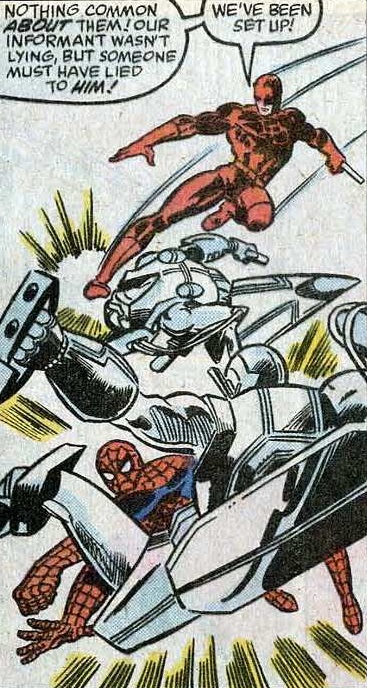
The story focuses on the mystery of the disruption to the drug supply which turns out to be down to the High Evolutionary's Purifiers killing several distributors and dealers whilst preparing a scheme to render everyone in New York unconscious and then sterilise everyone with unacceptable DNA. Although both aims have been pursued by the Evolutionary's forces in earlier annuals it's surprising to see the same team attempting both at the same time and the result is they attract too much attention with the Kingpin forcing the details out of a captured Purifier then manipulating Spider-Man and Daredevil into attacking the Purifiers' base whilst Speedball has also stumbled across the plan. There's a good complex take on the Kingpin, concerned not merely with the immediate profit margin but also with ensuring his city is kept safe and using his resources to help the heroes where necessary. He even gets the Arranger to clear Spider-Man's name by getting the real criminal to confess to the murder of the drug distributors at the start of the story. Then at the very end he is shown expressing real concern about the wider threat. It's a reminder how he prefers the stability of the existing order and is prepared to help preserve it if needs be whereas a more simplistic villain would simply throw in with the bigger foe in town.

Overall this is a pretty good example of a traditional Spider-Man story with a double team-up thrown in for good measure. Spider-Man and Daredevil work well together and the menace is pitched at the right level for them. It's just unfortunate that space is devoted to introducing Speedball who really adds nothing to this tale and does not get a very impressive introduction.


2nd story: He who laughs...
Plotter & Penciler: Steve Ditko
Scripter: Roger Stern
Inking: Jackson Guice
Lettering: Rick Parker
Coloring: Tom Vincent
Editing: Jim Salicrup

Yes that's that Steve Ditko doing the plot and pencils. It's his first work on a Spider-Man book since 1966 - but he always refused to return to the main character and so is only drawing a back-up feature. Over the next few years he would appear in several more Spider-Man annuals in this way and so it's natural to wish he could have opted to return to the main character just one more time. Instead here is what was then his newest creation.

This could almost be from Speedball's own series which launched at this time and had almost exactly the same creative team at the start. One of the curiosities of the series is how many issues have multiple stories. There were a number of anthology titles around this time - examples include Strange Tales, Marvel Comics Presents, Solo Avengers and, over at DC, Action Comics Weekly - that offered multiple shorter stories but headed titles tended to have a single story each issue or at most a back-up story that focused on some of the other cast members in a separate story strand. Doing an ongoing headed series with multiple tales of the title character(s) was an extremely retro step.

And this story feels very retro. It's about thwarted ambition fuelling false revenge as an unsuccessful ex actor tries to murder Speedball's mother, believing she turned a director against him and so he failed to get a key break part. Now working as a janitor in a theatre he plans to attack her when she visits a friend there but first has to dispose of her son. This results in Speedball (who doesn't actually call himself by that name yet; instead he thinks of himself as "The Masked Marvel", his book's subtitle) bouncing around trying to distract and knock out the would-be killer before his mother can see him.

It's a rather weak story that's constrained by the need to have Speedball's powers triggered at key moments to advance the plot. The villain's motivation is believable but his attempts get sillier and sillier. Nor is it even resolved by the hero. Again this is not a good advert for Speedball and his series.


3rd story: The High Evolutionary: Kindred Spirits
Story: Mark Gruenwald
Pencils: Ron Lim
Inks: Tony DeZuniga
Letters: Ken Lopez
Colors: Gregory Wright
Editor: Ralph Macchio
Editor-in-Chief: Tom DeFalco

This is another info dump heavy chapter that rushes through the introduction of the New Men, with Bova, perhaps their best known member, being shown being genetically accelerated from a Guernsey cow, then more explanation about the nature of the Werewolf, though the High Evolutionary remains sceptical about the supernatural explanations, before the body of Jonathan Drew returns animated by a sixth century ghost called Magnus to explain how the spirit of the demon Cthon has been bound to Mount Wundagore and could be awakened by the Evolutionary's work. That's a lot to take in in just six pages but it does once again reinforce just how Marvel had let Wundagore get overused in far too many characters' histories so as to produce this mix of technology and magic and even Mark Gruenwald was starting to struggle to make it all seem consistent.

One thing that does stand out is that Gruenwald (or Macchio) isn't always writing the Evolutionary's dialogue consistently as an interwar British scientist. So some of his dialogue includes stereotypical upper class phrases like "old girl" whilst he also uses the American dating format for recording his experiments. More consistent is the way the way Herbert Edgar Wyndham is now wearing his armour full time as a sign of how he is retreating ever more from the outside world into a shell. The character is portrayed consistently as a rational scientist refusing to believe tales of magic even though he admits he does not understand the Werewolf. Although the amount of backstory to wade through can be overwhelming at times this saga so far has done a good job of building up the lead character.


Other material includes the plans for Peter and Mary Jane's apartment plus two unused covers by Larry Lieber & Jack Abel and Bob Layton from the black costume era and a plug for the Spider-Man newspaper strip. This annual may not be the best example of its series at the time as the latter was in quite a bold experimental phase but it's good traditional Spider-Man and a good introduction to crossover visitors as well as making good use of the event to tell a strong story. It's just a pity that it's had a new hero thrown in to poorly promote.

Saturday, 9 October 2021

Silver Surfer Annual 1 - The Evolutionary War

The Surfer comes back to Earth to have his DNA mapped.

Silver Surfer Annual #1

1st story: Adam
(At least that's what the internet thinks this story is called. The title lettering is extremely hard to read.)
Story: Steve Englehart
Pencils: Joe Staton
Inks: Joe Rubinstein
Letters: Ken Bruzenak
Colors: Tom Vincent
Editor: Craig Anderson
Chief: Tom DeFalco

Silver Surfer was the other big new successful series of this time and again one that's difficult to fit into a major Earth based crossover event. The whole thrust of the series was to get the Surfer away from Earth and into outer space where he encountered all the major cosmic races and entities. Meanwhile the High Evolutionary is focused on a plan to advance life on Earth. Somehow these two very different approaches have to matched.

The solution was to have the Evolutionary interested in the genetics of humanoids and seek to have the Silver Surfer's DNA mapped. For this he turns up at Olympia, home of the Eternals, and talks these beings into agreeing to undertake the task. Meanwhile the Surfer has decided to return to Earth to find the son of his recently deceased girlfriend Mantis though once he reaches the planet this gets forgotten for the rest of the annual.

Part of the complication is that this annual, more than most in this period, is wedged firmly into the ongoing narrative of the regular series. As a result the Surfer suddenly has to find a reason to be brought to Earth and then forget about it, before continuing his regular adventures. To tie things in with the regular narrative even further this issue also sees the resurrection of the Super Skrull, who has been spending a long time as disembodied radioactive particles orbiting the Earth but has now been resurrected as he could potentially restore his race's ability to change shape. Consequently this annual feels more like a special of the regular series than a chapter in an ongoing saga. It also brings the Surfer into contact with one of the most confusing sets of beings in the Marvel universe, the Eternals.

The Eternals were created by Jack Kirby during his mid 1970s return to Marvel and the series reflected his interest in the ancient astronauts theory that postulated Earth had been visited by aliens long in the past and much mythology was based on these meetings. As recounted by the Evolutionary in the opening pages the Eternals were created by the Celestials as an advanced race and went on to inspire many legends. The problem is that the series appeared to be intended by Kirby to take place in its own universe but later Marvel writers incorporated it into regular continuity which threw up its own problems, not least because the Marvel universe already depicted the Greek Gods and other pantheons as actual beings and so the Eternals had to co-exist with them and be confused for them. There's a brief attempt to try to unpick this mess here when the Surfer tells the Eternals that during his exile he spent time on Olympia and the Eternals' city that has reportedly existed for thousands of years simply wasn't there then but this annual would prove to be the series's only encounter with the Titans of Olympia (although their cousins on Titan would appear many times under later writers) and the revelation is not followed up on. The Eternals themselves are not very impressive, being easily talked into agreeing to map the Surfer's DNA to help the High Evolutionary's plan with no signs of coercion or any real exploration as to why they find his vision attractive. Later the Surfer is able to talk his way into leaving with no great debate either.

There's a real retro feel to this annual, right down to its use of the 1960s series logo instead of the current one and a strong homage to Kirby in the artwork whilst the story is the Surfer's first full adventure on Earth since his exile was lifted. Unfortunately it can't hide the sheer pointlessness of the tale. The Super Skrull's revival could have been handled in the regular series whilst the High Evolutionary doesn't return at the end so the entire attempt to map the Surfer's DNA is ultimately redundant to the general scheme. Big crossover events often wander into series that are ill fitted for them and have a completely inconsequential and forgettable encounter and this is a strong example of this.


2nd story: Nova! Moth to the Flame
Story: Steve Englehart
Pencils: Ron Lim
Inks: Chris Ivy
Letters: Ken Bruzenak
Colors: Tom Vincent
Editor: Craig Anderson
Editor in Chief: Tom DeFalco

Nova arrives back at Galactus's ship to find her master in pain. He needs very specific help and charges her with contacting the Silver Surfer to find Sue Richards.

This isn't so much a story as a bridging scene to set-up the storyline in the next few issues of the regular series and also to get the Surfer back from Earth. It's also notable for being Ron Lim's first work on the series that would go on to make his name though here he's drawing Nova and Galactus far more than the Surfer. As a result there's not too much to say about this tale beyond how it continues the pattern of firmly anchoring this annual into the narrative of the regular series although at the cost of confusion for passing readers since how Galactus came to eat the Elders is not explained whilst the Surfer rapidly forgets his search for Mantis's son. Otherwise it's a nice showcase for the series's new artist.


3rd story: Mantis!
Story: Steve Englehart
Pencils: Ron Lim
Inks: Randy Emberlin
Letters: Ken Bruzenak
Colors: Tom Vincent
Editor: Craig Anderson
Chief: Tom DeFalco

This is another brief scene as Mantis wakes up having lost her memory of all the events since her wedding to the Cotati and finds herself living on Earth under the name "Mandy Celestine" and lacking her empathy with plants. So she remembers her human friends and sets out to find the Avengers.

There's a bit more to say on this one. A pin-up elsewhere in the annual presents Mantis as dead (she was seemingly killed in issue #9 of the regular series) which hints at a great struggle to get her back into the series over editorial objections and we'll see the character again in both of the other series written by Englehart at this time, West Coast Avengers and Fantastic Four. Steve Englehart's website details his side of some of this but to the best of my knowledge his various editors have not put their version out there in as much detail though Sean Howe's Marvel Comics: The Untold Story does give a rather different reason for why Englehart left West Coast Avengers. But whatever the truth of the behind the scenes situation the result is that over the next few months Mantis will leap from title to title as she searches for her memories and her son. Here the character's amnesia works to cover up


4th story: The High Evolutionary: The Men, The Mine, The Mountain!
Story: Mark Gruenwald
Pencils: Paris Cullins
Inks: Tony DeZuniga
Letters: Ken Lopez
Colors: Gregory Wright
Editor: Ralph Macchio
Editor-in-Chief: Tom DeFalco

The saga continues with the land in the Balkans now identified as the site of Mount Wundagore. This begins to hint at the problems ahead because many different characters have had aspects of their backstories linked to the mountain over the years and this saga has to untangle them all. Here were see Herbert Edgar Wyndham and Jonathan Drew discovering a seam of uranium that will finance their plans and commissioning a citadel from a scientist who also wants to build an interplanetary spacecraft. There's some pretty advanced ideas for events set in the early 1930s as we learn the planned Citadel of Science will be able to travel into space itself. Meanwhile the mountain is plagued by a mysterious creature and Wyndham's mysterious benefactor returns to gift him Moloid workers to dig the mine and build the Citadel before disappearing.

This saga is starting to wade through the quagmire and it could do with some more helpful narrative captions. The mysterious stranger who gave Wyndham the genetic code and then the Moloids is never named and a caption tells us Wyndham never discovered who he was which means a key part of the story is simply explained away as a stranger wanting to foster scientific advancement. The scientist who designs the Citadel would appear to be an established character from the Marvel universe but he's using the German name "Horce Grabsheid" and is not explicitly identified as who he will become. As a result of too much info being dumped instead of explained this is the least satisfactory chapter of the saga so far.


Other material includes a gallery of pin-ups all by incoming penciller Ron Lim and inked by Joe Rubinstein. Details are given about each of the key characters in the series. Overall this is an okay Silver Surfer annual with good back-up features and a main story by the regular writer that seeks to advance ongoing plots but once again it's a very poor fit for The Evolutionary War event which really needs some chapters of much greater substance.

Wednesday, 27 February 2019

What If... 31 - Acts of Vengeance

What If... Spider-Man had kept his cosmic powers?

A common feature of What If... was to do a story where a major crossover event turned out differently. The first issue of the relaunched regular series asked "What If... the Avengers lost the Evolutionary War?" and later issues offered alternate outcomes for events such as "Secret Wars" (#114), "Fall of the Mutants" (#101), "Inferno" (#6 and #37), "Atlantis Attacks" (#25), "Infinity Gauntlet" (#49 and #104), "Operation Galactic Storm" (#55 & #56), "Age of Apocalypse" (#77 and #81) and the Spider-Man "Clone Saga" (#86). It's thus a surprise to see there wasn't one focused on the core of "Acts of Vengeance" and we only get a look at an alternate ending to the story of Spider-Man's cosmic powers.

What If... #31

Writer: Glenn Alan Herdling
Penciler: Scott Alan McDaniel
Inkers: Col. Sanders III & Sam Delarosa
Letterer: Ken Bruzenak
Colourists: Tom Vincent and Co.
Editor: Craig Anderson
Chief: Tom DeFalco

The opening scene with Captain Universe possessing the dog Casey features Glenn Herdling proposing to Laura - she said yes both here and in real life though I don't know which way round the proposals came. This scene helps the Watcher to (re)introduce the Uni-Power of Captain Universe and how it came to Spider-Man before explaining how in the regular reality the Uni-Power went on to mainly possess children and animals, leaving unexplored the potential of the power being held long-term by "a powerful, intelligent host. At least not in your reality...!" This story shows that potential.

The divergent point is straightforward - the power stays with Spider-Man after his battle with the Tri-Sentinel and as a result this story doesn't have to wade through retelling loads of existing comics. The only story I can spot from elsewhere is when Spider-Man teamed up with Avengers to fight Nebula, which is here handled in two panels as his powers provide both speedy resolution and concern for Thor and Captain America.

The theme is of the conflict between "With absolute power there comes absolute responsibility" and "absolute power corrupts absolutely". Over the course of this issue we see how cosmic Spider-Man steadily seeks to solve ever greater problems in the world, but things don't always go well. There's an early encounter with the Hobgoblin who, rarely for this era of Marvel, is presented as quite a serious threat, or at least he would be if not for Spider-Man's power level. Spidey tries to remove the physical changes made by demons, but only succeeds to turn Hobgoblin's face into Peter Parker's! (An existing spell by Doctor Strange means Hobgoblin thought he had a normal face and now thinks he has a monstrous one.) There's also a quick fight with Venom (who interestingly is drawn as he looked at the time of Acts of Vengeance rather than with the modifications Erik Larsen had made in the intervening two years), who is persuaded to reform and take Spider-Man's place as a street level crime fighter. This came over a year before the Lethal Protector phase of the character began, showing how many an idea was prefigured by What If... (but also perhaps that's where some ideas should have been left).

However Spider-Man taking on the role of the world's protector is bringing personal changes, with both Mary Jane and Venom's alien symbiote no longer recognising the man they once knew so well. This brings a very poorly handled moment when Aunt May inadvertently discovers Peter's secret. Although the cosmic powers are more shocking than just being Spider-Man, it's become a bit too much of a cliché that upon learning her nephew's secret she would suffer a heart attack. Even before this he has been neglecting Mary Jane terribly and the marriage nearly collapses but eventually proves to be more durable.

In the original stories Spider-Man did wonder if he could have used his powers to stop Gaddafi and end apartheid. However this dated quickly as in the two years between then and this story the world had moved on a bit with South Africa now clearly in the process of dismantling apartheid (one of the key steps, the National Peace Accord, was signed only a few days before the issue went on sale) and Gaddafi had been surpassed as the west's main target in the Arab world. As is so often the case in comics, the actual names of leaders and countries are not used but the area is explicitly identified as the "Persian Gulf" and as Spider-Man soars into a capital city and locates the bunker the dictator is hiding in with his "Republican Guard" the artwork doesn't fail to disguise and instead gives us the wonderful image of Spider-Man capturing Saddam Hussein.

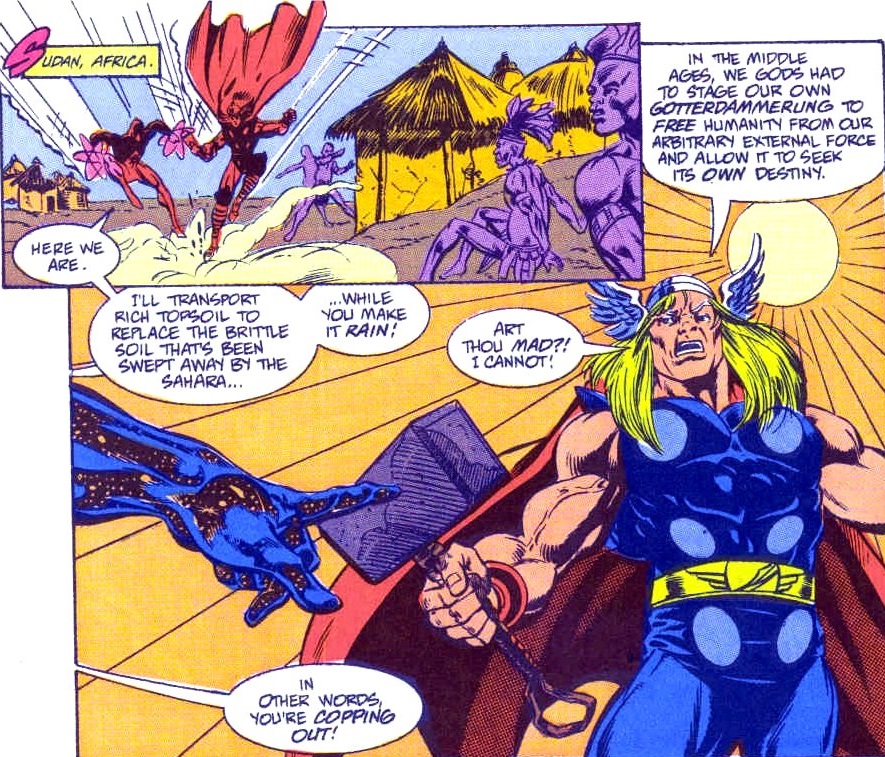
Spidey eventually tries to solve the problem of drought in the Sudan, forcibly recruiting Thor and this leads to a confrontation between the two about whether gods should allow people to seek their own destiny or intervene all the time. For a story exploring the real-world implications of having beings with such great powers, it's good to also get a realistic explanation as to why they don't set out to wipe out famine and the likes in the real world.

The finale brings a confrontation with Doctor Doom, who brings a hostage, Captain Ray Coffin who was the original wielder of the Captain Universe power. And Spider-Man doesn't hold back, leading to Doom snapping Coffin's neck, triggering the eventual confrontation between Peter's true side and Captain Universe, fought out as energy forms before bringing revelations about both Doom and what must truly be done with the Uni-Power. Thus he makes the final sacrifice by using Doom's weapon to release the power, creating a moment of universal unity, linking all minds together.

This obviously isn't a substitute for "What If... the Avengers lost Acts of Vengeance" but it was never meant to be and so shouldn't be approached in that way. Instead it's a good What If... that takes the basic concept from a storyline and shows what more could have been done but also why the regular Marvel universe couldn't go there. Unlike a lot of What If... stories it doesn't wind up with the gratuitous killing of characters for the sake of it or else being so tame as to produce a simplified alternative where a few identities, costumes and/or team memberships have changed but otherwise things are much the same. Instead it gives us a good exploration of the fundamental philosophical concept behind Spider-Man, turned up to the absolute degree.

What If... #31  has been reprinted in:
  • Nowhere at all it seems.

Saturday, 19 January 2019

Silver Surfer 33 - Acts of Idiocy

And now we come to another parody as the Silver Surfer encounters the Impossible Man...

Silver Surfer #33

Jim Valentino: wrote it without a care
Ron Lim: Artist extraordinaire
Tom Christopher: Inker beyond compare
Ken Bruzenak: Lettered it in his lair
Tom Vincent: Colourist with flair
Craig Anderson: Edited it in his underwear
Tom DeFalco: All he could do was stare!

The whole thrust of the 1987 Silver Surfer series was that the character belonged out among the stars, not confined to Earth. Additionally "Acts of Vengeance" came at a slightly difficult period creatively as Steve Englehart was wrapping up his run and fighting off editorial interference then came a couple of fill-in issues before the arrival of Jim Starlin with #34 who immediately kicked off the saga that would lead to Infinity Gauntlet (and the film Avengers: Infinity War). Putting the Surfer into Earth-based crossovers had already created awkward chapters in the annuals that had to contrive ways to get him back to (or at least near) the planet. Having such a powerful being lured to Earth by the alliance of super-villains just to target him would make little sense. So it's unsurprising that he was left out of it all and instead had a parody of the concept as the sole chapter of "Acts of Idiocy".

It's a straightforward issue. In it the Silver Surfer literally bumps into the Impossible Man and has to endure the latter's silliness, then deal with a fleet from an alien planet whose monarch has been insulted and wants redress. Impossible Man stories are often more about the character's wackiness and the frustration of those who have to endure him, than heavy in-depth plots. It's also quite a visual parade with the Shapeshifter taking on numerous forms ranging from Howard the Duck to Galactus to Forbush Man to Spider-Ham to it-looks-like-Superman-but-due-to-copyright-it-isn't to the Yellow Kid to Marilyn Monroe and many, many more. The Surfer is traditionally quite a noble serious character and so must be even more frustrated by this than most, yet can't let the Impossible Man be killed.

This issue may be an event driven fill-in but it's a reminder that the series as a whole went through periods when it seemed to be more about Marvel's outer space population as a whole with the Surfer at times a mere guide to everything rather than the driving force of the stories. Still here that comes with the territory.

Doing an in-universe parody of the crossover event rather than contorting to fit a deep space set series into an Earth based series is a wonderful solution to the problem. The Impossible Man is a particular taste, so this issue stands or falls depending on one's liking of him but it's quite a good portrayal of the character and he went on to encounter the Surfer a few more times, one of the more enduring relationships to have come out of the event. This is a good humorous issue of the series and a fun parody of the concept.

Silver Surfer #33 has been reprinted in:

Friday, 18 January 2019

X-Factor 50 - Acts of Vengeance

A simple glance at the cover shows the struggling demands, with banners for both "Acts of Vengeance" and the conclusion of "Judgement War" trying to fit into the top right-hand corner. Being a double-sized anniversary issue the prospect of having to give it over to a line-wide crossover must have irked even more than most. And so this issue is divided into two stories covering the two demands.

X-Factor #50

Writer: Louise Simonson (all)
Penciler: Rich Buckler (main)
Penciler: Terry Shoemaker (back-up)
Inker: Allen Milgom (main)
Inker: Hilary Barta (back-up)
Letterer: Joe Rosen (main)
Letterer: Michael Heisler (back-up)
Colourist: Tom Vincent (all)
Editor: Bob Harras
Editor-in-Chief: Tom DeFalco

The lead story sees the conclusion of X-Factor's adventures on an alien world full of mutants as they seek to free themselves before the Celestials destroy the planet, eventually coming to unite the planet's different factions. The story is very much a metaphor for the team's aims on Earth as they inspire others to rise up and work together. It's also the conclusion of some long running threads in the series, in particular Marvel Girl struggling from having absorbed the personality and memories of Madelyne Pryor and in turn Phoenix. This is one of the least explained elements so for new readers dipping in it becomes a confusing struggle. It seems clear that this story was written under the assumption that issue #49 would also carry an "Acts of Vengeance" banner and thus that issue would serve as the introduction for readers arriving via the crossover, whereas here everything gets on with the action. Read in isolation this tale offers classic new reader confusion.

The back-up story is a six-page piece "Meanwhile on Earth" as Apocalypse confronts the mysterious strange who soon reveals himself as Loki. This issue officially came out the same day as Thor #413 and so in theory this would not have broken the secret. However big crossovers have a frustrating habit of shipping out of order, made worse by the higher demand sometimes making it harder to find regular issues. And there's nothing in either of the two issues explicitly stating which way round they should be read. (It's a problem repeated by some of the attempts to create a general Marvel chronology that have found the off-Earth epics in both X-Factor and New Mutants to be significant problems for the chronologies of both "Acts of Vengeance" and "Atlantis Attacks" in the 1989 annuals and wind up having to put this issue right near the start.) It's also a surprise that Loki so willingly reveals his identity, shocked that Apocalypse hasn't worked it out. Notably Loki is depicted here in the costume introduced by Simonson's husband Walter during his run on Thor, whereas the main chapters of the crossover opt for his classic Silver Age look, again emphasising the disjointed nature of the story. Both this and the revelation feel like more failures of co-ordination and communication. The rest of the story is predominantly a fight in both physical and verbal form as Loki and Apocalypse trade blows and arguments about why the "Acts of Vengeance" are failing, the nature of humans and of being worshipped, until Caliban intervenes and then Apocalypse demonstrates the Celestial technology under his control. Loki some storms off in a huff.

Overall this issue is trying its best with demands that are clearly irritating the writer. It may not do a good job at explaining the ongoing storyline to new readers drawn in by the crossover banner, but given how well the previous issue did that one must assume that it was meant to have the banner as well. And although the "Acts of Vengeance" demands clearly irritate Simonson to the point of having the book's lead villain drive Loki out of the issue, it's done in a reasonably solid way. But given when this issue was published it was a very dubious idea to use Loki's real identity as it could have wound up as a spoiler. Overall this back-up is an okay little sideshow, but the lead story isn't really of interest on its own.

X-Factor #50 has been reprinted in:

Wednesday, 16 January 2019

X-Factor 49 - Acts of Vengeance

This issue doesn't carry an "Acts of Vengeance" banner but does contain a couple of pages that touch on the crossover. Otherwise it's a chapter of an ongoing storyline with the regular characters off world. Perhaps some other issues might have taken a similar approach. Oddly two of the worst offenders have the same writer and editor.

X-Factor #49

Writer: Louise Simonson
Layouts: Paul Smith
Finishes: Allen Milgom
Letterer: Joe Rosen
Colourist: Tom Vincent
Editor: Bob Harras
Editor-in-Chief: Tom DeFalco

This issue is faced with the difficulty that it's not possible to have the heroes take part in the crossover because of where the regular storyline has taken them. Nor is there a regular member or associate left behind on Earth who can carry the show. So instead the task of participating in the event falls to the book's main villain, Apocalypse, as he monitors the situation and finds the central alliance bizarre. His comments are telling:
Most of these evil masterminds would not, of their own wills, associate with each other. They behave oddly, so much out of character -- in some cases as to be baffling. Someone else is behind this conspiracy. Someone whose motives are quixotic and strange... but whose will... and powers... are overwhelmingly strong.
It's hard to disguise the author's commentary on the situation, pointing out the plot holes in the centre of the story and, perhaps, criticising the mastermind behind it in real life as well as the one in fiction. "Acts of Vengeance" created more problems for both X-Factor and New Mutants than for most titles and Simonson's irritation at what was no doubt a compulsory participation (whereas it seems to have been voluntary to take part in "Inferno", for which Simonson wrote the majority of the core titles) is understandable. The arrival of the mysterious stranger with an offer to join the alliance suggests further discussion on the subject.

Otherwise the issue is the penultimate part of "Judgement War" in which X-Factor have been transported to a planet with a technologically advanced but culturally mediaeval society. In this chapter a brainwashed Iceman has to fight Archangel in the arena as part of the power struggles, whilst the Beast and Cyclops work with rebels to free their friends. It's amazing to realise this issue is by the same writer as New Mutants #84. Both are the penultimate parts of long running sagas with the team away from Earth and both have just two pages taking part in "Acts of Vengeance", although New Mutants is the only one to include a banner on the cover. But whereas that issue is an impenetrable mess for new readers brought in by the crossover, this one is careful to introduce the characters and situation through narrative captions to make it clear just what's going on. It's almost a pity it doesn't have the banner, because this is how to make the best of such a situation.

This is a series that's firmly sticking to doing its own thing and bluntly saying so. However it's also doing it in a way that any extra readers brought in by the broader event are catered for. The Apocalypse scenes are good in themselves but the issue as a whole isn't that essential to the crossover, but does get credit for doing the best it can to meet the conflicting needs of the varied readership.

X-Factor #49 has been reprinted in:

Wednesday, 12 September 2018

Dr Strange Sorcerer Supreme 13 - Acts of Vengeance

The final Dr Strange issue of the crossover is once again divided in two.

Dr Strange: Sorcerer Supreme #13

Writer: Roy Thomas (all)
Writer: Dann Thomas (main)
Writers: Jean-Marc Lofficier and Randy Lofficier (back-up)
Artist: Jackson Guice (main)
Artists: David Day and Dan Day (back-up)
Lettering: Janice Chiang and Michael Heisler (main)
Lettering: Joe Rosen (back-up)
Colours: Max Scheele  Tom Vincent (all)
Assistant Editor: Mike Rockwitz
Editor: Ralph Macchio
Editor-in-Chief: Tom DeFalco

The back-up story is a further chapter from "The Book of the Vishanti", continuing the story of the Darkhold and the Montesis guarding it, along with the rise of both the Ancient One and Dracula. It feels a more coherent piece than the previous chapter, not least because of the easily recognisable elements of the existing mythology.

The lead story follows on from the previous issue and sees the Enchantress force Arkon, the ruler from another dimension, to attack Doctor Strange. Arkon is additionally motivated by a desire to make Clea his queen, allowing him to add the Dark Dimension to his realms as well. This leads to a somewhat unlikely hand to hand duel with Doctor Strange, who has never been much of a physical fighter and although his survival is explained at the end it just seems bizarre that he would ever agree to such a fight. Much of this issue, and indeed the previous one, has focused on the strength of the relationship between Stephen and his wife Clea even though they are usually dimensions apart. Each faces an alternate admirer of a kind and each rushes to the defence of the other in their own ways.

Arkon's motivations are also easily understood - he's two stages removed from the central "Acts of Vengeance" conspiracy and thus isn't motivated by that at all but rather simply by the fact the Enchantress has stolen his thunderbolts that can get him home. Still it solves the general problem of finding foes who can present a sufficiently powerful challenge to Doctor Strange and at the same time come under the direction of a conspiracy of distinctly mortal villains.

Overall this is an uptick after the previous issue but not the most dynamic and there's increasingly a sense that this is a series that wants to hurry up and finish its part in the crossover and then get back to telling its own stories. It's a reminder that with such a sweeping event not every creator is always enthusiastic all of the time.

Dr Strange Sorcerer Supreme #13 has been reprinted in:

Wednesday, 5 September 2018

Dr Strange Sorcerer Supreme 11 - Acts of Vengeance

The title on the cover of this issue is a little confusing as the phrase "Sorcerer Supreme" is missing; nevertheless this is part of the series's full title (and hence causes a lot of confusion for people trying to navigate the various different Doctor Strange series). Back in the day further confusion was caused by this series being a direct market only one, allowing it a higher price tag, artwork right up to the edges and fewer adverts, but at the cost of a lesser prominence. In universe, the lead character would no doubt like such a lower profile.

Dr Strange: Sorcerer Supreme #11

Writer: Roy Thomas (all)
Writer: Dann Thomas (main)
Writers: Jean-Marc Lofficier and Randy Lofficier (back-up)
Artist: Jackson Guice (main)
Artists: David Day and Dan Day,
Lettering: Janice Chiang (main)
Lettering: Joe Rosen (back-up)
Colours: Tom Vincent (all)
Assistant Editor: Mike Rockwitz
Editor: Ralph Macchio
Editor-in-Chief: Tom DeFalco

The issue focuses on Doctor Strange first trying to deal with the consequences of his younger brother having become a vampire, including a flashback detailing Stephen's dirty secret about how he neglected his family, leading to Victor's death. The problem is that this is a very awkward addition to the hero's backstory. As he himself admits, the accident that killed his brother didn't lead him to remorse about his attitude, and instead he paid to have his brother's body cryogenically preserved, paid for by a trust fund that wasn't affected by his later descent into alcoholism. The idea that a top surgeon would put his faith in the possibility his brother could one day be brought back to life, or even just pretend as a way to avoid his guilt, doesn't ring true. Nor does the idea that Stephen was careful enough with his finances to ring-fence the arrangements to keep Victor on ice, yet drank everything else away after the accident that ruined his hands. The result is a bodged continuity implant that in the long run can only really be justified if something sufficiently interesting is done with Victor.

The other part of the story focuses on a sensational biography of Doctor Strange recently written by Morgana Blessing, leading to both author and subject winding up on a late evening chat show with Strange hoping to be dismissed as a fake and have the attention disappear. The tactics of the show in getting both guests onto the set are somewhat dubious as is the instant publicity, but this is the hook to draw in the villain of the piece, the Hobgoblin. This is the second Hobgoblin, widely dismissed by other characters, writers and readers as a joke sullying the Goblin legacy, and recently he received a curious power upgrade during "Inferno" when he was given demonic powers that also transformed his appearance. As a result he is now a stronger match for the magician than the latter assumes, able to evade a number of the spells. However he's true to his mercenary roots, having been sent by Doctor Doom to dispose of Strange, and the resulting battle feels more balanced than it might otherwise have been. It also has some consequences for the fall out from Blessing's biography. As a result the wider crossover easily fits into the ongoing flow of events without any significant disruption to the ongoing flow of the series, instead enhancing it.

There's also a back-up story, "The Book of the Vishanti: The Curse of the Darkhold Part III - Dawn of Blood". This is another piece of mythology building and refining that explains some of the key mystical forces and books through the ages. It's a decent piece but, as is often the case with these sorts of back-ups, it has no bearing on the main strip.

Dr Strange Sorcerer Supreme #11 has been reprinted in:

Monday, 27 August 2018

Thor 410 - Acts of Vengeance

Although it doesn't have a banner proclaiming the crossover, Thor #410 effectively starts it.

Thor #410

Words & Plot: Tom DeFalco (all)
Pictures & Plot: Ron Frenz (lead)
Finished Art: Joe Sinnott (lead)
Illustrated: Herb Trimpe (back-up)
Lettering: Michael Heisler (lead)
Lettering: Richard Starkings (back-up)
Colouring: Tom Vincent and George Roussos (lead)
Colouring: Nel Yomtov (back-up)
Editing: Ralph Macchio (all)

Coming almost midway through the run by Tom DeFalco and Ron Frenz, this issue mainly focuses on the conclusion of a story in which Doctor Doom steals Thor's hammer to use in his latest scheme again the other Doctor Doom, also known as Kristoff. A back-up story tells a tale of Volstagg of the Warriors Three.

The back-up is one of many "Tales of Asgard" that expand the mythology of the series. It's a straightforward comedic piece, as Volstagg focused tales tend to be. The lead story includes a team-up with Hercules and She-Hulk but the latter doesn't really contribute much beyond a few comedic moments and being an extra in a fight. Otherwise this is a relatively tame tale of Hercules and Eric Masterson (a mortal man Thor has been merged with) battling with Doctor Doom's Defence Droids whilst Doom uses a device to freeze time in Latveria and invade the castle, only to find his alternate self is prepared.

As the most prominent villain in the Marvel it's inevitable that Doctor Doom will be seen a lot in the coming crossover, so this issue is handy as a quick introduction to his status quo in the period - during a period when he was assumed to have been destroyed, a record of his personality and some memories was implanted into his young ward & designated heir Kristoff who came to believe he was the real Doctor Doom. Kristoff has held power in Latveria and regards the returned real Doctor Doom to be an impostor. As a result the latter has been operating in exile, trying to regain his kingdom through a variety of schemes. Given Doom's arrogance it's unsurprising that he blames the failure of this one on Thor even though the Thunder God's involvement was inevitable once the hammer was stolen. So it's understandable when at the end a mysterious stranger appears and proposes "an Act of Vengeance!" that Doom is interested.

However Doom is not normally a Thor villain. It's a strange route to bring him into the plot and an early sign of just how poorly disguised the stranger's identity is. Otherwise this issue is a relatively straightforward tale in the Silver Age homage style that DeFalco and Frenz had refined on the series. For much of its run Thor has had a feeling of the old fashioned about it, but for a series starring a character from mythology that's not necessarily a bad thing.

Thor #410 has been reprinted in: