Thursday, 28 October 2021
Spectacular Spider-Man Annual 8 - The Evolutionary War
Spectacular Spider-Man Annual #8
1st story: Return to Sender
Script: Gerry Conway
Pencils: Mark Bagley
Lettering: Rick Parker
Inks: Keith Williams
Color: Bob Sharon
Editor: Jim Salicrup
Editor in Chief: Tom DeFalco
The High Evolutionary is making a couple of final investigations in this penultimate chapter of the event. He goes out into space to investigate the Young Gods, a group of twelve humans genetically advanced by the various pantheons on Earth and taken away by the Celestials, but judges them "only children with god-like powers" and leaves to continue his plans. However Daydreamer reads his mind and discovers his plan with the Young Gods dividing in two over whether they should seek to stop him or not interfere in human destiny. One faction goes to confront the Evolutionary on Earth with the other following to stop them. Meanwhile Spider-Man encounters the Purifiers chasing a woman and is shocked to discover she resembles his dead former girlfriend Gwen Stacy. He soon realises this is her clone and catches up with her when she is captured by the Purifiers. Transported back to the Evolutionary's base Spidey gets caught up in the battle between the Purifiers and the Young Gods whilst the Evolutionary makes a careful study of Gwen's clone and comes to a startling revelation.
There's a lot going on in this annual so let's get the biggest problem out of the way first. The Young Gods simply do not fit into Spider-Man's world. They are a very obscure group of characters originally introduced by Gerry Conway in his early 1970s run on Thor with a later writer refining them and adding the Celestial connection. They have had very few appearances over the years, primarily because few other writers have touched them and Conway was either not at Marvel or working on inappropriate series. Here they just stick out like a sore thumb and it's easy to see why there was no great demand for them to return or be given their own series. The fight scene in the Evolutionary's headquarters (now a giant submarine) could have featured any group of heroes for all the difference it makes. And Daydreamer's role at the end doesn't match her powers which are given in the "Fact Pages" later in the annual as "Limited precognition, verbal and telepathic thought control, the ability to create 'visions'". None of this explains how she is able to neutralise and reverse the effects of a genetic virus that transforms a person "on a cellular level into a near duplicate of the original" and restore "Gwen" to her true self.
This brings us to what the annual should be notable for as the retcon here should by rights have completely stopped one of the most notorious Spider-Man stories of all time. Contrary to myth the heavy retconning of the events of the Original Clone Saga began in the 1980s before anyone had heard of Ben Reilly. The clone of Gwen Stacy had not been seen since the end of the original saga (which was also Conway's last issue of Amazing Spider-Man) when she made her peace with both Peter and what she really was and there was never any real need to bring her back. But here we get the revelation that she isn't a clone after all. The Evolutionary reveals that he wondered how a university professor could have come up with cloning (clearly forgetting that in the Marvel Universe numerous academics have been able to access and develop all manner of advanced technology) and instead that he had developed the genetic virus then kidnapped another woman similar to Gwen and infected her to create what appeared to be a complete genetic duplicate. (Incidentally the name "Joyce Delaney" doesn't appear in this annual despite what some synopses online state.)
There is so much about this that just doesn't make sense. Firstly why is the Evolutionary so concerned about the work of a long dead university professor whose work has left only one remaining clone around? There is nothing indicating that his plans for genetically advancing the human race can be derailed by this. Secondly if cloning was beyond the ability of Warren then how did he come up with the genetic virus? Thirdly if Gwen Stacy wasn't a clone then what about the others? Who was the Spider-Man clone? Carrion claimed to be a clone of Warren gone wrong so who was he actually? Finally if Gwen's clone was actually another woman then how come her disappearance wasn't noticed?
Some of this would be resolved in a forthcoming issue of Spectacular Spider-Man but it began the trend of partial retcons of the Clone Saga that didn't cover every detail and which would require further stories & retcons to clean things up, often including explaining how Carrion fitted into the new version of events. But it's also notable that the revelations in this annual should have closed off the possibility of bringing back any other clones as the genetic virus could simply have been purged from the system. (However instead the annual was largely ignored for much of the Clone Saga with the revelations here simply brushed aside until a persistent assistant editor managed to get the only issue of Scarlet Spider Unlimited to address them. But that's a story for another day.) It's a pity as the genetic virus approach would have been a much easier way to get the story settled once and for all.
It's not clear why (presumably) Conway felt the need to revisit the Clone Saga at all. Was it because there was growing public awareness that cloning did not lead to fully grown identical duplicates being made in laboratories? Was it to shut down the possibility of other writers bringing back the clones? If so then it was spectacularly unsuccessful. But the result is a big retcon of a story from thirteen years earlier that could have just left things there and then.
(On the subject of continuity this story also repeats a common continuity error by Conway. For some reason he repeatedly got the details of Peter's high school years wrong, here claiming that Peter and Mary Jane knew each other then when in fact they didn't meet until Peter was at university. Time and again he would make this error and also imply that Peter had dated Liz Allen in high school with Mary Jane disliking her then. This has appeared so many times and so clearly in his Spider-Man stories from both the 1970s and 1980s that it can't be a mere misinterpretation.)
This annual would have worked a lot better as an earlier chapter in The Evolutionary War when it would have made more sense for the High Evolutionary to be exploring genetic anomalies as he is a natural character to use to explore the truth behind Warren's experiments. It doesn't feel like a penultimate chapter at all and instead feels like a fill-in marking time between the two Avengers annuals. The obsession with the Young Gods also weighs this story down further. However there are some good moments such as the two scenes between Peter and Mary Jane as they face the memory of Gwen and just what it says about their relationship with each other. But overall this is a mess of a story weighed down by a disproportionate focus on inappropriate guest stars and a needless retcon that makes little sense.
2nd story: Opposing forces
Writer: Gerry Conway
Pencils: Mark Bagley
Inker: Mike Esposito
Letters: Rick Parker
Color: Bob Sharon
Editor: Jim Salicrup
Editor in Chief: Tom DeFalco
Several of the Young Gods have travelled to Jerusalem where they discover an ancient robot buried in the hills that feeds off anger and is triggered by the presence of the Young Gods and an Israeli army patrol fighting a group of teenage Palestinian protestors. The Young Gods argue over whether to get involved and charge in but only achieve success when several come together to form the Uni-Mind.
Rather than a back-up focusing on some Spider-Man characters we instead get a solo tale for the Young Gods that shows off the differences in their philosophies about getting involved with human affairs as well as a demonstration of their powers and a rather forced message about the power of working together. This tale just shows why the Young Gods have not interested other writers as they're a rather dull cliched set of characters. Putting the story here along with five "Fact Pages" about them just adds to the sense that they've taken over Spider-Man's annual unnecessarily. It ends with a caption announcing "To Be Continued... Watch future issues of Spectacular Spider-Man to find out where!" but instead they wouldn't be seen again until a multipart story in Marvel Comics Presents in the early 1990s. And it's easy to see why. This is just a waste.
3rd story: The High Evolutionary: Kindred Spirits
Story: Mark Gruenwald
Breakdowns: Ron Lim
Finishes: Tony DeZuniga
Letters: Ken Lopez
Colors: Gregory Wright
Editor: Ralph Macchio
Chief: Tom DeFalco
This chapter tells of how the High Evolutionary returned to mortal form albeit far more advanced than contemporary humans, the creation of Counter-Earth and his relationship with Adam Warlock. The Counter-Earth saga has a notably more scientific approach and veers away from the Biblical parallel of the original story whilst there's also a retelling of the final (for then) showdown between Warlock and the High Evolutionary.
Once more the saga is retelling past Marvel stories though the encounter with Warlock was another flashback due to his own title ending before it could happen (although it was prophesised) and he was soon after killed off. That was one of Mark Gruenwald's earliest pieces of continuity surgery so with this chapter he has now come full circle. Also coming full circle is the way the Evolutionary starts and ends the chapter in his energy thought form, almost as though anyone missing this annual (such as someone who read both Avengers books but not the crossovers) would not feel they were missing something. However it's a pity that the reasons behind Warlock's false belief that Counter-Earth has been destroyed is not explained here beyond speculation that his Soul Gem is interfering with his perception. Otherwise it's a straightforward summary of a distinct period of the Evolutionary's appearances.
Other material includes "The Young Gods Fact Pages!" outlining their origin and each of the characters. Yet again it reinforces the idea that this annual wants to be a Young Gods annual. For some reason a lot of 1980s Spider-Man annuals have a tendency to forget who was the star of the series and suggests that many creators were longing for the days of Marvel Team-Up. This is especially disappointing given how important the revelation in this annual should have been for Spider-Man continuity in the long-term.
Monday, 11 October 2021
Amazing Spider-Man Annual 22 - The Evolutionary War
Okay we've hit a publishing mistake here. The back-up feature "The High Evolutionary" has a strict chapter order and the next one should be Fantastic Four Annual #21. However the lead feature in that has the first recap of the event so far in chronological order and places it after this issue. So I've opted to publish these two posts simultaneously in lead feature order.
(And this is another annual with a lot of creators so some of the labels are in a separate post.)
Amazing Spider-Man Annual #22
1st story: Drug War Rages
By Tom DeFalco
As told to David Michelinie
Photos: Mark Bagley & Mike Esposito
R. Parker signs on
B. Sharen in the red
J. Salicrup indicted
T. DeFalco shrieks
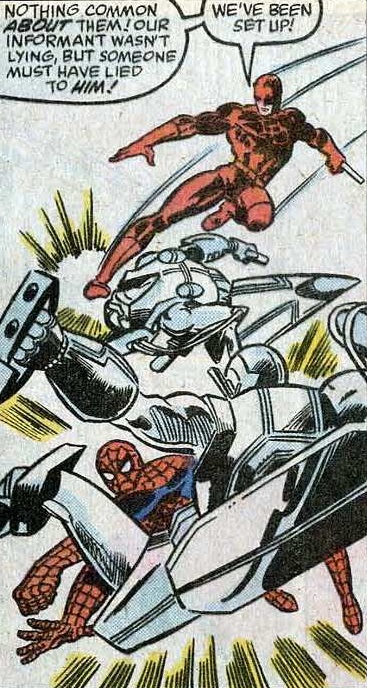
This is the first annual in The Evolutionary War to actually build on events earlier in the saga as New York deals with the consequences of the interruption of the drugs supply in Punisher Annual #1. Otherwise this annual feels quite traditional, perhaps in part because Tom DeFalco is plotting but also Mark Bagley adopts a very traditional approach to the artwork that stands in strong contrast to Todd McFarlane's contemporary work on the regular series at this time. It's a nice suitable retro feel for a story that also resorts to some traditional moves such as Spider-Man being falsely accused of a crime and J. Jonah Jameson being delighted at being proved right. There's a team-up with Daredevil and a good use of the Kingpin. But there's also the debut of a new superhero.
Speedball was the newest hero Marvel was about to launch in his own title and he's given a preview here. But it's not a very good one. There's no origin story, just a quick mention of an "accident" that gave him his powers, and the character comes across as a mess. When Robbie Baldwin encounters a force it triggers a kinetic power that sends him jumping all over the place which he tries to use to fight street level crime. There's a half decent idea in that and with some refinement to give him a degree of control that could at least all him to walk around without being terrified of brushing into anyone it might work. But the problem here is that we're given neither the origin of a new hero when he can be expected to have difficulty controlling his powers nor an appearance once he's fully come to terms with them. To add to the problems neither his creator Steve Ditko nor his regular scripter Roger Stern is working on this story and so Speedball is just thrown into this story to bounce around without contributing much that couldn't have been handled by either Spider-Man or Daredevil.
Overall this is a pretty good example of a traditional Spider-Man story with a double team-up thrown in for good measure. Spider-Man and Daredevil work well together and the menace is pitched at the right level for them. It's just unfortunate that space is devoted to introducing Speedball who really adds nothing to this tale and does not get a very impressive introduction.
2nd story: He who laughs...
Plotter & Penciler: Steve Ditko
Scripter: Roger Stern
Inking: Jackson Guice
Lettering: Rick Parker
Coloring: Tom Vincent
Editing: Jim Salicrup
Yes that's that Steve Ditko doing the plot and pencils. It's his first work on a Spider-Man book since 1966 - but he always refused to return to the main character and so is only drawing a back-up feature. Over the next few years he would appear in several more Spider-Man annuals in this way and so it's natural to wish he could have opted to return to the main character just one more time. Instead here is what was then his newest creation.
This could almost be from Speedball's own series which launched at this time and had almost exactly the same creative team at the start. One of the curiosities of the series is how many issues have multiple stories. There were a number of anthology titles around this time - examples include Strange Tales, Marvel Comics Presents, Solo Avengers and, over at DC, Action Comics Weekly - that offered multiple shorter stories but headed titles tended to have a single story each issue or at most a back-up story that focused on some of the other cast members in a separate story strand. Doing an ongoing headed series with multiple tales of the title character(s) was an extremely retro step.
And this story feels very retro. It's about thwarted ambition fuelling false revenge as an unsuccessful ex actor tries to murder Speedball's mother, believing she turned a director against him and so he failed to get a key break part. Now working as a janitor in a theatre he plans to attack her when she visits a friend there but first has to dispose of her son. This results in Speedball (who doesn't actually call himself by that name yet; instead he thinks of himself as "The Masked Marvel", his book's subtitle) bouncing around trying to distract and knock out the would-be killer before his mother can see him.
It's a rather weak story that's constrained by the need to have Speedball's powers triggered at key moments to advance the plot. The villain's motivation is believable but his attempts get sillier and sillier. Nor is it even resolved by the hero. Again this is not a good advert for Speedball and his series.
3rd story: The High Evolutionary: Kindred Spirits
Story: Mark Gruenwald
Pencils: Ron Lim
Inks: Tony DeZuniga
Letters: Ken Lopez
Colors: Gregory Wright
Editor: Ralph Macchio
Editor-in-Chief: Tom DeFalco
This is another info dump heavy chapter that rushes through the introduction of the New Men, with Bova, perhaps their best known member, being shown being genetically accelerated from a Guernsey cow, then more explanation about the nature of the Werewolf, though the High Evolutionary remains sceptical about the supernatural explanations, before the body of Jonathan Drew returns animated by a sixth century ghost called Magnus to explain how the spirit of the demon Cthon has been bound to Mount Wundagore and could be awakened by the Evolutionary's work. That's a lot to take in in just six pages but it does once again reinforce just how Marvel had let Wundagore get overused in far too many characters' histories so as to produce this mix of technology and magic and even Mark Gruenwald was starting to struggle to make it all seem consistent.
One thing that does stand out is that Gruenwald (or Macchio) isn't always writing the Evolutionary's dialogue consistently as an interwar British scientist. So some of his dialogue includes stereotypical upper class phrases like "old girl" whilst he also uses the American dating format for recording his experiments. More consistent is the way the way Herbert Edgar Wyndham is now wearing his armour full time as a sign of how he is retreating ever more from the outside world into a shell. The character is portrayed consistently as a rational scientist refusing to believe tales of magic even though he admits he does not understand the Werewolf. Although the amount of backstory to wade through can be overwhelming at times this saga so far has done a good job of building up the lead character.
Other material includes the plans for Peter and Mary Jane's apartment plus two unused covers by Larry Lieber & Jack Abel and Bob Layton from the black costume era and a plug for the Spider-Man newspaper strip. This annual may not be the best example of its series at the time as the latter was in quite a bold experimental phase but it's good traditional Spider-Man and a good introduction to crossover visitors as well as making good use of the event to tell a strong story. It's just a pity that it's had a new hero thrown in to poorly promote.
Wednesday, 10 October 2018
Spectacular Spider-Man 159 - Acts of Vengeance
Spectacular Spider-Man #159
Script: Gerry Conway
Breakdowns: Sal Buscema
Finishes: Mike Esposito
Lettering: Rick Parker
Colours: Bob Sharen
Edits: Jim Salicrup
Editor-in-Chief: Tom DeFalco
This is another issue that feels like it's treading water and isn't even fully in sync with other things happening. Early in the issue Spider-Man is astonished to discover that he can now fly, yet he discovered this power in the previous chapter of the sage (Amazing Spider-Man #327). It would have been so easy to modify this to his powers getting out of control again, but this part of the script hasn't been fixed. There are also a couple of subplots shown in the title, but both don't really advance. One sees another conversation about the possibility of getting Joe Robertson a pardon, but this is a storyline that has dragged out interminably and the angle of his lawyer being interested in a sleazy Daily Bugle photographer is something that we could just do without. Meanwhile J. Jonah Jameson has plans to launch a new photo journal magazine in order to get himself back into news publishing and is trying to recruit Peter to the project. Although it has long-term possibilities, at the moment this just feels like a distraction.
It is an unfortunate case that this storyline feels insufficient for the number of issues assigned to it. Consequently we're getting inconsequential chapters that do next to nothing to really advance the story and just show the problems of having too many series for a character all trying to tell the same tale. If this was a deliberate attempt to show why the three books should be running their own stories (as indeed they largely did for the next three years) then it proved the point. However I think it instead reached that by accident.
Spectacular Spider-Man #159 has been reprinted in:
Friday, 7 September 2018
Spectacular Spider-Man 158 - Acts of Vengeance
Spectacular Spider-Man #158
Writer: Gerry Conway
Breakdowns: Sal Buscema
Finishes: Mike Esposito
Colourist: Bob Sharen
Letterer: Rick Parker
Editor: Jim Salicrup
Editor-in-Chief: Tom DeFalco
Okay since he appears on the cover, let's tackle the first problem with this story. Spider-Man has fought the Trapster before, including in this series (#42), three times as part of the Frightful Four and once solo. And both Gerry Conway and Sal Buscema were present for one of those encounters (Marvel Team-Up #2 and #58 respectively). But then it is particularly difficult to find villains that Spider-Man hasn't encountered before, given his multiple titles, former team-up book and many guest appearances have meant he's been around the Marvel universe far more than just about any other hero.
However this isn't the only continuity error that sticks out here. Although much of the chronology of "Acts of Vengeance" is debatable, the three Spider-Man books have a clear order as established by previous crossovers (which have been surprisingly few; it wasn't until 1993 that the Spider-Man books began routinely running multi-part storylines across each other). Thus it's strange to see the Kingpin here recruited to the central alliance (otherwise so far consisting of Doctor Doom, Magneto and the Wizard) when in Amazing Spider-Man #326 he was said to be the one who sent Graviton to deal with Spider-Man and thus already a part of the scheme. This lack of co-ordination within the Spider-Man office is not a good sign and more broadly there will be a number of questions about the order of involvement of the leaders of the alliance and their various hidden motivations. Now is not the best time to discuss the presence of Magneto as he's not a major presence in this issue and there are ones coming up that are more appropriate, but overall it's an interesting start to the scheme by bringing together three major villains plus a has-been like the Wizard.
The Wizard isn't the only one with a poor reputation. The Trapster took on his current name nearly a quarter of a century earlier, but he's never been able to shake off the ridiculous initial one "Paste-Pot Pete", with both Spider-Man and the Kingpin using it. His abilities have also long been mocked yet here he overpowers Spider-Man in the space of just three pages using a mixture of paste and grease. He's been specifically picked by the Wizard so it's understandable that he's gone in with weapons to overcome Spider-Man's ability to stick to walls, yet it's an astonishingly quick and one sided encounter, with no real distractions to explain how Spider-Man can be taken down so easily. This is the problem with deliberate defeats to set up subsequent encounters and it stands out the more when the foe comes with all the baggage of an acknowledged loser that the Trapster has.
But this is only a prelude to a major transformation. Doing some work in a science lab, Peter Parker gets exposed to an energy burst which enhances his sense and powers. He becomes invulnerable to electricity, starts generating giant sized hands made of webs, fires energy bolts from his fingers and can sense just about everything for miles until he gets that under control. It's an interesting step-up in his power levels and leaves Spider-Man scared of what the consequences might be. For a crossover event in which the balance of power is going to be deliberately altered, it's actually quite appropriate for one of the heroes to be suddenly more powerful than usual, making the encounters more unique which is handy given the already mentioned limitations of finding foes Spider-Man hasn't fought before.
This issue also briefly touches on the later stages of one of the more bizarre Spider-Man stories from the period where Joe "Robbie" Robertson was sent to jail for not having reported a crime when he was a young reporter. The problem with the story has always been the absurdity that a witness gets jailed for being intimidated into silence. The judge may have been corrupt but a judge is not the whole system and it shouldn't have to take a presidential pardon for such an absurdity to be overcome.
Overall though this is a fairly solid issue that brings some local mysteries alongside the wider event, helped by some always spectacular artwork.
Spectacular Spider-Man #158 has been reprinted in:
- Spider-Man: The Cosmic Adventures (1993)
- Acts of Vengeance Omnibus (2011)
- Amazing Spider-Man Epic Collection: Cosmic Adventures (2013)
Friday, 23 August 2013
Essential Hulk volume 1

Essential Hulk volume 1 contains, in the original edition, all six issues of the original Incredible Hulk series and then the Hulk strips from issues #60-91 of Tales to Astonish (the anthology series that also starred Ant-Man/Giant Man and which later featured Namor the Sub-Mariner). Everything in the volume is written by Stan Lee. Jack Kirby draws the first five issues before being succeeded by Steve Ditko who carries on into the early Tales to Astonish stories. Kirby then returns for a few issues before switching to do layouts which are finished by a mix of "Mickey Demeo" (Mike Esposito moonlighting whilst at DC), Bob Powell, Scott Edward, John Romita and Bill Everett, then issue #84 is credited to "Almost the whole blamed Bullpen". After this (and probably not coincidentally) we get full pencils from John Buscema and Gil Kane. Later editions have added the Hulk's guest appearance in the Giant-Man strip in Tales to Astonish #59 (written by Stan Lee and drawn by Dick Ayers) which served as a trailer for the Hulk's own strip. (This strip can also be found in Essential Ant-Man volume 1.) This is literally a volume of two halves albeit unequal ones. The first consists of the original Incredible Hulk series that lasted just six issues back in 1962-1963. Reports are divided as to whether it actually a poor seller or if it was just a victim of Marvel's limited number of titles due to its distribution deal and displaced by Sgt Fury and his Howling Commandos. But either way the result was that the Hulk soon lost his own title and was relegated to wandering through the pages of other books such as the Fantastic Four, the Avengers and even the Amazing Spider-Man. Then after about a year and a half without his own feature, he was given a slot in Tales to Astonish.
This disjoint in the early years has often affected how they've been viewed. The original six issues have been reprinted many times - a pocketbook reprint lent to me by a friend many yeas ago was the first time I read any Silver Age Marvel stories (but I honestly can't remember what colour the Hulk was in the first issue) - but there's been much less attention given to the Tales to Astonish strips. Indeed a note at the start of the original edition of this volume specifically states that many of them hadn't been reprinted "since... well, even Stan Lee can't remember when!" (The Masterworks didn't start on them until a few years later.) It's apologising for the variation in reprint quality due to the nature of the archival material, but it's also a reminder that the Hulk entered his first forgotten era earlier than almost any of his contemporaries.
(The reprint quality is more than passable though. Indeed the worst looking page in my edition is actually one with 1990s artwork! It's a divider page between the two series with the front and back cover art on either side. Unfortunately one side seems to have the images overlaid on each other, like a double exposure. Later editions have better reproduction and lack the note.)
The Hulk's origin story is mostly timeless but there's one element that has bcome dated. Scientist Bruce Banner develops a powerful bomb emitting a special kind of radiation but gets caught in the blast of an undelayed test whilst saving a teenager who has wandered onto the site for a bet, and the resulting energy causes him to change into a monster - that's pretty easy to map to any era. Yes there's a bit of silly science about the effect of the rays. The arms race may have been a more prominent factor of the Cold War but even today nuclear weapons are a live and argued issue and it doesn't matter if it fits current US weapons testing policies. It's the presence of a Communist agent amongst the test staff and the interest of the Soviets that makes the first issue a little dated, though one could reasonably airbrush Igor into being a generic foreign spy of an unnamed or fictitious country. (Making him an alien infiltrator in disguise might be simultaneously timeless and also true to the spirit of some of the era's science fiction but... well... "Yeeesh!") The origin is retold in issue #3, for no real purpose (unless it was to fill up the page count), but with all the spy elements removed.
There are some other aspects to the series that show the silliness of the time, most obviously the way that Bruce is able to obtain a lot of scientific equipment on the sly and easily assemble everything from a gamma machine to the door to the Hulk's underground prison, with a ten foot thick concrete slab held in place by a steel rod. Later on Rick Jones is able to obtain and install a replacement rod with no-one noticing. And there's one issue where Rick is able to charter a private plane at only a few minutes' notice to fly him and the Hulk to confront the latest villain.
One thing rapidly becomes clear that there didn't seem to be a strong sense of direction for the series. At first we get the tale of a man who transforms into a brutish monster at night - a latter day take on Dr Jekyll and Mr Hyde, or at least the popular impression of it. But this doesn't last and soon we shift towards the scenario of the Hulk being a mistrusted hero and Bruce controlling the transformation through a gamma ray machine. However issue #6 shows signs that the control is beginning to break down with delayed and incomplete transformations and then signs that the change can be brought on by extreme aggression. Issue #6 also sees the Hulk granted a Presidential pardon, suggesting a further shift in direction but the run ends before we can see where it goes. The Hulk's personality is initially that of a simple giant but midway through Bruce gains control of the monstrous form. However there are signs that either Bruce is losing control to the Hulk's personality or else he is changing with the power, as the Hulk becomes ever more brutish.
We also see the debut of the most prominent of the Hulk's supporting cast, with all of them introduced on the first few pages of the original issue. Rick Jones is a carefree orphaned teenager who sneaked onto the test site for a bet, but he rapidly becomes loyal to Bruce for saving his life. Rick is about the only teen sidekick in the early Silver Age Marvels - teenagers are otherwise the stars, full members of teams or absent altogether. But unlike many DC sidekicks, Rick largely helps away from fights, looking after Banner/the Hulk, obtaining equipment for him and so forth. At one stage a second accident temporarily results in the Hulk being under Rick's control, a very different arrangement from the norm. At the end of the series Rick and friends form the "Teen Brigade" (well it was 1963) of amateur radio operators across the country to help when needed. The slang was probably dated even at the time but it's good to see some independent organisational initiative. However the main romantic interest is a bit of a washout. Betty Ross at this stage is a rather weak Daddy's Girl who has fallen for Bruce and will defend him against her father's criticisms but otherwise seems to spend most of her time pining for Bruce, being scared by the Hulk or serving as a damsel in distress to be rescued. It's only in the very last few panels that she and Bruce step out together.
Betty's father becomes the Hulk's main foe. General "Thunderbolt" Ross rapidly decides the Hulk is a menace, in part because of Betty's fear of him. Most issues see him trying to capture or destroy the Hulk and sometimes the former is achieved but not for long. Although other military officers are shown with a sceptical view of the Hulk's attempts to do good, Ross believes the worst at all times and thinks others are tricked. The result is a tense backdrop as the Hulk is often on the run and in hiding.
The Hulk battles several other foes in these tales but it's surprising how obscure most of them have remained. The first issue features the Gargoyle, a man deformed by bomb tests who is now a genius working for the Soviets but wishing only to be normal again. He gets his wish in the issue and dies at the end. Death isn't normally an obstacle for a Marvel villain but as far as I'm aware he's never returned outside flashbacks. Issue #2 has that traditional type of enemy, an alien race seeking to invade Earth, though with the Toad Men we actually get an entire invasion armada, rather than just an advanced scoutship as is more normally the case. Issue #3 sees the first big name villains in the form of the Ringmaster and his Circus of Crime. And at this stage it's amazing they can get away with their trick - they turn up in a small town, hold a circus performance where they hypnotise the audience and make them hand over all their valuables before going round the rest of the town to do the same to the handful of inhabitants who didn't come. Then they leave for another. It's little surprise that the FBI soon spot the connection. Issue #4 sees an attack by Mongu "the Gladiator from Outer Space!" but he's just a Soviet agent in a giant suit trying to catch the Hulk and I don't think he's been seen since. The following issue introduces General Fang, a Chinese warlord, and Tyrannus, another underground ruler. Finally issue #6 sees the debut of the Metal Master, an alien with the power to control and change the atoms of all metal. Oddly, despite the tendency of Marvel to leave few ideas unmined, very few of these foes have made many return appearances. The Ringmaster and the Circus of Crime and Tyrannus are about the only ones who've popped up a lot but the rest have made few to none.
These early issues show a series in flux, not really sure whether it wants to be a monster saga or a superhero series. Elements of both genres are present but without a firm sense of direction and at some points such as issue #3 it feels as though the intention is to start again, retelling the origin and transforming the Hulk. Whereas later eras of the Hulk would make a virtue out of constant change, here it feels more like uncertainty. The result is a weak series that deserved a break and a chance to try again later.
Tales to Astonish #59 has been added to later editions and at the time it would have served as a mini recap of the Hulk's status quo. Giant-Man and the Wasp head to New Mexico in the hope of convincing the Hulk to rejoin the Avengers but interference by the Human Top results in Giant-Man and the Hulk battling it out. It's interesting to see some minor changes in the Hulk from his portrayal in his original series - now Bruce Banner changes when he gets stressed and the Hulk doesn't seem to have any of Bruce's mind in control (although he retains the memory that Giant-Man is after him). We're on the Hulk's initial stomping ground and both Betty and Thunderbolt Ross are reintroduced (Rick, however, is now hanging out with the Avengers and Captain America). It's a fairly straightforward tale that could be forgotten.
The revived series in Tales to Astonish picks up largely where things were left off, although Rick is initially away with the Avengers. Early on, we're introduced to the military base's new security chief Major Glenn Talbot, a further antagonist for both the Hulk and Bruce, and a rival for Betty's affections. Talbot is rather unlikeable for much of the run but towards the end he has temptation dropped in his lap when he takes a call clearing the Hulk and could delay relaying the news until it's too late, thus giving him a chance with Betty, but instead realises his duty is to pass on the message immediately.
Once the strip is restored, it rapidly establishes that Bruce transforms into the Hulk at moments of extreme stress and anger, the best known cause of change between the characters. Curiously it's also used to change him back to Bruce until issue #67 when calmness and rest now achieve this. Up until issue #66 the Hulk talks fluently, albeit in a slightly "gangster" manner, but then he starts speaking in the more primitive "Hulk smash!" speech pattern best associated with the character. Issue #70 sees Bruce's mind once more controlling the Hulk but steadily the latter's brutish nature takes over.
Issue #64 sees Rick confessing Bruce's secret to the President (not shown, either because the issue came out near election time or nobody wanted to repeat a notorious mistake Action Comics made when an issue went on sale featuring John F. Kennedy just after his assassination), feeling he will never betray it and can give help. From a modern perspective it's odd to see such reverence given to a mere elected politician. From at least Richard Nixon onwards the phrase "If you can't trust the President of the United States, who can you trust?" has had a very different meaning. The President makes a few further appearances with less reluctance to show him as Lyndon Johnson, but an executive order giving Ross the power to grant the Hulk an amnesty comes too late. Later on when the Hulk is believed to have been destroyed, Rick confesses the secret to Talbot in the hope of clearing Bruce of charges of being a traitor to his country. This has the effect of changing the long term dynamics of the series as Bruce will be ever more a fugitive, though at this stage he's able to hold off the army and prove his worth.
One reason why many of the stories appear to have had few reprints is the continuous serial nature of them. With only ten pages an issue the strip opted to tell an ongoing epic with each issue flowing into the next from issues #60 through to #79. This suits a continuous reprint format series perfectly, but isn't so good for pick 'n mix collections which is probably half the reason why so few had had recent reprints when this volume first came out. The early issues focus on an epic story involving the Leader, another human exposed to gamma rays but on this occasion his brain has been enhanced instead of his strength. The Leader has developed much technology, including his "Humanoid" minions, an artificial lifeform especially grown, and he is seeking to steal various forms of further technology to advance his goals and spots the potential for using the Hulk. This ultimately leads to his sending the Hulk to the home of the Watcher to obtain the "Ultimate Machine" - something that looks like a goldfish bowl but contains all the knowledge of the universe. Here the Leader's intelligence is his own downfall as the machine overloads his mind and kills him.
The Leader is by far the biggest foe introduced in these issues, though in the last few issues we also see the debut of the Abomination. Otherwise the new foes introduced are comparatively minor players for the Hulk, though some have played bigger parts elsewhere - the Amphibian, the Secret Empire and the Boomerang. We also get a handful of foes from other series including the Chameleon, the Executioner, the Mole Man and the Stranger. It's interesting to see a number of themes that would appear again during Peter David's epic run on the character. As well as a Hulk who seemingly fuses both his and Bruce's personalities, there's a trip to a dystopian future, and conflict between different sub-surface rulers (also a step towards tidying up some of the duplication in the early Marvel universe). In a way it suggests the Hulk was taken back to his roots, even if those roots were pretty obscure.
Towards the end of the volume there appear to be signs of the series meandering with some abrupt changes of direction. Issue #81 introduces the Secret Empire, a shadowy criminal organisation, and over the next few issues there's considerable build-up as we see the start of a power struggle. But then the Secret Empire abruptly disappears from the strip and the only acknowledgement comes a few issues later when Boomerang comments on how they've now been "smashed". Possibly this is a consequence of the art chaos as the crucial issue would have presumably been #84 which is drawn by "Almost the whole blamed Bullpen", suggesting a rush job to get the issue to the presses in which key plot points were lost. (Actually the Secret Empire was picked up in the other half of Tales to Astonish in the Sub-Mariner strip but there's nothing here to actually tell the reader of this.) Later on there's a report of an attempt on Betty's life but we never see it. The art situation also results in the last four issues here being some of the worst art in the entire volume. Gil Kane drew many great comics in his career but all artists can have their off moments and this is one of his. The art is far too cartoony, with both the Hulk and the Abomination looking especially silly, and it detracts from a crucial moment as for the first time the Hulk battles a super strong foe that is the product of gamma rays. Often the best foes for a hero are those who offer a dark reflection of them and the Abomination is the obvious candidate to serve that role with the Hulk. Unfortunately we get a rather limited clash here before the Stranger takes the Abomination away, and the art just lets it down completely.
In general the Tales to Astonish strips aren't really anything spectacular. When read together they flow quite quickly, but readers at the time must have found the ongoing stories took forever to complete. Although we get a couple of new foes with strong potential, one is killed off in his first storyline and the other taken away from Earth. Neither of these necessarily restrict a villain's use in the future but they can leave the series in a weakened state in the meantime. The chaos surrounding the Secret Empire is a real let down, especially as all the issues have the same scripter. Add in the repeated pursuit and conflict with the military, which can eventually tire, and it's all a bit of a letdown. Consequently this era of the Hulk somewhat deserves its obscurity.
Overall this volume shows that the Hulk is a great idea on paper but very difficult to realise in practice. The original series shows a complete uncertainty about what to do with the character and when revived later on he's let down by very long storylines, repetition with the military and some artistic confusion. Perhaps the original series had a mercy killing and there's not a great deal in the rest of the volume to suggest the best direction for the Hulk had yet been found.