Showing posts with label John Byrne. Show all posts

Monday, 11 February 2019

Avengers West Coast 57 - Acts of Vengeance Aftermath

This issue continues the saga of the Scarlet Witch's descent story, though it would turn out to be the last one written and drawn by John Byrne. Entitled "Family Reunion", it appropriately adds her brother Quicksilver to the mix.

Avengers West Coast #57

Writer and penciller: John Byrne
Inker: Paul Ryan
Letterer: Bill Oakley
Colourist: Bob Sharen
Editor: Howard Mackie
Editor-in-Chief: Tom DeFalco

But it's an interesting inversion of the family dynamics. Traditionally the Scarlet Witch was the most dovish of the three but here she's a hawk whereas by contrast Magneto only attacks when necessary and will not harm restrained foes. Even Quicksilver is advocating more caution than usual, though there are some hints that all is not as it seems with him. The issue continues the move towards restoring Magneto as a noble but ultimately villainous fighter for mutant rights, even recreating his Asteroid M base. Otherwise it serves to show just how powerful both he and his daughter are, able to shrug off rescue attempts by first the original Human Torch then Iron Man and later an assault on Asteroid M. Such is his power he simply returns the Avengers to Earth secure in the belief they will not attack again and also offers Iron Man the chance to leave them alone. Tony Stark has clearly learned from past encounters with Magneto to equip his armour with anti-magnetic devices and benefits from the current claims that the original Iron Man has been replaced, meaning Magneto doesn't expect a foe with experience of him.

For all the talk of Magneto having been reverted to his Silver Age portrayal by "Acts of Vengeance", here Byrne is writing a more complex character, acting as much as a father seeking to protect and nurture his daughter as anything else. He speaks of protecting mutantkind but explicitly draws a distinction from "the destruction of humanity" and only acts when attacked. This is much closer to the complex Magneto who tried to reform but found failure pushing him back and then declared he was as much seeking to become a target to take fire away from other mutants than this has often been written up as.

If anything, the problem is taking too much from the recent X-Men titles. Barely a year after "Inferno" and we have another story of a mother twisted by abandonment, loss of her children and manipulated by dark powers into going bad and unleashing dark magic, right down to attacking her erstwhile friends and playing on her brother-in-law's feelings. The story also seems to be running rather slowly and this issue could surely have been combined with the previous one and still get from the revelation of Wanda's transformation to the asteroid without repeated conflicts that ultimately do little to advance the plot.

It's a pity that John Byrne's last issue on the series is both slow and somewhat derivative as his handling of Magneto has especially shown there was a lot more to the debate about the character than merely the Claremont vs the Silver Age debate it's somewhat caricatured as. This is a storyline with good ideas but taking too long to get through them.

Avengers West Coast #57 has been reprinted in:

Friday, 8 February 2019

Avengers West Coast 56 - Acts of Vengeance Aftermath

Continuing the story of the Scarlet Witch's descent into darkness accompanied by Magneto there are actually three strips in this book. One back-up is a four-pager set during "Atlantis Attacks" and depicts the first modern meeting of the original Human Torch and Captain America, shown by reader demand. It's a straightforward piece showing the two war time comrades briefly reflecting on the old days, how things have changed and how both their partners have died. There's also a one-page strip (not always reprinted) in which John Byrne goes on panel to explain that Tigra's appearance in that year's annual was an error down to him getting muddled when he informed the writer which team members were available.

Avengers West Coast #56

Writer and penciller: John Byrne
Inker: Paul Ryan
Letterer: Bill Oakley
Colourist: Bob Sharen
Editor: Howard Mackie
Ed.-in-Chief: Tom DeFalco

The main story focuses upon the Scarlet Witch who is changing in more ways than one. Capturing several of the other west coast Avengers she reveals how she has embraced her power and is preparing to take revenge on them. The scenes as she taunts and torments them are chilling, though it's probably for best that the editors modified half a page to avoid the implication that at one point she performs oral sex on Wonder Man. The big revelation is that her powers have changed. Rather than making the improbable happen, they now seem to be altering reality, such as recreating the house that was previously destroyed, bringing Wonder Man back to life and even, in the lab, altering the historic record of a sample piece of metal. Magneto also returns and it becomes clear the family reunion is a step towards a mutant-human war in which the Scarlet Witch will be on the mutants' side.

This quite a talkie issue, bringing various subplots up to date and re-establishing the Scarlet Witch's recent misfortunes. It's also pretty critical both for this storyline and the long-term history of the Marvel universe. Wanda's powers have long been poorly defined and so it helps to take time here to make clear just how they now work. At the same time after the crossover it's handy to catch up on the characters and subplots such as Tigra having gone feral and been shrunk down, as well as new ones such as the team's potential issue. But this doesn't detract from the chilling effects of the scenes of the Avengers suspended in air, prisoners of their own teammate and then a strong cliffhanger suggesting further darkness ahead. This continues to be a strong dark series.

Avengers West Coast #56 has been reprinted in:

Monday, 21 January 2019

Avengers West Coast 55 - Acts of Vengeance

"Acts of Vengeance" is concluded, officially at least, in this issue. It's been quite a journey, and there are a number of aftermaths to come, but for now we reach the showdown with the mastermind of the piece.

Avengers West Coast #55

Written and pencilled: John Byrne
Inked by: Paul Ryan
Coloured by: Bob Sharen
Lettered: Bill Oakley
Edited by: Howard Mackie
Ed.-in-Chief: Tom DeFalco

But one thing that immediately leaps out is just how little of the issue is devoted to ending the crossover. Of the 22 pages, ten are given over to advancing other plots in the series involving either the Scarlet Witch's continued troubles or Immortus's mission to eliminate alternate timelines. As a result the issue ends on a cliffhanger involving the former. Collected editions were only just getting going back in the late 1980s so it's probable that the idea of "writing for the trade" simply didn't exist then, but it has been a notable feature of a lot of Byrne's later work for Marvel that it hasn't been the best for collecting, either not having neat cut-off points at the end of issues or using difficult story structures such as leaping from a cliffhanger against one foe to starting against another and filling in the gap in a flashback or even telling a story in reverse chronological order. Of course here one could make the point that crossover and subplots are handled on separate pages, and so the contemporary practice of excising repetitive or extraneous material could have allowed for a coherent trade, but in modern form it feels awkward. However the subplots do mean we get to see Abraham Lincoln star in the story, a rather unexpected guest appearance. And the Scarlet Witch storyline involves Magneto, thus building on his role in the crossover, so there is a natural flow in the narrative. Still it does suggest the main event has somewhat run out of steam.

Meanwhile the Avengers finally learn the truth of who's behind the attacks whilst their prisoner, the Wizard, escapes with a teleportation device hidden under his fingernail. It's an amazing piece of miniaturisation that seems fantastic but it's a technology that goes back to the early Silver Age including the very first Hulk adventure. But his return to the committee room infuriates the mysterious stranger as it's allowed the Avengers to trace them. And the stranger now reveals himself as Loki, shocking most of the villains and prompting the Kingpin to slip away.

The Avengers come for a showdown as we discover the committee room was based on the Isle of Silence, though the dialogue here suggests the name is metaphorical. It makes sense that the villain who inadvertently caused the Avengers to be formed in the first place would try to destroy them and that he's doing so from a realm where his powers are enhanced, making him a match for the ad hoc combined team of nine who arrive. The line-up has most of the biggest names on the team such as Thor, Captain America, Iron Man, the Wasp, Hank Pym, Hawkeye and the Vision plus Mockingbird who co-founded the west coast team and the Falcon. It feels quite an appropriate line-up for a sequel to the very first adventure. And it's also appropriate that it's Thor rather than Captain America who gets to make the grand speech at the end of the battle.

However we don't get a grand all-out attack on the Avengers by the combined forces of the super-villains and their henchmen. This annoys Loki as well as his plans have descended into a quagmire of egos, but reflects some of the general problems with the crossover best saved for an overview conclusion.

As a final chapter issue, this frankly feels lacking. It's really only half an issue devoted to the conclusion and doesn't feel sufficiently grand. The remaining super-villains all retreat with the Red Skull's suggestion they take the opportunity to strike quickly dismissed. This issue really should have been completely devoted to the conclusion and it suffers as a result.

Avengers West Coast #55 has been reprinted in:

Friday, 11 January 2019

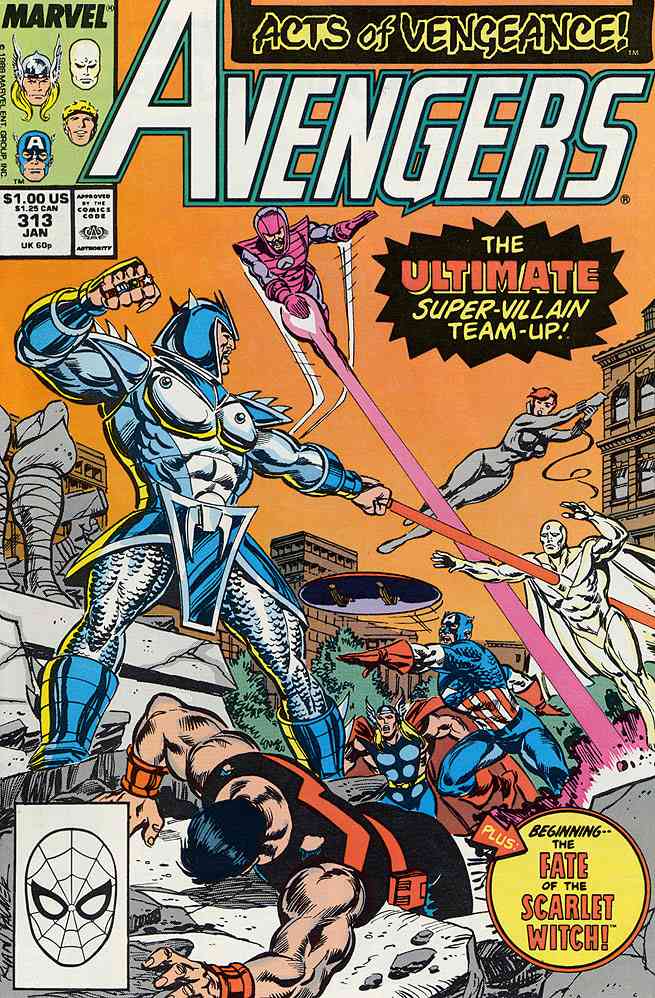
Avengers 313 - Acts of Vengeance

"The Ultimate Super-Villain Team-Up!" proclaims the cover. It's a phrase that many in Marvel have long wanted to use over the years, echoing the 1970s series, and here it makes an appearance in all its glory as the action heats up. But at times this is less of a team-up than a squabble.

Avengers #313

Artists: Paul Ryan and Tom Palmer
Writer: John Byrne
Letterer: Bill Oakley
Colourist: Mike Rockwitz
Editor: Jim Salicrup
Ed.-in-Chief: Tom DeFalco

This issue sees the Mandarin go on the direct attack. Outside of the X-Men issues, which have barely acknowledged the wider event, the Mandarin hasn't done a great deal in the crossover. For that matter the central alliance of villains hasn't made its major follow-up assault against the Avengers yet. Instead there's a lot of squabbling which comes to blows here as Doctor Doom and the Red Skull briefly fight before the Kingpin walks in and dismisses them as children. Meanwhile the Wizard has followed the Mandarin, hoping to seize the initiative. If the intended message is that super-villains ultimately can't work together for long because of their egos, conflicting interests and different ideologies then it's been presented subtly over a long period. Such is the lack of loyalty that the Mandarin thinks nothing of firing his rings at the Avengers when the Wizard will be caught in the crossfire, then fleeing to leave his ally to be captured. The Mandarin here may be dismissive of an onlooker's "petty racism", but he's coming as a modern-day wizard in armour and is much more of the traditional cackling villain here than he was in the X-Men issues.

The Avengers continue to struggle with collapsing public support for super heroes, but this aspect of the story would work so much better had it been more integrated into the crossover rather than largely serving as a sideshow in a handful of issues. Thus once the Avengers arrive to tackle the Mandarin the crowds disappear and there's no comment at all as to what effect this has on public opinion. Instead it's largely an action piece with the Mandarin and Wizard using their powers and weapons to provide a strong challenge.

The issue also sees Magneto capturing the Scarlet Witch, stealing an entire wooden house in the process. Although he's been part of the main alliance, that effectively ended with his attack on the Red Skull and these events are more progressing a storyline that will come to a climax in later issues of Avengers West Coast. Though having writer co-ordination between the two Avengers team books is a good idea, they're still by definition set in different locations and attempts to tell a single story across them don't work well outside of formal crossovers. And this is very much looking beyond the end of the event.

It's not the only one. The issue sees Doctor Doom shot by the Red Skull and eventually explode, revealing him to have been a Doombot, perhaps all along. This is a very well-established practice of Doom, with more than one writer retconning appearances of Doom into robots (making for difficulties in constructing a chronology, though it gets much worse with Kang), but it also neatly takes Doom out of the equation, as though he's bored of the whole thing. It's slightly surprising that the Red Skull is shocked given the recent revelation that he too has an army of identical robots.

There's a real sense of things hotting up with this issue, and not just the Doombot. It's easy to forget that "Acts of Vengeance" ran over only three months, as the large number of issues can make it seem so much longer, but here in the core of the crossover things are now heading for what looks like a spectacular climax.

Avengers #313 has been reprinted in:

Monday, 31 December 2018

Avengers West Coast 54 - Acts of Vengeance

It had to happen. With John Byrne both writing and drawing the series and with the original Human Torch having returned, it was inevitable that there would be a cover homage to Fantastic Four #1. And this in turn drives the villains with the Mole Man appearing, accompanied by monsters such as Giganto (seen of the cover), Tricephalous and other beasts underground.

Avengers West Coast #54

Written and pencilled: John Byrne
Inked by: Paul Ryan
Coloured by: Bob Sharen
Lettered: Bill Oakley
Edited by: Howard Mackie
Editor-in-Chief: Tom DeFalco

Of course this brings up the slight problem that the Mole Man has actually fought the Avengers at least twice in the past, with first Iron Man and then the Scarlet Witch on the team. One could rationalise it that the alliance of super-villains regard the west coast Avengers as a separate team from the Avengers (for some members that would be a more hurtful blow than anything else), or that as the Scarlet Witch is comatose and Iron Man is publicly a replacement for the original then it's still an original encounter. It's notable that neither of these heroes actually get to meet the Mole Man himself. And the cover scene doesn't appear in the issue, but then again neither did that of Fantastic Four #1.

The story is based around an attack on Los Angeles by the Mole Man's creatures, with the west coast Avengers quickly scattered into several groups. Thus Iron Man sets out to remove Giganto to a safe distance, determined not to harm the creature despite the urgings of US Agent. Wonder Man and the original Human Torch investigate underground to meet with the Mole Man. And the Wasp and Hank Pym seek to protect the comatose Scarlet Witch whilst their qunijet is attacked by Tricephalous. Meanwhile Magneto observes events, unaware that he in turn is being monitored by the mysterious stranger. There's a slight twist on the regular approach of the crossover in that rather than approaching the Mole Man and offering him a trade of enemies, the leading super villains (or perhaps one amongst them) have instead provoked an attack by staging an assault on the Mole Man's Monster Island pretending to be the west coast Avengers, thus pushing him into reprisals.

This is a relatively straightforward chapter of the crossover that manages a good bit of variety to the structure of foes whilst staying true to the core concept. However this the fourth of the six issues of the two main Avengers titles and only the final page seems to advance the main storyline as the two Avengers teams compare notes and deduce that everything else is a distraction but they're under direct attack. This doesn't feel like the major step forward that the crossover needs at this stage.

Avengers West Coast #54 has been reprinted in:

Monday, 3 December 2018

Avengers 312 - Acts of Vengeance

With this issue of Avengers we see the central core of the crossover pulling together ever more. Significantly most of the Avengers seen here are from the west coast team (the Wasp, the Scarlet Witch, the Vision and Hank Pym) or reservists called up (the Falcon), a sign of how the attacks are continuing to occupy and cripple the Avengers' operational ability. So now would be a good time for a major attack by the alliance of leading villains.

Avengers #312

Artists: Paul Ryan and Tom Palmer
Writer: John Byrne
Letterer: Bill Oakley
Colourist: Christie Scheele
Editor: Jim Salicrup
Editor-in-Chief: Tom DeFalco

Instead the alliance is squabbling. With this issue we get to see a meeting of the alliance in depth for the first time. And it's not going too well. One of the biggest criticisms of the whole alliance is that it is composed of villains with huge egos and some very different perspectives on the world. The panel showing the opening of the meeting is a glorious piece that conveys just how little the six like each other, with only the mysterious stranger holding them together, and there's a particularly nice touch in the way Magneto is staring at the Skull with undisguised hatred. Here the tensions spill over with the Red Skull and Magneto especially showing their hatred of each other and contempt for everyone else and most of the others pile in to refute the Skull's dismissal of them as "common criminals". Only Doctor Doom stands above it all. But the meeting is also a wonderful parody of the real-life world of organisations and corporations where everyone is expected to gather together in person merely to receive reports they could have been sent in writing. Absolutely nothing is achieved in this meeting though later in the issue we see the alliance watching the Avengers on monitors where it's confirmed they had nothing to do with an attack by Freedom Force and suggest taking a more active role. Luckily, we don't witness the processes of someone coming up with a motion, formally tabling it, entering in a row because of the very different meaning of the term "to table" in meetings on either side of the Atlantic, then eventually discussing the proposal etc... But overall the implication is that the limited central action is largely because of squabbling egos.

Consequently the Avengers face a group of villains who have been manipulated by the mysterious stranger without his allies' knowledge. The Blob, Pyro and Avalanche have actually fought the Avengers before in the annual that introduced Rogue and both the Vision and Scarlet Witch were on the team at the time but there's no acknowledgement of that here and instead the Avengers react like these three are an unknown quantity. Given the high profiles disagreements between the creators, one does have to wonder if John Byrne simply blanked out anything written by Chris Claremont. What should be a simple fight proves anything but, with the three villains a strong match and clearly well briefed, forcing the Avengers to find some unusual ways to take them down, especially the Blob. And all the time the fight is leading to ever greater debate amongst the public about the value of super-heroes.

This issue works well in bringing the core threads of the crossover together with the leading villains' committee meeting an especial highlight. However the clues to the mysterious stranger's identity are extremely obvious.

Avengers #312 has been reprinted in:

Wednesday, 28 November 2018

The Mutant Misadventures of Cloak and Dagger 9 - Acts of Vengeance

It's not hard to guess which of the leaders' alliance is most used in "Acts of Vengeance". And once again Doctor Doom is shown to have carried out at least the initial commissioning of the villains (though he subcontracts the details to the Jester). But it's astonishing to see that the lesser villain used more than any other is Hydro Man. Never one of the big-name Spider-Man villains, he somehow keeps getting picked for inclusion in groups across the event, even though he gets captured each time.

The Mutant Misadventures of Cloak and Dagger #9

Script: Terry Austin
Art: Mike Vosburg
Backgrounds: Don Cameron
Letters: James Novak
Colours: Glynis Oliver
Pin-Up Art: Mark Texiera, Howard Chaykin, Charles Vess, John Byrne and Walt Simonson
Editor: Carl Potts
Chief: Tom DeFalco

This is an extra-large issue that sees a team-up with the Avengers with a twist. For some reason, perhaps because they've been seen fighting Spider-Man a few times, Cloak and Dagger have turned up not on the central alliance's list of heroes to dispose of but instead on a list of potential villains to recruit. And thus the Jester has come to add them to a team that will attack an Avengers public meeting.

This is a new Jester, who has taken on the role after the original retired to become an actor. Using a new version of a villain, especially in such a key role, feels so detached from the principles of "Acts of Vengeance" that it seems most likely the Jester was picked for use and drawn into at least the previous issue before someone realised the character was no longer available and so an explanation was hurriedly worked into the script to work around the mistake. The rest of the team assembled are pretty obscure foes of limited powers, including the Rock, the Fenris twins and a robot of the Hulk. The "Assembly of Evil" isn't a complete walkover but ultimately proves not much more than a nuisance. Either Cloak and Dagger and/or the villains who declined to join, such as Typhoid Mary and the Leader, were critical missing elements or else the real target was not the Avengers themselves but rather their reputation. One of the underused themes of the crossover is the public debate about whether the super-heroes make sure safer or more dangerous for their ordinary public and a crossover in which numerous villains are attacking the heroes should provide plenty of fuel for the debate. But instead this aspect has not been used so much outside the Fantastic Four issues and so the wider backdrop is lacking here.

Going for a team-up also means a trick has been missed. Cloak and Dagger normally have gritty street level adventures against non-costumed foes and are generally isolated from much of the wider Marvel universe, so this crossover could have provided an opportunity to face them off against some bigger name established villains. But unfortunately that opportunity has not been taken and so instead we have a team-up that somewhat crowds out the stars of the book, with a somewhat lightweight fight that at times has elements of slapstick, particularly in the scenes with She-Hulk and both the Hulk robot and the Jester.

Overall this is a rather disappointing issue. It doesn't feel worthy of either a double-sized issue or of being Cloak and Dagger's sole participation in the crossover. All round it feels like a set of wasted opportunities.

The Mutant Misadventures of Cloak and Dagger #9 has been reprinted in:

Tuesday, 13 November 2018

What The--?! 6 - Acts of Vengeance

Marvel has a long history of self-parody strips and comics, ranging all the way back to Not Brand Echh in the 1960s. Its main series in the late 1980s and early 1990s was What The--?!, which had a 26 issue run over five years with even the schedule a parody at times, coming out monthly, bimonthly, quarterly and appearing at random times. Issue #6 came out during a big event and parodies it with 'Everybody vs. Everybody Else in "SMACKS OF VENGEANCE!"'

What The--?! #6

Written and pencilled by: John Byrne ("Smacks of Vengeance")
Inked by: Terry Austin ("Smacks of Vengeance")
Lettered bu: Rick Parker ("Smacks of Vengeance")
Coloured by: Mike Rockwitz ("Smacks of Vengeance")
Co-Writer: Doug Rice ("Origin of the Pulverizer")
Co-Writer/Artist: Hilary Barta ("Origin of the Pulverizer")
Letterer: Willie Schubert ("Origin of the Pulverizer")
Colourist: Linda Lessmann ("Origin of the Pulverizer")
Writer: Howard Mackie ("Sore wants a Haircut!")
Penciler: Adam Blaustein ("Sore wants a Haircut!")
Inker: Chris Ivy ("Sore wants a Haircut!")
Letters: Brad K. Joyce ("Sore wants a Haircut!" and "Adventure into Boredom! Fear!")
Colourist: Ronn Stern ("Sore wants a Haircut!")
Story: Peter B. Gillis ("Adventure into Boredom! Fear!")
Pencils: Doug Rice ("Adventure into Boredom! Fear!")
Inks and most of the good jokes!: Hilary Barta ("Adventure into Boredom! Fear!")
Colours: Kelly P. Corvese ("Adventure into Boredom! Fear!")
Editors: Terry Kavanagh and Carl Potts
Editor-in-Chief: Tom DeFalco

This eight-page strip doesn't go for a big spanking fest but rather justifies its title with an intro that explains the situation just "smacks of vengeance". In this parody there is a small invasion by villains from the Dee-See universe such as the Jokester, Sinestronie, Magilla Grod and Metal-Toe, causing problems for heroes such as Scaredevil, the Mighty Sore, Wrillimean and the Revengers, led by Chaplin America. There's even a cameo by Casper and Wendy from Harvey Comics before Chaplin America decides there are too many companies and throws them out. Most of the names are straightforward twists on the existing heroes such as Ironed Man, the Scarlet Wench, the Visionary, Wondrous Man, the Wisp and Buckeye, but calling Quasar's parody "Motorola" is a joke that doesn't work well without background knowledge. ("Quasar" is a brand of electronics originally from Motorola, but the name doesn't seem to have been used outside the US and Motorola sold the brand 15 years before this issue was published.)

This is mainly a strip full of gags but it also does something very surprising. There's a mystery villain who overstays their time in the One-Hour Lurking Zone and their identity is revealed. And, as we'll see later on, it's the identity of the mysterious stranger, published (according to Mike's Amazing World of Comics) three weeks before both regular comics that revealed it went on sale. It has to be said that the stranger's identity hasn't been too well disguised, but it's astonishing that a parody comic could do this even with the crossover's core writer at the helm. Maybe the schedule or the shipping got mixed up (a problem that has hit a lot of Avengers based crossovers over the years) or maybe the identity was considered so obvious as to not try to disguise it any further.

This issue also contains three other parody tales with an especial emphasis on some of the most popular characters and themes in comics at the time, and not just at Marvel. "Origin of the Pulverizer" takes a twist on the origin of the Punisher (starting with a scene in a park when a gang boss kicks a boy's dog into orbit) and throws in several elements from other series and characters, particularly Batman. But the moment that really made me sit up in surprise is the scene where the man who will become the Pulverizer sits contemplating how to instil terror into criminals only to be hit by a brick through the window which results in inspiration for his visual identity. I wonder if Doug Rice and Hilary Barta were aware of Lew Stringer's wonderful Brickman, which did the exact same joke over a decade earlier. In reverse, Stringer recalls that he was certainly aware of this:
"Sore wants a Haircut!" sees the character go to the barber's only to find it specialises in a particular style seen across multiple Marvel characters. "Adventure into Boredom! Fear!" sees a confrontation between the Man-Thang and the Swamp-Thang about their origin and the style of the words in their respective strips. The comic also mocks some of the adverts from bygone years, whether for Marvel merchandise or for toy weapons or dubious archaeological finds. There's even a back-page parody of the "build up your muscles to deal with bullies on the beach" adverts that throws in a parody of Thor for good measure.

All in all this is quite a fun little piece that playfully mocks Marvel and beyond, though at the time it would have lost marks for giving away the identity of the mysterious stranger. But beyond that it's good for what it is.

What The--?! #6 has been reprinted in:

Wednesday, 7 November 2018

Wolverine 20 - Acts of Vengeance

This issue continues Wolverine's adventures in the Latin American cliché of Terra Verde with the continued interference of Tiger Shark the only element from the wider event. Otherwise this is a middle parter of the story and very much an action driven one as La Bandera and her rebels try to free political prisoners from a medical centre with a side-line in experiments, whilst Wolverine and Tiger Shark each keep on coming back.

Wolverine #20

Writer: Archie Goodwin
Breakdown artist: John Byrne
Finishing artist: Klaus Janson
Letterer: Jim Novak
Colourist: Mike Rockwitz
Editor: Bob Harras
Editor-in-Chief: Tom DeFalco

The issue opens with a strong sequence as Tiger Shark forces Wolverine into the depths of the sea and shoves his claws into a coral reef, leaving him unable to extract himself in the time before his air runs out. It's such a strong sequence that it really should have been the cliffhanger to the last issue instead of just Tiger Shark intercepting Wolverine as the latter fled the medical centre through the sea. It also confronts Wolverine's cockiness well as he initially thinks how he hasn't got a chance against Tiger Shark in the water and these are the sort of odds he likes. A pattern recurs through the issue as each fight makes it appear that the loser is doomed, only he comes back at an unexpected moment later on. Only at the end of the issue do we get a permanent conclusion to the conflict though Wolverine doubts his foe will be killed in the process.

The rest of the issue focuses on a battle with the military dictator who is using a special variant of cocaine combined with his ex-wife's mysterious healing powers to produce a super soldier for the country. Meanwhile La Bandera tries to free political prisoners and confront the dictator but enthusiasm for a rebellion is in somewhat short supply. There's also an indication that the real power is the president's adviser Geist, an aged Nazi who survived the war and went on to help various governments with secrets, acquiring cybernetic elements to his body in the process. However this element of the story is still mired in cliché and doesn't yet overcome it to provide an original spin.

Being the conclusion of the title's involvement in "Acts of Vengeance" but only a middle part on its own storyline means that this is an unsatisfactory issue for the crossover reader even though it confirms that excellent matches of heroes and villains can be made out of the basic premise. But otherwise it has too many cliched elements and leaves the event before sorting them out without being sufficiently gripping to stay around for the local storyline's conclusion.

Wolverine #20 has been reprinted in:

Monday, 5 November 2018

Wolverine 19 - Acts of Vengeance

We come now to what is surprisingly the first ever issue of Wolverine to take part in a crossover. In the early years of this series there was a real determination to ensure that this series stood on its own merits rather than merely feeding off events in Uncanny X-Men, with the result that Wolverine's solo adventures are largely set elsewhere. It notably did not take part in a number of crossovers between the other mutant titles such as "Inferno", "X-Tinction Agenda" and "X-Cutioner's Song" and may also have avoided having annuals to duck out of further crossovers. Consequently the first 74 issues of the title are almost their own beast, give or take the stories that build on revelations in Marvel Comics Presents. But this and the next issue are the exception to this rule, suggesting that either a Marvel-wide event could override the wishes of the X-Men editors or else having John Byrne as the artist on a series guaranteed its inclusion in a crossover he was heading. But notably Archie Goodwin manages to weave the crossover into an existing storyline so that it feels completely natural.

Wolverine #19

Writer: Archie Goodwin
Layouts: John Byrne
Finishes: Klaus Janson
Colourist: Mike Rockwitz
Letterer: Jim Novak
Editor: Bob Harras
Editor-in-Chief: Tom DeFalco

The storyline itself concerns Wolverine's investigations into a cocaine supply line that's come into Madripoor, a Singapore-like city where he spends most of the early years of his solo series, with his old foe Roughhouse captured and experimented on. The cocaine has also been supplied to the United States, creating further complications. So when Wolverine arrives at the source, the Latin American country of Tierra Verde, he soon comes across Tiger Shark who's been sent to deal with the country's hero La Bandera. A brief cutaway scene establishes that the Kingpin has sent Tiger Shark both for revenge for disruption to his operations but also as part of the broader conspiracy. It's a sign of how easy it would be to cut the wider event from the storyline. As we'll come to more with the Uncanny X-Men issues, Wolverine has been officially considered dead and undetectable to equipment for a while now so he's one of the few heroes who it's natural to not target. Despite this, Tiger Shark is actually quite a good fit since one of Wolverine's biggest vulnerabilities is drowning and so a water-based foe presents a stronger challenge than usual.

Tierra Verde is a country that's cliché upon cliché. A Latin American country with a military dictatorship, rebellion openly forming in the streets, state involvement in international drug crime and an ex-Nazi operating in the country who actually says, "an embarrassing cliché, yes?" The concepts are so well-worn, especially at Marvel, that it makes one wonder if there are any other story types set in the region. This is La Bandera's first appearance and she quickly falls into the classic sidekick role of the young innocent girl contrasting with the experienced and cynical Wolverine. Otherwise as the first issue to see Wolverine in the country this is predominantly a scene-setter, with the complications of Tiger Shark getting in the way as Wolverine makes his way to the heart of the operation.

Although this is the third part of the overall saga, the scene shifting helps to make the issue sufficiently accessible for readers brought in via the wider crossover. The Kingpin sending someone to take down a previously never before seen hero may not be the biggest event going but given the odd set-up for the X-Men at the time it's understandably hard to arrange a more conventional conflict and Tiger Shark is a good match for Wolverine anyway. Overall this is not the most essential of chapters in the crossover but a good example of how to incorporate it into the regular flow of a title.

Wolverine #19 has been reprinted in:

Wednesday, 17 October 2018

Avengers West Coast 53 - Acts of Vengeance

Avengers West Coast was the series that brought John Byrne back to the mainstream Marvel universe after a two-and-a-half-year absence over at DC, latterly also working on a bit of the New Universe. At this stage he'd been writing and drawing the title for nearly a year making bold changes such as literally deconstructing the Vision, to be rebuilt as an all-white, emotionless being, or bringing back the Original Human Torch. In the process a lot of this change has wreaked havoc on the Scarlet Witch.

Avengers West Coast #53

Writer/Penciler: John Byrne
Inker: Keith Williams
Letterer: Bill Oakley
Colourist: Bob Sharen
Editor: Howard Mackie
Ed.-in-Chief: Tom DeFalco

But also Byrne was now writing both of the Avengers team titles, in a period when Marvel was trying to build a clear franchise mentality, much as it later did in the mid-2000s. One factor to watch out for is just how this crossover handles the perceived second tier status of the West Coast based team. Were they subordinate to the New York team, with the latter being THE Avengers, or were they the co-equals of the "East Coast Avengers"? Over at DC the recent expansion of the Justice League International had seen the existing title renamed "Justice League America" but that was at least close to the team's historic title, so it was less of a problem to give parity of esteem to "Justice League Europe" (and even to "Justice League Antarctica"). But over at Marvel the Avengers retained their historic title and there were often periods when readers of that book might as well not have been aware of the existence of the West Coast title. Hopefully a major crossover based on the Avengers with both teams written by the same writer would not fall into this trap.

However this particular issue is focused more on getting its characters caught up in the crossover rather than advancing the wider plots, whatever Magneto and/or the mysterious lackey may think in the opening pages. One thing that does seem clear is that the lackey isn't Immortus (not that he was a strong suspect anyway), who is shown operating his own schemes to eliminate alternate timelines as part of some unspecified plan involving the Scarlet Witch. Otherwise we have an issue in which various characters are still coming to terms with recent events, with the Scarlet Witch having suffered a breakdown due to recent events, the Vision determining to switch to the east coast team and the Human Torch still coming to terms with learning about the death of his partner, Toro. Into this mix comes an attack by the U-Foes, a group who recently clashed with the east coast team but are predominantly obscure Hulk foes. Their mixed abilities mean they're a good match for this current crop of Avengers (Scarlet Witch, Vision, Original Human Torch, Wasp, Hank Pym and Iron Man) but ultimately the fight is set-up as a holding tactic to occupy the team until the U-Foes discover they've been set up whilst Hank discovers much bigger things are going on.

This isn't a bad issue for bringing the West Coast Avengers into the bigger event, but we've already had a lot of issues in the crossover (even if we stick to just publication dates a good dozen came out before this one) and a chapter written by the head writer in one of the main books really should be advancing the overall plot at this stage rather than still going through the preliminaries.

Avengers West Coast #53 has been reprinted in:

Monday, 17 September 2018

Avengers 311 - Acts of Vengeance

We now come to the first issue written by the crossover's originator, John Byrne. Although there are multiple orders around for the crossover and some of the issues already looked at weren't published until after this one, it's still surprising to find so much of the event has already happened before its guiding hand has written their first issue. But then this isn't new - "Inferno" had a lot of build-up by Louise Simonson before Chris Claremont's first issue appeared.

Avengers #311

Artists: Paul Ryan and Tom Palmer
Writer: John Byrne
Colourist: Nelson Yomtov
Letterer: Bill Oakley
Editor: Jim Salicrup
Editor-in-Chief: Tom DeFalco

Despite Paul Ryan drawing both the cover and the story inside, the former is somewhat misleading as it features the current Avengers team when only Quasar appears in this issue. Instead the Avengers' support crew have to fight off an assault against Hydrobase, the team's current headquarters on an artificial island. Given the speed of the attack and the way that the island itself is targeted one has to wonder why the Avengers chose a base that has proven to be so vulnerable. It's also unclear from this issue (and indeed from the internet) whether the mansion on the island is the original one somehow transplanted from New York. If so then it's a rather ignominious end for the Avengers' original headquarters, destroyed with only the team's newest member and support crew to see it. But then this is from an extended period long considered one of the weakest in Avengers history. Over the course of about sixty issues between the departure of Roger Stern and the permanent arrival of Bob Harras the longest continuous run was Byrne's, at just a dozen issues (plus a plot on the next one) whilst the team line-up went through numerous changes. Bringing the Avengers low fictionally at the same time feels quite appropriate.

The assault comes from a squad of robots sent by one of the leading villains but for some strange reason the two of them shown here have their identities hidden. We've already seen some of the them without shadows and a leading villain who wears a green cloak, has a lot of scientific expertise, has lost a kingdom and is addressed as "Doctor" isn't exactly the hardest mystery villain to guess. Either the creative team aren't all singing from the same hymn sheet or else this is a homage to the paper-thin mysteries of the Silver Age. Dialogue here about many heroes having already been attacked confirms that this isn't a placing error and indeed just about all the full chronologies of "Acts of Vengeance" have issues showing at least some of the leaders before this one, so the mystery feels rather pointless. The green cloaked figure's co-conspirator's blue armour may not be as widely known but it also doesn't hide the identity from anyone who has seen it before. Meanwhile the mysterious strange who recruited the leaders of the conspiracy is shown in a setting that's somewhat suggestive of his identity, but it's probably best to wait for a full meeting of the leaders to discuss that.

As the first major part of the crossover this issue really should be doing more to anchor the overall narrative and introduce the set-up. Instead it feels like a middle chapter of an event which leaves the structure weakened. This also contains one of the biggest acts of destruction in the whole event and it's understandable that the attack happens whilst most of the Avengers are tied up elsewhere, but it might have been better to wait to first show them all caught up rather than making their absence here implied. All in all this is a stuttering start to the event.

Avengers #311 has been reprinted in:

Friday, 13 November 2015

What If... Essential Captain Britain volume 1?

This time the look at hypothetical Essential volumes take a somewhat different series and format...

Essential Captain Britain volume 1 would contain the character's original stories from Captain Britain Weekly #1 to #39 and then the stories from Super Spider-Man and Captain Britain Weekly #231 to #253, including the reprint of Marvel Team-Up #65 and #66 in the last six issues with additional splash pages added when the two US issues were each split in three for the weekly format. These issues have had a mixture of reprints over the years in both the UK and US, starting with the 1978 Captain Britain annual but in the UK at least the best modern source are the trade paperbacks from Panini (who now hold the Marvel reprint licence in the UK), specifically volume 1 Birth of a Legend (which had two different covers), volume 2 A Hero Reborn and volume 3 The Lion and the Spider. Alternatively the issues were published in the US in two oversized hardcovers entitled Birth of a Legend and Siege of Camelot. The writing on the Weekly comic is first by Chris Claremont and then Gary Friedrich who carries onto the merged Super Spider-Man with help along the way on plots by Larry Lieber, Jim Lawrence and Bob Budiansky. Jim Lawrence then finishes off the Super Spider-Man issues and Claremont returns on Marvel Team-Up. The art on the UK stories is by Herb Trimpe, John Buscema, Ron Wilson, Jim Lawrence, Bob Budiansky and Pablo Marcos with John Byrne on the Marvel Team-Up stories.

For those less familiar with the British comics industry of old (and in to some extent this is still the same today), it differed from the US in a number of ways including retaining a younger focus for longer and used the weekly anthology format far more. "Free" gifts would sometimes come attached as a way to boost circulation at a launch, smooth over a price rise or help at relaunch moments. (Nowadays most British comics aimed at younger readers seem to come packed with multiple "free" gifts every issue.) Full colour was rarer, with many comics having some pages in black and white or in a three tone format that added a single colour and it was far from unusual for a strip to switch between colour, black and white or three tone in a single issue. Series would often contain multiple strips, some originated for the title, some imported reprints and some reuses of old strips, plus additional features. When a series was nearing cancellation, it would often be "merged" into another series, which in practice meant adding the main strips and the cancelled comic's title though over time both would be diminished. A disappeared series could also experience something of an after-life in the form of holiday specials, usually carrying reprints or left-over inventory material, and annuals, which here are hardback books mainly aimed at the Christmas market (normally carrying the following year's date although there have been exceptions) and again carried a mixture of strips, features and quizzes.

Superheroes are thinner on the ground here and the British generally aren't into massive flag waving American style overt patriotism. So creating a British version of Captain America and making them last seems rather a tall order. However that's not quite the way the character went. It is hardly an original observation to note that whilst Captain Britain's name may be derived from Captain America, the character owes rather more to Spider-Man with a small dose of Thor thrown in for the origin. Thus we get the tale of a university science student with an alliterative name, family members whom he tries to keep out of trouble, a struggling relationship with a girl, a campus bully and an authority figure with a heavy opposition to all costumed heroes in general and this one in particular. Then there are the dead parents, although this isn't established at the outset, and an investigation into their fate leads to conflict with the Red Skull. The costume also downplays the overt patriotic elements with the Union Jack confined to the top of his mask and wrist bracelets, whilst the heraldic lion isn't such an automatic symbol that screams "Britain". Otherwise, the main colour is red. The main Captain America influence can be found in the powers and weapon, with Captain Britain initially only have super strength and agility plus a predominantly defensive weapon, although as time goes on and other writers take over the quarterstaff is first revealed to also generate energy shields and blasts and is subsequently replaced by the Star Sceptre , a more ornate piece that additionally brings the power of flight. And the origin shows an ordinary man gaining powers thanks to mythical magic, though the wizard who co-grants them isn't explicitly named as Merlin for some time to come. So certainly there's a lot of borrowing from other characters even if not mainly from the most obvious one. However few ideas are truly original and it's the mix and blend that matter. Here there's a lot of originality and potential clear from the start.

But despite generating several hundred pages of material, the original Captain Britain strip lasted barely fifteen months. It's clear that Marvel had high hopes for the character and series but also that sales success was elusive and this shows in a succession of reactions. First, there's the resort to a big name guest star in the form of Captain America for quite a protracted run. (Nick Fury also appears but his own adventures were reprinted elsewhere in the comic.) Then there's a change of format with an expansion in the number of pages and strips masking a contraction as the title strip shifted to black and white. And then there was the cancellation of the title with a trumpeted merger really being a cover for dumping the remaining material in another title so as to salvage some of the costs. All of these developments took place within nine months. And whilst the continuation in Super Spider-Man may have allowed for the resolution of the existing storyline, the last few originated stories seem so detached and thrown together that it seems the merged comic was just treading water until the Marvel Team-Up story was available to be simultaneously printed in the UK and US. Otherwise, it would have faced the embarrassment of cancelling the feature only to revive the character within a matter of weeks. As a result the last weeks feel very patchy as though leftover ideas were grabbed and thrown in without too much thought for overall narrative coherence - e.g. why Captain Britain, in costume, has come to an island as part of a group visit goes unexplained - or continuity - for instance Betsy goes from being a commercial pilot to a professional model without explanation, beginning the long-running practice of making sudden changes to her without a coherent explanation. As a whole, the strip suffers from being constantly in a state of panic. But it also suffers from a lack of authenticity, and this may be the reason why 1970s readers didn't take to it in sufficient numbers. (Equally, it may be the case that Marvel had unrealistic expectations for the series, hoping for rather higher sales than for its all-reprint titles. I don't know if the strip had any contemporary printings in other countries but it's doubtful there was much additional income available to support it.)

Chris Claremont may have been born in the UK and Herb Trimpe may have lived in Cornwall for a while (and the spellings may be British and the British characters at least don't sloppily use "England"/"English") but fundamentally this strip feels far too American, writing about a stereotype of Britain gleaned more from films, television and the odd guidebook than from reality. Brian Braddock's Britain of the 1970s is an idealised land of moors, country houses, villages of superstitious people willing to burn anyone suspicious as a witch, super spy agencies, functioning London docks, a monarch who can easily take the fleet off to war with no one objecting and more. The dialogue is often Hollywood~ised, whether it's the excessive use of swearing and Cockney or subtler things such as British characters saying "Prime Minister Callaghan"/"Mr Prime Minister" for a surprising guest star when those US styles aren't used here. (Captain America and Nick Fury also use them but they at least have the excuse of being abroad.) The political elements of the stories are rather generic with Callaghan and Parliament's treatment being pretty interchangeable with any national leader and legislature apart from the iconic showdown when a bomb is planted on the face of Big Ben's clock. The Queen's appearance is surprising for the amount of actual power she's credited with, being able to call out the navy to go and reinstate a dictator with a touch of Ian Smith about him in the fictional nation of Umbezi. And the general style of the series is that of a conventional Marvel US superhero series, without any particular home-grown twists or humour. As a result, the strip doesn't feel particularly British in spite of the name or location. It's little wonder it spent so much of its brief existence trying to find a way to survive.

It also doesn't help that at times the strip wanders all over the place, with ideas introduced and then rapidly changed. This is most notable in the way that Dr. Synne is changed from a magician to a man controlled by an advanced computer and then before the computer can be taken on and deactivated, it falls under the control of the Red Skull but becomes only a minor part of his overall plot. Braddock Manor gets blown up during the story and the computer is ultimately ignored. The sudden change of approach to the villains is reflective of a wider shift as Gary Friedrich takes over the writing from Chris Claremont and shifts the series even more in the direction of a generic superhero series. And just as the UK entered a year of patriotic celebration of the Queen's Silver Jubilee, the strip drifts into the American national myth of coming in and saving the British from the Nazis with the arrival of both Captain America and Nick Fury in order to battle the Red Skull.

There aren't many recurring foes in these tales though a number of the villains introduced here have since popped up in other Marvel stories. The origin villain is the rather forgettable Joshua Stragg the Reaver, seemingly a businessman trying to corner the market in nuclear energy through the use of a hi-tech assault force to attack research centres and kidnap scientists. In pursuit of Brian he picks up the sword his quarry has rejected and becomes a powerful knight who is soon dispatched. Subsequent foes include the Vixen's mob of hi-tech bank robbers, the Hurricane with wind powers, the dark dream generating magician turned old man powered by a computer Dr Synne, the aforementioned but unnamed super computer and its projection Mastermind, the scientist Lord Hawk with his robotic bird of prey, the Mind-Monster who inhabits another realm alongside Merlin, Nykonn the other-dimensional dark magician, the motorcycling thug the Highway Man, his employer the Manipulator who is actually the deposed white dictator of a southern African nation seeking restoration through mind controlling the Queen, the alien Lurker from Loch Ness with a ship that has come to resemble the Loch Ness Monster, the Black Baron who is both vampire and werewolf, Doctor Claw the mad scientist on a remote island, and the serial killer the Slaymaster who targets collectors and steals their most valuable objects. The Marvel Team-Up issues introduce the bizarre assassin Arcade with his funhouse of terror, as well as briefly establishing a Maggia interest only to kill them off in a subplot. But by far the longest running and most established villain to appear is the Red Skull with a scheme to either take over or destroy the UK by holding the Prime Minister hostage in order to get Parliament to surrender. As the contemporary Chancellor (and one of the strongest candidates to replace him) would say of this nonsensical approach, "Silly Billy!"

But the most recurrent problem for Captain Britain is Detective Chief Inspector Dai Thomas of the Metropolitan Police. As with most fictional police officers his jurisdiction runs wherever the story needs it, and he brings a recurrent threat to Captain Britain. Though used somewhat to fill the J. Jonah Jameson role, he is actually a very believable antagonist since an official police officer is naturally going to be hostile to superheroes running around as self-appointed vigilantes taking the law into their own hands. And his background is expounded upon to explain that he's even more hostile than other authority figures because on a trip to New York his wife was a bystander killed during a superhero battle. Nor is he selective in his discrimination, being just as hostile to Captain America. As a result, he comes across as a well rounded character with an understandable motivation for his hostility to the hero. The series initially offers a contrast in the role of good cop Detective Inspector Kate Fraser who proves much more sympathetic to Captain Britain, but she's forgotten amidst the change of writers. Both had previously had bit parts in Marvel US titles and serve to help subtly connect these adventures to the mainstream Marvel universe being published over in the US (indeed the main name used for it today was introduced in a later Captain Britain story). The rest of the authority side of the cast comes in the UK's answer to S.H.I.E.L.D. - Strike - Special Tactical Reserve for International Key Emergencies, yet another in the long line of agencies whose names seem to have been chosen more for creating a memorable acronyms than anything else. Both it and its director, Commander Lance Hunter, recur throughout the run with a strong indication that Captain Britain will eventually be conscripted to work for the agency.

The non-costumed side of Brian's life also brings a somewhat underused supporting case. Thames University seems a rather generic institution, not based on anywhere specific but rather an institution that can support as diverse a range of plots as possible. Amongst Brian's fellow students are Courtney Ross, the inevitable romantic interest, and Jacko Tanner, the campus bully and rival for Courtney's affections. When Courtney is a bystander injured in a battle Captain Britain is rather too open about his concern for her. Later on Arcade deduces enough to kidnap Courtney and use her as bait in her funhouse, suggesting Brian is rather too loose with his identity. His siblings, Betsy and Jamie, also discover it quite quickly. Betsy here demonstrates hints of her psychic powers that she will later use heavily in X-Men but otherwise is something of a blank slate available as a recurring damsel in distress despite being a working women in either aviation or modelling depending upon the writer. Jamie is more consistent as a racing car driver who tries to help his brother more than he should, to the point that Brian eventually resorts to tying his sibling up to keep him from danger. Brian is given guilt to carry that his parents were electrocuted by the supercomputer in the mansion basement whilst he was out with a girl, but it's hard to rationally accept anything as his fault. There's no reason why he would have been with them below stairs, nor could he have spotted the danger in time. And where were Betsy and Jamie at the time and why don't they carry any guilt? It's another part of the attempt to copy the elements of Spider-Man but failing to make them convincing.

Apart from the final six issues, these stories were all originally written for a weekly format of just seven pages at a time (though a couple of issues go to eight pages and pass off the final page in black and white as "A Captain Britain do-it-yourself colour page!"). It's quite a constraining format without that much space to develop characters and subplots but at the same time it's easier to run lengthy stories as the action continues week from week. Wisely the story lengths are variable rather than trying to line up to three issues at a time that could then be collected in the US format; however some storylines run on for more weeks than there's plot for and sometimes it takes two issues before revelations promised in the next issue caption are delivered upon. The art is generally strong as well though the artists take time to remember these were originally published on a larger page than a US title and so have more room to work with. The final six issues constitute the reprint of Captain Britain's first US appearance in Marvel Team-Up. Being reproduced so quickly in the UK allowed for extra splash pages to be produced for individual chapters. These manage to slot in quite nicely (although they were only done in black and white so can look odd when combined with the colour pages from the US) without disrupting the story flow at all.

But despite the writers and artists adapting to the format well, overall it's hard to disguise just how weak the original Captain Britain stories are. The basic problem seems to be a belief that sticking a superhero in the UK and slapping around some names and Union Jacks would deliver strong results when instead it delivers a rather inauthentic piece. US fiction in many different mediums has been popular in the UK but it rarely tries to pretend it's a great local thing. As a result the series struggled then and now as not sufficiently convincing but the wrong conclusions were drawn leading to a state of flux and panic throughout the strip's lifetime until it was just treading water before a key US appearance. These adventures are very disappointing to read even today.

Should they have had an Essential edition? It's hard to say. One thing where an Essential edition would have helped is in standardising everything in black and white. The "Captain Britain do-it-yourself colour pages!" do stand out in the trade paperbacks (although colour versions were done for the 1978 annual that have been reused since) and the Marvel Team-Up issues were never meant to be read as a hybrid of original US colour material and additional UK black and white material so again an Essential could remove the jar. More pertinently the main strip went black and white from issue #24 onwards, midway through the Red Skull storyline so having it all in black and white would help. But although the format itself would offer advantages, the material quality raises real questions. Were these the only Captain Britain stories then they are frankly so poor they could be easily forgotten, leaving the Essentials to focus exclusively on Marvel's US output. But some of the later Captain Britain stories were landmarks that might be worthy of a volume 2 - which by definition would need a volume 1 to come first. The stories have had reprints on both sides of the Atlantic so there is clearly a market for them but they're not something that really needs to be collected in every library style format.

Friday, 23 October 2015

What If... Essential Champions volume 1?

Another look at a series as if it had been collected in an Essential volume, including all the additional issues included in other collections. This one is otherwise found in Champions Classic volumes 1 and 2.

Essential Champions volume 1 would contain all seventeen issues of the 1970s series plus the crossover issue Super-Villain Team-Up #14, the guest appearances in Iron Man annual #4 and Avengers #163, and also the epilogue in Peter Parker the Spectacular Spider-Man #17 to #18. (This is also the combination of the forthcoming Masterworks edition.) That would be a slim volume but there are some Essentials this thin. Bonus material, if it were needed, could include some unused covers - the Classics include one for issue #7 that had only minor changes - and also entries from the Official Handbook of the Marvel Universe. The writing on the main series is initially by creator Tony Isabella who is succeeded by Bill Mantlo with one issue by Chris Claremont. The art on the main series is by Don Heck, George Tuska, Bob Hall and John Byrne with most making at least one return during the run. The Iron Man annual is written by Mantlo and drawn by Tuska, the Avengers issue is written by Jim Shooter and drawn by Tuska, the Super-Villain Team-Up one is written by Mantlo and drawn by Hall, and the Peter Parker the Spectacular Spider-Man issues are written by Mantlo and drawn by Sal Buscema.

1975 was a big year for team titles at Marvel. As well as the ongoing exploits of the Avengers, Defenders and Fantastic Four it also saw the launch of the All New All Different X-Men, the debut of the Invaders and the start of the Champions. But whereas all the other titles would last for several years, Champions would limp along for just over two years, confined to the odd eight-issues-a-year format that would make multi-part stories take ages to resolve and never really breaking out into a big hit. In the years since there has been little in the way of revivals bar a one-off reunion to work with X-Force in one of the 1998 team-up annuals. Otherwise the team has been mostly forgotten and treated as a joke when remembered, with Iceman once bemoaning "Do you have any idea how hard it is to find a major super-villain in Los Angeles?" (We'll find out in this review.) The nadir must surely have been when the right to use the name was won in a poker game by the team usually known as the Great Lakes Avengers but even they didn't make much of a mark with it before finding yet another name. And so the Champions have languished in obscurity.

Part of the problem may be the sheer difficulty of getting the original team back together under the title "Champions" - after the original series ended a different comic company adapted a role playing game property by the same name and at least twice Marvel has been rebuffed in attempts to reobtain the trademark. (The X-Force/Champions '98 annual was probably part of one of these attempts.) But also the team members are a pretty disparate bunch normally found spread across very distinctive parts of the Marvel universe and it can't be the easiest task to obtain the whole set for even a one-off reunion.

The team itself is initially comprised of five heroes, with another joining midway through. Leading the group is the Black Widow, who has recently left Daredevil and is developing ever more into a strong independent character in her own right. She's also one of the first women leaders of a Marvel team and also brings to the team both her adoptive father Ivan Petrovich and demons from their past in the Soviet Union. Bankrolling the team is the Angel, fresh out of the X-Men, now that newer members have taken over, heavily enriched through inheritance and ditching his secret identity in favour of being open and free with the world. Also recently having left the X-Men, but maintaining his secret identity for now, is Iceman. The youngest team member, he initially feels he wants to get on with his life and plans on dropping aside as soon as the team is fully established, but finds himself staying around to the point that this plan gets forgotten, especially under a new writer. The team's muscle is provided by Hercules, who proves to be the catalyst around which the group is initially drawn together, and he stays around for the adventure. The most distant is all the five is the Ghost Rider, seen here in the early years of his career when Johnny Blaze had full control over his flaming alter ego, who often feels distrusted and out of place amongst his teammates. Midway through the run the team is joined by Darkstar, a new hero from the Soviet Union with dark energy powers and a mysterious past. The main supporting cast member is Richard Feinster, a recently sacked lecture agent at UCLA who becomes the team's business manager.

The Champions are based in Los Angeles and have as their aims to help the "common man" with more down to earth problems, in contrast to the more global and intergalactic threats faced by other teams. It's a worthy aim, as is setting the series away from the New York norm of the Marvel universe. But in practice the team wind up facing quite a number of established larger than life super-villains and take on global and even universal threats. It looks harder to escape the conventions than it seems.

With very little pre-existing ties to bring the team together the series starts by creating a set of coincidences to get all of them to the campus of UCLA in order to get caught up in the same menace. Iceman is starting studies there and is visited by the Angel whilst Hercules has been appointed a visiting lecturer on the reality behind Greek myths. The Black Widow is applying for a post as a Russian language teacher and the Ghost Rider's alter-ego of Johnny Blaze happens to be motorcycling through the campus. The initial menace is the arrival of Pluto the Greek god of death who seeks to force Hercules and Greek god turned little remembering Atlas era hero turned new lecturer in humanities Venus to marry his allies, Hippolyta, queen of the Amazons, and Ares, god of war, so that they will be unable to battle against Pluto's planned take-over of Olympus. The opening adventure takes up the first three issues with a journey to Olympus itself thrown in and results in the five working together and realising how well they mesh as a team. It's hard to disguise that most superhero teams have had awkward origins precisely because they rely on cautious loner heroes suddenly discovering how well they work together, but the Champions seem especially forced given the ongoing distrust of Ghost Rider and the initial reluctance of Iceman. It's as though they were thrown together by dictat rather than emerging as a natural combination.

The team takes a few more issues before it's fully constituted, complete with its own transport in the form of the Champscraft and a headquarters in a Los Angeles skyscraper. However both get assembled by dodgy contractors and a minor recurring theme are the problems with equipment failure though it doesn't come to the forefront until the epilogue in Peter Parker the Spectacular Spider-Man. The team's public relations are also a bit of a mess, with their official launch coinciding with an adventure such that only the Angel and Hercules are available for the press conference which gets attacked by the Crimson Dynamo, the Griffin, and the Titanium Man, whilst a photoshoot of the dissolution of the team is an equal damp squib with only the Angel still around when Peter Parker arrives.

When one looks at the foes encountered by the Champions it rapidly becomes clear just how easy it is to find supervillains in Los Angeles including some quite major ones. As well as the initial clash with Pluto there are encounters with a group of Soviet foes including the Titanium Man, a new Crimson Dynamo whose real identity is a shocker for the Black Widow and Ivan, and the Griffin. This group also includes the first appearance of Darkstar but she soon defects. Then there's an encounter with Warlord Kaa of the shadow-people with guest appearances by Hawkeye and the time-displaced Two-Gun Kid. The team's most wide-ranging adventure initially seems to be up against the Stranger but he is in fact looking to save Earth and the real threat comes from Kamo Tharnn (later better known as the Possessor) who seeks to recapture the Runestaff that can save the day. The Avengers appearance sees conflict with the Greek Titan Typhon who forces battle between the two whilst the Iron Man annual brings them up against Modok and AIM. The crossover with Super-Villain Team-Up involves a strange contest between Doctor Doom and Magneto in which the latter must find a way to stop the ruler of Latveria from taking over the world with a special neurogas, forcing the Master of Magnetism to seek out allies, finding them in the form of first the Beast and then the Champions. The final issue sees an attack by the Vanisher, utilising both the Sentinels and the mutants the Blob, Lorelei and Unus the Untouchable. The biggest new foe introduced here is Swarm, a collective sentient hive of bees with the mind and skeleton core of a Nazi scientist. There are a few lesser foes such as new ones like Dr Edward Lansing, a scientist abusing a care home in order to perform experiments, or Rampage, an inventor hurt by the economic downturn who dons an exo-skeleton to initially rob banks. Rampage is the most recurring of the team's foes, being used by the Soviet foes in an action that leaves him paralysed and then coming back for an act of revenge at the very end. There's also an encounter with Stilt-Man that's so forgettable he's left in the hands of the guest-starring Black Goliath whilst the Champions deal with the Stranger's problem.

The series ultimately lasted only seventeen issues and ends on a mini-cliffhanger as the Champions wonder about Darkstar's true nature. But this goes unresolved and the team is unceremoniously disbanded in a flashback in the pages of Peter Parker the Spectacular Spider-Man which otherwise serves as a straightforward team-up with the Angel (in fact it's a surprise this story wasn't told in the pages of Marvel-Team-Up) as they face down against the Champions' old foes Rampage and the shoddily constructed building. And that was the end of the Champions' story, bar one very brief reunion many years later.

So is Champions a title that should have had an Essential collected edition? The existence of the Classic reprints is the most obvious argument against but there are certainly other titles in the Essentials that have been collected elsewhere in colour. And the bar for inclusion in the Essentials was not actually that high - several short-lived 1970s series such as Godzilla, Ms. Marvel and Super-Villain Team-Up all qualified for a single Essential volume so not lasting long was clearly no barrier. Nor is the series anywhere near as mediocre as some material included in the Essentials. It may not be the most memorable of titles and the team suffers from feeling like it was assembled to fit arbitrary criteria, but there's a sense of trying and purpose to these tales that hold together reasonably well. A single collected edition would be thin without much obvious extra stuff to include - very maybe the X-Force/Champions '98 annual but that would be a much later pick and otherwise that's pretty much it as a contemporary appearance in Godzilla would be a monster of a rights issue. But there's just about enough already. This is a series that certainly does deserve reappraising as whilst it's not the greatest team title ever it's certainly a lot more credible than the dismissive comments and jokes of later years would suggest. I don't know how the trademark situation would have been an issue, though it clearly didn't stop the Classics doing two volumes. All in all the Champions is a good little series that would certainly have earned a place amongst the Essentials.