Saturday, 16 October 2021
X-Factor 32 - Inferno Prologue
X-Factor #32
Plotter/Editor in Chief: Tom DeFalco
Scripter: Louise Simonson
Guest Artist: Steve Lightle
Letterer: Joe Rosen
Colorist: Petra Scotese
Editor: Bob Harras
We're in the period when Walter Simonson was writing Avengers so it was perhaps inevitable that there would be an encounter with X-Factor at some point. But this comes on an issue from which Walter Simonson is notably absent and instead there's a plot from Tom DeFalco, who at this time was also now writing Thor. So rather than a natural encounter we get what has all the hallmarks of a fill-in issue just when major developments appear to be on the horizon.
In fairness the issue feels like it's been woven into the regular narrative rather than simply having a character suddenly flashback to a hitherto unseen adventure. That's particularly helpful as this issue came out and is set during a period of great flux in the Avengers. The Fall of the Avengers was an especially dark period for the team and this issue comes out midway through that storyline when the roster is down to four members - Thor, the Black Knight, She Hulk and Dr Druid - and this particular combination would last all of four issue. Things don't seem so bad on the opening pages as the team donate the site of the former Avengers Mansion as a public park but amongst the crowd are some mysterious strangers who analyse the Avengers and then turn out to be aliens. On board their ship they change into duplicates of the Avengers and reveal their plan - revenge on Thor for a past defeat that led to the leader's father's overthrowal as Supreme Warlord of Xarta, then conquest of Earth to use its resources to launch a bid to retake Xarta. However then they detect Ship over the Atlantic and opt to attack it.
Unfortunately there are no footnotes present to denote that these are the Carbon Copy Men from one of the earliest Thor stories in Journey into Mystery #90. In their original appearance they were poor copies of the Skrulls and even defeated the same way. DeFalco and Ron Frenz's Thor run was notable for being a particularly strong homage to the Lee-Kirby years with several obscure characters revisited so it's not that surprising to find the Xartans revisited. And shapeshifters allow for a battle that visually shows the two teams fighting in an era when it was no longer easy to engineer a fight between two superhero teams over some casual disagreement. But it is a very odd choice of foes for a fill-in issue of another series and so the main encounter is extremely forgettable. However there are attempts to weave ongoing development into the issue with the kids successfully convincing Ship to break its orders so as to let them help save the team from the aliens whilst Iceman reflects on his failures that led to the Beast nearly dying. We also get the introduction to the series of the demon N'astirh who has made a deal with the hooded leader of the mysterious group introduced last issue to have infant mutants kidnapped to serve as sacrifices in a special rite.
Despite these best intentions it's hard to deny the sense of frustration that the cliffhanger of the Beast's fate from last issue is left dangling as Hank lies on life-support throughout this issue rather than attempting to explain just what happened to him at the end. Some fill-in issues can hold up well when they don't feel too intrusive but this one comes at a very awkward time and so is less than welcome.
Monday, 11 October 2021
Amazing Spider-Man Annual 22 - The Evolutionary War
Okay we've hit a publishing mistake here. The back-up feature "The High Evolutionary" has a strict chapter order and the next one should be Fantastic Four Annual #21. However the lead feature in that has the first recap of the event so far in chronological order and places it after this issue. So I've opted to publish these two posts simultaneously in lead feature order.
(And this is another annual with a lot of creators so some of the labels are in a separate post.)
Amazing Spider-Man Annual #22
1st story: Drug War Rages
By Tom DeFalco
As told to David Michelinie
Photos: Mark Bagley & Mike Esposito
R. Parker signs on
B. Sharen in the red
J. Salicrup indicted
T. DeFalco shrieks
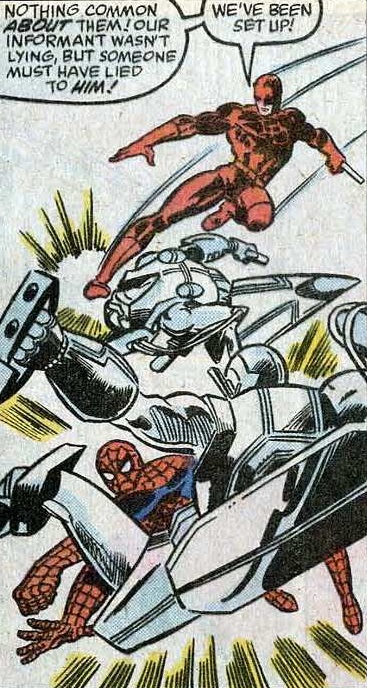
This is the first annual in The Evolutionary War to actually build on events earlier in the saga as New York deals with the consequences of the interruption of the drugs supply in Punisher Annual #1. Otherwise this annual feels quite traditional, perhaps in part because Tom DeFalco is plotting but also Mark Bagley adopts a very traditional approach to the artwork that stands in strong contrast to Todd McFarlane's contemporary work on the regular series at this time. It's a nice suitable retro feel for a story that also resorts to some traditional moves such as Spider-Man being falsely accused of a crime and J. Jonah Jameson being delighted at being proved right. There's a team-up with Daredevil and a good use of the Kingpin. But there's also the debut of a new superhero.
Speedball was the newest hero Marvel was about to launch in his own title and he's given a preview here. But it's not a very good one. There's no origin story, just a quick mention of an "accident" that gave him his powers, and the character comes across as a mess. When Robbie Baldwin encounters a force it triggers a kinetic power that sends him jumping all over the place which he tries to use to fight street level crime. There's a half decent idea in that and with some refinement to give him a degree of control that could at least all him to walk around without being terrified of brushing into anyone it might work. But the problem here is that we're given neither the origin of a new hero when he can be expected to have difficulty controlling his powers nor an appearance once he's fully come to terms with them. To add to the problems neither his creator Steve Ditko nor his regular scripter Roger Stern is working on this story and so Speedball is just thrown into this story to bounce around without contributing much that couldn't have been handled by either Spider-Man or Daredevil.
Overall this is a pretty good example of a traditional Spider-Man story with a double team-up thrown in for good measure. Spider-Man and Daredevil work well together and the menace is pitched at the right level for them. It's just unfortunate that space is devoted to introducing Speedball who really adds nothing to this tale and does not get a very impressive introduction.
2nd story: He who laughs...
Plotter & Penciler: Steve Ditko
Scripter: Roger Stern
Inking: Jackson Guice
Lettering: Rick Parker
Coloring: Tom Vincent
Editing: Jim Salicrup
Yes that's that Steve Ditko doing the plot and pencils. It's his first work on a Spider-Man book since 1966 - but he always refused to return to the main character and so is only drawing a back-up feature. Over the next few years he would appear in several more Spider-Man annuals in this way and so it's natural to wish he could have opted to return to the main character just one more time. Instead here is what was then his newest creation.
This could almost be from Speedball's own series which launched at this time and had almost exactly the same creative team at the start. One of the curiosities of the series is how many issues have multiple stories. There were a number of anthology titles around this time - examples include Strange Tales, Marvel Comics Presents, Solo Avengers and, over at DC, Action Comics Weekly - that offered multiple shorter stories but headed titles tended to have a single story each issue or at most a back-up story that focused on some of the other cast members in a separate story strand. Doing an ongoing headed series with multiple tales of the title character(s) was an extremely retro step.
And this story feels very retro. It's about thwarted ambition fuelling false revenge as an unsuccessful ex actor tries to murder Speedball's mother, believing she turned a director against him and so he failed to get a key break part. Now working as a janitor in a theatre he plans to attack her when she visits a friend there but first has to dispose of her son. This results in Speedball (who doesn't actually call himself by that name yet; instead he thinks of himself as "The Masked Marvel", his book's subtitle) bouncing around trying to distract and knock out the would-be killer before his mother can see him.
It's a rather weak story that's constrained by the need to have Speedball's powers triggered at key moments to advance the plot. The villain's motivation is believable but his attempts get sillier and sillier. Nor is it even resolved by the hero. Again this is not a good advert for Speedball and his series.
3rd story: The High Evolutionary: Kindred Spirits
Story: Mark Gruenwald
Pencils: Ron Lim
Inks: Tony DeZuniga
Letters: Ken Lopez
Colors: Gregory Wright
Editor: Ralph Macchio
Editor-in-Chief: Tom DeFalco
This is another info dump heavy chapter that rushes through the introduction of the New Men, with Bova, perhaps their best known member, being shown being genetically accelerated from a Guernsey cow, then more explanation about the nature of the Werewolf, though the High Evolutionary remains sceptical about the supernatural explanations, before the body of Jonathan Drew returns animated by a sixth century ghost called Magnus to explain how the spirit of the demon Cthon has been bound to Mount Wundagore and could be awakened by the Evolutionary's work. That's a lot to take in in just six pages but it does once again reinforce just how Marvel had let Wundagore get overused in far too many characters' histories so as to produce this mix of technology and magic and even Mark Gruenwald was starting to struggle to make it all seem consistent.
One thing that does stand out is that Gruenwald (or Macchio) isn't always writing the Evolutionary's dialogue consistently as an interwar British scientist. So some of his dialogue includes stereotypical upper class phrases like "old girl" whilst he also uses the American dating format for recording his experiments. More consistent is the way the way Herbert Edgar Wyndham is now wearing his armour full time as a sign of how he is retreating ever more from the outside world into a shell. The character is portrayed consistently as a rational scientist refusing to believe tales of magic even though he admits he does not understand the Werewolf. Although the amount of backstory to wade through can be overwhelming at times this saga so far has done a good job of building up the lead character.
Other material includes the plans for Peter and Mary Jane's apartment plus two unused covers by Larry Lieber & Jack Abel and Bob Layton from the black costume era and a plug for the Spider-Man newspaper strip. This annual may not be the best example of its series at the time as the latter was in quite a bold experimental phase but it's good traditional Spider-Man and a good introduction to crossover visitors as well as making good use of the event to tell a strong story. It's just a pity that it's had a new hero thrown in to poorly promote.
Thursday, 23 September 2021
Uncanny X-Men 228 - Inferno Prologue
And so the X-Men enter an all new era starting with... a flashback fill-in issue.
Uncanny X-Men #228
Scripter: Chris Claremont
Guest Penciler: Rick Leonardi
Guest Inker: Terry Austin
Colorist: Bill Wray
Letterer: Tom Orzechowski
Editor: Ann Nocenti
Guest Plotter, Editor-in-Chief: Tom DeFalco
This is the first issue in a very long time that is not solely written by Chris Claremont (collaboration with artists aside). Instead we get a plot by Tom DeFalco revisiting a character from Dazzler's own series albeit one introduced years after he stopped writing it. It's a classic fill-in structure with the main story told in flashback (and even containing flashbacks within the flashback) whilst the first and last pages anchor it to a character in current continuity, in this case O.Z. Chase a bounty hunter friend of Dazzler's as he reads a letter from her detailing an adventure she and Wolverine had with him.
This is the first problem with the issue - why on earth is Dazzler telling Chase about events he was involved with? And also Dazzler has not been with the X-Men that long which limits the period in which this adventure could take place to at most a few weeks before she could have sent the letter. It's likely this issue was intended to be used much later on but the big change in the X-Men's status quo is such that the narrative device won't work for a good while yet and so it's been pressed into service at this point. The result is that of all the former team members and supporting cast characters to be seen reacting to the news of the X-Men's death in the Fall of the Mutants we get an obscure bounty hunter and his cigar eating hound from the tail end of Dazzler's solo title.
The story also resorts to what was already becoming a tired cliche - a character Wolverine has interacted with in the past but never mentioned it before or since. In fact this time we get two. Wolverine's past has evolved from a well of story ideas to an incredibly convoluted list of characters and situations as "mystery" gets treated as a casual dumping ground. It stands out even more when he's not the regular character first drawn into the events but instead is following Dazzler as she rushes to Florida to help her friend who has been arrested on suspicion of being a werewolf killer. The real killer turns out to be Vladimir Zaitsev, a mutant ex Soviet agent Wolverine has tangled with before and is now on the run having first defected to the US and then fled to Columbia but has been deposed as a drug lord. As a result the Soviets are trying to eliminate him whilst the US government is trying to catch him. The latter is represented in the form of Henry Peter Gyrich, another character whose past and present are regularly adapted to suit the needs of the story at hand. Here we discover that he was Wolverine's CIA contact when the latter worked for the Canadian Special Intelligence Service. The story climaxes in a showdown in the Florida swamp where Zaitsev proves rather demanding in insisting on his life for his three hunters' and Cerberus decides to take the deal on offer. Back in the present Chase finishes reading the letter and hears the news of his friends' deaths then confronts a bigot in the bar about them.
It's easy to beat up on fill-in issues. They are invariably structured to be dropped in whenever they're needed and so can't do anything significant with the characters. The ongoing narrative structure also often requires them to be told in a flashback format to make them easier to adapt when called into service. And events in them invariably get forgotten completely. Chase hasn't been seen since this issue and I don't think any other issues have done anything with Gyrich and Wolverine's history. But that's by the by. The real problem with this issue is its placing. Coming immediately between a dramatic storyline and the launch of a bold new status quo for the series it can't disguise itself as an intruder getting in the way of ongoing developments. Because Inferno Prologue collects all the issues of all three series since the Fall of the Mutants it's understandable why it's wound up here but this has a strong potential to be the single most ignorable issue in this entire run. And it would have to be the very first Uncanny X-Men issue we come to.
Wednesday, 13 February 2019
Thor 414 - Acts of Vengeance Aftermath
Thor #414
Words & Plot: Tom DeFalco
Pictures & Plot: Ron Frenz
Finished Art: Joe Sinnott
Inks: Mike De Carlo
Lettering: Michael Heisler
Colouring: George Roussos
Editing: Ralph Macchio
The issue sees Thor's human alter ego, Eric Masterson, continue to struggle with the competing demands of everyday life and being the alternate form of an Asgardian god. Not only are hero duties interfering with work commitments but also his ex-wife is seeking to retake custody of their son, and it's looking to shape up to be a nasty fight that Thor won't be able to do anything about. Hercules is also suffering from a strange outbreak of fear that weakens his effectiveness in battle, especially when Ulik uses a magical talisman to increase his size and strength.
Oddly the hero of the day turns out to be police Lieutenant Marcus Stone, on the verge of resigning from the force at his wife's insistence. With Thor and Hercules trapped under a pile of cars (and Thor reverted to Eric out of reach of the hammer), it's Stone who intercepts Ulik on a rooftop and shoots at him until Ulik falls and knocks himself out. Stone (one of a number of characters who suffers brief race changes at the hands of George Roussos) would go on to command the special unit Code: Blue and it's an early sign of how under DeFalco and Frenz the title might maintain a retro Silver Age look and feel, but it would also veer heavily into the mortal world, showing the potential of humans in the face of great odds. Unfortunately here it comes across poorly that despite the presence of both Thor and Hercules it takes one mortal man's courage to succeed; this sort of moment would have been better left to an untransformed Eric.
Overall this issue does the job of finishing off the loose end from the last issue, with Ulik acknowledging he was brought to help in the "Acts of Vengeance". The artwork is as ever solid and brilliantly retro, whilst the continuing plots of the problems in Eric's life work well. However the story goes a bit too far in breaking down the existing heroes in order to elevate the ordinary humans and there are better ways to approach this.
Thor #414 has been reprinted in:
- Thor: In Mortal Flesh (2017 Epic Collection)
Monday, 14 January 2019
Thor 413 - Acts of Vengeance
Thor #413
Words & Plot: Tom DeFalco (all)
Pictures & Plot: Ron Frenz (lead)
Finished Art: Joe Sinnott (lead)
Pencils: Ron Lim (back-up)
Inks: Mike De Carlo (back-up)
Lettering: Michael Heisler (all)
Colouring: Nel Yomtov (all)
Editing: Ralph Macchio (all)
The lead story sees Thor trying to get the bottom of his recent problems to discover why he has been suffering spells of weakness and just who is behind the attacks on the super heroes. Meanwhile his alter ego of Eric Masterson is trying to get control of his own life as he faces a battle with his ex-wife for custody of their son. And Hercules is experiencing moments of sudden fear. Then a magazine cover inspires Eric to seek help from Doctor Strange to try to sort out Thor's problems and this leads to the "Inner Questing" ritual as Thor and Strange venture into the thunder god's subconscious to discover the answers. Elsewhere the mysterious strange monitors Thor's actions and sends his henchman to deal with Thor, Hercules and Strange. However Strange's Sanctum Sanctorum is protected by magic and so the henchman withdraws, followed by Hercules.
Inside Thor's subconscious he encounters a foe wearing his old armour, leading to a classic "my enemy - myself" fight that Strange and Eric can only watch. Finally Thor subdues his foe and removes the masked helmet to reveal the cause of his weakness. It's Loki. Elsewhere the stranger confirms this, revealing his true form for the first time in the crossover.
To put it mildly, this is not a particularly dramatic revelation. (It was also given away in What The--?! #6 but this is the first confirmation it's the same in the regular reality.) The mysterious stranger has various magical abilities and has been shown monitoring things from a throne room with monitor screens in flames. He has an especial hatred for the Avengers, identifying in particular the Wasp and Hank Pym. And the most blatant giveaway is the central alliance of super-villains. Consisting of the traditional strategic archenemies of the Fantastic Four, the X-Men, Captain America, Iron Man, Spider-Man & Daredevil and the Human Torch, it's an alliance that could have been put together at any time since the mid-1960s. The absence of Thor's archenemy, who also caused the Avengers to be formed in the first place, was highly telling and there was no attempt to give Loki any alibi elsewhere. (Other candidates, such as Baron Mordo and Immortus, have been shown during the crossover.) The only unclear point is just how Thor determines that Loki is behind the "Acts of Vengeance" as well as the loss of strength, since he doesn't see the scenes the readers do.
This is a surprisingly key moment in the crossover, yet it went out of its way to hide it from contemporary readers, perhaps so another moment that we'll come to could serve as the official discovery. This is a pity as Thor is the title with the strongest retro Silver Age feel to it, especially thanks to Frenz's Kirby homage artwork, and "Acts of Vengeance" has a strong Silver Age throwback to it. This really deserved to be put on a stronger pedestal.
Thor #413 has been reprinted in:
- Acts of Vengeance Omnibus (2011) - lead only
- Thor: In Mortal Flesh (2017 Epic Collection)
Friday, 26 October 2018
Thor 412 - Acts of Vengeance
Thor #412
Words & Plot: Tom DeFalco (all)
Pictures & Plot: Ron Frenz (lead)
Finished Art: Joe Sinnott (lead)
Pencils: Ron Lim (back-up)
Inks: Mike De Carlo (back-up)
Lettering: Michael Heisler (all)
Lettering: Jack Morelli (lead)
Colouring: Nel Yomtov (all)
Editing: Ralph Macchio (all)
Most of the New Warriors are familiar characters - Namorita, cousin of Namor, Firestar, former co-star of Spider-Man and his Amazing Friends, Speedball, a recently launched hero, Marvel Boy, a former sidekick to the Thing in his solo days, and Kid Nova, star of the 1970s solo series. They are led by a newly created character Night Thrasher, who in a sign of Marvel's determination to have some "heroes for the 90s" fights on a skateboard, is terminally serious and willing to try lethal measures even if his teammates won't. It's always good to see imagination and development at Marvel and the New Warriors did go on to have their own title which lasted quite well for a 1990s series, then a good many revivals. But the idea that they could in any way be a problem for the Juggernaut is very hard to swallow. It seems absurd that Night Thrasher has been able to convince all the sceptics to even try this, rather than seeking help from more experienced hands, and even though they admit their best hope is to cause enough irritation to buy Thor time to recover, it's still patently absurd to see Night Thrasher skating all over Juggernaut without being splattered to one side. Some of the team do have sufficient super strength to throw railway vans at him which is just about plausible, but overall this is a rather unfortunate choice of fight to launch a new team from and it just doesn't convince. It's also not too clear just why it takes so long for Thor to open a dimensional portal. Thor is continuing to suffer from mysterious seizures which makes it understandable he would need some help in a fight such as this, but for such a major confrontation it would have been much better to keep him completely solo - indeed last issue he actually went out of his way to make sure Hercules didn't come along.
Otherwise this issue sees continued problem for Thor's alter ego, Eric Masterson, as his ex-wife arrives to claim custody of their son, whilst the back-up story, written by DeFalco and drawn by Ron Lim, continues a tale of Beta Ray Bill. But overall this is a very disappointing issue that undermines what should have been a highly memorable confrontation and it would be best redeemed with a rematch in which Thor is at full power and solo.
Thor #412 has been reprinted in:
- New Warriors: Beginnings (1992) - lead only
- New Warriors Classic volume 1 (2009) - lead only
- Acts of Vengeance Omnibus (2011) - lead only
- Thor: In Mortal Flesh (2017 Epic Collection)
Wednesday, 24 October 2018
Thor 411 - Acts of Vengeance
Thor #411
Words & Plot: Tom DeFalco (all)
Pictures & Plot: Ron Frenz (lead)
Finished Art: Joe Sinnott (lead)
Pencils: Ron Lim (back-up)
Inks: Mike De Carlo (back-up)
Lettering: Michael Heisler (all)
Colouring: Nel Yomtov (all)
Editing: Ralph Macchio (all)
A lot of the line-ups across this event so far have been ones that probably weren't too demanded. In some cases the villains are a surprisingly obvious fit that it's curious they haven't been pitched against the hero before. In other cases the match-up is quite bizarre, either because of the mismatch of power levels or due to their normally inhabiting very different worlds. But one match-up above all others just feels so naturally right that it's good to see it happen - Thor versus the Juggernaut. The strongest (traditional) hero against an unstoppable force.
Again we see the mysterious stranger directly setting up the encounter, once again raising the question as to why he needed to assemble an alliance of foes when here he simply uses his power to transport the Juggernaut out of jail and onto the streets of New York. Thor's mortal alter-ego Eric Masterson learns of the rampage from television and heads out to confront him, even though his thoughts acknowledge that "groups like X-Factor usually handle mutant menaces like him" (the Juggernaut not being a mutant was presumably not well known and the X-Men were believed dead at this time). It's a cliché of comics that a villain's rampage is broadcast through the media and invariably the intended hero always shows up, even when the villain is from another series. Here it has the right effect even though it's clearly not being directed by the mysterious stranger who cannot locate Thor when he's transformed into Eric. But the battle also attracts the attention of others through the internet, a sign of the coming times, though they deserve more attention next issue.
The conflict is pretty tough, with Juggernaut proving able to resist even Mjolnir and then grabs the hammer on the return trip to attack Thor. It's a fight with consequences and Thor has to devote his efforts to ensuring a thrown car hits the one spot where it won't hurt anyone or that a coach full of passengers is landed safely. Meanwhile Juggernaut just keeps on coming, taking the battle into a railway yard where the goods vans prove useful weapons. Thor is weaker than usual due to some mysterious seizures and so it's credible that he hasn't resolved the conflict when help shows up.
Of all the new combinations of heroes and villains so far this is easily the best to be put together. Thor's strange seizures help to prolong the fight and make the eventual help credible but otherwise this is a strong first chapter.
Thor #411 has been reprinted in:
- New Warriors: Beginnings (1992) - lead only
- New Warriors Classic volume 1 (2009) - lead only
- Acts of Vengeance Omnibus (2011) - lead only
- Thor: In Mortal Flesh (2017 Epic Collection)
Monday, 27 August 2018
Thor 410 - Acts of Vengeance
Thor #410
Words & Plot: Tom DeFalco (all)
Pictures & Plot: Ron Frenz (lead)
Finished Art: Joe Sinnott (lead)
Illustrated: Herb Trimpe (back-up)
Lettering: Michael Heisler (lead)
Lettering: Richard Starkings (back-up)
Colouring: Tom Vincent and George Roussos (lead)
Colouring: Nel Yomtov (back-up)
Editing: Ralph Macchio (all)
Coming almost midway through the run by Tom DeFalco and Ron Frenz, this issue mainly focuses on the conclusion of a story in which Doctor Doom steals Thor's hammer to use in his latest scheme again the other Doctor Doom, also known as Kristoff. A back-up story tells a tale of Volstagg of the Warriors Three.
The back-up is one of many "Tales of Asgard" that expand the mythology of the series. It's a straightforward comedic piece, as Volstagg focused tales tend to be. The lead story includes a team-up with Hercules and She-Hulk but the latter doesn't really contribute much beyond a few comedic moments and being an extra in a fight. Otherwise this is a relatively tame tale of Hercules and Eric Masterson (a mortal man Thor has been merged with) battling with Doctor Doom's Defence Droids whilst Doom uses a device to freeze time in Latveria and invade the castle, only to find his alternate self is prepared.
As the most prominent villain in the Marvel it's inevitable that Doctor Doom will be seen a lot in the coming crossover, so this issue is handy as a quick introduction to his status quo in the period - during a period when he was assumed to have been destroyed, a record of his personality and some memories was implanted into his young ward & designated heir Kristoff who came to believe he was the real Doctor Doom. Kristoff has held power in Latveria and regards the returned real Doctor Doom to be an impostor. As a result the latter has been operating in exile, trying to regain his kingdom through a variety of schemes. Given Doom's arrogance it's unsurprising that he blames the failure of this one on Thor even though the Thunder God's involvement was inevitable once the hammer was stolen. So it's understandable when at the end a mysterious stranger appears and proposes "an Act of Vengeance!" that Doom is interested.
However Doom is not normally a Thor villain. It's a strange route to bring him into the plot and an early sign of just how poorly disguised the stranger's identity is. Otherwise this issue is a relatively straightforward tale in the Silver Age homage style that DeFalco and Frenz had refined on the series. For much of its run Thor has had a feeling of the old fashioned about it, but for a series starring a character from mythology that's not necessarily a bad thing.
Thor #410 has been reprinted in:
- The Warriors Three Unleashed (2011 Premiere Edition Classic hardcover) - back-up only
- Thor: In Mortal Flesh (2017 Epic Collection)
Friday, 16 October 2015
Friday, 11 September 2015
Essential Wolverine volume 6
Essential Wolverine volume 5 consists of issues #111 to #128 including the oddly numbered #-1 issue from "Flashback Month" and also "Wolverine '97", that year's annual. The writing sees the end of Larry Hama's run, including #-1, followed by stints by Warren Ellis, Tom DeFalco and Chris Claremont with the annual by John Ostrander and Joe Edkin. The artwork is mainly by Leinil Francis Yu, with contributions by Anthony Winn, Cary Nord, Denys Cowan, Stephen Platt and Angel Unzueta plus issue #127 by, get ready for it, Leinil Francis Yu, Carlos Pacheo, Cary Nord, Jeff Matsuda, Melvin Rubi and Mike Miller. The annual is by Leonardo Manco. With lots of creators, naturally there's a separate labels post.This volume contains a five issue run consisting of issues from one event and then one crossover, coming at an unfortunate moment for the title. "Flashback Month" was a curious event run by Marvel in May 1997 whereby nearly every title had a special issue set way back in the pre-super-hero days before Fantastic Four #1, with the logo, art, lettering and colouring all adopting a simpler form reminiscent of those days, Stan Lee introducing each story in person and the regular numbering being set aside in favour of "Minus 1". The odd numbering alone has made these issues rather a pain to find at times and it wouldn't have been to surprising if this one had been left out of this volume by mistake. But the event is also remembered for the way it backfired heavily on Marvel with sales actually dropping and many retailers finding even their caution was insufficient with some regular buyers rejecting the Flashback issues as out of continuity and out of sequence and thus easy to ignore. The event seems to have put off special odd numbering for a good while but otherwise carries a reputation for retro set issues that rudely interrupted series mid-story, random continuity based adventures featuring characters with no powers interacting with odd combinations of guest stars, dodgey continuity by newer writers not yet up to speed on the rather random histories of certain characters, and the seeding of big plans by writers who would be off the title before they could get round to following them up. It was further hampered by most of the Marvel titles at the time not actually featuring characters who had been around in the Silver Age - a big chunk was temporarily absent due to the Heroes Reborn experiment - and so the stories would be even more strained.
The Wolverine #-1 issue is a mixed offender. It actually came out between storylines, with "Operation: Zero Tolerance" starting the following month, and is written by the series's long term writer who by now was very familiar with the character and what had been revealed of his background. It also has the advantage of being set after Wolverine acquired the adamantium and claws and so provides a suitable dose of nostalgia as we see an amnesiac Wolverine on an early adventure encountering Sabretooth and not knowing him, then facing off against Hydra agents amidst a backdrop of various agencies of various governments all having their own agendas for Wolverine. There are cameos by James and Heather Hudson, Ben Grimm, Nick Fury, Carol Danvers and the Black Widow, all trying for false nostalgia but not really generating the spark. Ultimately tales of sinister government agencies are a more recent phenomenon and rather undermine the attempts to create a pseudo-1961 style whilst most of the cameos have been thrown in for the sake of it. There's no real revelations in this story beyond showing how Wolverine came to like cigars - hardly the most pressing thing needing an origin - and nothing set up for the future. It doesn't even serve as a good introduction to the series for any readers drawn to the special issue. All in all this is one of the worst examples of event comics.
After such a long run, it's a pity that the last five months of Larry Hama's time on the title are taken up with one event or another. "Operation: Zero Tolerance" was the big X-Men crossover in the summer of 1997, seeing the mysterious Bastion utilising a new type of Sentinel/human hybrid to bring mutants under control with government backing. A number of the X-Men get captured and taken to the old Hulkbuster base where they seek to escape, rescue other captives including Jubilee and fend off another round of Sentinel hybrids. It's rather dragged out over four issues that at times feel like they belong more in the pages of X-Men or Uncanny X-Men than in Wolverine, though at least this part of the storyline doesn't weave in and out of different titles and thus slow down this collection. What makes the story hard to follow here is that it starts with the X-Men already captured and arriving at the Hulkbuster base and then after four issues it ends on a cliffhanger involving Cyclops that is resolved in another title and thus not in this volume. It's a pity as this series has normally managed to stand pretty well on its own without needing lots of additional comics just to understand what's going on but here it rather slips up and the result is four inconsequential issues that make for a very disappointing end to Larry Hama's run.
It appears this wasn't planned, as Hama's last non-event issues seem to be building up both a new status quo and long-term threads. After coming back to the X-Men's mansion Wolverine decides he is better heading out on his own elsewhere and settles in a suburb of New York, taking a job at a construction site and developing a friendship with his female foreman. At the same time, Zoe Culloden of Landau, Luckman and Lake entrusts Wolverine with protecting a mysterious cube. The spirit of Wolverine's old mentor Ogun attacks, possessing a succession of Wolverine's friends and the affair also attracts the interest of Daimon Hellstrom, the Son of Satan. All in all it's a very so-so take that is clearly meant as the foundation for something bigger, but as is so often the case with a change of writers, and particularly with fill-ins between them, both the new status quo and the grand plans are abandoned amidst the changeover. As a result even Hama's last non-event storyline is a disappointment and so he leaves the title with his best days clearly behind him.
Hama's departure is followed by a variety of fill-in writers, none of whom lasts any distance of time. The most common feature is a resort to Wolverine's past to pull out a previously unmentioned character to drive the story, starting with the annual in which he revisits the time he was on a mission to aid a scientist defecting from the Soviet Union only for the Soviet agent "Wolf" to intercept them, killing the scientist but letting Wolverine and the scientist's daughter escape. Now the Wolf has returned, having been genetically enhanced with the DNA of his animal namesake and seemingly seeking revenge on Wolverine and the daughter. Over in the regular series there's a four-part epic involving a mercenary known as McLeish or the "White Ghost" from Wolverine's time in Hong Kong who killed Logan's girlfriend's father for the Triads and in return Logan believed he'd killed him. Now it seems McLeish has survived and is subjecting Wolverine to a gauntlet of hire killers in revenge. It's a tough thriller but it's also about two issues too long for all that it actually does.
There's another encounter with Roughouse and Bloodscream from the Madripoor era, followed by a team-up with Captain America against a bunch of killers using invisibility technology. The final showdown takes place before an audience at a time when Cap is experiencing a huge surge of popularity to almost religious levels, making for quite a contrast between his reception and the way Wolverine is normally responded to, if at all. But both these tales are simply marking time.
The final four-part storyline in this volume sees the return of Chris Claremont to the series, after having been away from the mutant titles and Marvel as a whole for nearly seven years. And it's a story arc that suggests that his absence was for the better as we get a storyline packed with guest appearances, silliness and unexplained developments. The anniversary issue #125 brings together a wide range of Wolverine's female allies from over the years, serving to underline his ties and also to allow for a passing back of the torch from Jubilee to Shadowcat as the innocent youthful sidekick. But the whole thing gets messier and messier as the Viper brainwashes many of the women and both Jubilee and Wolverine are forced to relive past actions by both themselves and others. Most of this part of the plot is ditched once the anniversary issue is over and the focus turns to the wedding of Wolverine and the Viper for frankly incomprehensible reasons. Just to add to the mix, Hydra and the Hand team up to take over Madripoor whilst Sabretooth, now enhanced with an adamantium skeleton, shows up to attack Wolverine but then unites with Shadowcat to save Madripoor from take-over. It's a tangled web of shifting alliances, complicated further by a protracted sequence in which Wolverine seeks to pick off Hydra agents by convincing them the Hulk and members of the Avengers, Fantastic Four and X-Men are all in town, simulating various heroes' powers with movie effects. The whole thing reads like a mishmash of various Claremont obsessions over the years that have been shoved in a blender and poured out in an incoherent whole, made worse by some rush work on the art including issue #127 having no less than six different artists. The one good idea in the whole mix is Sabretooth being enhanced and deadlier than ever, making for very tense encounters between him and Wolverine, but it is sidelined in the rush to get through everything else. All in all it's a rather messy ending to the volume but a symbolic sign of the incoherence that has plagued it.
This volume is a classic example of how a series can get into a mess when a long term writer moves on and there's no clear plan in place for what to do with the series, resulting in a protracted set of fill-ins and overlong storylines that meander about, doing nothing to develop the character or take the series forward. What should have been a triumphant return by Claremont, and which was doubtlessly highly anticipated as such, instead turns into an incoherent mess as far too many elements get chucked into a single storyline without proper explanation. The volume is also let down by having to contributed to the overlong "Operation: Zero Tolerance" crossover and the "Flashback Month" event where neither of these contributes anything of significance to the series. Overall this is quite a poor volume.
Friday, 21 August 2015
Essential Wolverine volume 5 - creator labels
Yet again we have a volume with a lot of creators so here's a post for some of the labels.Friday, 17 July 2015
Essential Marvel Two-in-One volume 4
Essential Marvel Two-in-One volume 4 contains issues #78 to #98 & #100 and annuals #6 & #7. (Issue #99 is a team-up with the licensed character Rom and thus unavailable here.) The writing is mainly by Tom DeFalco with some by David Michelinie, David Anthony Kraft and Jan Strnad with the final issue by John Byrne. One annual is by Doug Moench, the other by DeFalco. Most of the art is by Ron Wilson bar a few issues by Alan Kupperberg.As this is a team-up title, here's the usual list of the titled guest stars in each issue:
78. Wonder Man
Annual 6. American Eagle
79. Blue Diamond
80. Ghost Rider
81. Sub-Mariner
82. Captain America
83. Sasquatch
84. Alpha Flight
85. Spider-Woman
86. Sandman plus a back-up with the Impossible Man
87. Ant-Man
88. She-Hulk
89. The Human Torch
90. Spider-Man
91. [None billed but this issue supplies the volume's cover so have a guess]
92. Jocasta
93. Machine Man
94. Power Man and Iron Fist
95. The Living Mummy
Annual 7. [None billed]
96. [None billed]
97. Iron Man
98. [None billed]
100. Ben Grimm
Note the increasing number of issues not promoting a second star towards the end of the series; a sign of where things would eventually go. These stars are once again taken mostly from the more obscure side of the Marvel universe but with some exceptions and some attempts to build up their profiles.
This period of the title sees an initial drift back to the book's roots as a team-up title first and a Thing series second. There are a few times when the book gets used to either wrap up left-over matters from another series or else make significant changes to one of the guest stars. An example of the former comes in issues #92 & #93 which serve as a two-part tale that seems to be more about giving Machine Man one great final adventure following the cancellation of his own title (whose last issues were written by DeFalco) than about advancing the events in the Thing's life. It brings Machine Man into conflict with Ultron and introduces him to Jocasta for the first time, forming the basis on which DeFalco would later build the brilliant Machine Man limited series set in 2020 and often reprinted (including twice in the UK in the back-up pages in Transformers). In all this the Thing feels a bit like a spare part, at times relegated to a hypnotised state as a mindless minion of Ultron whilst the focus is upon Machine Man and some of his supporting cast such as mechanic "Gears" Garvin and psychologist Peter Spaulding, or upon Jocasta as she seeks to find a purpose in the world and make friends, both human and mechanical. It's a good tale but it's also one of the last examples of how team-up books could often get conscripted into sorting out things when a regular series bit the dust.
A rather odder development comes with the appearance of Spider-Woman in the final part of the volume's only real epic. A succession of issues see the Thing and Namor the Sub-Mariner then Captain America and Giant-Man (Bill Foster) battling Modok and Aim, with the Thing being infected by an experimental virus but a cure being obtained. Meanwhile Giant-Man is slowly dying of radiation poisoning but declines his one chance of a cure in favour of saving Ben's life. Ben in turn goes searching for the one expert on radiation who may be able to cure Bill - Walter Langkowski aka Sasquatch of Alpha Flight. The search leads to the Canadian wilderness and a battle with the spirit Ranark in which the rest of Alpha Flight get drawn in as the battle rages across much of Canada. But it's too late for Langkowski's treatment to have an effect and so Bill heads for Los Angeles to tie up his affairs with the Thing in tow, where they join with Spider-Woman in battling a new Atom Smasher who replaced the foe who gave Bill the poisoning in the first place. Salvation ultimately comes for Bill but at the cost of Spider-Woman's special immune system that makes her invulnerable to poisons, drugs and gases. It's a nice moment to see one hero sacrifice part of their powers to help another but it's very odd to remove a key power of a hero with their own title in what is, from their series's perspective, a throwaway guest appearance. Spider-Woman's series was still going at this time, having reached issue #42, and that should have been the place for this to take place in. But instead the issue has been treated as such a throwaway that it's not even included in Essential Spider-Woman volume 2. A development that does make more sense here is that of the Blue Diamond, as the Second World War hero, who has been little seen in the present day, gets a radical makeover at the hands of Shanga the Star-Dancer, and the two head off together.
Both the annuals see new characters introduced but one tale has more of an impact than the other. The first annual included here sees the debut of the American Eagle, a rather minor and somewhat stereotyped hero in an adventure that also sees Ka-Zar and Wyatt Wingfoot caught up in a battle with Klaw. The last annual is more spectacular, with no specific guest star billed but instead the Thing is one of many strong heroes kidnapped for an intergalactic boxing match with the Champion of the Universe, an Elder devoted to physical fights. Doc Samson and Namor the Sub-Mariner both drop out in training whilst Thor is disqualified and the Hulk is dismissed when he reverts to his mindless savage form. Then in succession Sasquatch, Colossus and Wonder Man fail leaving it down to the Thing to try to achieve what no other being has ever done - last more than two rounds in the ring with Champion. It's a tough battle with just about all the Marvel heroes watching. It leads to a fun follow-up in the regular series as Ben lies injured in hospital with a horror of a nurse who blocks most visitors whilst outside many old foes decide to take advantage of the situation and attack a vulnerable Thing yet the other heroes stand in their way and eventually both sides resort to uniting their forces. This may be one of the earliest times all the Marvel heroes got together to battle a veritable legion of villains and yet little is made of it as it's mostly played for laughs. But whilst the battle is raging there's a strong serious and moving moment inside the hospital as one old foe finds his way to Ben's room.
Between issues #86 & #96 the Sandman is taken forward light years. Having only just escaped from his last mess when he accidentally merged with Hydro-Man into a giant mud monster, the Sandman is now reassessing his life, starting with a drink in a bar where he declines to fight when the Thing turns up. Instead they just sit and talk, realising how they have much in common, and we learn a lot about the Sandman's life before the explosion that gave him his powers. It's a very sympathetic look at a villain who is given a second chance and his freedom by the Thing and doesn't disappoint - when he shows up at the hospital it's to deliver cigars and beer. The nurse might not approve but these issues have done much to make the Sandman a more sympathetic and human character and show there is a chance of redemption. The character has had quite a mixed handling over the years but it's here that he stepped up and it also reflects well on Ben in his handling of the situation.
There aren't too many other recurring villains or themes throughout the volume with most issues being a done-in-one conventional team-up. A few exceptions pop up, starting with a team-up with Wonder Man on the set of a rather dire television series called "Monster Man!", based on the Thing's exploits but sufficiently changed for legal reasons. The show is being manipulated by Xemnu the Titan, with the producer Ted Silverberg left searching for new material to rip off. He shows up again when he seeks revenge on the Thing with a dire monster movie but things get out of hand when the dinosaur special effects prove more realistic than anyone realised, forcing the Thing and Iron Man to clean up with Tony Stark using his business interests to mop up the aftermath. Otherwise it's a run of one-off tales including a confrontation with the Ghost Rider who has now become a separate personality from Johnny Blaze and is getting out of control. Easier to control is the Impossible Man who has now reproduce, forcing Ben to find ways to keep the whole Impossible Family entertained whilst he finds a new home planet for them.
There's a visit to a world in a micro universe where Ben has been taken to champion the ruler Pearla against Zorak of the Lizard People and only Ant-Man, now a role fulfilled by Scott Lang can save him. Back at normal size Ben gets hired to protect Los Angeles from a terrorist called Negator - and also fend off the advances and demands of the She-Hulk in her most flirtatious mood yet. David Anthony Kraft enjoys revisiting another aspect of She-Hulk's first series when he pits the Thing and the Torch against the cultist the Word and his daughter Ultima. There's also a battle with Sardeth the Sorcerer at a mediaeval recreation fair, with Spider-Man showing up to help and irritate the Thing. Elsewhere Ben gets caught up in some chaos as a rich eccentric inventor goes on the run with the Thing trying to help him but Power Man and Iron Fist have been hired to recover him for a company. Ben also finds himself visiting Egypt twice, including an encounter with the Living Mummy in which they battle the ancient High Priest Nephrus - who has transformed Alicia into his bride.
The last couple of issues in the volume veer away from the traditional approach of the series, with an issue that's more of a solo story in which Ben and Franklin Richards meet a video game inventor and get transported to a dimension where the elements of the video game come to life. The Tron influence is all too clear but fortunately the art doesn't try to accurately depict the world - there's nothing that dates faster than computing. The final issue sees Ben return to what he thought was an divergent timeline created by his attempts to cure himself of being the Thing at an earlier stage in his life but finds instead it's a pre-existing alternate timeline which has collapsed into a dystopia ruled by the Red Skull and it's down to Ben and his counter-part to save the day.
The final story addresses a minor subplot about whether or not Ben is better off being the Thing or not, with an earlier issue seeing Reed Richards privately speculate that the reason successive cures have always been unsuccessful is because Ben is secretly scared Alicia prefers him as the Thing and would reject him in human form. The visit to the alternate world has an effect and the last page show Ben deciding overall if he could pick between human and Thing form he'd pick the Thing. His relationship with Alicia remains much the same throughout the volume, with a brief period where she moves into the Baxter Building to be safer - only to find that with all the madness in there it's anything but safe.
This volume concludes the whole series as it was replaced after this by a solo Thing title, suggesting it was felt the team-up format had had its day. As this was the first of Marvel and DC's four main team-up titles to end it's arguable that it was killed too soon but it's certainly the case that much of this volume is more conventional team-up than the adventures of the Thing and an ever changing set of guest stars, insofar as the distinction was made. This volume maintains the general fun of two heroes working together that team-up titles always bring but it's not as strong or as coherent as some earlier periods. Still overall it offers lots of good individual adventures and makes for a strong collection.
Friday, 10 July 2015
Essential Avengers volume 8 - creator labels
Another volume with lots of creators so here's a post for some of the labels.
Friday, 27 February 2015
Essential Ghost Rider volume 4
Essential Ghost Rider volume 4 consists of issues #66 to #81 which concluded the original series plus later appearances in Amazing Spider-Man #274 and New Defenders #145 & the first few pages of #146. After the final issue of Michael Fleisher's run the rest of the series consists of runs written by Roger Stern and J.M. DeMatteis, with artist Bob Budiansky co-plotting a number of issues. Most of the art is by Bob Budiansky with early contributions by Don Perlin and Tom Sutton. The Amazing Spider-Man issue is scripted by Tom DeFalco and drawn by Ron Frenz while the New Defenders issues are written by Peter Gillis and drawn by Don Perlin and Luke McDonnell.The final volume of the original Johnny Blaze Ghost Rider starts off with the series in a rather traditional fashion but then steadily builds up to deliver a bold conclusion to the run. But before it gets there it goes through a few routines. Michael Fleisher's run ends on a somewhat flat note as the carnival is attacked by a witch's spirit. There's then a fill-in by future writer J.M. DeMatteis in which Johnny fights a group of small town thugs and encounters a woman who has withdrawn from life in bitterness over her daughter's death but comes to help due to the intervention of her daughter's spirit. This mix of wandering through small time thugs and spirits had dominated the series for quite some time now but over the last two runs we get some more developed ideas that also make good use of the supporting cast in the carnival.
Issue #68, which also provides the striking cover to the volume, includes a retelling of the origin for the first time in a while. Told via the device of Johnny going into a church confession booth, it sees a number of minor additions to tidy over some of the more awkward bits such as establishing that Johnny had an interest in the occult before he made his infamous pact or that Roxanne Simpson learned of his promise to his dying adoptive mother and did not think him a coward. And although the being he made his pact with is still called "the Devil", Johnny says "Don't be so shocked, Father. It wasn't the Devil you warn kids about in Sunday School -- though, as far as I was concerned, he might as well have been." It's the first noticeable step away from identifying "that devil-thing" as the traditional Satan from Christianity. However it's not until issue #73 when the Ghost Rider is talking to Johnny within his mind that the name "Mephisto" is first used (overlooking the inventory story from Marvel Super-Heroes that was reprinted in volume 3), presumably as part of a general move to avoid depicting the Devil directly. Overall issue #68 is one of those origin retellings that manages to stay fresh, helped by a framing device as the Ghost Rider stops a priest killer who has come to rob the church, and makes for a strong debut for both Roger Stern and Bob Budiansky, the latter quickly establishing himself as one of the best artists the series has yet seen.
Stern's run may only last six issues but manages to pack a lot in. Following the origin retelling we get another small town tale as Johnny gets caught in the machinations of a romantic triangle of a flirt that leads one of her boyfriends to attack the carnival in a giant earth mover. There's then an attack by a swarm of deformed people who kidnap Jeremy, the carnival's freakish but gentle giant, and yet once their apparent master is overthrown Jeremy finds the attraction of an island where he is normal too good to reject. Another DeMatteis fill-in goes smoothly into the flow as Null the Living Darkness temporarily fuses with a teacher frustrated with his life. But the high point of Stern's run comes in his last two issues as Cork the Clown's son Eliot is revealed to be the Circus of Crime's Clown, trying to put his past behind him but lured back when his old comrades commit acts of sabotage and seriously injure his father. However Eliot is more devious and lures the Circus into a trap - but the Ghost Rider doesn't realise this and attacks the Clown with his hellfire. For the rest of the series Eliot is a hollow shell of himself, a reminder to Johnny of the horror within himself. This is also one of the best uses of the Circus, with the Ringmaster deliberately left in prison allowing the other characters to thrive and show how a talented performer like Eliot got drawn into crime in the first place. Overall Stern's brief period on the book has revitalised it but even better is still to come.
Many comic series have ended abruptly. Some get a rushed final issue or two that seek to provide a quick conclusion at the expense of many loose ends. Others just go out with a routine issue and only a brief acknowledgement of the series's ending in a closing caption or on the letters page. And there are those series that just stop abruptly mid story and no sense of a conclusion at all. Sometimes this would lead to another title being conscripted in order to provide a conclusion but sometimes the whole thing would be left up in the air with the planned final issues confined to file. (The 1990s Ghost Rider series was one of the worst of these with the scheduled final issue not even being printed and the story prepared for it didn't see the light of day for another decade. A generation earlier the original Ms. Marvel was another such case.)
But this Ghost Rider is much luckier. This is a series with a good conclusion that feels as though it was planned out. I'd be surprised if J.M. DeMatteis had actually been signed up for an entire eight issue run to end the series as that seems a rather long commitment but from the outset we get a steady building up of the mythology, both revisiting key elements whilst also adding to them. It's also notable that the series avoids the most obvious conclusion, which would be to have a showdown in Mephisto's realm that sees Johnny freed from the curse and escape to a happily ever after life. That precise story almost happens in issue #76, which is also the first to establish the Ghost Rider as a fully independent entity with a hitherto forgotten past and a name, Zarathos. As a contest between Mephisto and his rebellious underling Asmodeus, Zarathos has to win his freedom from Johnny by surviving a gauntlet in the underworld. However the ending comes with a twist as Johnny and Zarathos's determination to stop each other results in their being remerged as they leave Mephisto's realm. Had they continued to work together they could have peacefully walked through the portal together and arrived back in the world free of each other.
Other issues introduce Centurious, a long-lived man without a soul of his own who devours others', whilst the carnival is given its own climax as owner Ralph Quentin succumbs to the suggestions of Steel Wind, a female cyborg biker acting on behalf of the mysterious Freakmaster. Eventually we learn the Freakmaster is the vengeful son of two freaks abused by Quentin during his early years as a carnival owner. Now the son seeks to liberate freaks and perform drastic surgery on the Quentin carnival to turn the scales. Coming in a period when Johnny has one more than one occasion encountered images of his birth and adoptive parents it's a good contrast between the different ways filial duty has led to vengeance in different forms. Between this story and the Circus of Crime one most of the supporting cast get expanded and given a strong resolution to their stories. One who doesn't though is Cynthia Randolph, the journalist who has been travelling with the carnival for some considerable time as she researches an article about carnival life. The problem is that she seems to have spent an inordinate amount of time on this one project since the carnival has been shown moving between multiple venues and also there are indications that the series is occurring at something close to real time. Towards the end of the run she starts talking about using all her notes to produce a whole book and there are hints that she's also investigating Johnny's secrets, but ultimately nothing comes of it and she joins a long line of supporting characters who drift endlessly through multiple writers.
But the main emphasis in these final issues is on the conflict between Johnny and Zarathos, who has now regained his identity and memories due to the intervention of Nightmare. We learn of the demon's history of being awakened by a tribe and stealing souls that led him to conflict with Mephisto. The latter attacked through agents including a prince, subsequently revealed as Centurious, who resisted the power and led to Mephisto's triumph. Conflict between Johnny and the Ghost Rider has been present throughout much of the series's run but it now develops a new edge as we head to the conclusion. Also adding to the resolution is the return of Roxanne Simpson after a long absence. Now she seeks Johnny's help in dealing with the Sin Eater, a small town evangelical preacher who claims to consume people's sins but is actually stealing their souls for Centurious. In the final issue the Ghost Rider frees the town's people from Centurious's Crystal of Souls, trapping his foe there instead. But this denies Zarathos final vengeance; however the dying Sin Eater offers a way to send Zarathos into the Crystal, freeing Johnny in the process. But Johnny is unaware and resists, fighting to control the body... In a symbolic ending it's the intervention of Roxanne, whose feelings towards Johnny have been mixed due to their long separation, who now reaches out and makes Johnny surrender, allowing Zarathos to triumph and be dispatched to the Crystal. Johnny is now free and he and Roxanne ride off for a life together whilst the Crystal falls into the possession of Mephisto, making Zarathos his slave once more.
As conclusions to long running series go, this is one of the best. Roxanne's saving of Johnny mirrors the way she saved him from Mephisto's control back in the origin. Zarathos's history may be a recent addition but it feels a natural part of the cycle, allowing for a conclusion to an ancient run. And the final page of Johnny and Roxanne biking away with Mephisto holding the Crystal superimposed over them makes for an excellent last shot. The series has gone out on a true high.
As well as the end of the regular series we also get a further adventure for each half of the Ghost Rider. Unusually they're not printed in the original order of appearance, but given the second tale this seems appropriate. The first is Amazing Spider-Man #274, a special overlong issue with no adverts and also a crossover with Secret Wars II. In this story the all-powerful Beyonder is set to destroy the entire multiverse but agrees to a wager with Mephisto to delay this for twenty-four hours if his champion of life can prove mortals are worthy of existence. The Beyonder temporarily releases Zarathos to serve as his agent and get Spider-Man to renounce his sense of responsibility by refusing to prevent the assassination of the Kingpin. As a Spider-Man adventure this may be an usual scenario but it goes right to the heart of the character and his fundamental philosophy of life, also making it one of the best Secret Wars II crossovers. But Zarathos feels very out of character to the point that he didn't need to be used. For most of the protracted torment he is disguised as various dead characters in Spider-Man's life, and then goes for a direct attack in the form of a hooded avenger. Only briefly do we see him in anything like his traditional look (still minus the biker gear) and using his hellfire. Any demon could have filled his role in this story of temptation. It's a rather ignoble return of the demon.
The final material in the volume consists of New Defenders #145 and just the first six pages of #146. Taking place in the aftermath of a major Defenders battle these issues are mainly focused on character and organisational developments in the aftermath. It's in this context that Johnny and Roxanne turn up at the Defenders mansion, having detected the now passed danger, both to visit Johnny's old Champions comrades, Iceman and the Angel, and to ask the latter for a loan. The reason for only including the first six pages of #146 become clear as it's at this point Johnny and Roxanne say their farewells and department, with the Defenders commenting on their good fortune. Despite prominently featuring on #145's cover, Johnny isn't the main focus of these issues and at times the end of the volume feels to be detouring massively into the late era Defenders status quo. Nevertheless they serve as a nice little epilogue to the run. Johnny has now found peace and happiness and this gives a brief glimpse at his happily ever after days.
All in all this volume is a very strong conclusion to a series and character that it's been a delight to discover through the Essentials. The series has had its periods of formula and wandering before but here it takes the elements and enhances them, building up the mythologies of both sides of the character. Lasting well beyond the fads for both horror and motorcycle stunts, the ending of Ghost Rider shows how even the most faddish of concepts can be used for dramatic tales well beyond the fad they feed off. There are careful tweaks to the mythology and an honouring of the series's past that all make for a perfect ending.
Friday, 10 October 2014
Essential Ghost Rider volume 3 - creator labels
Once more there's a volume with a lot of creators, so here's a separate post to carry the labels for them.
Friday, 22 August 2014
Essential X-Factor volume 2
Essential X-Factor volume 2 reprints issues #17-35 & Annual #2 plus Thor #378 in which Ice-Man teamed up with Thor with consequences in the main series. Bonus material includes the original character design for Archangel, the cover of the relevant issue of The Official Marvel Index to the X-Men and Official Handbook of the Marvel Universe entries for Apocalypse, his Horsemen, Archangel, Rusty Collins, Infectia, and Ship. The regular issues are all written by Louise Simonson, with Tom DeFalco plotting one, and the annual is by Mary Jo Duffy. Most of the art is by Walter Simonson with individual issues by June Brigman, Sal Buscema, Steve Lightle and Terry Shoemaker, whilst the annual is drawn by Tom Grindberg. The Thor issue is written by Walter Simonson and drawn by Sal Buscema.This volume has a cover design unique amongst the main Essentials; only the Handbooks and Marvel Saga have anything similar. The covers from issues #24 to #26 combine to form a continuous image which is wrapped around the whole cover, albeit with a transparent dark band on the spine. One consequence is that the word "Essential" is missing from the cover, perhaps a reason why the non-reference Essentials reverted to the earlier design for another year. It's a pity as I feel this layout is especially good at showcasing the artwork whilst displaying the credits on the cover.
The non-regular issues show a few varied problems of inclusion and placing. The Thor issue contains a guest appearance by Ice-Man that sees his powers increased out of control and this is followed up directly in X-Factor. However the Thor appearance is a two-part story and only the second part is included. It would have probably been better to have either both parts or none. The annual demonstrates a problem from 1987 as the regular series has some quite tight continuity between issues since the story flows from one to the next, thus making it hard to place the annual at a clear point where the team's day out in the park and trip to the Moon can take place between issues. The fact that it's by a different creative team from the regular series doesn't help and it feels as though the only character to have any lasting changes is Quicksilver, who otherwise is completely absent from both this volume and its predecessor. Otherwise this tale of X-Factor, Franklin Richards and Quicksilver both being caught up in Maximus's latest bid for power over the Inhumans, complete with a guest cameo by Power Pack, just feels inconsequential and easy to ignore despite efforts to delve into Jean's feelings about Scott and Phoenix. Here the annual gets placed between issues #23 & #24, which doesn't reflect the original publication dates either (that would be between #20 & #21), but this is the point where X-Factor gets teleported off to Apocalypse's Ship and not exactly a time for them to all go for a walk in the park. Still I'm not sure where the best alternative place to put it actually is.
Notably absent from the volume are any of the other issues involved with "The Fall of the Mutants". This was an unusual crossover as none of the three main titles - X-Factor, Uncanny X-Men and New Mutants - crossover in terms of storyline but instead in terms of the theme of big status quo changes. However a number of other Marvel titles did tie in, mainly with the events shown in X-Factor and there are references here to what happens in Captain America and Power Pack. The former's absence doesn't seem to impact on the story at all and is easily explained away by dialogue and captions but the latter might have helped to show how the kids got involved and the full fate of Pestilence, both of which are a little confusing when presented on their own. Also absent is annual #3, which is the opening part of the "Evolutionary War" crossover and which clearly takes place during this volume, not just because of the time of publication and the status quo depicted but also because the crossover's final part, in Avengers #17, takes place at the same time as issue #34 and is responsible for the Beast's absence from the latter issue. With the regular series seeing storylines flow from issue to issue and numerous cliffhangers, including at the very end of the volume, it would have been quite doable to push issues #34 & #35 back to volume 3 and run the annual here, with its precise placing no more awkward than that for annual #2. This would also have the advantage of putting more of the build-up to the "Inferno" storyline into the same volume as the main events (and is the reason why volume 3 is the place to consider the X-Terminators limited series). If the Essentials are ever revived this volume and its successor would be amongst the top contenders to have the contents reshuffled, providing of course that both new editions are out at the same time and it's always possible to get all the material in just a single set of volumes (which was a problem for a while when the new editions of Essential X-Men were staggered).
As for the regular issues, this volume charts the team facing great despair, destruction and death yet rising to the challenge to the point that "The Fall of the Mutants" really should be entitled "The Rise of the Mutants", ending with the team having achieved an amazing public relations success. Their victory over Apocalypse and saving of New York is lauded by the public, with their earlier deception explained away, and not only do the team become popular heroes but so do mutants in general. Individual members face redemption and restoration, but also some very dark moments affecting not only them but those around them. The series flows well with strong developments that enhance all the main characters. A recurrent theme is friends heading over to the other side, though in one case they had been secretly plotting there all along. The smallest scale Caliban, who becomes the first rescued mutant to be promoted to the full team, but he repeatedly feels inadequate as his powers can only track mutants and cannot contribute to fights. This weakness, and the team's failure to address it in time, leads to his accepting Apocalypse's offer of power when all the others reject it. It's a very brief rise and fall, and it's surprising how little its dwelt on by the others, suggesting that perhaps Caliban may have been right.
What is heavily dwelt on is the Angel's return. Having been rescued at the last minute by Apocalypse, Warren is now transformed into Death, the fourth Horseman of Apocalypse, despite not actually riding a horse. Warren is full of hatred from the circumstances of his downfall and so now armed with his new metal wings and leading War, Famine and Pestilence he is a force to be reckoned with, upping the tension no end. However he sees the consequences of his actions when it appears that Ice-Man has been killed and so Death turns on Apocalypse then flies off, staying his distance because he still feels abandoned by X-Factor and instead seeking his revenge upon the true author of his downfall, Cameron Hodge.
X-Factor's publicity director has already been causing the team problems with his campaign stirring up anti-mutant hatred, but it soon becomes clear he has an ulterior agenda. In the course of his aims he forced through the court order that amputated Warren's original wings then persuaded his old university roommate to leave all his money to X-Factor - with Hodge in control. It all goes on "the Right", an organisation Hodge has set up to destroy mutants, complete with some silly looking but deadly battlesuits. Hodge's motivations are rooted in class based superiority, believing himself to be part of the real homo superior, but there's also a hint in his conversation with the demon N'Astirh that his attitude to Warren is more complex. He talks of his private contempt for Warren even before the latter grew his wings, with a product of old money being scorned by that of even older money, but it's hinted that Hodge's feelings towards Warren are more complex and began in admiration, and also that his kidnapping and killing of Candy Southern may be to prevent anyone else being happy with Warren. Whilst the general idea of the team's business support having his own agenda works, some of the detail is offensive. Today it would be impossible to present a bigoted organisation under such a blunt name as "the Right" and rightly so but I don't know if anyone made a public fuss at the time about such a gratuitous swipe. The spurned homosexual theme is far more subtle but it does drift into a rather cliched theme that really should be avoided. Fortunately issue #34 ends with Warren decapitating Hodge, bringing closure.
The previous issue brings another form of closure as the Beast comes full circle. During the battle with Apocalypse's Horsemen, a touch by Pestilence causes Hank's mind to deteriorate whenever he uses his strength and over subsequent issues he steadily regresses. However new foe Infectia, who has the ability to rearrange people's bodies into monsters known as "Anti-Bodies", accidentally kisses the Beast and causes a chain reaction which restores Hank's mind but in his furry form. It has been less than three years since he lost the fur and next issue captions suggest this was not a popular move, so we see one further step in undoing some of the early set-up.
Not all the developments are reversionary, with Ice-Man suffering from his powers being so enhanced that he has difficulty controlling them and eventually has to resort to using one of the Right's restraining devices. Before then his main source o help has been the young mutant Leech, who now joins the other rescued mutants full time. Also added to the line-up is Rictor, a young mutant with the power to cause earthquakes. Ice-Man oscillates between being light-hearted around the children to showing a much more serious side when circumstances dictate it, slowly growing up. The younger mutants are at times sidelined but they're shown steadily developing control of their powers and proving their worth on the occasions they go into battle, especially when fighting the Xartans, aliens from the early days of Thor now impersonating the Avengers or, on a lesser level, dealing with gangs. Otherwise they settle into life aboard Ship, their new living headquarters, though show independence when they opt to take the Christmas gifts that have been showered on the team and donate them to children in hospital. Towards of the volume another status quo shift is foreshadowed with the announcement that the young mutants will be sent to regular schools to get mainstream education, not something they are looking forward to.
Meanwhile Cyclops and Marvel Girl are rekindling their relationship, with Jean coming to terms with the fact she has to compete with the memory of not one but two women who were identical to her, whilst Scott has accepted that his wife and son are dead when he gets the shock news that Madelyn had been alive all the time only to die with the X-Men, but Christopher is still alive. This leads into the big storyline at the end of the volume as Scott tries to find Christopher, eventually succeeding at the orphanage he grew up in only to clash with both demons and Nanny, a walking, talking metal egg who kidnaps children and has their parents murdered. The storyline isn't fully resolved in the volume but there's clearly a lot more building up. Unfortunately Nanny herself is too comical a foe to take seriously, even if her Orphan Maker sidekick has the horror of being one of the kidnapped children.
Although "the Fall of the Mutants" propels X-Factor and mutants in general to great public acclaim, there are dark clouds on the horizon with the passage of a Mutant Registration Act requiring all mutants to register their powers, but the response by team members is nuanced. Elsewhere it leads to increased tensions and fears. Meanwhile something almost magical is happening with everyday things coming to life in New York whilst the demon N'Astirh is plotting and seeking multiple allies. It all serves as a strong cliffhanger to carry things forward.
There are some individual elements in this volume that are silly or offensive, but in general it shows the series at full force, never resting but instead building things up and continuing to make this a very different series from the other X-Men books. The main cast are put through a tough set of situations but rise to the challenge and come out triumphant.