Showing posts with label Marie Severin. Show all posts

Friday, 22 October 2021

Alf Annual 1 - The Evolutionary War

There's an alien life form on Earth and meeting the High Evolutionary could be the least chaotic thing to happen to him.

Marvel wasn't just publishing superhero comics in 1988. One of their lasting series was Alf, based on the popular sitcom of the time and its spin-off cartoons. I have to admit to barely remembering the series. Some of the live action episodes were shown here in ITV before it got transferred to Sky which we didn't have. I don't think the cartoons were ever shown here. And I completely missed both the US comic and its UK reprints (both under its own title and in the Marvel Bumper Comic) so this annual is the only time I've ever encountered the comics.

I'll say upfront - this is a comedy comic not a superhero adventure one and so should be approached as such. It's also got many more stories than the average annual so let's see how much they pack in and how comprehensible it is.


Alf Annual #1

1st story: The Return of Rhonda

Story: Michal Gallagher
Pencils: Dave Manak
Inks/Colors: Marie Severin
Letters: Rick Parker
Editor: Sif Jacobson
Editor in Chief: Tom DeFalco

The first story is a sequel to an episode from the live action series in which Alf (or Gordon Shumway to give him his real name but "Alf" is how he's usually referred to) got in contact with his old girlfriend from Melmac and nearly went away with her to found a new planet. Now Rhonda has crashed on Earth and wants Alf to come with her. He takes time to make up us mind and in the meantime the Tanner family have to put up with having another Melmacian about.

Visually the characters seem to be based on the cartoon rather than the live action show and Dave Manak has a good cartoony style that works well for such an unconventional sitcom. This story has the right idea of introducing the basic set-up through a visiting character but then fumbles by making it a sequel to a specific television episode that not everyone may have seen and threatening a change to the dynamic. Although Alf was a massive it back in the day it's not too wise to make a special too impenetrable.

There are some good moments in the story, particularly Brian Tanner's reaction to the prospect of Alf leaving or the culture clash as Rhonda inflicts her cooking on Kate, perfume on Lynn and car engineering on Willie. It soon becomes clear how this series conforms to the stock sitcom family of well-meaning father, nurturing mother, teenager, precocious child and eccentric live-in (sort of) relative though it's not so obvious as to just why the Tanners are so attached to Alf such that they have taken him in and are happy to see him stay.

This story is a fun wacky sitcom piece but as someone coming to the series effectively cold it doesn't do the best job at introducing the set-up.


2nd story: Back to Human Nature
Gallagher/Manak/Severin
(The credits for each remaining story are just three surnames with no specific roles given.)

This is a tale of the Tanners and Alf going on a camping trip in Yosemite National Park. On the first night Alf goes chasing after a bobcat and he and Willie then find themselves lost in the dark and having to deal with the local wildlife. It's quite a simple plot that lends itself to some good situation moments such as Alf chasing after the bobcat without realising how dangerous it is or the moment where Willie grabs what he thinks is Alf in a cave and runs out only to find he's picked up a bear cub - with the parent following him. It's just the sort of tale a classic summer special should have.


3rd story: Safe at Home
Gallagher/Manak/Severin

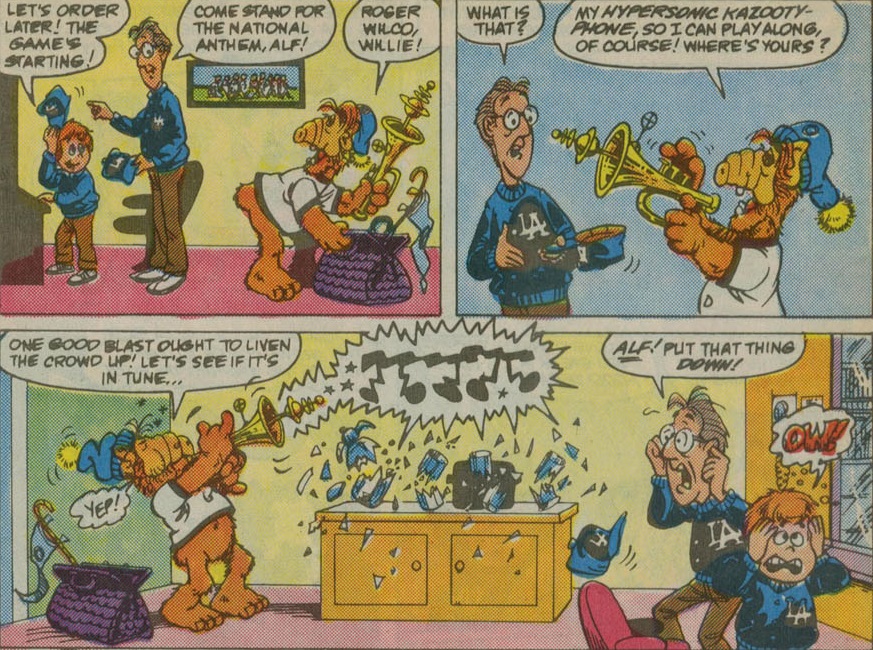
Willie takes Brian and Alf to watch a baseball game from a private box where the alien can't be seen. But Alf is used to a very different audience etiquette and when he gets excited his nose lights up very brightly...

As someone who doesn't understand baseball it's fortunate that this strip is based around the situation in the viewing box rather than the details of the game and the critical moments are easy to understand. The comedy as Alf starts playing a trumpet to the national anthem or using a repulsor to interfere with the ball make for good culture clash moments whilst Willie and Brian's reaction to the moment when the game is lost is understandable for any sports fan no matter what the sport.


4th story: You Give Me Fever
Gallagher/Manak/Severin

Alf is taken ill with a strange Melmacian disease - influence-a in which he acts out delusions brought about by media and the Tanners have to indulge him whilst keeping him in the house. First he thinks he's General Patton putting them through training, then a sleazy reporter revealing Willie and Kate's secrets then finally Robin Hood tying them up and preparing to give away their things. It's a one joke story that just about avoid outstaying its welcome though some of the delusions are especially silly particularly the reporter.


5th story: A Campy Approach
Gallagher/Manak/Severin

Brian is going away for summer camp and looking forward to it. But Alf is from a world where summer camps are punishments and he becomes convinced that this is what Brian has been sent to. So he devises a plan to travel to the camp and liberate Brian.

This is another culture clash story with Alf's misunderstanding and determination to save Brian from a terrible fate having hilarious consequences. There's a fun scene when Willie is phoned up to be asked a trivia question about a movie and Alf assumes the conversation is about other horrific camps. Later Alf disguises himself as a gorilla and Willie has to set minds at ease. But the best fun comes at the end as Kate gives Alf the most appropriate punishment. This is the highlight of the annual as a good extended comedy situation that explores the scenario fully.

At on point a projection of the High Evolutionary's head appears and demands to question Alf but it's not a convenient time so he agrees to come back in a couple of days. It's an odd interlude leading into the final story.


6th story: You Say You Want an Evolution?
Gallagher/Manak/Severin

This final two page strip sees the Evolutionary materialise in the Tanner house one night to talk to Alf and determine that he is not a threat to human development before cleansing Alf's memory of the incident. Alf declares the whole thing a nightmare and the consequence of reading eleven Marvel annuals before going to bed.

It's a fun little trailer for the whole event and it maintains a good ambiguity about whether Alf is in the Marvel universe or not. The High Evolutionary spoke at Alf's graduation and is in character but Alf is also aware of the existence of Marvel comics telling the story. But then many a comedy strip has broken the fourth wall in such a manner. It's also notable that the eleven annuals seen include ones for Daredevil, Thor and (seemingly) Alpha Flight. Did the final cut come late in the day or was this just an acknowledgement of series left out?

Overall this is a nice little link to Marvel's big event without descending into parody or overwhelming a comedy title. It's surprising more wasn't made of this as it's a good way to draw readers in to try some variation.


There's no bonus material as such in the annual but oddly there is an advert for itself that reproduces the cover and curiously notes it's from "Star Comics" when that imprint had now been wound up and in any case was never used for the series. There's also a two-page strip advert for the Bullwinkle and Rocky series.

It's a pity that the cover has a limited relationship to the contents. It's apparently based on a dream sequence in the television series but out of context it just looks like a crazy moment. Also there's not as much holiday content (let alone Alf draining Willie Tanner's savings) as promised.

As a whole this annual is very different from the other ones I've been looking at. There are far more stories but they're all focused on the core characters. Comedy series often rely heavily on gags and incidents rather than extended plots so it's unfair to criticise the story structures. It's a pity the first story is a direct sequel to an episode of the television series as it would have been better to introduce things for readers less familiar with every episode. I'm not sure how many readers actually were brought in by The Evolutionary War tie-in - it's prominent on the cover but this annual is not mentioned in the others or on the standard list so many could easily overlook it. But it's a good comedy piece and a reminder of a time when Marvel reached out to a broader range of readers. For that it's worth seeking out.

Monday, 28 January 2019

Damage Control 4 - Acts of Vengeance

And so we come to "The Final Act!" as Damage Control's second limited series comes to a conclusion, with this issue featuring a prominent guest star in Nick Fury, Agent of Shield. Fury's own series was up and running at this time but notably didn't take part in the crossover, with a change of writer around this time possibly the explanation. But instead Fury and his fellow agents get used here in a showdown for the corporate wranglings that have crippled the special repair business.

Damage Control (volume 2) #4

Writer: Dwayne McDuffie
Penciler: Ernie Colon
Inkers: Stan Drake & Marie Severin
Letterer: Rick Parker
Colour: George Roussos
Editor: Sid Jacobson
Big Guy you don't wanna mess with: Tom DeFalco

The issue is surprisingly predictive in its revelation that Damage Control is being run into the ground by its now owner, who "is willing to gut the whole company to raise cash". Damage Control may at times allow for subtle digs at the distinguished competition, but this target would ultimately prove closer to home given the convoluted corporate manoeuvres in the 1990s that ultimately left Marvel as a whole filing for bankruptcy. Fortunately for anyone without a business education the story presents the financial situation in a sufficiently simple form to understand how the owner wound up owing the Kingpin a lot of money and had to resort to bleeding the company to death.

Elsewhere the workers are still on strike but are talked into helping stabilise a building whilst a rescue operation is carried out, reflecting the very real dilemmas often faced by striking firefighters. Placards with slogans such as "DC is grossly unfair" and "DC stinks" are surprising in that Marvel could print these and get away with them (and not have to modify the artwork for later reprints). It's not clear who exactly is responsible for them, but a glance at the credit lists for the creative shows that only some of them went on to do much work for DC comics. Perhaps the scene at the end when the Damage Control building, with a prominent "DC" marked out on the roof, is sold to a comic company who "made a great deal of extra money this summer from a movie" helped placate feelings. Meanwhile over in another DC, Anne Hoag ensures that Commission on Superhuman Activities doesn't deliver a unanimous report in favour of registration.

Steadily the management rebuild relationships and reputations, helped by Fury, and Shield leads a takeover bid. Here comes perhaps the most dated joke as a subordinate Shield agent produces a briefing on computer that will take three hours to deliver, until Fury demands a one-word recommendation on whether to buy. This predated the arrival of Power Point and the computers of the era were not the best things for presentations. Robin Chapel faces down the Kingpin to make it clear he's no more influence in the firm, something he just doesn't mind as the "Acts of Vengeance" have proved quite profitable. Finally we learn that Damage Control has now completed the clean-up after the Acts.

This is a bit of a rush around issue aiming to tie up all the threads raised by the earlier ones and wisely sets itself at the end of the crossover to allow for a clear conclusion. Still it provides a good comedic take on corporate rescue packages and company chaos and gets extra credit for doing this long before Marvel faced its own problems. This is a fun little epilogue.

Damage Control (volume 2) #3 has been reprinted in:

Wednesday, 3 October 2018

Incredible Hulk 363 - Acts of Vengeance

Oh, well that makes tons of sense. You hate this guy, so you attack some other guy. Cripes, what a dopey plan.
Incredible Hulk #363

Writer: Peter David
Penciler: Jeff Purvers
Inker: Marie Severin
Letterer: Joe Rosen
Colourist: Glynis Oliver
Editor: Bobbie Chase
Lord-High-Everything-Else: Tom DeFalco

Some of the regular Marvel series did not participate in "Acts of Vengeance" as much as others. In some cases this was because the timing of the event clashed at least in part with ongoing multi-part storylines. But also the crossover was clearly not popular with every writer, as seen by the way various characters are openly dismissive of the whole scheme. Both these problems come up with Incredible Hulk, which was about to start the four-part "Countdown" storyline and so consequently only contributes a single issue to the wider event. And Peter David clearly did not like the premise, with the Hulk voicing his views in the quotes above. David was now in the third year of what turned out to be an eleven and a half year run on the series and so in a position of strength. He's also had quite a number of run-ins with John Byrne over the years. So it's unsurprising to find him making his views on "Acts of Vengeance" firmly known and, as we'll see, he was not the only writer to do so.

The issue itself comes from the "Joe Fix-It" period where Bruce Banner is now once more changing to the Hulk at night and reverting at daybreak (as dramatically demonstrated at the start when the Hulk goes leaping at night without realising how soon daybreak is coming, with the result he starts transforming back whilst falling from a great height), with the Hulk being a normal intelligence grey skinned being who has been working as an enforcer in the Las Vegas underworld. As ever Bruce is trying to find a way to cure himself of the Hulk, working undercover as a janitor at a nuclear research centre. Yet again Doctor Doom handles the allocation of a villain to attack the title's star, in this case the Grey Gargoyle whose touch can turn objects to stone. It's a fairly straightforward application of the crossover's premise, even if both hero and villain have their doubts about it. The fun comes as the Gargoyle discovers his power may work on Banner but has rather less effect on the Hulk.

There's a good explanation given for why "no one told the Hulk" but the effect is limited by the colouring. When a character is grey, is turned into a grey substance and is operating at night when the lighting and shadows make a lot of things look grey, it can be a little hard to tell exactly what form the Hulk is in at key moments, especially when the Gargoyle tries to destroy what is, apparently, a stone Hulk. There're a few minor points when the colouring fails to show the gloves the Gargoyle's hands when he's in human form and as this is pretty fundamental for the way his powers work it's the sort of error that can add to the confusion in the story. The result weakens the fight scenes in spite of the running commentary and the pretty brutal way the Hulk neutralises the Gargoyle at the end.

This is an issue that is quite open about how a crossover event has turned up to get in the way of things and at times feels like it's on autopilot, just doing the bar minimum to meet its obligations to the line. It's one that can quite easily be missed.

Incredible Hulk #363 has been reprinted in:

Friday, 4 December 2015

Essential Defenders volume 7

Essential Defenders volume 7 comprises New Defenders #126 to #139 plus the two four-part limited series Iceman and Beauty and the Beast. Bonus material includes various adverts for the series and Official Handbook of the Marvel Universe entries for the Angel, the Beast, Gargoyle, Iceman, Moondragon and Valkyrie. The main series is written by J.M. DeMatteis and then Peter Gillis. Most issues are drawn by Don Perlin with others by Alan Kupperberg, Sal Buscema and Mike Zeck. A brief comedy piece in #127 is co-written by Ann Nocenti and Marie Severin and drawn by the latter. The Iceman limited series is written by DeMatteis and drawn by Kupperberg and the Beauty and the Beast limited series is written by Nocenti and drawn by Perlin.

Were the New Defenders created even a decade later it's very likely that the existing title would have been cancelled and replaced with a new series starting from issue #1 in spite of some continuity of personnel, as happened with later examples such as the New Mutants/X-Force or the Avengers/New Avengers. And in turn it's probable that it would have been reprinted in a different format so I wouldn't actually be writing this post. (Indeed the early issues have also been collected in the Classic-in-all-but-name format but so far there hasn't been a second volume.) But instead at the time it was more standard to continue the existing title and numbering through a bold new direction rather than rebooting the numbering and creating yet more issue #1s and volumes to confuse us all.

The New Defenders differ from the previous incarnation in having a more formalised and institutionally recognised team, though it takes some time before they sort out matters such as a leader, a fully resourced base and government clearance. By this point none of the founding members are around and instead the team is initially made up of the Valkyrie, Gargoyle, Beast, Angel, Iceman and Moondragon, with newish character Cloud subsequently joining them. Even by the standards of the Defenders this is a rather bizarre line-up drawing characters from all over and it helps to explain why this team is one of the most obscure and forgotten in Marvel's history despite having no less than three former X-Men on the team. This is also a series that tries to continue to explore the weird and offbeat rather than battling big name supervillains. It also seeks to do some things with the characters that are quite different from the norm, though it doesn't always do so in the best way.

The early issues resolve the ongoing Secret Empire saga, with the newly organised New Defenders battling alongside S.H.I.E.L.D. against a succession of agents and robots. Much of the situation is mundane apart from Professor Power now occupying the body of his son whose mind was destroyed in a battle with Professor X, fuelling a desire for vengeance against Xavier's children at the same time as wider plans for global destruction and conquest. The real emphasis is on how the team is still coming together, with the members learning the hard way that they need to co-ordinate their actions whilst the question of leadership is still unsettled. At the same time their traditional New York home is destroyed and the team relocate to the Angel's remote mountain home in New Mexico. The resolution is also a brutal introduction to the very different ethics amongst the team with Moondragon demonstrating the complexity that will recur throughout the run.

Subsequent issues have a variety of foes from the surreal to the wacky. Gargoyle is captured by a middle eastern wizard and grown to enormous size in order to battle his teammates whom the wizard mistakenly believe are demons. A visit to San Francisco sees the team working with a hard arse private detective in a run-in with drug smugglers that's fairly mundane in itself but as revenge the assassin Manslaughter is sent to their base to dispose of them and his powers and skills make for a tense issue as he sneaks through, picking off the team one by one. The base is also invaded by a set of mutant plant spores that prove nearly impossible to destroy. The nearby town harbours a criminal whose body is invulnerable to fire, making him the perfect arsonist for hire. On the sillier side is the introduction of the Walrus, a man endowed with the proportionate ability and strength of his namesake. His attack is damaging to the Beast's slowly developing career as a lecturer, with the situation made worse by the intervention of would-be hero the Fabulous Frog-Man. In times past Frog-Man would wind up on the list of Defenders members but instead the new organisation means he becomes the first costumed hero to truly ally with the team. The second is Red Wolf, who works with the team in investigating the many deaths around a silver mine that turns out to be a portal to the realm of the Asgardian trolls.

But at times it seems the biggest threat is within the team's own midst. Moondragon previously took over a whole world and as part of her rehabilitation Odin has assigned her to the Valkyrie and placed a metal band around the telepath's head to restrict her from using her power too much for personal gain. Throughout the run Moondragon frequently declares her available power is insufficient to deal with the problem at hand and urges the others to remove the band. Gargoyle eventually sees inside her mind during a link and discovers how in the past her mind was invaded by the ancient Titan demon known as the Dragon of the Moon. In fighting off the demon she has become like it, even taking its name. Eventually the trolls offer to remove the headband, bringing Moondragon's struggle to learn humility and control to the fore. There are also hints that Moondragon has used her powers to influence other team members to fall for her. Early on both Iceman and the Angel fall for her and repeatedly think exactly identical thoughts but this disappears after a change in writers.

In general the rest of the existing members are developed slowly with hints more than anything else. The Beast launches a career as a lecturer that takes him away from the team at times, though not always from danger. Valkyrie continues her mission to watch over Moondragon but also demonstrates that she still performs her mythological role when she guides the spirit of a dying heroic sheriff to the afterlife. Gargoyle continues his friendship with the Defenders' housekeeper Dolly Donahue. The Angel continues worrying about how the Champions fell apart and determining that it won't happen to this team. Iceman finds himself drawn to not only Moondragon but also Cloud, with confusion as a result. The team's eventual leader is a surprise as she's not active in the field but instead a manager who is good at organising the team and getting the base's facilities sorted, Candy Southern. It's a change from the normal type of superhero team leader, showing how things are done differently. The team is a little more conventional in having a cute pet in the form of Sassafras the dog.

Cloud, the newest member, throws up some of the most promising but also frustrating developments. A young woman with the ability to turn into a cloud (when she changes back naked there's always conveniently enough vapour covering up exactly the right places), she has been used as an agent by the Secret Empire who killed her parents and deceived her into believing Seraph was her sister. The fact that Seraph was a Soviet double agent just compounds the confusion and so it seems only the Defenders can offer a place where Cloud can truly belong. She settles in well and finds herself attracted to Moondragon, declaring her feelings for her at the end of one issue. Then it gets seriously messy. Cloud is torn between wanting to go with her feelings and her instinct that they are wrong, a dilemma many who've struggled with their sexuality will recognise. But then Cloud decides the only way to make things right is to change her human form to male. This in turn makes Iceman very uneasy as he had been drawn to Cloud, and Cloud's subsequent switching between male and female forms does not help the situation.

It's incredible that a regular Marvel comic was willing to go anywhere near these subjects in 1984 and it shows the advantages some of the more obscure titles had in being able to push boundaries. But the combination of both sexuality and transgender issues feels less like a pushing of the boat as far as possible and more like a cack-handed, and possibly editorial driven, attempt to back away from having a lesbian relationship storyline. Cloud's transformation feels not like an embracing of true identity but rather an attempt to conform to societal norms by changing gender to avoid a same sex relationship. It feels uncomfortably close to a practice that even today is still carried out in parts of the world whereby lesbians, gays and bisexuals are forced to undergo gender reassignment surgery to "cure" them of their sexuality by making them the opposite gender to those they have feelings for. Further issues try to undo some of the damage with a revelation that Cloud's true self is somehow two separate beings, one female, one male, but the precise implications of this aren't explored before the end of the volume. What's left is a bold step forward and two chaotic steps back.

Issue #127 fell in "Assistant Editors' Month" when all the Marvel editors were supposedly out of the office for a month and their assistants were able to run loose with wacky ideas. But here the sole contribution (bar a comedy figure in the cover box) is a two page comedy strip in which Ann Nocenti daydreams about having all power and transforming the line - before the production manager appears in the dream with a load of mundane tasks that need address, shocking her back to reality. Given that this really only the second issue of the new incarnation of the team (issue #125 may have sported the "New Defenders" series title but was as much about out with the old as anything else) it would have been foolish to suddenly switch away from the norm for a month, showing the problems that come with line wide events that have no respect for individual series's autonomy.

The Iceman limited series is very bizarre. It was presumably published to capitalise on the character's popularity from his co-starring role in the cartoon Spider-Man and his Amazing Friends but it really doesn't seem to know just what audience it's pitched at or just what it's trying to do. There's a basic theme of parents and children coming to understand one another but otherwise we get a turbulent adventure that goes from a Drake family party in a small town on Long Island to a city during the Second World War to the realm of the mysterious Oblivion. There's time travel, dreamscapes, self-doubt and conflict amidst what at first promises to be a bold solo adventure but turns into an introspective psychological analysis. It feels as though the basics of the story and the entity Oblivion were originally drawn up for some other character but were then used for Iceman without too much thought. The character has a long history of outwardly being the goofy light-hearted member of successive teams whilst inwardly being full of self-doubt and wondering if superheroing is the right thing for him or if he should complete a conventional education. This history is respected and expanded upon through exploring his parents' attitudes to his career choices, whilst he's once again drawn to a woman, this time literally the girl next door, Marge. However it starts going weird when she's attacked by the duo of White Light and the Idiot, goes seriously off the rails when he's flung back to the 1940s and meets his parents in his youth whilst under attack from Kali, before finally becoming a complete mess when Iceman's father is killed in the past, causing him to fade out of existence and into the realm of Oblivion. Iceman simply isn't the right character for a cosmic introspection adventure. On more than one occasion in the series he's confused with the Silver Surfer and one has to wonder if this was on the writer's mind as well. The dedicated limited series was in its early days when this was produced so it may not have been clear if this was meant as a one-off piece of character development or a test run to see if there was both creative and sales potential to support an ongoing title. But whatever the aims, the result is a complicated mishmash which can hardly have appealed to readers lured in by the character's cartoon appearances. It's presumably been included here in order to make up the page count to allow the whole New Defenders era fit two whole volumes, an unfortunate move in hindsight, but it frankly could easily have been left in a pile of long forgotten limited series that don't get dug out for complete sequential reprint runs.

So too could Beauty and the Beast. This is a very odd series that seems to have started with the title and then tried to find appropriate contents. It doesn't really succeed and winds up having to distort both title characters in order to fit into the roles required of them. The Beast takes some time out from the team and goes to Los Angeles where he surprisingly falls for Dazzler despite nothing in their histories together suggesting this and they break up at the end with no real mention of it again. Dazzler is at a low point in her career having been recently outed as a mutant and now finding her work all dried up as a result of prejudice. She foolishly accepts a job in a strange underground theatre that turns out to be a modern gladiatorial arena where she's being drugged to lose control of her powers and dispel notions of leaving. The Beast tries to convince her to leave and there's further complications with the alleged son of Doctor Doom trying to use the set-up for his own purposes plus his father making his own plans despite being dead in other Marvel titles at this time. About the only decent concept in the whole story is the Heartbreak Hotel where a number of mutants with quite ineffective powers have found a safe haven. But otherwise this limited series is a turgid mess of scenario, characterisation and continuity that really should have been completely forgotten rather than being given not one but two reprintings across the Essentials (the other is in Essential Dazzler volume 2).

The inclusion of the two limited series was presumably to help fit the whole New Defenders era into two standard size Essential volumes but with the ending of the line the result is this incarnation only gets halfway and the series as a whole stops tantalisingly close to the final issue. Consequently this volume feels somewhat insubstantial as it only gets part of the way through developing the characters and team, not helped by the change of writers midway through and the limited series having no noticeable impact in the regular title. That's a pity as, numbers aside, this is effectively the first volume of a new title and it could have used some more issues. As a result, what we get is a protracted formalisation of the Defenders that nails down the membership but is still sorting through the rest of the set-up. Some of the characters get more attention than others and the developments with Moondragon are especially strong. Unfortunately the handling of Cloud's feelings for Moondragon starts off well but is then handled in a terrible manner that suggests a sudden change order from on high. Overall this is a title that really tries to do things differently from before but isn't yet hitting stellar heights.

Friday, 19 December 2014

Showcase Presents Doc Savage volume 1

It's time for a special side-step to look at a Marvel series collected in a black and white on cheap paper - but it's not quite an Essential.

Over the years Marvel have seen many licences come and go, often making it hard to reprint some adventures in later years - we've already seen issues of Giant-Size Spider-Man or Marvel Team-Up amongst other series that have had to be left out of the Essentials because of the guest stars involved. But often the terms of the original licence are more favourable for reprinting the character's own series, albeit in unusual places. Usually the rights to the stories end up being held by the characters' copyright owners and so later licensees can reprint the adventures. The likes of Marvel's Conan, Transformers, G.I. Joe and others have found their way back into publication under these terms (although joint adventures with Marvel's own characters can remain problematic). Doc Savage is another such series, with the rights held in recent years by DC.

Showcase Presents Doc Savage volume 1 reprints the eight issue magazine series Doc Savage from 1975-1977. Everything is written by Doug Moench, with plotting on one story by John Warner and John Whitmore. The art is by the likes of John Buscema, John Romita, Tony DeZuniga, Rico Rival, Marie Severin, Val Mayerik and Ernie Chan. The volume includes a number of pin-ups from the series but leaves out articles and interviews even though it only comes to 448 pages - Showcase Presents volumes have shown a much greater flexibility on page counts than Essentials.

Doc Savage first appeared in 1933 and has very much remained a man of his time. The amazing men - and they were invariably men - of the pulp magazines of the era are the direct ancestors of the superheroes who emerged at the end of the decade but often they haven't aged as well. Whereas the superheroes have been subject to a steady updating over the years, reflecting changing priorities and attitudes, the pulp action heroes and some of the contemporary comic strip characters have proved harder to adapt and update into complex and fallible characters struggling against the odds. As a result there are usually two latter day ways of presenting them - either in a self-mockery that extenuates the ridiculousness of the characters and the situation around them or else played straight in a reasonably accurate recreation of their original era give or take some the embellishments of the original stories. A lot of the movies of heroes of this era or homages to them just fall flat with only the Indiana Jones series really succeeding.

A movie version of Doc Savage was released in June 1975, but I've never seen it in full (and it's not had a conventional DVD release but rather a burn on demand one; a sign of a perceived limited market). Clips on YouTube suggest it was a rather campy take on the character and it frankly looks like it felt at least a decade old on its original release. The trailer is not the most enticing. But it's clear that there was an attempt to drum up interest in the character following the success of the republishing of the original pulp magazine stories as paperback books in the previous decade with James Bama's stylised covers forming the basis for the character's look in subsequent comics. Earlier in the 1970s Marvel had run an eight issue normal sized colour series and there was a both a Giant-Size reprint special and a team-up with Spider-Man in his own Giant-Size series in the first half of 1975. Then came this magazine series, which is a blatant tie in as the first issue came out the same month as the movie and both use the subtitle "The Man of Bronze" although the magazine's cover drops it from issue #3 onwards.

The man himself is not the most developed of characters, reflecting his pulp roots. Doc Savage has trained his body and mind to the ultimate perfection, making him super strong and super intelligent, with fast reflexes and the ability to solve any problem or situation with the utmost ease. He is highly disciplined with most stories showing him taking two hours each day to undertake a physical and mental workout to enhance himself. He is also focused - like many traditional heroes of serialised fiction he shows no interest in romance at all and is instead dedicated to the mission at hand. But here come the two problems with the character. He is too perfect with no substantial flaws that cause significant problems in his adventures. About the only flaw on display is his sexism towards both his cousin Pat and Monk's secretary Monica, declaring "Adventure is no place for a woman" (page 267) when brushing off the former. But even this flaw isn't used efficiently as Pat forces her way into going on the adventure with the regular team from the outset rather than coming in to the rescue. Beyond this Doc Savage is a know-all and do-all who can achieve just about anything and this makes it harder to get excited about such a hero. And at times he seems beyond human - indeed some of his foes explicitly shout this in frustration. On only one occasion do we hear of how he deals with captured criminals (most foes die in the climaxes) and it is to "perform certain surgical procedures upon your brains after which you will remember nothing of this -- nothing of what you did..." (page 389) In other words he will perform lobotomies on them. From a modern perspective the practice itself is horrifying but what's also concerning is the way in which Doc Savage feels he has the right to arbitrarily impose a punishment and literally change how people think. Given the characterisation and the era it is hard to avoid thinking of the concept of the übermensch, especially as that word has historically been translated as "superman".

Now Nietzsche's philosophy is generally unfamiliar to me and his own ideas have had their reputation damaged through association with the Nazis, so it's hard to judge just how far Doc Savage conforms to the übermensch model as originally conceived, though it's notable that Doc Savage's adventures often start out as the straightforward helping of others rather than proactively seeking to save the world and personally make history. But the perfect man is not a character concept that works well in this day and age. It didn't really in the 1960s & 1970s which is why so many film and TV adaptations went down the road of camp and self-mockery. But here we have a straight adaptation of the original pulps that is all too faithful to their 1930s sensibilities and outlook. And that just doesn't feel right.

To some extent Doc's aides, only once here called the "Famous Five", offer a more realistic approach. Several defy stereotypes in their appearance and characterisation but they are all experts in one way or another. They consist of:
  • "Monk" aka Lieutenant Colonel Andrew Blodgett Mayfair - expert in chemistry and owner of a pig called "Habeus Corpus" (sic - occasionally the correct spelling "Habeas Corpus" is used instead) who sometimes accompanies him on his adventures.
  • "Ham" aka Brigadier General Theodore Marley Brooks - top attorney and stylish dresser
  • "Renny" aka Colonel John Renwick - engineer
  • "Long Tom" aka Major Thomas J. Roberts - electrical expert
  • "Johnny" aka William Harper Littlejohn - archaeologist and geologist expert
What immediately dates this group is its composition, being all male and appearing to all be from the same ethnic and social background. Had the not been created until at least the 1960s then there would have almost certainly been a woman there and if created in the 1970s the group would have been multi-racial. The military ranks are mentioned on each introduction and raises questions as to how the first four, who all appear to be around their 30s, could have risen to such high ranks. None of them appear to be career soldiers but equally they seem a little young to have achieved these ranks as recruits in the First World War, especially given that the United States was only a belligerent for less than two years before the Armistice. The problem is slightly compounded by the adventures being given dates between 1933 and 1939, yet nobody seems to age in this time. It feels like these titles have been given to the characters just to enhance their standing as expert support for Savage. Monk and Ham get the most attention, with the two constantly bickering, fighting and playing practical jokes on each other. Ham fancies himself as a ladies' man, although women he flirts with do not always want the same outcome, but most of the team are attracted to at least one woman throughout the run, leaving Doc Savage above sexuality.

Issue #3 states it is starting a series of solo adventures for the five as back-up tales; however that issue's solo story of Monk is the only one to appear and subsequent issues revert to the format of full-length adventures. The story is set at the same time as the issue's main adventure, with Monk thus absent from it, and this restriction may have proved the feature's undoing.

The other character of note from the original pulps to appear here is Pat Savage, Doc's cousin who appears in just issue #5. There isn't room to fully explore her skills and strengths but she is similar to her cousin in many regards and more than a match for any of his aides as well as resourceful enough to force her way into an adventure to Loch Ness. Clearly a forerunner of the likes of Supergirl, she is rather underused and could have appeared more to provide balance in the series and help to pull it forward.

The adventures themselves are very much in the pulp tradition with lots of over the top villainy, some science fiction and fantasy, globe trotting, fancy gadgets and the resolution of matters with fists. There are monsters, mutants, deformed men in iron masks, secret bases, global conspiracies and more. It's all traditional adventuring that sticks to its roots. None of the villains are recurring and the dates given suggest the adventures may take place out of publication order. There's some sophistication, with problems to be solved and so providing a challenge beyond getting to a place and fighting a solution. Some of the puzzles are immensely complicated such as a pair of multi-levelled cryptic clues in the first issue that take nearly four whole pages for Doc Savage to unravel and seem almost impossible for any readers bar perhaps the most advanced crossword solvers. Yet the same issue features a blatant clue to the villain's identity in the form of his name, though notably this isn't remarked upon. Perhaps Doc Savage doesn't want to admit to being so complicated that he overlooked the obvious. On another occasion Savage is able to deduce that "Maison Blanche" is a translation from not English but Spanish and so the destination is not the White House but Casa Blanca.

The reproduction on this volume is quite good considering that the source material for the magazines is often in a worse state than the regular sized comics. A small note on the front page thanks Mark Waid "for loan of source material" suggesting that this volume has been compiled from original copies of the printed magazines themselves. If so then an excellent job has been done in remastering them. Unfortunately a few errors have crept in such as the inversion of pages 166 & 167. I don't know if that error was made in 2011 or 1975.

Overall this volume is of interest as a curiosity, being one of a surprisingly high number of times when one of Marvel's licensed titles has been reprinted by the current rights holder. Unfortunately the contents aren't that great. If you're a fan of the 1930s pulp adventures then this volume is a good homage to them. But if you're expecting something more sophisticated and reflecting the sensibilities of the 1970s then it's a disappointment. Both the character and the wider cast are very clearly dated and no real attempt has been made to update them in any way. That may have been an artistic decision or a restriction of the licence but the result is a fairly lightweight series that fails to hold up by even the standards of when it was first printed.

Friday, 1 August 2014

Essential Power Man and Iron Fist volume 1

Essential Power Man and Iron Fist volume 1 contains issues #50 to 72 & 74 to 75, comprising the first third of the merged series. Issue #73 is absent, due to it featuring a guest appearance by Rom whom Marvel no longer holds the rights for. Bonus material consists of a couple of in-house adverts for the series but it's clear from the advertised prices that these come from later on. The writing sees the end of Chris Claremont's run on the characters, a brief stint by Ed Hannigan and then an extended run by Mary Jo Duffy with the odd plot contribution by Bob Layton or Steven Grant. The art takes a while to settle down with a brief run by Trevor Von Eeden before an extended one by Kerry Gammil; other issues are drawn by a mixture of John Byrne, Sal Buscema, Mike Zeck, Lee Elias, Marie Severin and Alan Weiss.

The idea of merging one weak selling title into another series has been common place throughout the history of publications, not just comics. However, often "absorption" would be a better term because one title would make little contribution beyond a small addition to the cover logo and maybe the odd feature that wouldn't last long. But occasionally the fusion would be on equal terms, with both halves at the forefront throughout the rest of the series's life. Power Man and Iron Fist was one such series.

Taking a streetwise product of the blaxploitation genre and pairing him with the rich but other worldly product of the martial arts craze was not the most obvious of moves. Indeed I'm not certain who came up with it, though as the merger coincided with a run on Power Man by the Iron Fist creative team of Chris Claremont and John Byrne there's an obvious place to start looking. But whoever had the idea, there was little to lose as both characters were slumping in sales as their respective crazes were dying and the alternative was most likely cancellation. Instead an odd couple teaming up permanently was tried. It wasn't without precedent at Marvel - there were some similar themes and half of the locations in the teaming of Captain America and the Falcon, whilst Iron Fist's solo title had already teamed up a practitioner of oriental fighting methods with a streetwise black in the form of Colleen Wing and Misty Knight, the Daughters of the Dragon. But it was still an awkward pairing. What makes it credible is that it takes a number of issues before the two are in permanent partnership and even then the differences between them are brought up from time to time. But wisely the series isn't played for laughs even though odd couples from very different backgrounds with all the problems and conflicts that arise from them are staple fare for sitcoms. We get the odd lighter moment, such as Power Man having to crash at Iron Fist's place whilst his own home is rebuilt, only to find his partner's place just makes him uncomfortable. Or when we see how Iron Fist's upbringing as first a pampered rich child and then a member of a hidden civilisation have left him lacking some basic knowledge about and skills for life such as the value of money or how to control a vehicle. But these are individual aside moments and instead the focus is invariably serious. Indeed this is a book that doesn't shy away from pain, with some especially brutal maimings and deaths shown with all their consequences. The Heroes for Hire have noble motives but they inhabit an increasingly gritty world.

The early issues in the volume are surprising in that it takes a while, and several writers, before a permanent partnership is established between the two. I'm informed that the legally registered name of the series did not switch from Power Man to Power Man and Iron Fist until issue #56 (although the legal info on the inside front cover of this collected edition draws no such distinction; either I'm misinformed or whoever prepared the Essential's information made a mistake), which almost matches the fictional solidification of the partnership. Were Marvel's editors nervous about the combination even after the launch and so hedged their bets so that they could quickly return to a solo Power Man series if needs be? That's more plausible than it being a deliberately planned story arc running over seven bimonthly issues and a variety of creative teams. But once Mary Jo Duffy arrives the series quickly finds a firm footing for the rest of the volume, cementing the series as her defining title.

If there's one particularly awkward aspect to the series, it's the whole "Heroes for Hire" concept. It made sense for Power Man on his own to be working as a mercenary as he was a man of limited means and whose criminal status meant it was impossible for him to find a sufficient paying day job that would supply the funds needed to be a hero - in particular to keep up a constant supply of shirts. But Iron Fist is independently wealthy and the co-owner of a business even if he hands over the day to day running to his co-owner Joy Meachum once they've resolved some personal matters. He has so much money he never wants for anything and indeed at times just doesn't know the meaning of it. So why does he need to earn money through super heroics, a vocation traditionally provided for free, and where the jobs can wind up as being little more than glorified security guards? It's an aspect to the series not really cleared up - perhaps this is why Power Man is initially placed working instead for Colleen and Misty's agency, Nightwing Restorations - but as the series progresses there's a steady diminution of focus on big corporate hiring, although as Power Man maintains his old office above the cinema there is still an outreach to the ordinary person on the street. They also make a point of going off duty at 5pm each day to maintain their principles.

The series maintains many elements from both characters' solo titles, starting with the supporting casts. Because Power Man maintains his office above the cinema, we still get to see D.W. Griffith and Toby, and even the occasional appearance by the notorious soft drinks machine or its replacement. Iron Fist is still seeing Misty Knight and in turn her partner Colleen Wing is also around a lot. Misty was a police officer before losing her arm to a bomb and the impact of having a cybernetic arm is explored several times, including when she chillingly relives the moment. Her former police partner Rafael Scarfe is the series's most regular cop, and he often works in conjunction with Assistant District Attorney Bill Hao under DA Blake Tower. Elsewhere Iron Fist often works out with Bob Diamond, formerly of the Sons of the Tiger. He and Colleen eventually become an item but they seem to rapidly going from tensions hiding attraction to dating that I wonder if the missing issue #73 has a key scene that resolves this. Colleen also gets a memorable reunion with her father as he recovers his memory. Meanwhile the Heroes for Hire business is managed by lawyer Jeryn Hogarth, creating tensions over some of the contracts he accepts, with the office itself managed by executive secretary Jennie Royce. The most notable character to disappear is Power Man's girlfriend Dr Claire Temple who has been kidnapped one time too many and decides that she can no longer handle Luke Cage's life and he cannot give it up so they go their separate ways. Luke subsequently settles with fashion model Harmony Young. Also dropping away is Dr Noah Burstein who no longer has to give Luke support but he returns when his honeymoon is interrupted by an old foe. Then there's the return of Power Man's lawyer Big Ben Donovan, but now trying to steal drugs for himself. Another Power Man ally to reappear is Thunderbolt, only to die from accelerated growth. Also dying is Tony, the projectionist at the cinema. This is a much darker world than that inhabited by the average Marvel series from this time.

The enemies are drawn from a mix of each characters' solo titles, other Marvel universe books and some new creations. Old Power Man foes who reappear include Stiletto and Discus, plus some new incarnations of foes such as Senor Suerte. Coming from Iron Fist's side are Princess Azir, caught up in intrigues related to her home country of Halwan, Sabretooth, now allied with the Constrictor from the Incredible Hulk and many other titles, the Golden Tigers under the leadership of a new Chaka, and then a variety of longstanding foes in the return to K'un-Lun storyline. And the two jointly contribute Bushmaster, who seeks a cure for his condition only to turn to metal and crumble away in a chilling sequence. Meanwhile from other titles we see Boss Morgan, Nightshade, the mobster Bull, all from Captain America and the Falcon or the earlier Tales of Suspense stories, the Living Monolith from the pages of X-Men, complete with much of the team as well, or Maggia boss Caesar Cicero and his henchman Man Mountain Marko, both from Amazing Spider-Man. New foes include the Incinerator, a bank robber in a flame suit, Senor Suerte, the vengeance seeking younger brother of Power Man's old foe, El Aguila, a vigilante who later allies with the Heroes for Hire, Colonel Eschat, a mercenary wiping out his old colleagues, Supremo, a would be military dictator of a Latin American country who actually hires the heroes to locate the existing regime's money supply via the drugs trade, and Montenegro, a mountain climbing crime boss pursuing a piece of technology hidden on a coin.

The final couple of issues feature probably the most obvious Iron Fist storyline not yet done - a return to the lost civilisation of K'un-Lun with a number of old foes returning. Rather than waiting ten years in real time, he and Power Man get there when transported in battle with the wizard Master Khan, who is also the deity of K'un-Lun. In the mystical city Iron Fist discovers and relearns a number of key points about his life and family, clarifying for certainty that his father was originally from outside the city but found his way there, and that Miranda was his half-sister. In conflict with variously the plant race the H'ylthri, the mysterious Ninja, Iron Fist's uncle Nu-An and Master Khan, Iron Fist proves himself worthy of his legacy, and Power Man as a worthy ally. But it also leads to Iron Fist standing up to all the strange customs and practices of K'un-Lun and taking the opportunity to return to the outside world. It's a journey of self-discovery that reinforces the character and the partnership, boding well for the future.

On paper this is a series that shouldn't work. Taking two heroes who had been created to jump on the bandwagon of passing fads and sticking them together should have resulted in a mess that either got demerged or cancelled within a handful of issues. But instead something happens to make it work. The two characters with their very different resources and background prove to be a highly effective odd couple, with the partnership being one of true equals and both heroes getting their fair share of focus. The differences between the two make for some fun asides and occasional disagreements but don't prove insurmountable and so the pairing is fully dynamic, helped by a gradual build-up before the two formalise their partnership. Add in a strong supporting cast that makes use of the best of both books and the series is rapidly firing on all pistons. But what's also a surprise is just how gritty and dark the series is, with some quite brutal deaths and dark psychological moments. It is a much more gritty and down to earth series than many of its contemporaries and a surprisingly strong read even today.

Friday, 3 January 2014

Essential Hulk volume 2

Essential Hulk volume 2 contains the Hulk strips from issues #92-101 of Tales to Astonish which was then transformed into a new Incredible Hulk series and the volume contains issues #102-117 and annual #1. Bonus material includes the back-up story from Incredible Hulk #147. Most of the issues are written by Stan Lee or Gary Friedrich bar one by Bill Everett & Roy Thomas and another by Archie Goodwin & Roy Thomas. The art is mainly by Marie Severin and Herb Trimpe, with Frank Giacoia providing breakdowns on one issue. The back-up from #147 is written by Thomas and drawn by Trimpe.

The first volume showed two attempts at the Hulk that just couldn't find a clear identity and direction for the series, with the result that it meandered aimlessly. And once again, we have a volume that founders due to the extremely limited nature of the central character and the poorly developed cast and environment around him. The Hulk is an oversimplistic monster and alter ego Bruce Banner is much underused with the result that there's not much meat to these tales, just an ongoing saga as the Hulk wanders from situation to situation whilst the military and others employ a variety of different methods in order to try and neutralise the monster. The situation is made worse by an inconsistent approach to the monster's intelligence levels with his dialogue varying from extremely childlike to rather more sophisticated and an uncertainty over how much he hates the human race, with some stories seeing him try to protect humans and others showing him far more hostile. The main development of note is the heavy use of characters from other series, although they are primarily lesser known supporting characters and villains rather than the big name stars.

The use kicks off right from the start of the volume as the first couple of issues see the Hulk encounter the Silver Surfer; the latter making his first ever appearance outside of the pages of the Fantastic Four. Then over the course of subsequent issues he crosses paths with the likes of the High Evolutionary and some of his creations like the New Men and the Knights of Wundagore, Namor the Sub-Mariner (in a crossover between the two strips in Tales to Astonish, taking up an entire issue), the Puppet Master, the Warriors Three, Odin, Loki, the Enchantress, the Executioner and other Asgardians, the Rhino, Nick Fury and S.H.I.E.L.D., the Mandarin, Ka-Zar, Zabu and the Swamp Men, and the Sandman. The annual also gets in on the act and sees him encounter the Inhumans, getting caught up in an attempted coup by Maximus against Black Bolt with several other Inhumans seen including Gorgon and Lockjaw. Amongst the new foes are the Legion of the Living Lightning, the Space Parasite, the Missing Link, who is an intermediate stage of evolution awakened and mutated by radiation, Umbu, a robot in the Savage Land, the Galaxy Master, and the Leader's Super-Humanoid. The Hulk also gets out his stomping ground at times, with visits to New York, the Soviet Union, China, the Savage Land and the Inhumans' Great Refuge in a mountain range, as well as trips away from Earth to Wundagore II, Asgard or Berhert.

This is quite a diverse range of characters and settings but it can't conceal the basic problem that this particular incarnation of the Hulk isn't terribly interesting and it's difficult to generate excitement in such circumstances. The adventures take a step away from the continuous epic seen in the previous volume and are now more piecemeal, making them easier to pick for one-off reprints and to use the Hulk in other series but at the same time very little is developed. Few of the new foes are particularly memorable and the only significant reuses are the Leader, brought back to life with an "I took precautions and wasn't completely dead" explanation that now opens him up for future tales, and the Rhino, providing another super-strong foe with recurring potential. Otherwise we get a succession of stories that alternate between Bruce Banner/the Hulk being pursued by the army, sometimes captured, until he either escapes or else a bigger menace comes along and only the Hulk can stop it, or else some powerful being wants to make use of the Hulk for his own purposes. It is possible to base a series around the pursuit of a monster when the pursuing characters are compelling, but unfortunately that's not the case here. Rick Jones is used sparingly, eventually determining the Hulk is a menace who must be stopped, before disappearing into other series. General "Thunderbolt" Ross remains a driven cliché whilst Betty Ross continues to spend a lot of time crying for Bruce and wishing he could be cured of the Hulk curse. Major Glenn Talbot is trapped by the dilemma of the Hulk being his main obstacle for Betty's affections but he cannot bring himself to perform the obvious action to remove his rival, knowing that Betty would just hate him for it.

But aside from Betty's feelings in the matter, it's surprising that nobody is prepared to take the obvious step and execute Bruce on an occasion when he's been captured and is still in human form. Yes Bruce may be a top scientist but he's now been deemed enough of a menace that great amounts of force are devoted to stopping him. The absence of any exploration of this point may be attributable to the comic standards of the era, but from a modern perspective it's a surprising omission. However we do get to see that Bruce has done his best to take precautions, leaving notes for a device that (in a cameo) Reed Richards is able to construct and this gadget is used to transform the Hulk back to Banner, seeming permanently - and just at the wrong moment when the Hulk is all that stands in the way of the Missing Link. Fortunately the latter monster is emitting enough radiation that it restores the Hulk.

Although this volume is overall a meandering, directionless series there are some individual stories that do slightly stand out. One sees the Hulk captured on the orders of the High Evolutionary and transported away from Earth in order to fight the renegade New Men on Wundagore II - it seems the High Evolutionary just can't stop trying to create a new utopia and populate it with his creations. In the final battle the Evolutionary is mortally wounded and has no choice but to undergo an experiment in accelerated evolution, becoming an all powerful being who can instantly set all things to right before going on to become one with the cosmos. It's not as obvious as some later uses of the Evolutionary - most obviously in the original Warlock saga - but it does show a surprising willingness to take a mortal man and turn him into almost a god. The ending suggests that the Evolutionary's story has come to its natural conclusion, though it's always possible to bring back a character no matter how permanent their end seems to be. Such is the case with the Leader who is revived in the last few issues in the volume and he proves himself to be highly adaptable and devious, proving able to restrain the Hulk for ages whilst plotting anew. It all makes for a recurring conflict between gamma-enhanced brain and gamma-enhanced brawn. Although there's not exactly much competition for the role, the Leader is clearly earning his position as the Hulk's archenemy and it's one of extremely few signs of the series starting to develop the characters needed to create exciting sustained adventures.

The encounters across the wider Marvel universe also include conflict with two of the Hulk's future comrades in the Defenders. His meeting with the Sub-Mariner is complicated by the Puppet Master controlling the Hulk to force him into a fight but it shows how strongly matched the two are, making for a memorable struggle as their strips collide to celebrate Tales to Astonish's 100th issue. The meeting with the Silver Surfer is more interesting and tragic. Both are outcasts pursued by the hostility of humans yet due to the Hulk's anger and misunderstanding they initially end up fighting. Each wants to leave Earth but the Surfer is trapped and the Hulk proves unable to control the Surfer's surfboard after snatching it. But as the Hulk lies subdued there comes the possibility that the Surfer's powers could cure him once and for all by purging the gamma cells. Unfortunately another misunderstanding causes the Hulk to lash out and drive off the Surfer, denying a chance at a real cure. Whether the Surfer might still be able to cure the Hulk or not is something that only a few later writers have addressed, with one showing it was possible but the location of the action required it to be reversed to save Bruce's life, whilst on another occasion the Surfer discovered that the Hulk had been separated from Bruce and thus there was no Banner to turn him back into. Still it's a nice little encounter that shows the two outcasts have much in common and could work well together if they could overcome their suspicions and misunderstandings.

Sadly misunderstandings seem to be almost everywhere as both the Hulk and those around him frequently jump to conclusions and assume the worst, resulting in a succession of fights and denying the creature a chance to show his peaceful side. The Hulk may have a lot of anger but he also wants to live in peace and tranquillity, with friends who will understand and accept him for what he is. That's a goal many of us can identify with, along with the frustration that comes when such simple aims seem to be permanently denied, but it really isn't sufficient to sustain the series no matter how many guest appearances are thrown into the mix. This can make many Hulk adventures extremely turgid and this volume seems to be packed with more than most.

The main saving grace comes in the artwork, with Marie Severin vividly bringing the series to life but then Herb Trimpe takes it up several gears, producing some highly dynamic work that brings both the characters and the battles to life. However the writing just isn't fancy enough. In a parallel to Amazing Spider-Man, we see Stan Lee leave the series only to return after a handful of issues by other writers. The problem is that the series is drifting both with and without Lee, as though his creative energies were starting to wane after such a huge output for many years. However he'd been on many series for so long that it wasn't always easy to step into his shoes and in the case of both the Incredible Hulk and the Amazing Spider-Man it took two departures to finally find the best ongoing successor. Oddly it was Roy Thomas who would prove to be the ultimate immediate successor on Hulk when his Spider-Man tenure was the brief first attempt. But his main Hulk work is in volumes to come. The final story is a taster of things to come, showing the Hulk encountering a mirage of a town in the desert but his enhanced senses bring it to life and just for a brief moment he seems to have found both a friend and a place in life. It's a nice little tale and although I'm not sure why it was chosen for inclusion here, it shows the Thomas/Trimpe team can produce enjoyable individual stories, giving hope for the future.

In the meantime this is a rather poor overall entry in the series; an example of how the Essentials inevitably wind up collecting rather weak periods on some of the longest running titles and occasionally a series can get cut up in such a way that the overall result is just the weaker period without overlapping onto a better time either side or some one-off spectacular issues. But also it shows the fundamental problems inherent in the basic set-up of the Hulk and either some major character development or some significant changes to the status quo would be needed to overcome these problems. However until then what's left is a rather rambling dull series.

Wednesday, 11 December 2013

A few Sub-Mariner previews

Whenever I complete a full set of Essential volumes for any particular series and character I intend to take a look at any later issues reprinted in other volumes. Other than the Spider-Man and Daredevil titles, Sub-Mariner is the first such series that qualifies, as there is just one solitary volume out so far.


Sub-Mariner #20 written by Roy Thomas and drawn by John Buscema, reprinted slightly abridged in Giant-Size Super-Villain Team-Up #1, reprinted in turn in Essential Super-Villain Team-Up volume 1

It's my understanding that the abridgement consists of panels in adjacent pages amounting to the equivalent of one whole page. It doesn't seem to have affected readability. This is a fairly straightforward tale in which Namor, who has lost both his power of flight and the ability to breathe underwater, flees though New York until he stumbles upon the Latverian embassy where Dr. Doom tries to recruit him as an ally, first by persuasion and then by coercion. It's easy to forget that there was a time when Namor rivalled Doom as the Fantastic Four's greatest foe and the two briefly allied. However they have each gone a long way since and this issue shows how far apart they now are, with a renewed alliance well and truly off the cards. The issue is very much a character piece as it shows the different outlooks and approaches of the two. Ironically it was reprinted at the start of Giant-Size Super-Villain Team-Up despite being a strong indicator as to why a permanent teaming of the two can never work. Doom attempted to overcome the problems, but the story wound up as a premature obituary for that series.

Sub-Mariner #22 written by Roy Thomas and drawn by Marie Severin, reprinted in Essential Doctor Strange volume 2 and also in Essential Defenders volume 1

This was the middle part of a storyline run across Doctor Strange, Sub-Mariner and the Incredible Hulk, wrapping up the leftover threads from Doctor Strange's series. Namor returns to Atlantis where his ability to breathe is restored but then he gets summoned to Boston by Doctor Strange to help in the struggle against the Undying Ones. The crossover is structured reasonably well so that it's possible to just read this issue by itself, but other than the opening scenes in Atlantis this does feel much more like a Doctor Strange issue than a Sub-Mariner one. As a key issue in restoring the title hero's abilities it probably shouldn't have been combined with a wider crossover; an approach that was unfortunately used all too often in later years. There's the start of a strong understanding between Namor and Doctor Strange that would come to the forefront in the Defenders, but as yet no hint of any regular teaming between them.

Sub-Mariner #34-35 written by Roy Thomas and drawn by Sal Buscema, reprinted in Essential Defenders volume 1

These two issues see Namor in search of allies to neutralise a human device that accidentally  threatens the world. In recruiting the Hulk they come into conflict with the military forces of San Pablo, yet another Latin American military dictatorship. Their battle devastates the military forces such that rebels are able to overthrow El General. Then the group, dubbed "Titans Three", head to the island where the device is along with Dorma and the Atlantean scientist Ikthon. Titans Three clash with both the army guarding the device and a squad of Avengers sent in, until Ikthon repairs a flaw and everyone realises the danger that has been averted. These two issues were clearly testing the water for the concept that became the Defenders and show how Namor can assemble some allies when needs be but his confrontational approach isn't always the ideal solution. I find Latin American military dictatorships an excessively used cliché in Marvel comics from this era, especially when they come with rebels seeking to overthrow them. Titans Three is an interesting idea for a team made out of hot-headed loners often at odds with the human world, but such character types are inevitably not team players and some additional unifying element is needed if the group is to work on a regular basis.


By coincidence these issues between them show Namor interacting with nearly all the characters he's best known for teaming up with; the main exception is Captain America. (His interaction with the Fantastic Four over the years is rather more complicated.) There are signs of just how prickly he can be but also how well he works with those he respects and/or needs. Otherwise the issues show glimpses of wider developments in the series such as his temporary power restriction or steps towards marriage to Dorma, and wet the appetite for another Essential Sub-Mariner volume.

Friday, 12 April 2013

Essential Defenders volume 1

The Defenders were very different from the teams that came before them. They weren't a formal gathering of heroes drawn together into a regulated organisation like the Avengers or the All-Winners Squad. They weren't a family of adventurers like the Fantastic Four. And they weren't an outgrowth of a school for training the powered like the X-Men. Instead they were a "non-team", a disparate group of individuals with no real organisation and no clear definition of membership, working together as needs be.

The original Defenders ran from 1971 until 1985, almost exactly matching the traditional dates for the Bronze Age of Comics. In a further twist the set-up stories included here cover the years 1969-1971 where the beginning of the Bronze Age is unclear, whilst at the other end of the run the last twenty-seven issues, running in 1983-1985 when the Bronze Age was winding down, saw the team heavily transformed into the "New Defenders". Few titles so perfectly match the period and show the various trends that ran through it.

Essential Defenders volume 1 reprints Defenders #1-14, plus Doctor Strange #183, Sub-Mariner #22 & #34-35, the Incredible Hulk #126, Marvel Feature #1-3 and Avengers #116-118 plus an extract from issue #115. The Doctor Strange, Sub-Mariner and Incredible Hulk issues feature first a crossover and then a team-up between different combinations of the three title characters and the Silver Surfer before they were made a regular team which was tested in the pages of Marvel Feature, one of Marvel's many try-out titles (later in its run it carried Ant-Man and then team-ups involving the Thing before the latter spun off into Marvel Two-in-One), before being given its own series. Early on in the run the Defenders clashed with the Avengers in what was at the time a lengthy crossover, and the issues from both series are included here.

The Marvel Feature issues are written by Roy Thomas and drawn by Ross Andru, then the Defenders issues are written first by Steve Englehart and then by Len Wein, and all drawn by Sal Buscema. The Doctor Strange issue is written by Thomas and drawn by Gene Colan, the Incredible Hulk issue is written by Thomas and drawn by Herb Trimpe, the Sub-Mariner issues are all written by Thomas and drawn by Marie Severin or Buscema, and the Avengers issues are all written by Englehart and drawn by Bob Brown.

So what precisely is a "non-team"? The Defenders differ strongly from most Marvel teams in that there is no real formal organisation. There's no home or base for the members, no formal rules of incorporation, no regular meetings replete with rigid meeting protocol, no clear definition of membership or criteria for who actually is and isn't a "member" and so forth. At this stage it's just a group of heroes drawn together when needed, who work with others they encounter in the course of such gatherings. But even here there's also the start of disagreements over just how organised the Defenders should be, with Namor being very firm until the end that there are no members whilst the Valkyrie wishes to join. Doctor Strange may see himself as the "leader" of the Defenders, but he commands far less authority over the others than the likes of Mr. Fantastic or Professor X over their respective teams.

Despite the protests of Namor and the traditional "non-team" status of the Defenders, it is possible to identify some clear members. At this stage the members are all amongst the heroes most commonly associated with the team. A popular image has built up of the Defenders having four founders, Doctor Strange, Namor the Sub-Mariner, the Incredible Hulk and the Silver Surfer. But this volume is a revelation of how that isn't quite the case as the four don't all appear together until Defenders #2, which is the fifth issue to go out under that title (Marvel Feature also included the individual strip's logo on the cover) and the tenth in the volume overall. It's questionable as to how far the Titans Three teaming of all bar Doctor Strange counts as a proto-Defenders story - they don't use the team name and, as we'll see, the good doctor is the initial keystone of the team. The initial Undying Ones crossover with Strange, Namor and the Hulk is on firmer ground here as it is revisited early on in the series. So the Surfer is really an add on, even if he has subsequently been included in many a founders' reunion, even within the original Defenders run itself (but that comes in much later volumes). The cover to this volume reuses that of Marvel Feature #1 and so we get just the other three heroes, thus doing a little bit to correct latter day revisionism. It's significant that all four heroes are strong loners, with Namor, the Hulk and the Surfer traditionally hostile to being pulled in to help others, a hostility that recurs throughout these issues making for some tense situations when the heroes are drawn together once more, with Namor in particular angry with the way he's drawn in. However over time Doctor Strange steadily works on developing a friendship with the Hulk to the point where at the end the Green Goliath is becoming more trusting and willing to stay around and work with the others. In contrast Namor is increasingly losing the battle against the Defenders becoming an ongoing team and being summoned against his will to help on missions, and so he withdraws altogether for the time being.

Several other heroes fight alongside the Defenders in these issues. The Valkyrie is a sort-of new character, the result of a fusion of an alter ego previously used by the Enchantress with a mad human woman. There's some initial discomfort amongst the others about this arrangement but the ethical side and any attempt to undo the spell are quickly forgotten and the Valkyrie becomes the first real committed recruit to the team who actually wants to be there. At the end of the volume Nighthawk works with the team and joins on the very last page, taking the place of Namor and showing the first signs of the Defenders becoming a slightly more coherent team. Namorita pops up but only for a single issue when her cousin is transported away and she helps find him. Hawkeye works with the Defenders for several issues, but his own comments at first place him clearly as a guest star rather than a "member" and when he departs he comments on having only stayed around for a specific job rather than anything permanent. That job involves the Black Knight who is even more firmly in the guest star category, encountering the Defenders on an adventure where he gets turned to stone. Later his spirit is sent back in time and the team go after him, but he opts to stay in the past and so never really becomes a Defender in any way. The volume also contains a couple of encounters with the Avengers, but the two groups are clearly delineated throughout.

The Defenders-Avengers conflict kicks off in earnest in Avengers #116, which starts with a note that it's the tenth anniversary of the start of the Avengers. It's an odd way to celebrate what is admittedly only a small milestone. The storyline itself was groundbreaking in being about the longest crossover to date in terms of both the number of issues and the publication time. Alongside the Undying Ones crossover that first brought Doctor Strange together with the other two founders, it was a sign of the way the comics industry would steadily develop to the stage where more and more storylines would require readers to buy additional issues from series they didn't normally read in order to get the whole story. It's great for providing extra material to fill collected editions decades later, but at the time it could lock out readers who for one reason or another didn't have access to the other title(s) on their local newsstands, and I don't know if subscribers got advance warning or special offers to receive the other issues as well. The storyline itself is relatively simple with one villain tricking the Defenders into a quest for a powerful item and another villain tricking the Avengers into fighting them, with each team assuming the others have impure motives. A significant chunk of the adventure is then taken up with fights between individual members of the team in different locations around the world before they realise they've been duped and team up to confront the villains and save the world. When summarised it does feel a bit like a standard Justice League of America plot. The emphasis is very much on the characters, with opportunities to see some clashes that hadn't been done for a while, such as Hawkeye against Iron Man or Namor against Captain America.

The Defenders face many villains in the course of these adventures. The Undying Ones debuted in Doctor Strange but in the final issue #183, which starts this volume off. The Nameless One and the Nightcrawler each debut in Sub-Mariner #22 and Incredible Hulk #126 respectively but these issues were tying up Doctor Strange's story after his own title was cancelled. The Titans Three story sees the trio fight first El General, the (oh what a surprise) military dictator of a Latin American country (also later on during the Defenders/Avengers clash there's a visit to an ex-Nazi's castle in a Latin American country) and then a clash with the Avengers in order to prevent a new device from inadvertently destroying the Earth. Once the Defenders proper get going, they fight a mixture of new and pre-existing foes. The New foes include Omegatron, a magical computer with a doomsday nuclear weapon attached, Necrodamus, a dark sorcerer, Calizuma, the leader of a group of warrior wizards, Cyrus Black, another evil sorcerer with a longstanding grudge against Doctor Strange, Chandu, a twelfth century mystic, and Nebulon the Celestial Man. Note just how many of these foes could easily have debuted in Doctor Strange had it still been running. Foes from other series include Yandroth and then Dormammu, both from the Doctor Strange strip in Strange Tales, Xemnu, who first appeared in Journey into Mystery in the pre-superhero era, the Giant Squids and later Casiolena, both having debuted in Avengers, the Enchantress, the Executioner and later Loki, all of whom are originally from the Thor strip in Journey into Mystery, Attuma and the Red Ghost, both from Fantastic Four, Mordred, from the 1950s Black Knight, and the Squadron Sinister, also from Avengers. The latter are evil copies of the Squadron Supreme and both are a deliberate erm... "homage" to DC's Justice League of America, allowing for substitutes for inter-company crossovers before they actually happened. The Squadron members shown here are Hyperion (based on Superman), Doctor Spectrum (based on Green Lantern) and the Whizzer (based on the Flash) plus renegade turned good Nighthawk (based on Batman). Overall there are rather fewer pre-existing Doctor Strange foes in this volume than I'd come to expect, but many of the new creations could have been cut from his series's cloth. Invariably with the Defenders initially consisting of two physically very powerful heroes and one of the most powerful magicians, the threats they face have to be similarly strong and this doesn't really change with the addition of extra members and guest stars. Instead, the team continues facing predominantly magical and mythical foes, with a smattering of other fantastical and cosmic types.

The threats the team face are a mixture of the small and personal as well as the grand scale to the Earth or even the entire dimension. At the end of the team's first story in Marvel Feature #1 Doctor Strange suggests the name "Defenders" - "A fitting name for such a grouping as we -- if we've need to meet again." The name is convincing, especially as it is initially picked for a team assembled just in emergencies. And the team may increasingly congeal as the series proceeds but there is still a lot of defending going on. On the smaller scale the members do look out for each other somewhat, with an ongoing plotline as Doctor Strange tries to find a cure for the Black Knight's stone form. This leads to a small personalised adventure in issue #11 as everyone is transported to the twelfth century Middle East during a Crusade. Unfortunately there doesn't seem to have been a great deal of research with both "King Richard the Lion Hearted" and Prince John out there, fighting the "Mohammedeans" or occasionally called "Arabs" - not the most sensitive terms to use. It's not the more nuanced and sensitive view of the Crusades that was emerging at the time.

As mentioned above, Defenders ran for the duration of the Bronze Age. Looking at just the early issues here there are some signs of the changes but others would come later. The team itself is structurally very different from the more grand and formalised teams established in the Silver Age. The crossover with Avengers began a trend that would grow over times. And there's a brief sign of some of the growing trend towards more socially aware comics, primarily in the form of the Valkyrie's feminism. But whilst she demonstrates her worth as a member of the team holding her own when she destroys the Omegatron early on, she's not the best representative of liberated women as after all she's one persona occupying another's body and was created by an Asgardian goddess (although that would get retconned later on) and so lacks actual experience of the human world. Otherwise much of the emphasis of the series is on fantastical adventures rather than on more down to earth affairs.

This is a volume that encompasses the team going through three different writers as one sets up the series, a second then has a year and a half long run (albeit only eleven issues as the series was initially bimonthly) before a third takes over for the last few issues. It surprising how the changing writers aren't particularly noticeable with the series maintaining its themes and not veering off in a new direction and having everything changed under a new regime. Consequently momentum is maintained and there's a good clear sense of what the Defenders are, even if there isn't a precise definition of membership, and how they carry out their objectives. The team contains quite a diverse set of individuals but manages to hold together and they're a believable force. The team was very different to much of what had come before, but that works to its advantage and it wasn't just another variation of already tried themes. It had a good strong start.