Showing posts with label Roger Stern. Show all posts

Monday, 11 October 2021

Amazing Spider-Man Annual 22 - The Evolutionary War

Spider-Man and Daredevil team up to solve a drug wars murder but bigger plans are afoot.

Okay we've hit a publishing mistake here. The back-up feature "The High Evolutionary" has a strict chapter order and the next one should be Fantastic Four Annual #21. However the lead feature in that has the first recap of the event so far in chronological order and places it after this issue. So I've opted to publish these two posts simultaneously in lead feature order.

(And this is another annual with a lot of creators so some of the labels are in a separate post.)

Amazing Spider-Man Annual #22

1st story: Drug War Rages
By Tom DeFalco
As told to David Michelinie
Photos: Mark Bagley & Mike Esposito
R. Parker signs on
B. Sharen in the red
J. Salicrup indicted
T. DeFalco shrieks

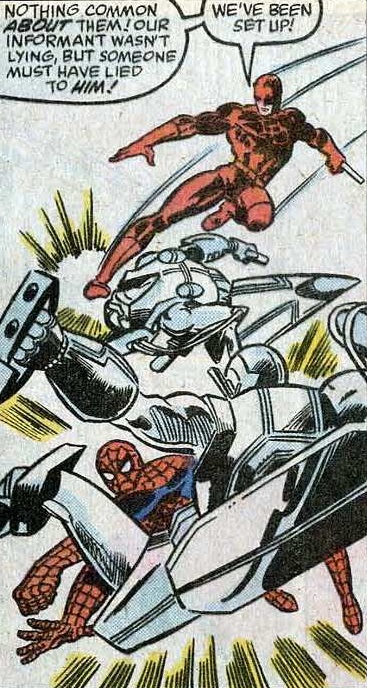
This is the first annual in The Evolutionary War to actually build on events earlier in the saga as New York deals with the consequences of the interruption of the drugs supply in Punisher Annual #1. Otherwise this annual feels quite traditional, perhaps in part because Tom DeFalco is plotting but also Mark Bagley adopts a very traditional approach to the artwork that stands in strong contrast to Todd McFarlane's contemporary work on the regular series at this time. It's a nice suitable retro feel for a story that also resorts to some traditional moves such as Spider-Man being falsely accused of a crime and J. Jonah Jameson being delighted at being proved right. There's a team-up with Daredevil and a good use of the Kingpin. But there's also the debut of a new superhero.

Speedball was the newest hero Marvel was about to launch in his own title and he's given a preview here. But it's not a very good one. There's no origin story, just a quick mention of an "accident" that gave him his powers, and the character comes across as a mess. When Robbie Baldwin encounters a force it triggers a kinetic power that sends him jumping all over the place which he tries to use to fight street level crime. There's a half decent idea in that and with some refinement to give him a degree of control that could at least all him to walk around without being terrified of brushing into anyone it might work. But the problem here is that we're given neither the origin of a new hero when he can be expected to have difficulty controlling his powers nor an appearance once he's fully come to terms with them. To add to the problems neither his creator Steve Ditko nor his regular scripter Roger Stern is working on this story and so Speedball is just thrown into this story to bounce around without contributing much that couldn't have been handled by either Spider-Man or Daredevil.

The story focuses on the mystery of the disruption to the drug supply which turns out to be down to the High Evolutionary's Purifiers killing several distributors and dealers whilst preparing a scheme to render everyone in New York unconscious and then sterilise everyone with unacceptable DNA. Although both aims have been pursued by the Evolutionary's forces in earlier annuals it's surprising to see the same team attempting both at the same time and the result is they attract too much attention with the Kingpin forcing the details out of a captured Purifier then manipulating Spider-Man and Daredevil into attacking the Purifiers' base whilst Speedball has also stumbled across the plan. There's a good complex take on the Kingpin, concerned not merely with the immediate profit margin but also with ensuring his city is kept safe and using his resources to help the heroes where necessary. He even gets the Arranger to clear Spider-Man's name by getting the real criminal to confess to the murder of the drug distributors at the start of the story. Then at the very end he is shown expressing real concern about the wider threat. It's a reminder how he prefers the stability of the existing order and is prepared to help preserve it if needs be whereas a more simplistic villain would simply throw in with the bigger foe in town.

Overall this is a pretty good example of a traditional Spider-Man story with a double team-up thrown in for good measure. Spider-Man and Daredevil work well together and the menace is pitched at the right level for them. It's just unfortunate that space is devoted to introducing Speedball who really adds nothing to this tale and does not get a very impressive introduction.


2nd story: He who laughs...
Plotter & Penciler: Steve Ditko
Scripter: Roger Stern
Inking: Jackson Guice
Lettering: Rick Parker
Coloring: Tom Vincent
Editing: Jim Salicrup

Yes that's that Steve Ditko doing the plot and pencils. It's his first work on a Spider-Man book since 1966 - but he always refused to return to the main character and so is only drawing a back-up feature. Over the next few years he would appear in several more Spider-Man annuals in this way and so it's natural to wish he could have opted to return to the main character just one more time. Instead here is what was then his newest creation.

This could almost be from Speedball's own series which launched at this time and had almost exactly the same creative team at the start. One of the curiosities of the series is how many issues have multiple stories. There were a number of anthology titles around this time - examples include Strange Tales, Marvel Comics Presents, Solo Avengers and, over at DC, Action Comics Weekly - that offered multiple shorter stories but headed titles tended to have a single story each issue or at most a back-up story that focused on some of the other cast members in a separate story strand. Doing an ongoing headed series with multiple tales of the title character(s) was an extremely retro step.

And this story feels very retro. It's about thwarted ambition fuelling false revenge as an unsuccessful ex actor tries to murder Speedball's mother, believing she turned a director against him and so he failed to get a key break part. Now working as a janitor in a theatre he plans to attack her when she visits a friend there but first has to dispose of her son. This results in Speedball (who doesn't actually call himself by that name yet; instead he thinks of himself as "The Masked Marvel", his book's subtitle) bouncing around trying to distract and knock out the would-be killer before his mother can see him.

It's a rather weak story that's constrained by the need to have Speedball's powers triggered at key moments to advance the plot. The villain's motivation is believable but his attempts get sillier and sillier. Nor is it even resolved by the hero. Again this is not a good advert for Speedball and his series.


3rd story: The High Evolutionary: Kindred Spirits
Story: Mark Gruenwald
Pencils: Ron Lim
Inks: Tony DeZuniga
Letters: Ken Lopez
Colors: Gregory Wright
Editor: Ralph Macchio
Editor-in-Chief: Tom DeFalco

This is another info dump heavy chapter that rushes through the introduction of the New Men, with Bova, perhaps their best known member, being shown being genetically accelerated from a Guernsey cow, then more explanation about the nature of the Werewolf, though the High Evolutionary remains sceptical about the supernatural explanations, before the body of Jonathan Drew returns animated by a sixth century ghost called Magnus to explain how the spirit of the demon Cthon has been bound to Mount Wundagore and could be awakened by the Evolutionary's work. That's a lot to take in in just six pages but it does once again reinforce just how Marvel had let Wundagore get overused in far too many characters' histories so as to produce this mix of technology and magic and even Mark Gruenwald was starting to struggle to make it all seem consistent.

One thing that does stand out is that Gruenwald (or Macchio) isn't always writing the Evolutionary's dialogue consistently as an interwar British scientist. So some of his dialogue includes stereotypical upper class phrases like "old girl" whilst he also uses the American dating format for recording his experiments. More consistent is the way the way Herbert Edgar Wyndham is now wearing his armour full time as a sign of how he is retreating ever more from the outside world into a shell. The character is portrayed consistently as a rational scientist refusing to believe tales of magic even though he admits he does not understand the Werewolf. Although the amount of backstory to wade through can be overwhelming at times this saga so far has done a good job of building up the lead character.


Other material includes the plans for Peter and Mary Jane's apartment plus two unused covers by Larry Lieber & Jack Abel and Bob Layton from the black costume era and a plug for the Spider-Man newspaper strip. This annual may not be the best example of its series at the time as the latter was in quite a bold experimental phase but it's good traditional Spider-Man and a good introduction to crossover visitors as well as making good use of the event to tell a strong story. It's just a pity that it's had a new hero thrown in to poorly promote.

Friday, 20 November 2015

Essential Thor volume 7

Essential Thor volume 7 contains issues #248 to #271 (issue #254 was a reprint represented here by the cover and a copy of the apology caption) plus Annuals #5 and #6. Bonus material includes an unused cover for issue #264. The writing is nearly all by Len Wein, including one annual, with one issue co-plotted and scripted by Roger Stern, a couple of back-up tales written by David Anthony Kraft and the other annual written by Steve Englehart. The art is mainly by John Buscema, Tony Dezuniga and Walter Simonson with the back-ups by Pablo Marcos whilst one annual is by John Buscema and the other by Sal Buscema.

The first annual in this volume is quite a curiosity, sitting outside the present day narrative and maybe outside of continuity altogether. It starts with a prologue that narrates the creation story from Norse mythology, showing how the worlds came about and Odin's rise to power. Then it embarks upon an alternate telling of the first encounter between Thor and Hercules, with Loki manipulating the situation to provoke conflict between Asgard and Olympus but Odin and Zeus have their own plans. It's also shown how each set of gods is reliant upon worship and the Asgardian attempt to capture the Ancient Greeks' loyalties completely flounders. The implication, though not explicitly stated, is that each set of gods were created by the worship of their followers, bringing the mythology to life, hence the contradictions created by their simultaneous existence. The story is also one of the first to rewrite modern Marvel history by showing a very different first encounter with Hercules from the original annual, but hand waves this away by pointing to the confusion and uncertainties of mythology that throw up stories that directly contradict one another. This tale was originally written for a black and white magazine series that never happened and then got modified into colour for the annual so it's nice to see it as close to the original intention as is now possible. The art is some of the best in the whole volume, showing John Buscema at his most mythic.

The other annual is, in itself, more mundane fare but would go on to have a big influence outside the title. It sees Thor transported to the future where he winds up in a team-up the Guardians of the Galaxy to battle Korvac, previously seen in the pages of the Defenders but who would go on to be a significant player in the Guardians' own timeline. This annual seems a rather tame beginning but it would subsequently form the basis for one of the most memorable of Avengers storylines. Otherwise it's a typical example of the annuals of the mid Bronze Age and its placing here between issues #266 and #267 is a little surprising as it pre-empts Thor's return to Earth. The two-part back-up "Tales of Asgard" is also tame, telling of how a young Thor learnt there is more to battle than weapons and that he must always use his brains first.

But the main interest comes in the regular issues as this volume contains an eighteen part epic saga (with the reprint falling one third of the way through) that focuses upon Odin's displacement from the throne of Asgard and his eventual return. Apart from some brief comedy at the outset, most notably the scene where Thor sorts out a traffic jam by physically lifting each car out and carrying it to the correct lane, this saga is set completely off Earth. Instead it combines Asgard, the various other realms such as Valhalla or Nornhein and a quest into deep space. The length may seem off-putting but it's never billed as a single piece and instead sees a series of adventures starting with the problems in Asgard due to Odin seemingly going corrupt and mad under the influence of new advisor Igron, then follows a search for the real Odin whilst Balder seeks to uphold the realm against an attack, concluding in a showdown back in Asgard.

It's a storyline with ambition but also at times it seems a little too willing to use almost every single aspect of the Thor stories that isn't connected to Earth, and even one or two that are. So for much of the epic Thor is allied with Sif and the Warriors Three with additional help from variously Balder, Karnilla, the Grand Vizier, Hildegarde and the Recorder. Many of the longstanding villains return, including Mangog, Hela, Ulik, the Grey Gargoyle, Amora the Enchantress, Skurge the Executioner, Loki and the Destroyer armour. There's even a return of the Stone Men from Saturn whom Thor battled in his very first appearance. The quest itself brings another piece of mythic conceit as Thor, Sif and the Warriors Three embark aboard the Starjammer (the name just predates the group from X-Men), a space ship that looks like, and is piloted as though it were, a Viking sailing ship. Towards the end of the quest it's fitted out with weaponry, but it still makes for a striking visual that reinforces that the Asgardian civilisation is built on magic, not science. And there's a strong menace, with even Ragnarok being threatened when Mangog arranges to have the Odinsword in its scabbard placed beneath the stolen throne so that he can kick the sword out and trigger the great destruction in the event of being overwhelmed.

But as well as all the returns there are lots of new ideas, with Mangog's restored power depending upon the worship of the Asgardians due to his disguise as Odin, and his downfall comes when he acts in anger to destroy their trust. Hela allows Thor to walk free of her realm as she reasons death would be preferable to what is to come to him. In space the quintet come across a derelict spaceship where the weaker passengers are being picked off by a monstrous tentacled beast called Sporr - but not for the reason everyone assumes. The Grey Gargoyle turns up as the captain of a ship of anthropomorphic animal space pirates. There's a dying alien race who seek to use the Asgardians' life-forces and magics to revive their fortunes, worshipping Thor and the others even whilst sending them to their deaths.

Less original moments come when the epic mines either the well-worn clichés of fables or the more predictable elements of the series itself. At one stage Thor petitions the spirit Mimir for the real Odin's location and is sent on a quest for a jewel; in the process Thor is forced to sacrifice the jewel to save the Trolls from the beast called Trogg having pledged to save them another way in order to prevent fighting over the jewel. Astonishingly Mimir gives him the information anyway, as the real quest was not for the jewel but to show Thor was worthy. This secret test of character has been done too many times in mythology to not be predictable. And there's the revelation that the mastermind behind the Enchantress and Executioner's attack on Asgard is none other than Loki, who once again secures the throne. Loki has frankly been done to death in the series and it would have been a greater surprise had he not appeared in this saga. Instead it makes the last few issues quite a comedown. There's an attempt to enhance his villainy with a moment when he sends the Enchantress and Executioner to their apparent deaths, but otherwise it's business as usual.

One of the more unfortunate effects of such a lengthy saga is the disappearance of Jane Foster as a character with barely a word. She insists on coming to Asgard with Thor and the others, pointing to Sif's spirit within her giving her strength, but once there she picks up Sif's sword and finds that when she slams it against the wall she is replaced by the goddess herself. Although the relationship between Donald Blake and Thor was messy for years and subject to retcons, there was a time when it seemed that the two were different personalities with separate histories who alternated, but this was never fully explored before it was established Thor had been Blake all along. Now for the first time we get the potential alternation of two distinct characters who cannot be so easily retconned into the same person, with the added complication that they are rivals for Thor's affections. There is a huge amount of potential in this... so it's a pity that Jane is forgotten for the rest of the volume and Sif treated as the sole entity occupying the body. When Thor opts to return to Earth Sif stays behind with no mention of Jane; nor is her absence addressed on Earth as Donald Blake seeks to re-establish himself there. It's as though she's been forgotten by all including the writer; a very arbitrary solution to the long running question of which of the two women is the right one for Donald/Thor, seemingly destroying a character in the process and ignoring all the potential story possibilities that could stem from the different aims and objectives of Jane and Sif.

But in spite of the individual problems, overall this storyline is fairly strong. Because of the twists and turns it's entirely possible to come in midway without missing important details for later, and so back in the 1970s this must have been more of a treat than an infuriation with the length, but it's all the better for having been collected in a single volume rather than being broken across more than one collection as indeed some releases do.

The last few issues see Thor return to Earth on his own, Odin having given the Warriors Three another mission that keeps them away whilst Sif also remains in Asgard. On Earth Thor finds he's been away for over a year (which will give the chronology mappers a headache), the building his surgery was in has been torn down and his regular patients scattered. Thus there's a clean slate for Donald Blake's life on Earth, though within these issues the only step taken is the suggestion of volunteering at a free clinic. Otherwise Thor battles a variety of foes he's not faced before, including the techno criminal Damocles, Stilt-Man, Blastaar and the computer F.A.U.S.T. The Damocles story is well constructed in the way it focuses upon the criminal and his brother Eric in conflict without being explicit in comparisons with Loki and Thor, and the climax where Eric finds himself with no option but to shoot his brother is very moving. Otherwise the adventures form a mini-epic as Stilt-Man is manipulated by Blastaar who in turn is manipulated by F.A.U.S.T. Stilt-Man has a new set of armour with a number of upgrades that make at least a semi-credible foe but Thor's power level means intervention by Blastaar is necessary. The chain of manipulation and betrayal eventually culminates in F.A.U.S.T. building itself a spaceship to attack humanity from orbit. But the conclusion feels rushed and undermining the title character as he turns to the Avengers and S.H.I.E.L.D. for help. It would have made a much better ending to the story and the whole volume if Thor had tackled and defeated the menace on his own.

Although there are some individual letdowns in the volume, overall it's very strong and shows a very good use of many of the series's elements yet doesn't deploy every single one of them. The grand epic is the high point of not just this volume but this period of Thor as a whole and having it all in one place makes for a very strong volume.

Wednesday, 21 October 2015

Some Avengers previews

As per the norm when completing a full set of Essential volumes for a particular series and/or character, here's a look at later issues collected elsewhere. Four further Avengers issues come up in other volumes.


Avengers Annual #10 written by Chris Claremont and drawn by Michael Golden, reprinted in Essential Ms. Marvel volume 1 and later editions of Essential X-Men volume 3

Ms. Marvel is found with her mind and memories gone after an attack by the mutant Rogue. The next targets are the Avengers as Rogue and Mystique set about trying to free the Brotherhood of Evil Mutants from prison. Meanwhile a recovering Ms. Marvel has some strong words to say.

This annual is strongly remembered for two reasons. It's surprising to recall that such a prominent X-Men member as Rogue was originally introduced in the pages of Avengers and indeed there are times when this story feels more like a chapter of X-Men that just happens to feature other heroes, with Spider-Woman teaming up with the Avengers. Rogue's ability to absorb powers and memories makes for a foe who can discover the team's secrets, making her an especially hard challenge to overcome as she works her way through the team's most powerful members.

But it's the epilogue that's the more shocking as the Avengers meet Ms. Marvel for the first time since she departed for Limbo with Marcus. And she doesn't hold back in blasting them for their failure to help her. She bluntly tells them how she was used and raped by Marcus and how when she turned to her friends for help they failed to realise this and responded in a cack handed way. It's a very blunt response to the events of issue #200 and as Claremont had been the main writer on her solo title it's easy to see this as a direct counter to how other writers had misused the character.


Avengers #214 written by Jim Shooter and drawn by Bob Hall, reprinted in Essential Ghost Rider volume 3

This issue features a compare and contrast between Yellowjacket and the Ghost Rider, both of whom have suffered a fall in glory due to their actions. Hank Pym finds himself expelled from the Avengers, informed the Wasp is divorcing him and ends up in a slum hotel. Meanwhile Johnny Blaze is working in a petrol station in a small town in the west and his alter ego attacks the passing Angel. The Avengers journey to the town to find the Ghost Rider, leading to a battle until the Angel recovers and calms things down and they let Johnny go free.

This is a somewhat slight issue, combining a guest appearance with ongoing plotlines and a downtime moment for much of the team. As a result the issue starts with a focus on day to day events in New York and the continued fallout from Yellowjacket's disgrace before the reduced team head west and largely serve as a curiosity for the townsfolk during their search. Earlier Jarvis lectures Captain America on the importance of allowing people to ultimately make choices for themselves rather than impose direction upon them, a lesson that guides his response here.


Avengers Annual #11 written by J.M. DeMatteis and drawn by Al Milgrom, reprinted in Essential Defenders volume 6

The Defenders' old foe Nebulon is exiled to Earth and seeks help from the Avengers, claiming to have reformed, whilst another of his species, Supernalia, recruits the Defenders claiming that Nebulon is going to destroy the world. The two teams clash in the Himalayas, with a mystery as to which of the two aliens is telling the truth.

This story comes from a period when there was a tendency for annuals to sometimes forget just who the primary character(s) for a series are. It reads as a good Defenders story, wrapping up the saga of one of their long running foes with some strong characterisation, but it's very much an intruder into the Avengers' own title and doesn't really do a great deal with the team beyond throwing them into a fight. The annual also includes the Charter and By-Laws for the Avengers, which will excite all those who have ever had to write or read constitutions. Half the space of the by-laws are taken up with membership, going into such details as how many meetings a year a reserve member is required to attend, and rather less space is given to how the aims and objectives of the team shall be implemented.


Avengers #263 written by Roger Stern and drawn by John Buscema, reprinted in Essential X-Factor volume 1

An aeroplane containing the Enclave and some equipment crashes into the bay, causing a massive explosion and ongoing energy geezers. The Avengers investigate and discover a cocoon at the bottom that resists all attempts to approach it and seek to find out just who or what is inside. Meanwhile the Melter prepares an attack but the Scourge of the Underworld has other ideas.

This was the launch of a mini-crossover with Fantastic Four that aimed to prepare the ground for the new series X-Factor that would reunite the five original X-Men. With one of them having been killed off, this crossover set out to bring them back to life. Pretty much all the controversial material is in the Fantastic Four chapter, leaving this as primarily an extended investigation of the strange goings on in the bay with the potential that the Enclave have once more created a super-being. The Melter scene is almost entirely detached from the main story, being one of a number of such scenes across the Marvel line that saw lame supervillains being killed off. Overall in isolation this is a rather tame issue of the series.

Friday, 16 October 2015

Essential Avengers volume 9

Essential Avengers volume 9 consists of issues #185 to #206 and Annual #9 plus a rare original story from the second Tales to Astonish series #12. Bonus material includes the covers of the collections Avengers: The Yesterday Quest and Avengers Visionaries: George Pérez. The writing is mainly by David Michelinie with various plots and/or scripts by Mark Gruenwald, Steven Grant, Jim Shooter, Bill Mantlo, Roger Stern, Bob Layton and Bob Budiansky with the annual by Bill Mantlo. The art is mainly by John Byrne and George Pérez, with other issues by Arvell Jones, Sal Buscema, Carmine Infantino, Don Newton, Alan Kupperberg and Gene Colan. The annual is drawn by Don Newton. The Tales to Astonish story is written by Tom DeFalco and drawn by John Fuller. And yes, there's a separate labels post.

The cover to this volume is an understandable but unfortunate choice. Originally produced for issue #200 it was structured around a big "200" which has here been removed with the Vision and Wasp moved slightly. But the result looks a little odd, especially as the Beast is now hovering mid air. It may be the main cover to show all the active Avengers in a non-story specific image but it just doesn't work here. And of course, it's the cover to one of the most notorious of all Avengers issues.

Leaving aside its most notorious element for a moment, issue #200 is extremely lacklustre for such an important number, with the main action being a set of time rifts that bring dinosaurs, knights, cavaliers and other generic historic foes to the present day, rather than any substantial battle with an old foe. It's hardly a grand moment worthy of the big anniversary double-sized issue. And that's especially annoying as the next story sees the return of Ultron. Marcus may be the son of old Avengers foe Immortus but it makes no real difference and he could just as easily have been a new character's offspring. And then there's the whole mess with Ms. Marvel's sudden accelerated pregnancy that lasts just a few days, resulting in the birth of a baby that rapidly grows to adulthood and explains he's manipulated the whole thing in order to escape from the realm of Limbo. A flashback narrated by Marcus explains how Ms. Marvel was kidnapped to Limbo, wooed with poetry, music and clothes and then seduced "after relative weeks of such efforts -- and admittedly, with a subtle boost from Immortus' machines". And she is shown accepting this to the point that she opts to accompany back to Limbo the man who has used mind control devices on her when his efforts to stay on Earth are thwarted. It's astonishing how this was not realised to be a tale of rape when it was thought up; but it was famously called out soon afterwards, first in Carol Strickland's essay "The Rape of Ms. Marvel". More recently I tested a quick synopsis on a friend with no interest in or knowledge of Avengers comics and he came to the same conclusion. The issue stands as a black mark on the whole of Marvel and is easily the worst in the entire volume.

Marcus isn't the only character who is revealed to be the child of a major villain, though in order to put all the pieces together one would have to either read contemporary issues of X-Men or see through the asterisks on issue #192's letterspage which is reproduced here. Issues #185 through to #187 constitute "The Yesterday Quest" storyline as the Scarlet Witch and Quicksilver journey to Transia to sort out the competing and contradictory information about their origins. In the process Wanda is attacked by Modred the Mystic and then possessed by the demon Ch'thon. Meanwhile Pietro meets Bova, the cow woman who served as midwife to the twins and who now reveals the truth about them and the three competing sets of parents. We now learn that the Whizzer and Miss America were not the parents after all, merely a couple that Bova and the High Evolutionary tried to trick into believing otherwise, and that Django Maximoff was actually their adoptive father who along with his wife raised them after their own twin children died. Their actual mother was a woman called Magda, fleeing her powerful husband and determined to protect the children from them. Joining up the dots reveals that the father was none other than Magneto.

It's worth noting that this story predates the revelations about fathers and siblings in the original Star Wars trilogy so is not as derivative as it may now seem. But it's still a dubious and ultimately unnecessary retcon. The motivation for the story is explained on the letterspage as a desire to sort out a load of contradictory moments over the years that didn't fit the previous revelation. There also seems to have been a motivation from the way Magneto and Quicksilver are often drawn looking very similar. But a lot of Marvel characters closely resemble one another without anything ever being said - nobody has yet come up with a story that reveals Captain America is the father or, as time goes by, grandfather of Hawkeye or Yellowjacket or any other clean-shaven blonde man drawn in the Marvel house style. There is simply no need to retroactively make Wanda and Pietro's parents anyone of significance. It's true that they had previously been made the children of Golden Age heroes the Whizzer and Miss America, but the mess would have been best just left alone. It's also somewhat pointless as Wanda and Pietro themselves don't find out who their actual father is at this point and nothing is done with this revelation at all at this stage.

The Avengers begin this volume in a state of restriction due to the controls imposed by Henry Peter Gyrich of the National Security Agency, who at times seems to be the main obstacle to saving the day. Things are made worse by the changing line-up as some of the members Gyrich has selected take leave, to his annoyance. The team quickly find ways to circumvent him where necessary, including a memorable moment when Captain America rings up the US President and gets him to overrule Gyrich, but eventually Gyrich threatens to shut the team down for good. The matter ends up in the hands of a Senate committee when an attack by the Grey Gargoyle proves fortuitous in proving the Avengers' worth and the restrictions are lifted. Not long afterwards the Falcon departs, having felt like an ineffective token member imposed upon the team who hasn't really contributed. It's hard to disagree with the latter half of his assessment, which seems to stem in part from the large number of writers on the series since he joined, making it harder to develop this part of the plot. The team settles back in a more expanded form with Wonder Man returning full time and the likes of Hawkeye, Yellowjacket and Thor passing through for an extended period. The new Ant-Man also appears but as a guest star for now.

Making their first appearance are the Elements of Doom, a group of creatures mutated from humans into beings with the qualities and powers of particular elements. There's also a poignant confrontation with Inferno, a steel worker who is thrown into molten slag with a fragment of Thor's hammer that turns him into a rampaging monster bent on revenge on the criminals who chucked him. Another monster created by industrial sabotage is Pyron, a saboteur who is turned into a ferocious fire wielder. But the big new foe is the Taskmaster. A man with the ability to reproduce any move he has ever seen without any practice at all, he has established a series of academies to supply henchmen to other villains. His unique abilities make it exceptionally hard for the Avengers to counter him until he encounters Jocasta, who he has no knowledge of. Older foes seen included Red Ronin from the pages of Godzilla, Ultron and the Yellow Claw.

The annual is a sequel to an issue of Iron Man not included here and sees an attack by the robot Arsenal, a secret weapon left over from the Second World War and now guided by a computer called Mistress. The whole thing is a tame affair but for some brief character moments for Iron Man as he realises who built the robot and computer and just who the latter's thinking is based on. The special Vision story included here sees the android dealing with terrorists who aim to assassinate a Latin American dictator arriving at an airport and sees him faced with the dilemma of having to either save the dictator or an innocent man suffering a heart attack. His solution does not win him cheers. It's also an odd piece as it unquestionably presents the dictator as a force for good stability and order and the revolutionaries as bad in spite of crying about liberty. A six page guest story is rarely the place to debate whether stable dictatorships or revolutions are better for a country but equally it's not the best place to be so blasé about it all.

There are rather a lot of issues focusing on the team off duty, whether it's Hawkeye taking a job as head of security at a technical company and fighting Deathbird, Wonder Man getting a job as the sidekick on a children's entertainment show, the Beast and Wonder Man on a double blind date, Jarvis dealing with a bully in his mother's neighbourhood, Wonder Man and the Beast finding mutated creatures in the sewers (years before the Turtles), or even the Elevator Incident when the whole team gets stuck in a lift shaft. Looking through it's clear that the partnership of the Beast and Wonder Man has appealed strongly to the writers but the two characters often don't rise far enough beyond mere comedy moments.

Overall this is something of a slight volume most notable for the notorious issue #200, the retcon about the Scarlet Witch and Quicksilver's parents and the introduction of the Taskmaster - and that's about it. Otherwise the foes and battles are mainly forgettable and there's just too much time devoted to the Avengers off duty to the point that the issues don't feel as special as they are billed. Without one particular issue this would be a relatively dull and disappointing period for the series but issue #200 makes this a particularly bad volume.

Friday, 1 May 2015

Essential Captain America volume 7

Essential Captain America volume 7 is made up of issues #231 to #257. The writing is mainly by first Roger McKenzie and then Roger Stern with plotting or scripting contributions by Jim Shooter, Michael Fleisher, Chris Claremont and John Byrne, and other issues by Peter Gillis, Paul & Alan Kupperberg, Mike W. Barr, Steven Grant and Bill Mantlo. The art sees the end of Sal Buscema's run and the entirety of John Byrne's plus other issues by Fred Kida, Alan Kupperberg, Frank Springer, Don Perlin, Rich Buckler, Carmine Infantino, Jerry Bingham, Gene Colan and Lee Elias. Additionally issue #257 included a couple of filler reprints from Not Brand Echh #11 & #12, both by Marie Severin. Also reprinted are a handful of letterspages on which Roger Stern expounds his approach to the character and series. The labels see a separate post.

This is another volume that shows that when Cap gets a good committed creative team then things can start to gel with firm foundations and a strong string of exciting adventures, but that also when a team leaves suddenly the book quickly sinks back into the quagmire of fill-ins, aimless wandering, excessive flashbacks and sub par adventures. Still the good in this volume strongly outweighs the bad.

The volume starts off with a multi-part storyline in which Cap faces off against the National Force, a bunch of modern day American neo-Nazis who brainwash crowds into support for their racial war. In the process, it is revealed that the National Force's Grand Director is the Captain America of the 1950s under the influence of Doctor Faustus. Over the course of successive issues Cap is forced to face down foes who were once friends and a man with his own face, with little help save for Daredevil. At one point Cap himself is brainwashed and winds up fighting for the National Force with a swastika painted on his shield. It's a chilling image that underlines how easy it is to take patriotism and unity and turn them into divisive weapons of hate. Equally chilling is the way that individual members of the National Force choose to incinerate themselves rather than risk capture.

But as well as the National Force seeking to purge America of "undesirable" elements, the storyline also serves as a grand clearing out of a lot of elements of Captain America's mythology. The very first pages see the Falcon confirm that he is going solo for now. Over the course of these issues Cap also cuts on his formal ties to S.H.I.E.L.D., though he accepts one final mission under a fill-in writer that takes him to the Himalayas where he has to rescue a telepathic girl from the Mind-Master and a whole range of henchmen, some more real than others. As Steve Rogers, Cap briefly revives his role as a police officer only to abandon it, symbolically stripping off his uniform in the commissioner's office and leaving it there as he goes into costumed action. The 1950s Cap is underused in the story, providing little more than a shock cliffhanger and a chance to clear him out as well when he seemingly kills himself by incineration. But even more shocking are the fates of two of Captain America's partners. A flashback in issue #236 reveals how, as a test to demonstrate his brainwashing was totally complete, the 1950s Cap accepted an order to shoot and kill Bucky. He may not have been the original Bucky, but that's due to a latter-day retcon and nonetheless he was the partner of the Captain America of the day. Casually killing him off in a flashback in which he doesn't even get to speak feels like a quick sweeping away of the character as part of a grand clear out of just about all the elements in Cap's life. Then the following issue goes on step further.

Earlier in the story Sharon has succumbed to the brainwashing and become another of the National Force spreading hate and fear on the streets. She is part of a group that gets into a confrontation with Cap but then she disappears and is not clearly seen when the others incinerate themselves to a crisp, leaving her fate uncertain. After the defeat of Faustus and the Force, Cap gives a press conference to explain his actions whilst under the influence of the brainwashing, and is then taken aside and shown news footage of his earlier fight. There he sees Sharon incinerate herself. It's a dark moment, made all the worse for taking place in the back of a news van as Cap plays the tape over and over again, realising there's nothing he can do for her now. Their relationship often came under pressure because their work often kept them apart, yet here they were so close to each other and he didn't even see her fate. It's a time when a major character's death in flashback works well, but coming so soon after the casual disposal of the 1950s Bucky and the dropping of so many other aspects of Cap's life and the result is a full cleaning of the slate over just seven issues.

The slate doesn't remain blank for long though. After some time away off panel, Steve soon finds a new home, a new career and a new supporting cast. Settling in a flat in Brooklyn, he goes into business as a freelance artist, leading to many a good joke about how artists struggle for work and have to deal with all kinds of bizarre clients. His portfolio case makes for a good hiding place for his shield in a change from forever hiding it on his back. Meanwhile Steve's building contains a variety of other tenants, each with their own career and back story making for a good supporting cast. The motherly figure of the building is Anna Kapplebaum, a survivor of the Holocaust who was saved in the camps by Cap's intervention many years ago; although she doesn't make the connection she finds she somehow recognises Steve and takes an instant liking to him. She is forced to relive her memories when the camp doctor, Dr Mendelhaus, resurfaces and is sought both by neo-Nazis based in Latin America and by Nazi hunters. In the resulting confrontation she finds herself facing her former tormentor holding a pistol. Less developed at this stage is Mike Farrell, a fire-fighter. Then there's Josh Cooper, a teacher of children with special needs. And, although she doesn't arrive until the Stern-Byrne run, there's Bernie Rosenthal, a glass blower who was at university with Mike. She almost has "future girlfriend" written on her forehead, taking an instant liking to him but getting frustrated with his frequent disappearances, including when he gets a phone call summoning him to the United Kingdom just when they're on the sofa together. It's a good mix of likeable characters who give Steve a strong life away from the Avengers and S.H.I.E.L.D. as well as offering strong story potential such as when one of the pupils at Joe's school suddenly dies and his father goes a grief-fuelled act of vengeance against members of the education board, the social security officer and his son's teacher, blaming them all for the death.

Roger McKenzie's run fizzles out in a sea of fill-ins with Cap facing a number of forgettable foes such as Bobo and Big Thunder, local mobsters trying to drive a man out of his home when he's the last tenant in a building and then trying to create a reputation by defeating Cap. Or there's the Manipulator, a being with two faces that subjects Cap to hallucinations after being hired by revenge seeking ex-police sergeant Muldoon. Or Adonis, a man whose attempt to replace his body goes disastrously wrong. The fill-ins at the end of the volume aren't much either, with Cap returning to a British castle where he dealt with a rocket during the war and now he has to deal with shrinking rays and the mysterious Druid. Or there's the Master of Matrix Eight, another neo-Nazi group headed by a former assistant of Baron Zemo. More notable is the first encounter between Cap and the Punisher, making for a strong contrast in their crime-fighting methods yet also showing some of the similarities between the two men.

But the big highlight of this volume is the run by Roger Stern and John Byrne. It comprises just nine issues (#247 to #255) and yet it delivers a high octane run that quickly grasps the core concept of Cap and proceeds to put him through a good mix of adventures with grand scale threats and closer, more personal moments. It also manages to deliver two memorable anniversary issues, both for issue #250 and for the character's fortieth anniversary in issue #255. Amongst the highlights is a sorting out of Cap's origin in the very first issue. In the space of just four pages much of the confusion added in the last volume is swept away as a set of artificially implanted memories, with Steve's roots as a New York child of poverty during the Great Depression restored, and to back it up Cap discovers his old army trunk and journal. Later issue #255 contains a retelling of Cap's origin and summation of his career, with much of it even produced directly from the pencils, producing a suitably retro Golden Age feel. Details are sorted out such as the name of the inventor of the Super Soldier Serum or the reasons behind the early changes in the costume and shield. The result is a comprehensive version of the origin that can stand as the definitive without too much querying. (Although it does seem to implicitly delete the adventure in Newfoundland right before Cap went on ice for decades, though that's an addition to the saga that's best forgotten.)

Issue #250 came out in a presidential election year and sees the New Populist Party attempt to draft Cap as their candidate for President after he saves their convention from terrorists. There are some subtle jabs at both the standard procession of serving politicians as candidates, at the usual assumption by third parties that only they can offer anything positive, and also at the desire for a leader that people trust and respect regardless of his experience and positions. It's one of the more gentle parodies of US politics that Marvel have done over the years but it allows Cap to make an assertion of his role in serving the American dream over and above the nation in reality.

The rest of the run puts Cap up against a number of different foes in some unusual combinations such as Machine Smith and Dragon Man plus robotic versions of both Baron Strucker and various Marvel heroes, or Mr Hyde and Batroc who find they have very different approaches to threatening New York City for money. But the highlight comes as Cap visits the UK where the vampire Baron Blood is once more stalking the land and threatening his brother, the original Union Jack. The story serves as a climax for both one of Cap's former fellow Invaders and his arch nemesis but also as a rebirth for a hero's spirit. Overall this is a well drawn and strongly scripted run with both creators firing at all strength and it well deserves its reputation.

This volume somewhat encapsulates the problems that the series has had over the years with the best creative teams rarely lasting long and a sea of weaker runs and fill-in issues leaving things in a mess with underdeveloped elements in the present and awkward additions to the character's past. But it also shows how it is possible to get beyond many of the problems by making a concerted effort to clear up messier points and clarify the past, allowing for the character to be taken back to his basic position as a champion for the American dream. Here we get both good clean-ups and one of the strongest, if shortest lasting, runs yet seen in the series, making for a volume where the good heavily outweighs the bad.

Friday, 27 February 2015

Essential Ghost Rider volume 4

Essential Ghost Rider volume 4 consists of issues #66 to #81 which concluded the original series plus later appearances in Amazing Spider-Man #274 and New Defenders #145 & the first few pages of #146. After the final issue of Michael Fleisher's run the rest of the series consists of runs written by Roger Stern and J.M. DeMatteis, with artist Bob Budiansky co-plotting a number of issues. Most of the art is by Bob Budiansky with early contributions by Don Perlin and Tom Sutton. The Amazing Spider-Man issue is scripted by Tom DeFalco and drawn by Ron Frenz while the New Defenders issues are written by Peter Gillis and drawn by Don Perlin and Luke McDonnell.

The final volume of the original Johnny Blaze Ghost Rider starts off with the series in a rather traditional fashion but then steadily builds up to deliver a bold conclusion to the run. But before it gets there it goes through a few routines. Michael Fleisher's run ends on a somewhat flat note as the carnival is attacked by a witch's spirit. There's then a fill-in by future writer J.M. DeMatteis in which Johnny fights a group of small town thugs and encounters a woman who has withdrawn from life in bitterness over her daughter's death but comes to help due to the intervention of her daughter's spirit. This mix of wandering through small time thugs and spirits had dominated the series for quite some time now but over the last two runs we get some more developed ideas that also make good use of the supporting cast in the carnival.

Issue #68, which also provides the striking cover to the volume, includes a retelling of the origin for the first time in a while. Told via the device of Johnny going into a church confession booth, it sees a number of minor additions to tidy over some of the more awkward bits such as establishing that Johnny had an interest in the occult before he made his infamous pact or that Roxanne Simpson learned of his promise to his dying adoptive mother and did not think him a coward. And although the being he made his pact with is still called "the Devil", Johnny says "Don't be so shocked, Father. It wasn't the Devil you warn kids about in Sunday School -- though, as far as I was concerned, he might as well have been." It's the first noticeable step away from identifying "that devil-thing" as the traditional Satan from Christianity. However it's not until issue #73 when the Ghost Rider is talking to Johnny within his mind that the name "Mephisto" is first used (overlooking the inventory story from Marvel Super-Heroes that was reprinted in volume 3), presumably as part of a general move to avoid depicting the Devil directly. Overall issue #68 is one of those origin retellings that manages to stay fresh, helped by a framing device as the Ghost Rider stops a priest killer who has come to rob the church, and makes for a strong debut for both Roger Stern and Bob Budiansky, the latter quickly establishing himself as one of the best artists the series has yet seen.

Stern's run may only last six issues but manages to pack a lot in. Following the origin retelling we get another small town tale as Johnny gets caught in the machinations of a romantic triangle of a flirt that leads one of her boyfriends to attack the carnival in a giant earth mover. There's then an attack by a swarm of deformed people who kidnap Jeremy, the carnival's freakish but gentle giant, and yet once their apparent master is overthrown Jeremy finds the attraction of an island where he is normal too good to reject. Another DeMatteis fill-in goes smoothly into the flow as Null the Living Darkness temporarily fuses with a teacher frustrated with his life. But the high point of Stern's run comes in his last two issues as Cork the Clown's son Eliot is revealed to be the Circus of Crime's Clown, trying to put his past behind him but lured back when his old comrades commit acts of sabotage and seriously injure his father. However Eliot is more devious and lures the Circus into a trap - but the Ghost Rider doesn't realise this and attacks the Clown with his hellfire. For the rest of the series Eliot is a hollow shell of himself, a reminder to Johnny of the horror within himself. This is also one of the best uses of the Circus, with the Ringmaster deliberately left in prison allowing the other characters to thrive and show how a talented performer like Eliot got drawn into crime in the first place. Overall Stern's brief period on the book has revitalised it but even better is still to come.

Many comic series have ended abruptly. Some get a rushed final issue or two that seek to provide a quick conclusion at the expense of many loose ends. Others just go out with a routine issue and only a brief acknowledgement of the series's ending in a closing caption or on the letters page. And there are those series that just stop abruptly mid story and no sense of a conclusion at all. Sometimes this would lead to another title being conscripted in order to provide a conclusion but sometimes the whole thing would be left up in the air with the planned final issues confined to file. (The 1990s Ghost Rider series was one of the worst of these with the scheduled final issue not even being printed and the story prepared for it didn't see the light of day for another decade. A generation earlier the original Ms. Marvel was another such case.)

But this Ghost Rider is much luckier. This is a series with a good conclusion that feels as though it was planned out. I'd be surprised if J.M. DeMatteis had actually been signed up for an entire eight issue run to end the series as that seems a rather long commitment but from the outset we get a steady building up of the mythology, both revisiting key elements whilst also adding to them. It's also notable that the series avoids the most obvious conclusion, which would be to have a showdown in Mephisto's realm that sees Johnny freed from the curse and escape to a happily ever after life. That precise story almost happens in issue #76, which is also the first to establish the Ghost Rider as a fully independent entity with a hitherto forgotten past and a name, Zarathos. As a contest between Mephisto and his rebellious underling Asmodeus, Zarathos has to win his freedom from Johnny by surviving a gauntlet in the underworld. However the ending comes with a twist as Johnny and Zarathos's determination to stop each other results in their being remerged as they leave Mephisto's realm. Had they continued to work together they could have peacefully walked through the portal together and arrived back in the world free of each other.

Other issues introduce Centurious, a long-lived man without a soul of his own who devours others', whilst the carnival is given its own climax as owner Ralph Quentin succumbs to the suggestions of Steel Wind, a female cyborg biker acting on behalf of the mysterious Freakmaster. Eventually we learn the Freakmaster is the vengeful son of two freaks abused by Quentin during his early years as a carnival owner. Now the son seeks to liberate freaks and perform drastic surgery on the Quentin carnival to turn the scales. Coming in a period when Johnny has one more than one occasion encountered images of his birth and adoptive parents it's a good contrast between the different ways filial duty has led to vengeance in different forms. Between this story and the Circus of Crime one most of the supporting cast get expanded and given a strong resolution to their stories. One who doesn't though is Cynthia Randolph, the journalist who has been travelling with the carnival for some considerable time as she researches an article about carnival life. The problem is that she seems to have spent an inordinate amount of time on this one project since the carnival has been shown moving between multiple venues and also there are indications that the series is occurring at something close to real time. Towards the end of the run she starts talking about using all her notes to produce a whole book and there are hints that she's also investigating Johnny's secrets, but ultimately nothing comes of it and she joins a long line of supporting characters who drift endlessly through multiple writers.

But the main emphasis in these final issues is on the conflict between Johnny and Zarathos, who has now regained his identity and memories due to the intervention of Nightmare. We learn of the demon's history of being awakened by a tribe and stealing souls that led him to conflict with Mephisto. The latter attacked through agents including a prince, subsequently revealed as Centurious, who resisted the power and led to Mephisto's triumph. Conflict between Johnny and the Ghost Rider has been present throughout much of the series's run but it now develops a new edge as we head to the conclusion. Also adding to the resolution is the return of Roxanne Simpson after a long absence. Now she seeks Johnny's help in dealing with the Sin Eater, a small town evangelical preacher who claims to consume people's sins but is actually stealing their souls for Centurious. In the final issue the Ghost Rider frees the town's people from Centurious's Crystal of Souls, trapping his foe there instead. But this denies Zarathos final vengeance; however the dying Sin Eater offers a way to send Zarathos into the Crystal, freeing Johnny in the process. But Johnny is unaware and resists, fighting to control the body... In a symbolic ending it's the intervention of Roxanne, whose feelings towards Johnny have been mixed due to their long separation, who now reaches out and makes Johnny surrender, allowing Zarathos to triumph and be dispatched to the Crystal. Johnny is now free and he and Roxanne ride off for a life together whilst the Crystal falls into the possession of Mephisto, making Zarathos his slave once more.

As conclusions to long running series go, this is one of the best. Roxanne's saving of Johnny mirrors the way she saved him from Mephisto's control back in the origin. Zarathos's history may be a recent addition but it feels a natural part of the cycle, allowing for a conclusion to an ancient run. And the final page of Johnny and Roxanne biking away with Mephisto holding the Crystal superimposed over them makes for an excellent last shot. The series has gone out on a true high.

As well as the end of the regular series we also get a further adventure for each half of the Ghost Rider. Unusually they're not printed in the original order of appearance, but given the second tale this seems appropriate. The first is Amazing Spider-Man #274, a special overlong issue with no adverts and also a crossover with Secret Wars II. In this story the all-powerful Beyonder is set to destroy the entire multiverse but agrees to a wager with Mephisto to delay this for twenty-four hours if his champion of life can prove mortals are worthy of existence. The Beyonder temporarily releases Zarathos to serve as his agent and get Spider-Man to renounce his sense of responsibility by refusing to prevent the assassination of the Kingpin. As a Spider-Man adventure this may be an usual scenario but it goes right to the heart of the character and his fundamental philosophy of life, also making it one of the best Secret Wars II crossovers. But Zarathos feels very out of character to the point that he didn't need to be used. For most of the protracted torment he is disguised as various dead characters in Spider-Man's life, and then goes for a direct attack in the form of a hooded avenger. Only briefly do we see him in anything like his traditional look (still minus the biker gear) and using his hellfire. Any demon could have filled his role in this story of temptation. It's a rather ignoble return of the demon.

The final material in the volume consists of New Defenders #145 and just the first six pages of #146. Taking place in the aftermath of a major Defenders battle these issues are mainly focused on character and organisational developments in the aftermath. It's in this context that Johnny and Roxanne turn up at the Defenders mansion, having detected the now passed danger, both to visit Johnny's old Champions comrades, Iceman and the Angel, and to ask the latter for a loan. The reason for only including the first six pages of #146 become clear as it's at this point Johnny and Roxanne say their farewells and department, with the Defenders commenting on their good fortune. Despite prominently featuring on #145's cover, Johnny isn't the main focus of these issues and at times the end of the volume feels to be detouring massively into the late era Defenders status quo. Nevertheless they serve as a nice little epilogue to the run. Johnny has now found peace and happiness and this gives a brief glimpse at his happily ever after days.

All in all this volume is a very strong conclusion to a series and character that it's been a delight to discover through the Essentials. The series has had its periods of formula and wandering before but here it takes the elements and enhances them, building up the mythologies of both sides of the character. Lasting well beyond the fads for both horror and motorcycle stunts, the ending of Ghost Rider shows how even the most faddish of concepts can be used for dramatic tales well beyond the fad they feed off. There are careful tweaks to the mythology and an honouring of the series's past that all make for a perfect ending.

Friday, 13 February 2015

Essential Doctor Strange volume 4

Essential Doctor Strange volume 4 is made up of issues #30-56 plus Man-Thing (volume 2) #4 and a story from Chamber of Chills #4. The writing is mainly by Roger Stern and Chris Claremont with contributions by Don McGregor, Ralph Macchio, Bill Kunkel, David Michelinie and J.M DeMatteis. The art is mostly by Tom Sutton, Gene Colan and Marshall Rogers with contributions by Ricardo Villamonte, Alan Kupperberg, Kerry Gammill, Paul Smith, Brent Anderson and Michael Golden. The Man-Thing issue is written by Claremont and drawn by Don Perlin whilst the Chamber of Chills story is written by Gardner Fox and drawn by Howard Chaykin. And yes, a separate post is needed for some of the labels. A bonus is a 1981 house ad for the series announcing the creative team as Roger Stern and Frank Miller but the latter doesn't seem to have made it to the title.

As always this is a difficult series to write and generate excitement about. There have been periods in the character's history when a creator has successfully grasped Doctor Strange and managed to make the elements work in such a way to produce a grand tapestry that has a real buzz to it. And there are other periods when the title wanders from writer to writer in a search for something to do. Unfortunately this volume exclusively covers the latter period. Both Roger Stern and Chris Claremont are highly successful writers with much acclaim for their work elsewhere, yet here they join the long list of creators who have tried and failed with the character. It's a wonder that this series lasted so long, especially considering it was bimonthly for the entire of the period covered here (and would stay so for the rest of the title's run, lasting long enough to generate the contents for a fifth volume). Some of the art is quite spectacular, and the reproduction is especially sharp, particularly in reproducing nuanced greys that help to distinguish astral forms from the solid. But the overall narrative is dull and so consequently this is the weakest of all the Doctor Strange Essentials if not one of the dullest in the whole Essential series.

That's not to say there aren't attempts to build something big, starting with a protracted saga involving the Dweller in Darkness that brings in some new lesser villains such as the mystic Alaric and the Dream Weaver, as well as pre-existing foes such as Ningal and D'Spayre. There's also a team-up with Namor the Sub-Mariner and another with the adventurer Murdoch Adams, whose sole previous appearance in Chamber of Chills is reprinted here in order to establish both him and his longstanding foe, the demon Ludi. The ending is awkward with the Dweller declaring victory as he has succeeded in making Doctor Strange doubt his abilities. It might have been followed up on but the arrival of a new writer immediately takes the series in a different direction.

One storyline sees Baron Mordo return as he seeks to destroy the Earth by opening Chaos Gates near the Nexus of All Realities located in the Florida swamps. En route he turns Stephen's old colleague Julian Phyffe into Azrael, a demon with the power to rapidly age people and things to death. The story leads to a crossover with Man-Thing, who sacrifices his chance of being restored by Mordo to human form to save the day and not even Stephen's magic can deliver the deserved reward. Meanwhile Clea and Wong have been captured and taken to another dimension populated by barbarians and wizards where Wong's ancestor's actions have led to the state of this world, including the transformation of the Princess Shialmar into the Shadowqueen. It's a tale of longstanding vengeance that helps to add to Wong's character but it's also a trip into the realm of sword and sorcery long after the fad had passed.

There are some lighter tales as well, including one in which Doctor Strange has to handle a nosy journalist who soon learns the importance of Stephen's work or an encounter with a demon at a highly traditionalist North Carolina university founded by the man who captured a bell that could summon the demon. The result sees a shattering of the traditionalist policies as the students start challenging them. Doctor Strange also teams up with Brother Voodoo to free the latter's brother's spirit from Damballah; the adventure also serves to underline the differences between the two heroes.

The volume sees Clea go through a cycle of uncertainty and doubt to advancement and optimism about her position with Stephen. Their relationship is developing strongly but she is unsure about her effectiveness as a disciple, often needing to be rescued by him. And her doubts are not helped by the return of various women from his past including Victoria Bentley and the previously unseen Madeleine St. Germaine, who under different circumstances might have ended up marrying Stephen years before. More troubling for her is Morganna Blessing, a writer in whom Clea detects great romantic feelings for Stephen. A pair of epics with Baron Mordo, Dormammu and Nightmare establishes that Morganna has been reincarnated multiple times throughout history. Stephen encounters several of Morganna's previous incarnations first as he pursues his foes through time to wartime Britain where Mordo has been manipulated by his grandfather and Dormammu as part of a scheme to bring the latter to Earth in the past. In battling this and encountering Sergeant Fury and his Howling Commandos, Stephen discovers that Morganna is a reincarnation of nurse Lady Pamela Hawley, Nick Fury's wartime girlfriend. Later as Stephen travels back through time in pursuit of a portion of Morganna's soul that has become detached and threatens human history and the realm of Nightmare. In the course of this he encounters further incarnations of Morganna and thus by predestination he creates the bond between them.

Doctor Strange's quest finally ends in Ancient Egypt as he finds himself caught up in the events of the Fantastic Four's visit to the kingdom of Rama-Tut way back in the earliest days of their title. There is no direct interaction between them and Stephen, whose body is captured and so has to spend most of the issue in his invisible astral form, with the result that early Marvel history isn't altered in any way. However Stephen's actions in focusing the sun upon the Thing are now the reason for the latter suddenly reverting to his human form at the oar of a galley, a moment of plot convenience in the original story that could have been simply dismissed as just a typical piece of Silver Age logic. But since neither Ancient Egypt nor Rama-Tut (better known as Kang and Immortus) have been significant forces in Doctor Strange's adventures, it's hard to avoid the conclusion that this setting was chosen simply for the opportunity to retcon away Ben's reversion and reduce the perceived silliness of the Silver Age. There is frankly no need to constantly revisit the Silver Age and tinker with the stories in order to explain away the odder plot elements, and it's certainly not a priority for Doctor Strange to be running around clearing up incidents from the Fantastic Four.

Eventually Clea decides that as a being from another dimension she is unsuited to be the disciple of the Sorcerer Supreme and that she should not stand in the way of another's feelings and so opts to return to the Dark Dimension to lead a band of rebels. This throws Stephen into a prolonged despair, moping around his house for a while including time to work off a standby fill-in issue featuring the couple that would otherwise no longer be useable in an emergency. (At seventeen pages it's also now too short as the series, and regular Marvel titles in general, had recently increased to twenty-two story pages, but this allows space for a longer framing sequence than usual.) He is then subject to an attack by D'Spayre that throws him into a succession of ever more bizarre realms in which first he died in the car crash and then he is just a fictional character in comics created by "Ted Tevoski" and "Les Tane". It's a crisis that also serves as an opportunity for Stephen to come to terms with his place in the universe and begin to move on. The final issue in the volume sees him back on form as he faces down three of Mordo's former demons who seek to invade the Sanctum Sanctorum under the guise of being a film crew for an interview conducted by Morganna. We get a recapping of the origin and also the potential starting of something as he and Morganna agree to start as friends and see how things develop.

There are a few other developments to the supporting cast with Wong given an ancestor in the form of Kan, a warrior monk whose actions in defeating the Wizard Kings have led to each successive generation of the family seeking to atone through serving mystics. The household staff is expanded with the introduction of neighbour Sara Wolfe who finds herself stuck in the house for a protracted period and ends up sorting out Stephen's bills, leading to her accepting the job of Business Manager and Social Secretary. She is the great-granddaughter of a Cheyenne shaman but her role in the series is limited to providing personal and business support, with the occasional humorous moment such as her attempts to declares items like Eye of Newt as a tax deductible expense. There is, however, a hint that something could develop between her and Wong in the long run.

Just occasionally there are unusual experiments in storytelling, with issue #53's summation of previous events being delivered by Gnit, an annoying beast that is literally the nightmare of Nightmare, who thus cannot dispose of it whilst his realm is threatened. It's a change from the usual dwelling upon a key character's thoughts and makes for a bit of comedy at an otherwise deeply serious time.

Beyond the inexplicable detour into the events of an old issue of Fantastic Four there are no individual issues in this volume that stand out as real stinkers. But as a whole it's just slow and stilted, showing how difficult it is to make this series exciting. It may avoid overusing the same villains again and again and it's not really retreading old ground but at the same time it all feels like it's going through the motions. All creators have their weaker moments and this is most definitely some of those.

Friday, 12 December 2014

Essential Doctor Strange volume 3

Essential Doctor Strange volume 3 collects issues #1-29 of his second series plus Annual #1 and the crossover issues of Tomb of Dracula #44-45. Bonus material includes Official Handbook of the Marvel Universe entries for Doctor Strange, his Sanctum Sanctorum, Eternity and Dormammu, plus a pin-up of Doctor Strange and Dracula from a Marvel calendar and an extra page used in a previous reprint of Tomb of Dracula #45. Most issues are written by Steve Englehart with shorter runs by Marv Wolfman, Jim Starlin and Roger Stern, and individual writing or plotting contributions by Frank Brunner and Roy Thomas. The art sees runs by Frank Brunner, Gene Colan and, right at the end, Tom Sutton, plus other contributions by Alan Weiss, Alfredo P. Alcala, Rudy Nebres, Dan Adkins, Jim Starlin and Al Milgrom. One issue sees a framing sequence around a reprint of Strange Tales #126-127 drawn by Steve Ditko and scripted by Stan Lee. The annual is written by Englehart and co-plotted & drawn by P. Craig Russell whilst the Tomb of Dracula issues are written by Wolfman and drawn by Colan. That's a lot of creators so there's a separate post for some of the labels.

Doctor Strange is a character and series that a lot of writers have struggled with over the years. Some seem to have very little idea as to what to do with the character beyond yet more rounds of battles with the likes of Baron Mordo, Dormammu, Nightmare and other foes from the original stories along with yet more encounters with Eternity for the sake of it, continuing to wallow in the legacy of Steve Ditko and Stan Lee but only really offering more homages of the same old. Others try to ignore all those elements and instead thrust the good doctor into new environments, taking him away from all of that but again it can be ultimately unsatisfying. Part of the problem is the lack of clarity around Doctor Strange's powers with his power level especially volatile to the point that stories can be resolved with deus ex machina endings. It's unsurprising to find that in this volume there are multiple attempts to contain his power, whether by temporarily depowering him whilst in a specific environment or else overtly trimming his wings when he gives up the role of Sorcerer Supreme, although he gets it back later on under a new writer.

The early issues do a lot for the mythology with the introduction of Silver Dagger, the fanatical ex-Cardinal who has become on of Doctor Strange's most recurring of foes, but otherwise we get an epic retread of familiar themes. But there's a real effort to build on what has come before rather than merely retelling the same kind of adventures. There's a return of Dormammu but as a reincarnation no longer bound by his previous vow to spare Earth and so opening up new dangers. At the same time we learn a great deal more about the Dark Dimension including the revelation that Clea is the daughter of Umar and Orini, and thus the true heir to the throne. Elsewhere Doctor Strange is thrust into the Orb of Agamotto and into the realm where he encounters Agamotto himself. (Although he is not yet explicitly named but it's pretty clear who this giant caterpillar is meant to be.)

There's a growth in the cosmic elements and a willingness to both define and shake up the universe, seen most obviously in the encounter with the personification of Death. Here the entity is presented as male though the female presentation would subsequently come to be the norm. Death and Eternity are now set out as the two fundamental forces in the universe, marking the very brief start to attempts to rationalise the many different seemingly all powerful cosmic entities who have shown up in Marvel comics over the years. Such is the boldness on the cosmic scale that the end of issue #12 sees the Earth itself destroyed by Mordo's madness. And it isn't an illusion or reversed but instead the planet is recreated by Eternity, with accelerated evolution to restore it to the exact moment. However Doctor Strange has to live with the knowledge of what happened, that everyone around him is a duplicate whilst he is the sole survivor of the original planet.

It's surprising just how close to modern religion this run gets. There's explicit acknowledgement of God and where He sits in the cosmic hierarchy with Eternity clearly below him. Later Doctor Strange battles a being who is presented explicitly as Satan. Although he acknowledges other names such as "Lucifer", "Mephistopheles", "Beelzebub" and "Old Nick", there is nothing here to suggest that he is in fact one of the many demons. Truly the Devil is the most inconsistently portrayed character in the Marvel universe.

One of the recurring themes sees Doctor Strange thrust into a variety of worlds in which he encounters aspects of himself and/or his life. One of the most memorable comes in a realm populated by duplicates of Stephen though the ruler is masked. And it seems Steve Englehart's hostility to Richard Nixon continued unabated even a year after the resignation because the ruler is hiding behind a Richard Nixon mask.

This mixture of the fantastic and the personal works well with some good development of Clea. She and Stephen demonstrate a mixture of uncertainty and disagreement over exactly what their relationship is, though given the age of these issues it's surprising that they're all but actually showing us the couple sleeping together. (For that matter the flashback depicting the one night stand between Clea's parents, Orini and Umar, is also quite close to explicit.) The two aren't always on the same wavelength about when they are being master and disciple and when they are a couple, leading to some unfortunate moments. Clea's insecurities are played on by a number of beings, and ultimately she is subjected to a spell by Xander that leaves her amnesiac and angry, attacking even Doctor Strange. Although the spell is short-lived and Clea soon returns to Stephen's side, it's clear by the end of the volume that there are still issues to resolve.

The United States's bicentennial is marked with an aborted saga called "the Occult History of America" in which Doctor Strange and Clea travel through the nation's history to investigate Sir Francis Bacon's New Atlantis. In the course of the journey they encounter Stygyro, who is presented as the perfect contrast to Strange, being a long-lived and powerful sorcerer from a previous era, travelling across the ages and even seducing Clea whilst in the form of Benjamin Franklin. Unfortunately both the saga and Stygyro fall victim to changing writers, with the Occult History hurriedly abandoned whilst Stygyro later turns up as one of the Creators. The Creators are the main focus of the rear of the volume as they and their agent Xander work to undermine Doctor Strange, even manipulating him into decisions that remove the Sorcerer Supreme title from him. They are a group of sorcerers working with the In-Betweener to reform the universe through the odd method of swapping places with the stars and remoulding the now human stars in their own image. At one stage the Earth has become a place occupied by anthropomorphic animals, including the boar Doctor Stranger Yet who provides for an interesting confrontation between the two counterparts. The epic climaxes in a showdown with the In-Betweener at the Wheel of Change.

The annual serves as a side-step from this storyline as Doctor Strange hunts for Clea but gets dragged into a power struggle in the realm known as Phaseworld, where the Empress Lectra battles both her sister Phaydra and the angel Tempus. However the revelation of Lectra's lies and illusions in luring Stephen ultimately result in the destruction of the whole realm and all who live within it. It's a curious little tale but ultimately it doesn't amount to much and it's easy to see why it would later be rewritten as the 1990s one-shot Doctor Strange: What is it that Disturbs You Stephen?

The crossover with Tomb of Dracula may be significant in the long run for the first interaction between the two lead characters but here it feels like a step out of the comfort zone and into a crossover for the sake of a crossover. It doesn't add much to either series and feels like it was done just to boost sales on the weaker selling title, though I'm not sure which one that was.

This run shows a few deadline problems that led to reprints; oddly both of the original stories are included in full here. In issue #3 Doctor Strange is on a journey through the Orb of Agamotto to confront Death and remembers the events of how he first met Clea and Dormammu. Here there's a brief framing sequence to tie things together, with the final page combining both modern and classic material so it would have been hard to present just the frame as sometimes happens when the Essentials come to a reprint issue. Still it's a surprise and delight to see a Ditko-Lee story again even if the contrast between the original artwork and the-then modern style is all too clear. Issue #21 sees a reprint of "The Coming of... Dr. Strange" from issue #169 of the previous series. It's odd that it's included here as the story is presented straight up as a reprint without any effort to incorporate it into the ongoing narrative. Due to a reduced page count a bit of the story has had to be trimmed and, using volume 2 side by side with volume 3, it's possible to compare the two to see what has been change. Most of the loss is in individual pages but occasionally two pages have been cut up to produce one condensed version. As the most substantial version of Doctor Strange's origin to date it's easy to see why it was chosen but it's harder to understand why it was included in this reprint volume unless someone in production failed to spot it was a reprint until it was too late.

Another issue that feels like a deadline problem is #29 which carries a team-up with Nighthawk as they battle Death-Stalker, the old foe of Daredevil. The whole thing feels odd and a little out of place in the run despite being by the regular creative team. Either this was an attempt by a newish writer to go in a different direction from before or else it was prepared as an emergency standby that could fill-in a gap in either this series or the Defenders. Either way it's a rather unsatisfactory ending to it all.

Overall this volume is solid but not always the strongest. The first two thirds show a good attempt to combine the traditional Doctor Strange mythology with some new elements and new takes on the existing ones, and it broadly works to make the series interesting. However there's still some repetition of themes and it continues in the last third of the volume which shows all the signs of multiple writers struggling with the situation they have inherited, with some going in a clearly different direction from what was previously planned, and the result is an unsatisfactory mess. Doctor Strange is a tricky series to get right so it's a pity when such periods don't last for longer.

Friday, 25 April 2014

Essential Hulk volume 6

Essential Hulk volume 6 consists of the Incredible Hulk #201-225 & Annual #6. Bonus material includes Official Handbook of the Marvel Universe entries for Jarella and the Constrictor. The writing on the regular series sees the end of Len Wein's run and the start of Roger Stern's plus scripting contributions by Gerry Conway and Chris Claremont and plots from Herb Trimpe and Jim Starlin. The art is mainly by Sal Buscema with individual contributions by Herb Trimpe, George Tuska, Keith Pollard and Jim Starlin. The annual is written by David Anthony Kraft and drawn by Herb Trimpe.

When going through the previous Essential Hulk volumes I had concluded that Herb Trimpe is the best Hulk artist yet, but here Sal Buscema more than gives him a run for his money and I may have to reassess the accolade after seeing the rest of the latter's run. As well as handling the ever diverse cast and settings with ease, Buscema captures the full range of the Hulk's emotions from angry brute to kindly, sympathetic child. The Hulk is a tormented soul, often just trying to find peace and tranquillity, and he can be very kind and caring to those he had befriended. It's a tricky task to depict the diverse characterisation of him but Buscema achieves it quite well. The writing is on an upswing, bringing a number of adventures that give both Bruce and the Hulk some strong character moments as well as providing excitement and action.

The greatest tragedy comes early on when the Hulk and Jarella are finally reunited, first in her world where they're set to be married. However they then get transported back to Earth and the slide now containing the atom upon which Jarella's world is located is destroyed. The couple seem set for a life of happiness on Earth, with Jarella used to the transformations between Bruce and the Hulk, and the monster in turn more responsive. But it's not to be as in a battle with the Crypto-Man Jarella dies saving a young child's life. This sends the Hulk into an even more angry rampage than usual, leading to a fight with his fellow Defenders, before Doctor Strange tries and fails to restore Jarella to life. In spite of the comfort offered by the other Defenders, the Hulk has never seemed more alone as he walks away crying.

Whether as Bruce or the Hulk, subsequent encounters with women fail to fill the gap left. Bruce tries to settle some more permanent roots by renting a flat in New York where he attracts the attention of his flirtatious landlady April Sommers who helps him find a job in construction. However April gets ever more suspicious of Bruce, with the complication of the return of the flat's previous tenant, magician Kropotkin the Great. Eventually Jim reveals that Bruce is the Hulk, but April is nearly won over by Bruce's assurances that he has the Hulk under control - until the transformation is triggered. Elsewhere the Hulk encounters a group of circus performers who have escaped the Circus of Crime, and especially befriends a sea nymph called Meriam; however she cannot survive long out of water and eventually he agrees to return her to the sea. It seems that the Hulk will never get the peace and companionship he desires.

And another couple find that the ever after isn't always so happy. Glenn Talbot has now had his mind restored but is a changed man who feels guilty about the grief he's brought to Betty and wishes to find himself. Consequently he and Betty split and go away separately. She decides the time has come to step out of the shadow of the various men in her life and to establish herself as her own woman, settling in a distant unnamed city and undergoing an extreme makeover. Meanwhile her father continues his military work, aware of how often things have gone round and round with the Hulk and other monsters, but still persisting in his mission.

The series has a rather odd time travel story in issue #204 where Bruce's attempt to cure himself of the Hulk results in his being sent back in time, seemingly taking the place of his younger self. This time he made it to a protective shield and so escaped the gamma bomb, going on to a life married to Betty - but Rick died in the blast and Bruce is haunted by both this memory and his time as the Hulk. Eventually his guilt overwhelms him to the point where he opts to go back in time and restore things to how they were. As with many time travel stories there are huge questions over just how the process works and just what memories of the past are retained. Early in the story Bruce and Jarella seem to be under the impression they will still be together in spite of removing the Hulk, but this doesn't come to pass in the resultant future. Nor is it clear whether Bruce has possessed his younger self's body, Quantum Leap style, or if he's somehow removed his younger self from the picture. And as in many a tale, the time traveller retains his memory of the original timeline when he arrives in an altered future. The whole story feels like a rushed filler, which it may well be as it's drawn by a returning Trimpe instead of the regular Buscema, and doesn't really reinforce the long term concept that Bruce will sometimes accept that getting rid of the Hulk isn't always the most important goal. Indeed at the end of the volume when it seems Bruce has been cured purely by means of a natural burn off of his body's gamma radiation, it's Doctor Samson who ultimately turns Bruce back into the Hulk to fight the leader, rather than Bruce himself succumbing to the argument for this course of action. However Samson may come to regret both this and his calling the monster stupid to provoke the right reaction as the very last panel of the volume shows, now that now the Leader is seemingly destroyed, an angry Hulk turns on Samson.

There's a good mixture of foes throughout this volume with some new creations. Although only one has had much impact in the Marvel universe, another may have had an influence elsewhere. The new foes start off with Kronak the Barbarian, a thinly disguised knock-off of Conan the Barbarian, the ruler of a sub-atomic world the Hulk passes through en route to Jarella's world. Then there's the Quintronic Man, a giant robot controlled by five different men (maybe the forerunner of the Transformers Special Teams). And there's a horrific encounter with "Billy", a human child mutated by radioactive waste into a cannibal, who lives in a cave with his brother and sister and consumes other humans. But the biggest new creation is the Constrictor, another in the long line of supervillains with a battle suit and a gimmick weapon, here the use of electrically charged adamantium cables. 

As well as the new creations, there is a horde of foes from other series, starting with Dragonus, a warlock previously seen in Werewolf by Night. The Crypto-Man had made just one previous appearance in Thor and so it seems rather unworthy that such an obscure foe should be the one to (indirectly) cause Jarella's death. A team-up with Doctor Druid brings conflict with Maha Yogi, previously the "Merlin" who fought both Thor and the X-Men in the Silver Age; this story also affords the opportunity to establish him as a phoney who impersonated the real Merlin. Maha Yogi is now accompanied by his henchman the cosmic gladiator Mongu, previously seen in Fear. Later at sea the ship Bruce is on is attacked by the pirate Captain Barracuda, first seen in the Human Torch's strip in Strange Tales. And of course there are return appearances by established foes such as Psyklop, the Absorbing Man, the Rhino and the Leader. There are also encounters with other heroes, albeit from the less well-known end of the Marvel universe. As well as the Defenders, consisting of Nighthawk, Valkyrie, the Red Guardian and Doctor Strange, and Doctor Druid already mentioned, there are appearances by both the Jack of Hearts and Stingray. Meanwhile the annual brings a one to one team-up with Doctor Strange to battle the Hive, originally seen in Fantastic Four, and their new creation Paragon, a product of the same cocoon that birthed Adam Warlock.

Although the writing shows an uptick in maintaining excitement and momentum, there's also the curse of the long running subplot that takes forever to be resolved. In issue #208 an ill and amnesiac man is found in the desert near the now-renamed Gamma Base. Over subsequent issues he fails to recover his memory but instead sneaks into a key laboratory. It's not until issue #223 that the man is revealed to be the Leader, infiltrating the base in order to launch his plan to conquer the world. Though the story itself is strong and makes for an exciting climax to the volume, the subplot drags on for far too long given just how much actual development it contains and tellingly is not actually resolved until a new writer has taken over.

The last handful of issues in this volume coincided with the launch of The Incredible Hulk television series, Marvel's first, and to date the longest lasting success with live action television. Running for five seasons and then three latter day "reunion" television movies, plus no end of reruns, The Incredible Hulk brought the character to much wider public attention for many, many years, However there were some notable changes to the origin, the character's name and the absence of his traditional supporting cast. The television series did have a slight impact on the comics by spurring the creation of She-Hulk, whose debut issue showed signs of the television influence, but in the main series there's no sign at this stage of any changes to match the screen - no change of the name to "David Banner" or any appearance by Jack McGee, although the reporter's quest simply wouldn't work in a comic book series where Bruce's survival and identity as the Hulk is publicly known. Nor is there any sign of the classic line "don't make me angry. You wouldn't like me when I'm angry."

At this stage the main sign in the comics world of the Hulk's growing profile would come in ever more appearances on the newstand, thanks to a mixture of his second title Rampaging Hulk (although its launch predated the television series by some months) plus appearances in Defenders, Marvel Team-Up (where he occasionally displaced Spider-Man as the lead star), Marvel Two-in-One (where the Thing was luckier) and the occasional Marvel Treasury Edition, plus various reprints. He wouldn't be the first or last character to be spread all over the racks, but rather than the multiple ongoing current titles Spider-Man now had, the Hulk was diversified with past set series, team appearances, guest appearances and one-offs. Consequently the character was not being excessively used in the same way as the wallcrawler and so a single creative team controlled his direction and fate.

And one development is a slight uptick in the Hulk's intelligence level, remembering more names and forming more complete sentences in order to better interact with those he encounters. It's to the comic series's credit that it didn't mimic its television counterpart and switch to an inarticulate version of the monster, but instead developed him a little more to open up the story possibilities. It's a subtle process with no great event causing a transformation, but the result is definitely an improvement for the better. So too is the general trend of the series, as ever putting the Hulk through a wide variety of situations but also emphasising the character in both human and monstrous form. The result is one of the better Essential Hulk volumes.