Showing posts with label Amazing. Show all posts

Monday, 6 December 2021

Amazing Spider-Man 313 - Inferno

Multiple searches for family members see the unexpected slithering in.

Amazing Spider-Man #313

Writer: David Michelinie
Art: Todd McFarlane
Lettering: Rick Parker
Color: Bob Sharen & John Wilcox
Editor: Jim Salicrup
Editor in Chief: Tom DeFalco

Peter and Mary Jane take a taxi out to Aunt May's house in Queens, narrowly avoiding a giant shark swimming in the air of the Midtown Tunnel. In Queens they learn Aunt May has headed off to Manhattan to find them so Peter sets off again, missing Aunt May who returns as public transport is down. Meanwhile Martha and Billy Connors are driving into New York to see their estranged husband/father who has recently got control over his transformation into the Lizard. However in New York Curt Connors has lost control amidst the Inferno. Spider-Man searches for May and concludes she may have gone to the university campus so heads there, dealing with a giant parade balloon of himself that has come to life on the way. On campus a possessed security guard lures Martha and Billy into the library and unleashes demons from the card catalogue but the Lizard intervenes as he wants them for himself. Then Spider-Man arrives, knocks out the Lizard and administers the formula to cure him. At first it doesn't work and he realises he needs an electric shock to reinforce it. The Lizard's left arm proves to be under the control of Connors and grabs a cable and applies it to transform him back. Curt tells his wife and son they must stay away from him and he will make arrangements through an intermediary. Mary Jane arrives by cab and tells Spidey May is safe at home. Meanwhile in a prison Jonathan Caesar consults a lawyer about a plan to destroy Mary Jane.

It's hard to shake the feeling that the Inferno issues of Amazing Spider-Man were structured in part to allow Todd McFarlane the opportunity to draw a number of classic Spider-Man villains, many of whom haven't been seen in the title for a very long time. It's also hard to ignore the feeling that the Amazing issues are deliberate action heavy whilst the Spectacular and Web ones have many subplots due to the respective artists' strengths and interests.

The Lizard is one of the more difficult villains of the Lee-Ditko era to do much original with. Curt Connors only rarely transforms into him and his reptilian form is rarely able to engage in subtlety or planning. Instead a typical Lizard plot see Connors become the creature who terrorises those around him whilst planning some scheme to have lizards overrun humans often through transforming them. Spider-Man fights the Lizard and administers a serum to revert him to Connors who is seemingly permanently cured but a later story will show that is not the case. The main obstacle to development seems to be the determination to always rescue Connors from his reptilian form which means the latter can never do anything long term or have time to imagine. This issue follows much of the same pattern and indeed from Spidey first encountering the Lizard to Connors re-emerging happens across just five pages.

There are some other moments in the issue such as a random shark appearing in mid air or a parade balloon of Spider-Man coming to life and attacking some kids (including the winner of a competition to appear in an issue) that also requires McFarlane to draw Spider-Man's traditional look that he'd otherwise deviated from. And the final page is a set-up for an interesting plot that sought to solve the objection that Peter shouldn't be married to a high flying model and living in a luxury apartment - by having an obsessive stalker take revenge to get Mary Jane blacklisted in the industry and the couple evicted. It's brutal but it's a much better way to solve that objection than a deal with the devil.

Overall this is another issue that's big on images and light on original plot which was becoming all too common amongst books drawn by some of the future Image founders. McFarlane draws a great Lizard but the story follows the same pattern as many before making for a rather unimaginative outcome. Still it's nice to see the artist made to conform to house style at least once.

Saturday, 13 November 2021

Amazing Spider-Man 312 - Inferno

Inferno brings out the goblins in more ways than one.

Amazing Spider-Man #312

Writer: David Michelinie
Artist: Todd McFarlane
Letters: Rick Parker
Color: Bob Sharen
Editor: Jim Salicrup
Editor in Chief: Tom DeFalco

Harry's memories of having been the Green Goblin have returned and he once more dons the costume to protect his family. Meanwhile Curt Connors is wondering if he still has the Lizard under control and Mary Jane is modelling as Cleopatra when gold snake jewellery comes to life. Spider-Man comes across the battle between the two goblins.

It's amazing to realise that the Green Goblin hadn't been seen outside of flashbacks for over a decade at this point. Instead an alternative had been created in the form of the Hobgoblin and although the original had twice confronted Harry Osborn over his father's legacy, Harry had got little further than picking up some pumpkin bombs to throw back. But the goblin legacy was always there and it was probably only a matter of time before someone realised what a mess of a character the second Hobgoblin was and looked elsewhere.

However at this point Harry is only concerned with protecting his family, nothing more, and shows no sign of remembering Spider-Man's identity or seeking revenge upon him. He scoffs at the suggestion that New York could use another crime fighter, declaring he has responsibilities as a married man. It's also clear he is utterly unready for this battle. Time and again he thinks how he's no longer insane and how that had given him an advantage in the past until he eventually realises that rationality could be the way out. The Hobgoblin is clearly the superior fighter but constrained by the intervention of Spider-Man and overconfidence to the point he doesn't realise the Green Goblin has outmanoeuvred him for an aerial bombardment. The Hobgoblin also continues to demand something without actually saying what until the end when Harry tells him it was destroyed years ago and "You're an idiot." A narrative caption adds "Sometimes -- the truth hurts!" Although not too blunt it continues the habit of treating the character as a fool and of little danger to a competent experienced foe.

Neither goblin is the original and with Harry having only just got back onto the glider there's a clear limitation to this battle that reduces the impact. But an eventual confrontation between the different heirs to the Goblin legacy had been much expected for several years and it's good to see it finally happen. A rematch when both have had further development is naturally anticipated here.

This is very much the action issue with limited development of subplots beyond showing that the Lizard is returning for a future issue and a surge of demons coming into New York to make things even worse. Presumably this is a deliberate structuring to put the main battle in the series with the future Image artist drawing a lot of splash artwork and leave the more character and plot focused developments to the titles with more traditional artists. As a result the main attraction is the long awaited battle and the art doesn't disappoint.

Sunday, 7 November 2021

Amazing Spider-Man 311 - Inferno

Spider-Man must deal with the consequences of the death of a would-be hero.

Amazing Spider-Man #311

Writer: David Michelinie
Artist: Todd McFarlane
Letters: Rick Parker
Color: Bob Sharen & Evelyn Stein
Editor: Jim Salicrup
Editor in Chief: Tom DeFalco

Outside New York's main library two lion statues come to life and Spider-Man tackles them. Swinging down an alley he rescues a couple from a mugging when a wall suddenly turns into a giant and attacks him. One of the couple tries to help by hitting the giant's ankle and gets crushed into the ground. Spider-Man destroys the giant by throwing a car through it but the man's death eats away at him and over the next day Peter is permanently distracted. Then at a bar he steps in to help subdue a bully and Mary Jane explains that like the man in the alley Peter stepped in to help regardless because that's who he is and the man died of his own choice. Peter comes to accept the situation and as Spider-Man he goes to retrieve his camera from the alley - only to discover there's no sign of the fight as if it was all an illusion. After getting information from the mugger he locates and overpowers the true cause - Mysterio.

Up to this point the Spider-Man titles had generally avoided crossovers especially those that required the creative teams to all work together. Kraven's Last Hunt and Mad Dog Ward were each done by a single creative team and run over all three titles instead of in just one. Secret Wars II crossovers had dipped in and out of the three series but never involving more than two at any given point. The crossovers with Inferno were thus the first time all three books would come together to tell a linked story though at this stage the only hint is on the final page as Harry Osborn deals with dreams about a goblin not realising another is watching his house. It was quite a significant step forwards though it would take several years before all then four titles would regularly crossover for years on end. Reportedly it was also unpopular with some readers at the time who either only subscribed to one of the series or who didn't have all three easily distributed in their neck of the woods which in part explains why it remained a rare thing. But it makes sense to tie the series together when taking part in a bigger crossover rather than giving three separate storylines within one big event.

This first issue is surprisingly tame though and rather working through the obvious. In a scenario where everyday objects are suddenly coming to life and attacking people there's an obvious suspect within the Spider-Man rogues' gallery. So it makes sense to get him out of the way. This is a pretty straightforward Mysterio story in which he fakes a situation to make Spider-Man doubt himself with a showdown on the set of a science fiction movie ("Star Fight IV: The Return of the Sequel") with some special effects. It's perhaps over simple with the scenes with Mysterio over focused on splashy art at the expense of plot, a sign of what would come to be called the Image style growing in prominence at the time. As a result this is a rather dull start to the Spider-Man part of the crossover.

Monday, 11 October 2021

Amazing Spider-Man Annual 22 - The Evolutionary War

Spider-Man and Daredevil team up to solve a drug wars murder but bigger plans are afoot.

Okay we've hit a publishing mistake here. The back-up feature "The High Evolutionary" has a strict chapter order and the next one should be Fantastic Four Annual #21. However the lead feature in that has the first recap of the event so far in chronological order and places it after this issue. So I've opted to publish these two posts simultaneously in lead feature order.

(And this is another annual with a lot of creators so some of the labels are in a separate post.)

Amazing Spider-Man Annual #22

1st story: Drug War Rages
By Tom DeFalco
As told to David Michelinie
Photos: Mark Bagley & Mike Esposito
R. Parker signs on
B. Sharen in the red
J. Salicrup indicted
T. DeFalco shrieks

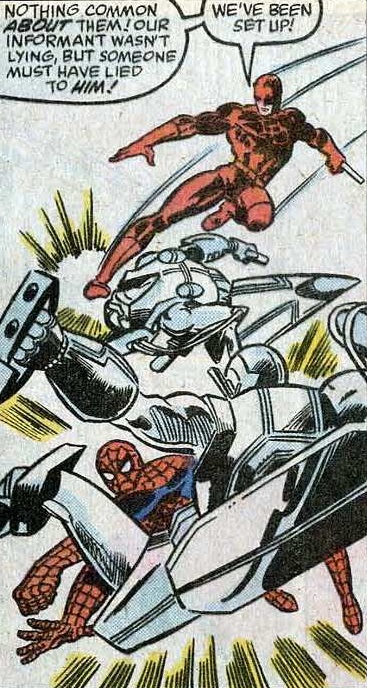
This is the first annual in The Evolutionary War to actually build on events earlier in the saga as New York deals with the consequences of the interruption of the drugs supply in Punisher Annual #1. Otherwise this annual feels quite traditional, perhaps in part because Tom DeFalco is plotting but also Mark Bagley adopts a very traditional approach to the artwork that stands in strong contrast to Todd McFarlane's contemporary work on the regular series at this time. It's a nice suitable retro feel for a story that also resorts to some traditional moves such as Spider-Man being falsely accused of a crime and J. Jonah Jameson being delighted at being proved right. There's a team-up with Daredevil and a good use of the Kingpin. But there's also the debut of a new superhero.

Speedball was the newest hero Marvel was about to launch in his own title and he's given a preview here. But it's not a very good one. There's no origin story, just a quick mention of an "accident" that gave him his powers, and the character comes across as a mess. When Robbie Baldwin encounters a force it triggers a kinetic power that sends him jumping all over the place which he tries to use to fight street level crime. There's a half decent idea in that and with some refinement to give him a degree of control that could at least all him to walk around without being terrified of brushing into anyone it might work. But the problem here is that we're given neither the origin of a new hero when he can be expected to have difficulty controlling his powers nor an appearance once he's fully come to terms with them. To add to the problems neither his creator Steve Ditko nor his regular scripter Roger Stern is working on this story and so Speedball is just thrown into this story to bounce around without contributing much that couldn't have been handled by either Spider-Man or Daredevil.

The story focuses on the mystery of the disruption to the drug supply which turns out to be down to the High Evolutionary's Purifiers killing several distributors and dealers whilst preparing a scheme to render everyone in New York unconscious and then sterilise everyone with unacceptable DNA. Although both aims have been pursued by the Evolutionary's forces in earlier annuals it's surprising to see the same team attempting both at the same time and the result is they attract too much attention with the Kingpin forcing the details out of a captured Purifier then manipulating Spider-Man and Daredevil into attacking the Purifiers' base whilst Speedball has also stumbled across the plan. There's a good complex take on the Kingpin, concerned not merely with the immediate profit margin but also with ensuring his city is kept safe and using his resources to help the heroes where necessary. He even gets the Arranger to clear Spider-Man's name by getting the real criminal to confess to the murder of the drug distributors at the start of the story. Then at the very end he is shown expressing real concern about the wider threat. It's a reminder how he prefers the stability of the existing order and is prepared to help preserve it if needs be whereas a more simplistic villain would simply throw in with the bigger foe in town.

Overall this is a pretty good example of a traditional Spider-Man story with a double team-up thrown in for good measure. Spider-Man and Daredevil work well together and the menace is pitched at the right level for them. It's just unfortunate that space is devoted to introducing Speedball who really adds nothing to this tale and does not get a very impressive introduction.


2nd story: He who laughs...
Plotter & Penciler: Steve Ditko
Scripter: Roger Stern
Inking: Jackson Guice
Lettering: Rick Parker
Coloring: Tom Vincent
Editing: Jim Salicrup

Yes that's that Steve Ditko doing the plot and pencils. It's his first work on a Spider-Man book since 1966 - but he always refused to return to the main character and so is only drawing a back-up feature. Over the next few years he would appear in several more Spider-Man annuals in this way and so it's natural to wish he could have opted to return to the main character just one more time. Instead here is what was then his newest creation.

This could almost be from Speedball's own series which launched at this time and had almost exactly the same creative team at the start. One of the curiosities of the series is how many issues have multiple stories. There were a number of anthology titles around this time - examples include Strange Tales, Marvel Comics Presents, Solo Avengers and, over at DC, Action Comics Weekly - that offered multiple shorter stories but headed titles tended to have a single story each issue or at most a back-up story that focused on some of the other cast members in a separate story strand. Doing an ongoing headed series with multiple tales of the title character(s) was an extremely retro step.

And this story feels very retro. It's about thwarted ambition fuelling false revenge as an unsuccessful ex actor tries to murder Speedball's mother, believing she turned a director against him and so he failed to get a key break part. Now working as a janitor in a theatre he plans to attack her when she visits a friend there but first has to dispose of her son. This results in Speedball (who doesn't actually call himself by that name yet; instead he thinks of himself as "The Masked Marvel", his book's subtitle) bouncing around trying to distract and knock out the would-be killer before his mother can see him.

It's a rather weak story that's constrained by the need to have Speedball's powers triggered at key moments to advance the plot. The villain's motivation is believable but his attempts get sillier and sillier. Nor is it even resolved by the hero. Again this is not a good advert for Speedball and his series.


3rd story: The High Evolutionary: Kindred Spirits
Story: Mark Gruenwald
Pencils: Ron Lim
Inks: Tony DeZuniga
Letters: Ken Lopez
Colors: Gregory Wright
Editor: Ralph Macchio
Editor-in-Chief: Tom DeFalco

This is another info dump heavy chapter that rushes through the introduction of the New Men, with Bova, perhaps their best known member, being shown being genetically accelerated from a Guernsey cow, then more explanation about the nature of the Werewolf, though the High Evolutionary remains sceptical about the supernatural explanations, before the body of Jonathan Drew returns animated by a sixth century ghost called Magnus to explain how the spirit of the demon Cthon has been bound to Mount Wundagore and could be awakened by the Evolutionary's work. That's a lot to take in in just six pages but it does once again reinforce just how Marvel had let Wundagore get overused in far too many characters' histories so as to produce this mix of technology and magic and even Mark Gruenwald was starting to struggle to make it all seem consistent.

One thing that does stand out is that Gruenwald (or Macchio) isn't always writing the Evolutionary's dialogue consistently as an interwar British scientist. So some of his dialogue includes stereotypical upper class phrases like "old girl" whilst he also uses the American dating format for recording his experiments. More consistent is the way the way Herbert Edgar Wyndham is now wearing his armour full time as a sign of how he is retreating ever more from the outside world into a shell. The character is portrayed consistently as a rational scientist refusing to believe tales of magic even though he admits he does not understand the Werewolf. Although the amount of backstory to wade through can be overwhelming at times this saga so far has done a good job of building up the lead character.


Other material includes the plans for Peter and Mary Jane's apartment plus two unused covers by Larry Lieber & Jack Abel and Bob Layton from the black costume era and a plug for the Spider-Man newspaper strip. This annual may not be the best example of its series at the time as the latter was in quite a bold experimental phase but it's good traditional Spider-Man and a good introduction to crossover visitors as well as making good use of the event to tell a strong story. It's just a pity that it's had a new hero thrown in to poorly promote.

Friday, 25 January 2019

Amazing Spider-Man 329 - Acts of Vengeance

It seems slightly surprising that the story of Spider-Man's cosmic powers has just run over the end of "Acts of Vengeance", especially as this arc has had a few too many chapters. It would have made more sense to follow the structure of "Inferno" and limit the main multi-part storyline to a handful of issues with others doing their own thing on the side, rather than padding things out so much and then needing an extra issue.

Amazing Spider-Man #329

Writer: David Michelinie
Penciler: Erik Larsen
Inker: Andy Mushynsky
Letterer: Rick Parker
Colourist: Bob Sharen
Editor: Jim Salicrup
Editor-in-Chief: Tom DeFalco

Still this final part does a lot to wrap things up, including a climax on the power stakes. Both Graviton and Sebastian Shaw are continuing to pursue Spider-Man, but the former is put off with a single blast. The latter is more cunning, opting to investigate just how Spider-Man got his powers and locating the scientist who was doing energy experiments at the time. From a modern perspective it's surprising that Shaw is able to blackmail Dr Lubisch by threatening to reveal to the board of Empire State University the details of how Lubisch was sacked from Heidelberg after performing a "rather unorthodox experiment". It seems strange that basic background checks were not performed, especially as by 1989 communication was already sufficiently advanced that universities would be able to contact one another quickly. Still it works that Shaw would turn to the same scientist to produce an "energy negator" to try to cancel out Spider-Man's powers - and that it instead cancels the block in the original transfer that led to Spider-Man acquiring them only slowly.

For Spider-Man has the powers of Captain Universe and now adopts the traditional look, albeit with a red webbed mouth mask. The Enigma force has detected great danger to humanity and empowered Spider-Man to defeat it, though why the powers to him so early is unclear, though Lubisch's experiments are the cause of the delay in fully adoption. One could also wonder if the danger was just the Tri-Sentinel (as Spider-Man's newfound cosmic awareness implies) or the "Acts of Vengeance" as a whole. The robotic menace turns out to be an after-effect of the Acts as Loki, looking rather freer than he was at the end of the final battle, opts to make a final mark on Earth by merging three prototype new Sentinels together. Given the steady step up in power levels of the foes encountered through this arc, a super robot enhanced by the magic of a deity makes sense as the ultimate threat level. And the Tri-Sentinel also evokes one of the classic Silver Age images, Spider-Man with six arms which was the very final panel of Stan Lee's original hundred issue run.

Three is a recurring theme in the issue, with the opening scene introducing the Sentinels set three days ago, Shaw blackmailing Lubisch three hours ago and Loki working his magic three minutes ago. The merged Tri-Sentinel has three faces, making it impossible to sneak up on, though Loki doesn't seem to have thought to reverse one set of arms for fighting in both directions. There's also a fusion to the logic circuits, so Shaw is unable to trigger a failsafe that would make the Sentinel turn in on itself. Instead it's down to Spider-Man to finish the task he received the powers for. Then the power departs, leaving Peter wondering if he could have done more with it to improve the world, a thought that we'll come back to.

At first glance, cosmic powers and Spider-Man are not a natural combination. But this storyline has taken the core philosophical line of the character - "with great power there must also come -- great responsibility" - and asked what happens when greatER power comes? As a one-off event it's been an excellent way to explore the character. The storyline may have had a few too many issues but the finale works in providing a clear explanation for the situation, delivering an ultimate threat and handling the foes who weren't previously captured. The art effectively captures Spider-Man's moves and the sheer scale of the Tri-Sentinel, making for a strong finish.

Amazing Spider-Man #329 has been reprinted in:

Wednesday, 14 November 2018

Amazing Spider-Man 328 - Acts of Vengeance

This is the last issue of the series drawn by Todd McFarlane and it's not hard to spot his is the greater influence on the story than David Michelinie. The issue is devoted to a fight between Spider-Man and the Hulk, whom McFarlane had previously drawn at Marvel. It could well have been his final issue at Marvel overall, and thus going out by drawing both the characters he'd made his name on would stand as a strong legacy. (Instead he succeeded in getting to draw and script a new Spider-Man series but that's another matter.)

Amazing Spider-Man #328

Writer: David Michelinie
Artist: Todd McFarlane
Letterer: Rick Parker
Colour: Bob Sharen
Editor: Jim Salicrup
Editor-in-Chief: Tom DeFalco

McFarlane's art is a pretty polarising subject. As someone who discovered it long after the event for me it's always been a part of Spider-history rather than an active debate but it's certainly very different from the house style that came before and indeed which both Sal Buscema and Alex Saviuk use on the Spectacular Spider-Man and Web of Spider-Man issues here. It works well enough, though it does seem to be pushing Spider-Man in an ever-darker direction reminiscent of other heroes, something the script picks up on with a scene where Spidey lifts up a criminal who asks, "Who are you?!?" and the reply begins "I'm Bat..." Well it was 1989 but it’s another needless homage. The cover is also a little odd in that Spider-Man seems to be lifting the Hulk up by his genitals, perhaps explaining the latter's bright green tongue.

The main plot is driven by the committee of villains having made an offer to Sebastian Shaw, recently deposed from the Hellfire Club. Shaw has the mutant ability to absorb energy and use it to enhance his strength and speed, which might have made him a good match for Spidey earlier in the storyline when the powers were still slowly developing. However here it would be a one-sided walkover - and Shaw realises as much, noting that Magneto is involved and suspecting this is really an attempt to dispose of an enemy once and for all. So Shaw instead hires the Hulk to do the job.

This is still the grey Hulk with a mercenary aspect and he accepts the task, though the battle is constrained by the sun rising hours earlier in New York than Las Vegas, with the result that the initial confrontation is aborted when he starts turning into Banner. The following night things are more brutal, with the Hulk seemingly larger than usual and Spidey really not wanting to hurt him until two children are threatened, resulting in a memorable single punch that knocks the Hulk into orbit. Comic fans have long debated who would win in a fight between Superman and the Hulk and at the time this would appear to be the nearest substitute given the difficulties of arranging inter-company crossovers. The point is even more explicit with one of the children commenting that Spidey needs a cape.

As a final bow out for such an influential artist this issue could have just been an indulgent fight between the two Marvel characters he was best known for. But this also works well in advancing the storyline as Spidey faces increasingly powered foes whilst also adding a new element to the mix in Shaw's interests in the powers. This keeps the storyline flowing well.

Amazing Spider-Man #328 has been reprinted in:

Friday, 5 October 2018

Amazing Spider-Man 327 - Acts of Vengeance

We continue with the storyline of Spider-Man's new cosmic powers, which here see both an increase in their development as he discovers how to fly and a step-up in the foes available as he clashes with Magneto.

Amazing Spider-Man #327

Writer: David Michelinie
Penciler: Erik Larsen
Inker: Al Gordon
Letterer: Rick Parker
Colourist: Bob Sharen
Father Figure: Jim Salicrup
Grandfather Figure: Tom DeFalco

So far in the Spider-Man portion of the crossover it's been easy to spot the hierarchy of the three titles, with Amazing Spider-Man inevitably the flagship and carrying such a major encounter, in contrast to Web of Spider-Man which can barely struggle to justify its existence. But the result is that here we get a very strong chapter as Spider-Man contemplates the effects of "with great power comes great responsibility" as he now faces even greater power and realises the consequences, most significantly when he whips up a super bat to knock a car out into the water, only to subsequently discover it's hit a cruise ship. Spider-Man's new powers continue to attract the attention of the media and in turn the leaders of the alliance, where I do wonder why the Kingpin is drawn at such an exaggerated size. Both Doctor Doom and Magneto have their own interests and plans and as a result the Master of Magnetism goes to investigate, leading to the first big fight between a hero and one of the leaders of the alliance.

"Acts of Vengeance" came out during a particularly protracted struggle within Marvel over the portrayal of Magneto. Over the course of nearly a decade Chris Claremont had steadily developed the character beyond a traditional villain into a more complex anti-hero. It was a development that wasn't popular with all Marvel creators and from time to time there were would be some quite pointed conflicts for control of the character. Magneto's role in the crossover is one of the most traditional, using him in a way that he could just as easily have been used back in the Silver Age along with all the other traditional big-name foes, but it does seem odd when considering his position as a fighter for mutants against humans to see him instead allying with humans. Here we get the first attempt to rationalise the situation when Magneto thinks of the arrangements as an alliance of convenience as part of his long-term preparations, and his interest in Spider-Man's powers comes through consideration of the coming war. It's somewhat stilted but it shows the problems of having a character written by conflicting sub-committees. Magneto is wondering if Spider-Man is a late developing mutant but soon concludes not, given the multitude of powers displayed which seems a little odd given the power set of some of the most powerful mutants around. Although Spider-Man and Magneto met in Secret Wars, I can't recall any particular fight between them there or find any other prior clash in the comics. (They had, however, clashed in both 1981 cartoons, the Spider-Man solo series and Spider-Man and his Amazing Friends, but those aren't part of the canon.)

The issue continues some good characterisation for Spidey as he discovers what he can about his powers and tries to gain an idea of how to control them, including through a meeting with his old friend Flash Thompson who has now become a professional boxer and faces the same dilemma of potentially hurting others. Meanwhile Mary Jane starts her job as a soap opera actress, playing a character who tries to commit adultery with a doctor and contemplates what impact the nature of her role will have on her marriage. This is effectively the start of Erik Larsen's run drawing the title, having done one chapter of an earlier saga, though as noted the switch-over from McFarlane is not a clear-cut changeover.

All in all this is a strong entry in both the cosmic powers saga and the wider crossover, showing how to use Spider-Man's powers to set up fights with foes on a level he's never been able to reach before.

Amazing Spider-Man #327 has been reprinted in:

Monday, 3 September 2018

Amazing Spider-Man 326 - Acts of Vengeance

The main appeal of "Acts of Vengeance" is that it pitches heroes against villains they've never fought before. But in some cases that may be a little difficult to arrange. At this point Spider-Man had had three ongoing titles for over a decade, as well as many more guest appearances. And that presents a strong challenge to the writers to find qualifying villains.

Amazing Spider-Man #326

Writer: David Michelinie
Penciler: Colleen Doran
Inker: Andy Mushynsky
Letterer: Rick Parker
Colourist: Bob Sharen
Editor: Jim Salicrup
Editor-in-Chief: Tom DeFalco

As we'll see, this is from a slight period of flux on the art side of the title, with Todd McFarlane leaving and Erik Larsen coming in but it's not a clean-cut changeover with no two consecutive issues between #323 & #329 handled by the same penciller as Larsen steadily takes over from McFarlane, with this issue drawn by a filling-in Colleen Doran.

This issue comes early in Spider-Man's marriage to Mary Jane, a subject that has consumed great debate over the years and led to many deeply controversial stories as writers tried to undo it. So it's of particular notice here that the Spider-writers of the late 1980s had solved the "problem" of Mary Jane being a high-flying supermodel by getting her effectively blacklisted in the industry due to a vendetta by an obsessive stalker. Instead this issue sees her securing a job as an actress in a soap opera and also her and Peter's flat warming party in the loft of Harry Osborn's building. It's a way of bringing her down to earth and making the marriage more equal, something that writers in other periods often forgot.

Otherwise this issue sees Graviton seeking to battle Spider-Man at the behest of the Kingpin. We've yet to see the central scheme in action, but already the heroes are being targeted. At this point Graviton has mainly appeared in the Avengers titles, with a few side appearances in the likes of Fantastic Four and Thor, so he's a genuinely unknown quantity for dealing with Spider-Man. Even Graviton is surprised at the idea that the Kingpin will sort out revenge on the Avengers in trade for this, but given Spider-Man's ingenuity it's perhaps natural to deploy such a powerful foe. More surprising is that the Kingpin has realised that targeting the Daily Bugle building is an easy way to draw out Spider-Man, suggesting he might want to work on shoring up his secret identity. But the result is Graviton attacks the building and then rapidly defeats Spider-Man, leaving him in a pile of rubble.

It's a straightforward tale that shows how the overall idea of Acts of Vengeance can potentially work, at least against the less powerful foes and also how the crossover can easily fit in a title's ongoing subplots so long as they're reasonably explained.

Amazing Spider-Man #326 has been reprinted in:

Friday, 8 January 2016

Twelve recommended Essentials

For my final post, I have decided to pick twelve volumes that especially stand out. The only restriction is that there is no more than one from each series. These aren't automatically the best stories - and the nature of the beast is that there are times when the incredibly good is collected with the incredibly dire - but twelve cases of the Essential series at its best. And the order has been chosen by lot.


Essential Moon Knight volume 2

Contains: Moon Knight #11 to #30

Moon Knight began as a foe for the Werewolf and then developed in the direction of a Batman clone but also acquired his own themes and the unique feature of his multiple identities that started to take on lives of their own. It took a while but soon it had found its own niche and cult following. This was one of the first series to be sold only in the direct market and it took full advantage of the shift to offer varied length stories that are free of the Comics Code Authority restrictions yet never being puerile or gratuitous just to show off its freedom. This volume represents by the middle issues of the series when it was at its height.


Essential Captain America volume 4

Contains: Captain America and the Falcon #157 to #186

Captain America was originally created during a great wave of patriotism and revived during another. But by the 1970s the US was changing and Cap seemed a man out of time in more ways than one. Then came new writer Steve Englehart who, together with artist Sal Buscema, set out to explore just what Cap's role is in this new world where the old certainties are gone and it's no longer so clear just what "serving my country" means anymore. The height of this approach comes in the Secret Empire story as Cap discovers a conspiracy that goes to the very highest levels, which in turn leads him to abandon his costume and the Falcon steps up to the forefront as the country is still facing threats.


Essential Dazzler volume 1

Contains: Dazzler #1 to #21 plus X-Men #130 & #131 and Amazing Spider-Man #203

When this was first announced many declared "Essential Dazzler" to be an oxymoron. But the Essentials have brought attention to many obscure series and characters, allowing them to be assessed anew without listening to decades old myths and assertions. This volume collects the first half of her series, allowing readers to judge for themselves and see a series that isn't the disco chaser of myth but instead shows a strong independent ordinary character trying to get by in life with the added complication of her powers. The Essential volume is a well-deserved rescue from obscurity.


Essential Black Panther volume 1

Contains: Jungle Action #6 to #22 & #24 and Black Panther #1 to #10

"Panther's Rage" was one of the first comic storylines to be written as though it was to be collected as chapters in a book and this volume does that and more so. Very often the biggest developments in comics are made in obscure series starring less well-known characters, and here is almost the definitive example of a hidden classic plus the start of "The Panther vs. the Klan!", taking the character to further heights. Sadly the volume also demonstrates how the Essentials scoop up the bad as well as the good with the start of Jack Kirby's run on the title that might as well be from an alternate reality, but that doesn't detract from the majesty of the bulk of the volume.


Essential X-Men volume 2

Contains: X-Men #120 to #144 and, in later editions, Annual #3 to #4

The All-New All-Different X-Men burst forth in the mid 1970s, presenting a highly crafted team of strong, well-defined characters who were put through a variety of situations. This volume covers the latter part of the Chris Claremont and John Byrne run when the team faced a range of scenarios from Alpha Flight trying to reclaim Wolverine for the Canadian government to Arcade subjecting them to his funhouse of horrors, but the high points come with two of the most influential X-Men stories of all time, the "Dark Phoenix Saga" and "Days of Future Past" which explore the problems with controlling great power and the dangers of anti-mutant prejudice run wild respectively.


Essential Rawhide Kid volume 1

Contains: Rawhide Kid #17 to #35

Marvel have printed many titles in numerous different genres over the years but haven't reprinted too many of them in recent years. But when they do it's often an eye opener. This volume is the sole Essential representation of the western genre, offering a good set of done in one enjoyable stories that mix the adventures of the lead character with other generic tales of the west. Very much a representation of the Atlas style before the Marvel superhero revolution, this volume is nevertheless a good, light fun read.


Essential Ghost Rider volume 4

Contains: Ghost Rider #66 to #81 plus Amazing Spider-Man #274 and New Defenders #145 & a bit of #146

It's rare for a long running series to end in a truly satisfactory way but Ghost Rider got one of the best conclusions going, allowing him to ride out on a high in what almost feels like it was the long term plan. The Ghost Rider may have begun as a fusion of the horror and stunt fads of the 1970s but he outlasted the fads to become something much stronger. Here the long running saga of the battle between Johnny Blaze and the demonic Ghost Rider reaches its climax here but there's time taken to remind and reintroduce the key elements for readers who haven't been along for the whole journey before the final end.


Essential Thor volume 3

Contains: Thor #137 to #166

Thor was a title that took a good while to really find its feet and get a long term permanent creative team but once it did Stan Lee and Jack Kirby proceeded to produce an amazing run of tales that combine Norse mythology and cosmic space adventure, with occasional interludes on Earth. By the time of this volume they had found out what worked and defined the character, with the stories here representing the absolute peak of their collaboration, ranging from battling the Mangog in Asgard to the conflict between Galactus and Ego the Living Planet in deep space. Truly this is the definitive Thor.


Essential Marvel Team-Up volume 2

Contains: Marvel Team-Up #25 to #51 plus Marvel Two-in-One #17

There's a sense of fun to a team-up book, often allowing the chance to enjoy both the regular and guest heroes in some nice one-off tales that don't require too much familiarity with the guests to follow them. But when in the right hands they can be even more. This volume contains some of the best of all the team-ups, ranging from the silliness of a team-up with Hercules where he tows the island of Manhattan through the seas to the deadly grittiness of a time travel saga that takes Spider-Man back to Salem in 1692 for a dark battle against the backdrop of the witch trials. This is a book that knows how to put together an epic out of several different guest stars and put the leads, whether Spider-Man or the Human Torch, through adventures they'd be unlikely to have in their own titles.


Essential Punisher volume 4

Contains: Punisher #41 to #59 and Annuals #4 to #5

The Punisher has always been a difficult character to handle because the approach of a self-appointed executioner is often at odds with conventional superhero ethics whilst the high fatality rate amongst both his foes and allies leaves limited scope for character development. It took a long time before he received an ongoing series and then in turn it took longer to really flesh it out but by the time of this volume it was coming together nicely. Here we get a mixture of traditional one-off tales against individual foes done well along with steps towards greater development with the handful of foes who have greater lasting power, most notably "The Final Days" epic that puts the Punisher in a marathon of endurance under pressure from the Kingpin.


Essential Warlock volume 1

Contains: Marvel Premiere #1 to #2, The Power of Warlock #1 to #8, Incredible Hulk #176 to #178, Strange Tales #178 to #181, Warlock #9 to #15, Marvel Team-Up #55, Avengers Annual #7 and Marvel Two-in-One Annual #2

Warlock was a highly experimental strip that routinely sought to push the boundaries of what was possible, most notably with its approach to religion. The volume collects the two 1970s epics that saw Warlock first go to Counter-Earth to drive out a dark force and redeem it and then into deep space to take on the corruption and hypocrisy of an inter-galactic church presided over by none other than his evil future self. The title character has no desire to be a hero and is merely a good man searching for himself but gets caught up in the horrors all around him. Twice the title was cancelled but each time the saga showed it could survive by resolving itself in another series with a spectacular climax.


Essential Spider-Man volume 1

Contains: Amazing Fantasy #15 and Amazing Spider-Man #1 to #20 & Annual #1

This volume encapsulates just why Spider-Man took off the way he did. It covers the single most creative period in the character's history, introduces most of the top villains and tells some amazing stories all at once. Spider-Man broke the mould in many ways and even today these tales stand up well as a strong set of adventures that need no replacement. Bringing big chunks of the Silver Age at affordable prices was one of the aims of the Essentials and it hit the ground running. This was the very first Essential I ever picked up and it's still great to this day.

Friday, 1 January 2016

What If... Essential Deadpool volume 1?

For a final look at a hypothetical Essential volume I turn to one of Marvel's biggest latter-day stars, the Merc with a Mouth in the days when he first became the Merc with a Monthly, the one and only Deadpool!

Woo hoo it's me!

Oh no! No! NO!

Hey I finally made it onto your blog!

Oh no you don't! Didn't you pay attention? You didn't know you were a comic character until the Writer of Death showed up and those issues aren't until later.

Yeah but you're inserting me into older material. And it wasn't quite Priest who...

Look let's stop this now. I'm the one with the keyboard, I'm the one who can type blanks into all your weapons - and I don't just mean your guns - and I'm not having another of these conversations. You have two choices - either p*** off and star in another film or I make like Fox and sew your f***ing mouth shut. GOT IT?!

Your funeral pal. See you in the funnier pages. Toodle-oo!

Now that that's over, back to normal service...

Essential Deadpool volume 1 would contain his first appearance in New Mutants #98, the two four-part limited series Deadpool: The Circle Chase and Deadpool: All New X-Men Limited Series (well that's what it says on the cover; it's also been called "Sins of the Past" in places) plus issues #1 to #11 & #-1 from his first ongoing series and the crossover annual Daredevil/Deadpool '97 as well as a guest appearance in the back-up story from Avengers #366 which ties in with the first limited series. That would make for a larger than usual volume but Deadpool's done this sort of thing before.

The bulk of the material can be found in Deadpool Classic volumes 1, 2 & 3 but the Avengers appearance is in Deadpool Classic Companion, an extra volume devoted to all those appearances sequential reprints often ignore. This doesn't include every early Deadpool appearance ever - in particular there are some X-Force storylines absent that would otherwise overwhelm any collected edition - but it catches his early years quite well. Otherwise, most of the earliest Deadpool limited and ongoing issues looked at here have been collected in a variety of editions, released in multiple countries and languages. The most complete source for the ongoing title is the Deadpool by Joe Kelly Omnibus.

(And for those wondering where the cover image has come from, it's a piece that did the rounds when the ongoing series was launched and is now probably best known as the cover for the trade paperback Deadpool: Mission Improbable which reprinted the first five ongoing issues back in 1998. Yes the standard practice for Essentials in the 21st century has been to use art from the original comics but since when did Deadpool ever conform to standard? And the obvious alternative image from New Mutants #98, as used on Deadpool Classic volume 1, is just hideous. It's unsurprising both the Italian edition and the British edition with just the two limited series went for the cover of the first issue of the second series, but this is a better option.)

Deadpool's first appearance in New Mutants is plotted & drawn by Rob Liefeld and scripted by Fabian Nicieza. The Circle Chase is written by Nicieza and drawn by Joe Madureira whilst the second limited series is written by Mark Waid and drawn by Ian Churchill, Lee Weeks and Ken Lashley. The ongoing series, including the "Flashback" and annual, is written by Joe Kelly with help from Pete Woods on one issue and contributions of a different kind from Stan Lee on another. The art on the series is mostly by Ed McGuinness with some issues by Kevin Lau, Shannon Denton and John Fang whilst John Romita contributes in a way on one issue whilst the "Flashback" issue #-1 is drawn by Aaron Lopresti and the annual by Bernard Chang. The Avengers story is written by Glenn Herdling and drawn by Mike Gustovich. Invariably this means there's a separate labels post. And I see someone has already done the dialogue for it. Grr...

This volume would cover an interesting and turbulent period in the comics market with Marvel and its travails often at the centre of the storm. During the early 1990s there was a massive rise in overall sales accompanied by a huge increase in the volume of titles and many characters received their own limited or ongoing series, with Deadpool amongst them. But it was notable that very few of Marvel's new titles lasted any length of time outside of the X-Men and Spider-Man families. (Exactly how few is subject to a few myths so worth checking in detail.) After a flurry of lasting successes launched in 1990 such as Namor the Sub-Mariner, Ghost Rider, Guardians of the Galaxy, New Warriors and even Barbie and Barbie Fashion, Marvel entered a long run of misses. Over the next six years many titles were launched but outside the Spider-Man and X-Men families only six series lasted more than three years - Darkhawk, Warlock and the Infinity Watch, Punisher War Zone, Spider-Man 2099 (counting that as a 2099 family title rather than a Spider-Man one), The Ren & Stimpy Show and Doom 2099. The last of these launched in early 1993 and all of these had gone by late 1996.

Meanwhile the various Marvel companies and divisions got involved in some complicated chaotic financial dealings that led to actions that exacerbated problems in the North American comics market, contributing to a massive crash, roughly around the time of Deadpool's second limited series and over the next few years Marvel lurched through a series of crisis decisions that saw many titles axed and several long running superhero titles farmed out to Image creators. The bleakest moment came in late 1996 with the announcement that Marvel had filed for bankruptcy protection. It seemed as though the creative edge had gone out of Marvel and few expected any new series to last.

Yet out of that winter came two series that did manage to last for a good number of years and show that Marvel had now got its mojo back. The second of these titles was Thunderbolts. The first was Deadpool.

But reading Deadpool's first appearance from some six years earlier there's nothing that hints at this. He may be the most prominent character on the cover of New Mutants #98 (with the element later lifted for the first of his Classic series) but within the story he's a one note character whose primary purpose is to establish the skill of another new character, Domino. Deadpool fights Cable and the other New Mutants before being overcome upon Domino's arrival and is then mailed to his employer with the implication that will be the end of him. As first appearances go it's extremely underwhelming though it establishes Deadpool as a rather chatty mercenary who just won't shut up. He would pop up again and again in the replacement title X-Force before benefiting from the massive explosion in the number of titles in the early 1990s in which even the most obscure character could get a limited series.

With the great explosion of came some titles came some not so great product and that's apparent here. The Circle Chase is primarily a quest series with Deadpool and a whole range of other characters hunting for an ultimate weapon mentioned in the will of the unseen Mr Tolliver. The quest spills over into a back-up story in the 30th anniversary Avengers issue which otherwise focuses on the Black Knight's battle with his squire turned evil, the Blood Wraith. The appearance here of Deadpool, and indeed the one-off Plug-Uglies - Flame and Foam - also searching for the weapon, provides a wider conflict to ensnare the Blood Wraith but otherwise is mainly incidental to the story, though there's a scene where Victoria Bentley is confused for Deadpool, something that can't happen that often. Even Deadpool's dialogue is tame, showing how difficult a character he is to write for.

Back in the regular series we're reintroduced to other elements of Deadpool's life such as his technician "Weasel", his artificial healing factor, his personal history with the mutant Copycat aka Vanessa and so forth. But the storyline itself is lame, consisting of a series of fights around the globe with the likes of Weapon X, Slayback, the Juggernaut, Black Tom Cassidy and various lesser foes, before a climax in which the weapon is revealed to be the least offensive tool imaginable and Deadpool saves himself through logic and selflessness in acting to heal Copycat. Overall this limited series just isn't anything to set the world on fire and is an unfortunate start to Deadpool's solo tales.

The US comics market was starting to go into freefall by the time the second limited series came along, but that may have been to the title's effect by increasing the talent available. This limited series is far more personal to Deadpool, focusing upon his history with the Weapon X project and as a mercenary plus his friendship with the X-Force member Siryn under the disapproving watch of her father Banshee. The story deals head on with one of the character's biggest problems, namely that his healing factor is so powerful that it removes any real sense of danger for the character. Here he has to come to terms with the factor failing and find a way to restore it, as well as a repeated encounter with the Juggernaut and Black Tom Cassidy, the latter now needing some healing of his own. It's a good little personally focused story, of the kind that the limited series format is best for. The only new character of any significance is Dr Killebrew, the geneticist responsible for Deadpool's healing factor in the first place and thus has good potential for recurring appearances over the years. Otherwise we get a movement of the lead character towards the more wacky side that would come into full force with the ongoing series.

Deadpool's ongoing title began in late 1996 and it's easy to forget now just how revolutionary or niche it often was. This series began before the regular South Park series launched, before the first Austin Powers movie had come out and indeed before much of the explosion of cartoony style adult humour series. Indeed at times it seems to be setting the trends. Marvel had done humorous titles before but never a mainstream universe superhero title with such a bizarre wackiness to it. This is a very experimental title that does its own thing, with a character highly different from the norm.

It's also easy to forget, especially now with such a major movie about to come out, that this was a title that was constantly fighting to survive and at times only holding on by the skin of its teeth. From memory Marvel announced its cancellation more than once and there was a big "Save Deadpool" campaign, trying to increase the number of subscribers to secure extra sales in advance. Marvel's then-recent track record on cancelling titles was not encouraging. Few honestly expected the series to last at all and expected Deadpool to then drop into obscurity. To predict the character's present day popularity and sales would have marked one as mad as the character. And yet somehow the book managed to last so long.

It's probable that Deadpool primarily survived because the series was so different from everything else the company was putting out and thus probably bringing in readers that Marvel otherwise couldn't reach. And the cancellation threat itself was oddly beneficial to the series, allowing the creators to experiment as much as they did because they had nothing to lose. The result was something truly amazing.

Now sure the issues contained here, covering the first year of the title, include some typical Marvel superhero comic clichés. There are the guest appearances, both by characters Deadpool has a history with and those with no previous connection. There's an encounter with a superhero team, allowing the Avengers logo to appear on the cover. There's a whole issue devoted to a Spider-Man encounter. There's some exploration of the character's past and origins. There's a supporting cast established, including an over helpful sidekick role, a recurring antagonist in day to day business and an elderly lady. And the storylines vary in length from done in one tales to multi-part sagas that try to go into more detail.

But it's the whole approach that is so different. It's best to think of the series as like an adult cartoon, with a foulmouthed anti-hero as the protagonist and some quite wacky and offbeat situations encountered along the way. The conventions are rarely conformed to but instead often sent up in their own wild and wacky way. Deadpool is slowly drifting towards herodom but it's a long journey for Wade Wilson, in spite of the hopes of Landau, Luckman and Lake in a long running subplot. Early on the healing factor is toned down, allowing for more tension. There's also a very unusual guest cast.

Weasel continues to help Deadpool from time to time, playing a pivotal role in the last issue as we learn more about his past and just how long an influence Wade has had on him. He makes for a likeable supporter who sticks by Deadpool in spite of everything and it works. More curious is Blind Al, an elderly woman who lives with Deadpool and we slowly discover she is his prisoner who has become accustomed to her situation despite all the crap she has to deal with. The exchanges between the two makes for a tricky relationship with each unable to admit how much they are dependent on the other. It can also set Deadpool back in the field, especially when Al sabotages his weapons.

As well as Deadpool's own home he also spends a lot of time at the "Hellhouse", a sort of community centre for mercenaries to hang out, collect assignments from the runner Patch and maintain tense relations with one another. Deadpool's main recurring rival in the series is the mercenary T-Ray, though the antagonism is not fully explored at this stage. There aren't too many new foes introduced at this stage with the main new one being Deathtrap who captures Deadpool and subjects him to a highly surreal situation. Otherwise the foes are drawn from a variety of other Marvel titles with appearances by the likes of Taskmaster, Vamp (one of the more obscure Captain America foes), Typhoid Mary and Kraven the Hunter.

The potential list of guest stars was not great if the title was consciously trying to avoid encounters with the X-Men family at this stage. A good chunk of big name heroes were absent because of the transfer to the Heroes Reborn pocket universe, but that proves advantageous in forcing a more experimental approach with those that are left. The first issue features Sasquatch, between stretches in Alpha Flight, with the traditional misunderstanding, fight and then team-up. Later on we get an appearance by Siryn which sets out just what Deadpool actually means to her. The handling of his rather creepy stalking her and hovering outside her bedroom window is a bit tame though. There's a tense encounter with the Hulk, at this point in his most inhospitable with Bruce Banner having been torn out of him. But the most memorable tales come with three other guest stars.

An extended story with Typhoid Mary leads to a crossover with Daredevil in the annual but this is different from what has come before. Although many a prior annual has contained a guest star joining the regular hero (and some have forgotten which is which), this one is the first to give joint billing to both stars. It was a successful experiment that led to nearly every annual the following year being such a team-up book. The story itself provides a strong contrast between Deadpool's wackiness and the traditional darkness of Daredevil, adding in a twist from the latter's past as he discovers just how responsible for Typhoid Mary's life he really is. Meanwhile Weasel and Foggy Nelson go out on the town, with the consequence that Deuce the Devil Dog changes owner and titles. A dog companion is part of old comics silliness that feels totally at home in Deadpool's title.

But two other guest appearances at the end of the selection are even more amazing. First come, wait for it, the Great Lakes Avengers. Sorry, a correction. At this point they had brought out of the Avengers franchise (the actual team being disbanded and presumed dead can't have helped) and were now "the west coast adjunct to the Thunderbolts... the Lightning Rods! Attracting malignancy away from those it would see electrocuted in its negatively charged grip of evil!" This was the first time the team changed their name, although the cover of issue #10 retains the original. On their few prior appearances the GLA Lightning Rods have been treated as a joke aspiring to Avengers membership and here they encounter Deadpool at an aquarium resulting in total chaos as they fight. By this stage the series has settled into a fantastic alternate cartoon approach and this works incredibly well.

Before we get to the final issue though, a quick word about the "Flashback Month" issue. And frankly #-1 is an example of where the gimmick completely failed. It was published in the middle of the Typhoid Mary storyline (and thus has had to be relocated to before it for collected editions), apologies for the interruption but doesn't really tie into anything in the ongoing series beyond the interest in Deadpool by Zoe Culloden of Landau, Luckman and Lake. And here her investigations only bring her into indirect contact with Wade, instead focusing upon Vanessa when she worked the streets. A character called Montgomery is created for the story seemingly only to allow a cover image of a terribly burned face. Overall we have the mess of trying to create a Silver Age retro feel for the most Modern Age of characters, made worse by the issue not actually focusing upon him at all. To top it off we now have to accept that the Landau, Luckman and Lake interest in Deadpool has been going for at least a decade, which may be a commentary on how long some subplots last but feels more like a product of trying to come up with anything that could tie in with the current title. Going by the issues in this selection alone, one could easily skip #-1 and miss nothing at all.

A much more successful attempt to create a Silver Age feel yet apply it to Deadpool comes in issue #11, a triple sized issue that is the inevitable Spider-Man issue but comes in a very different form. Rather than a fight or a team-up we get a wonderful time travel story in which Deadpool and Blind Al find themselves thrown through time and arrive in 1967 just in time to take part in the events of Amazing Spider-Man #47. The original issue is reprinted at the end and is a somewhat typical example of the middle period of Stan Lee's run on the title with John Romita's art really coming to the fore in a tale focused on Flash Thompson's leaving party with a gatecrashing by Kraven. But it's also an example of the innocence of the Silver Age comics and the weird slang that can sound utterly incomprehensible at times. And that becomes the beauty of it.

Deadpool and Blind Al find themselves impersonating Peter Parker and Aunt May respectively as they wander through the events of the issue, often drawn into the original comic pages in a Forrest Gump manner. Pete Woods's new art is highly sympathetic to the original, helped by veteran inkers Al Milgrom and Joe Sinnott recreating a classic feel. However the script is mocking in all its glory as Deadpool and Al brings their own sensibilities to it, commenting on the mad slang, the Osborn hair, the sexual undertones to what was originally written as fairly innocent material and so forth. Against all this the fight with Kraven is even more of an afterthought than in the original issue. Overall this is a wonderful contrast of the classic and modern approach with wonderfully biting satire to boot, making for what is easily the best issue in the whole selection.

As a whole this is a series that knows it's allowed to be different and revels in it. There had been anti-hero leads in comic series before but never any quite like Deadpool. His earlier appearances had shown some potential but also a lot of extraneous moments that have to be waded through. But the ongoing series finds a strong niche and runs with it as a comic form of adult sitcom cartoon, sending up the situations and presenting a wacky lead with incredible dialogue and few inhibitions. Based on this selection alone, Joe Kelly is the best Deadpool writer so far, really nailing the character. There are some individual poor issues but there are also some incredible ones, with #11 a contender for one of the absolute best Marvel issues of the 1990s.

So should Deadpool have had an Essential volume? Absolutely! Deadpool is a character who has transcended all other rules so recentism is no problem. There's a lot of material out there - the Classic reprints are already up to volume 14! - and a good cheap bulky volume would be a good primer. The Classics suffer from the first volume having to contain the two limited series so an Essential volume would get deep into the main run.

Yay! Now to time travel once more and sort it out.

Sigh... Oh well, he's someone else's problem now.