Showing posts with label guest appearances. Show all posts

Thursday, 8 May 2014

Guest appearance omissions: Transformers #3

Today is the 30th anniversary of the launch of the Transformers. So let's take a look at the first time their path crossed with Spider-Man's...

For a particular group of fans, one of Spider-Man's best-known guest appearances was in the early issues of the original Marvel Transformers series. However it's very unlikely to ever appear in the Essentials, not least because a different company now hold the licence to the title property. But it has had several other reprints in this century, including Transformers: Beginnings from Titan Books a decade ago and more recently in the second edition of The Transformers Classics: Volume 1 from IDW Publishing.

(Unfortunately the vagaries of copyright and licensing have meant it hasn't always been possible to include it in Transformers reprint series. The Titan volume of about a decade ago had no problems, but IDW were initially unable to secure licences for Marvel-owned characters and so had to replace the issues with text summaries in their first edition.)

Back in 1984 the Transformers were a new toyline with Marvel the first to portray their adventures. A four-issue limited series was commissioned; however it proved so popular it rapidly converted to an ongoing series without even resetting the numbering and eventually ran for a total of eighty issues plus a few spin-off limited series. (Over here Marvel UK ran their own series, reprinting the US stories but in order to fill the faster schedule many new adventures were produced that weaved in and out of the continuity. There were also reprints of other Marvel series as "back-up strips"; one of these reprinted Amazing Spider-Man annual #19 albeit rebranded as Iron Man of 2020, reflecting the more prominent role of the guest star.) The third issue of the limited series saw a guest appearance to help boost the franchise's profile.


Transformers #3, written by Jim Salicrup and drawn by Frank Springer

(Although Salicrup is credited as the writer on this issue, by all accounts it was a very difficult series for writers to get to grips with, going through three writers in four issues and editor Bob Budiansky had to outline it all. When the ongoing series began he switched to become the regular credited writer; however he was effectively the uncredited co-writer of the earlier issues and deviser of much of the basic franchise mythology.)

This issue picks up on the kidnapping of human mechanic Sparkplug Witwicky by the evil Decepticons, who hope he can convert Earth fuel into a form the robots from Cybertron can use. Sparkplug is tortured into agreement. Meanwhile the presence of giant robots on Earth attracts the attention of both the army and the media, including Peter Parker. Changing into Spider-Man he discovers the heroic Autobot Gears who convinces him of the Autobots' good intentions. Spider-Man and the Autobots work together to first penetrate the military cordon around the Decepticons' fortress and then whilst the bulk of the Autobots create a diversionary attack, Spider-Man and Gears sneak into the fortress and take the remain Decepticons inside by surprise, rescuing Sparkplug. With a plane to catch, Spider-Man takes his leave as Gears reveals Megatron got what he wanted from Sparkplug...

On reflection this is one of the fastest paced issues of the original Transformers limited series, with the emphasis very much on action whether the battles between the Decepticons and the military or the Decepticons and the Autobots, or the desperate rescue mission. It's an odd choice to pick Gears as the Autobot Spider-Man spends most time with - true Gears is one of the few who can fly but he's also one of the smaller Autobots and not one of the strongest, making him an unlikely winner of the physical fights here, plus he's got a grumpy personality and a dislike of humans which doesn't make for the best of banter. Would it have been too much to use one of the more chatty Autobots like Bluestreak? Or for one-on-one physical combat a better choice for the rescue might have been Brawn. But the most logical choice overall would have been to have Spider-Man team up with the Autobots' leader, Optimus Prime. Gears and Spider-Man manage to overcome the Decepticons they encounter rather too easily for my liking, including encasing the Decepticon leader Megatron in webbing. This really does feel like a set of extremely unlikely victories, even if they do have surprise on their hands.

Spider-Man is written in classic form, though it's easy to envisage this story without his involvement. For this issue he was put back in his alien costume despite having relinquished it a few months earlier in his own titles - apparently this was to appease the Transformers' toy company Hasbro who were concerned about an appearance by a character whose toy was produced by a rival so they used the costume that the Mattel  Spider-Man Secret Wars toy didn't have. The need to win over Hasbro to include him probably explains why it's easy to imagine this story without his involvement. However he brings a sense of both fun and the wider Marvel universe to the series (and let's just ignore the continuity problems that Transformers would later brush over on this point). Spider-Man is also drawn well, but the Transformers suffer from a lot of art and colouring problems (yet another reason for a black & white reprint).

Broadly there are two ways to draw the Transformers - either as poseable versions of the toys or as stylised versions called "character models" devised for their fictional appearances that don't always resemble the toys too closely. This issue sees a big step towards the comics using the character models exclusively but some of the characters have been drawn or coloured using earlier versions of the models - Megatron's appearance on the cover is the most obvious example - and a few such as Frenzy and Rumble have moments when they look more like their toys. A lot of the characters are also drawn awkwardly with weird and variable proportions plus some over heavy inking. There are also many times when the colours are at variance with the most familiar versions even within the comics themselves, making it sometimes difficult to recognise which character is which. Just to add to the problems some of the characters would be consistently coloured with a different scheme from the toys and/or the cartoon - Ratchet, Skywarp, Soundwave, and Starscream are all noticeably off-colour sufficiently consistently in the issue for it to not be a colourist's error. Ratchet and Starscream would eventually switch to more familiar colours (although it took Starscream some years) but the other two would keep theirs, presumably because of the problems of printing black as a colour under Marvel US's system forcing a much greater use of blue than on the toys. And there's the earliest example of a background appearance of a character who shouldn't be there when Shockwave appears in a couple of panels.

Overall this is a good, if superfluous, Spider-Man appearance and a pretty fast paced Transformers story but it's rather let down by the poor rendering of most of the Transformers and the inability to keep the colours consistent on some of them.

Monday, 30 December 2013

Guest appearances omissions: The Human Fly #1

Let's have a quick look at one of Spider-Man's guest appearances that seems unlikely to be collected in the Essentials, or it seems any other collected edition any time soon, from the debut issue of The Human Fly. This was one of Marvel's oddest series, which stated it was based upon a real life person but there's uncertainty over how true this was and I don't think they did any promotional real life appearances.


The Human Fly #1, written by Bill Mantlo and drawn by Lee Elias

Quite a chunk of this issue is told in flashbacks, establishing the origin of the Human Fly (the victim of a car crash who had much of his skeleton rebuilt and who made an amazing recovery then took up daredevil stunts to give hope to the disabled) and some of his supporting crew. The main tale involves the hijacking of a plane full of press reporters arriving for the Human Fly's next show, including Peter Parker investigating whether the Human Fly has anything to do with a villain by the same name that Spider-Man once fought (there isn't and the villain has since generally been called just "the Fly"). The Human Fly is lowered onto the exterior of the flying jet and blasts his way in to overpower the hijackers; the resulting chaos allows Peter to slip into his Spider-Man costume and join the fight. The leader hijacker tries to flee with a rocket pack but the Human Fly grabs onto his leg and goes with him. The hijacker is knocked out but the Human Fly faces death until Spider-Man provides a webline and web-parachute to save his life. Spidey rushes back to the now landed plane to preserve his secret identity leaving the Human Fly to take the credit and give the reward to charity.

This is a fast paced issue that sets out the basics of the series quite well, but the guest appearance feels awkward and unnecessary. Whilst the similarity in names would have had to be addressed eventually, there was no need to tackle it straight away. Spider-Man's appearance isn't even mentioned on the cover so unless there was a big advertising campaign he was hardly being used as a sales booster. It also feels uneven that the title character has to be saved at the end and the lead villain gets away; neither of which is a good sign for a series. Spider-Man is written in character (Mantlo had recently finished a run on Marvel Team-Up and was just starting his first run on Peter Parker, the Spectacular Spider-Man) but just doesn't need to be here.

Saturday, 17 August 2013

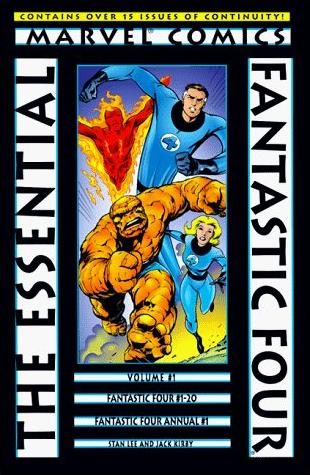
New releases: Essential Fantastic Four volume 9

Just a quick update post to note the release this week of Essential Fantastic Four volume 9, which contains issues #184-188 & #190-207 of the series plus Annual #12-13. Issue #207 contains a substantial guest appearance by Spider-Man. I've now added my thoughts on the issue (and the volume's cover) to the post More non-essential Spider-Man Essentials but for those who follow this blog by subscribing, here they are as well.


Fantastic Four #207, written by Marv Wolfman and drawn by Sal Buscema, reprinted in Essential Fantastic Four volume 9

This issue sees Peter on his first photo assignment for the Daily Globe and might have made a reasonable addition to Essential Spider-Man volume 9 because it shows him being hired by the Daily Globe, a precise point jumped over a bit in Amazing #194. In the space of less than one page Peter enters the Globe office, gets put on the salaried staff with an understanding about his time commitments and sent on his first assignment! Said assignment involves obtaining photographs of the students at Security College, a specialist institution for the offspring of the rich and famous who might otherwise be subject to kidnap attempts, including one Johnny Storm. The debate on journalism ethics has come a long way in the last three decades so it may just be the passage of time, but I was surprised Peter so readily accepted an assignment that effectively involves intrusion of privacy, even if he is photographing students out and about on the campus rather than in their private rooms. During the course of his attempts he discovers that the students are being hypnotised and used for nocturnal stealing by the Fantastic Four's old foe the Monocle. He convinces the Human Torch this is happening and they bring down the operation. The Monocle himself escapes the two heroes, but he'd tried to break away from the Enclave who blow up his rocket. All in all this issue feels rather awkward. The rest of the Fantastic Four don't appear at all as they're off on the planet Xander dealing with the left-over events from Nova and although Johnny's attendance at Security College was built up in previous issues, the whole thing feels as though it was scripted as a potential (fill-in?) issue of Marvel Team-Up. This is probably the reason why we get such a rushed introduction to Peter's career at the Globe and in the wrong series to boot – the script probably originally had him receiving a standard assignment but then the issue went out at a very awkward point in his own titles for this. However that doesn't excuse running part of a major development in Peter's life in another series.


Also in the volume are the issues which carry on the plotlines that were left outstanding at the end of Essential Nova volume 1.

Friday, 14 June 2013

The latest guest appearance

This month sees the release of Essential Wolverine volume 7 and within it is another guest appearance by Spider-Man from a much later era than any other, hence its own post. Without further ado...

Wolverine #148 written by Erik Larsen and drawn by Roger Cruz, reprinted in Essential Wolverine volume 7

Essential Wolverine may have only notched up seven volumes so far, despite being launched at the same time as Essential Spider-Man, but because Wolverine's solo series only began in 1988 the Essentials are now all the way up to 2000, the series that's reached further forward than any other (bar a solitary one-shot from 2001 reprinted in Essential Killraven). Issue #148 is part of the "Ages of Apocalypse" crossover and features an alternate take on the New Fantastic Four.

The New Fantastic Four was a brief-lived team that appeared in Fantastic Four #347-349. A renegade Skrull neutralised the original Fantastic Four but then found she was being pursued by other Skrulls and so assembled a team to deal with them. She picked Spider-Man, Wolverine, the Hulk and the second Ghost Rider (Dan Ketch) - at a time when these four just happened to have the topselling solo Marvel titles. After their single mission they disbanded but were later reformed in Fantastic Four #374 when Spider-Man was seeking to help the Human Torch who was wanted by the police and defended by the original Fantastic Four and Doctor Strange advised him to call in other heroes to help. This second appearance was to promote the new Secret Defenders title, whose original premise was Doctor Strange assembling ad hoc teams of heroes for particular missions. The idea of the New Fantastic Four staying together after their first appearance was also the focus of an issue of the second What If? series. Meanwhile the "Ages of Apocalypse" was a follow-on from another X-Men crossover called "Apocalypse: The Twelve"; but all you need to now is that reality has been warped by the mutant Apocalypse and the individual chapters are set in various alternate realities. (The title invokes 1995's event "Age of Apocalypse" which was set in a changed reality but you don't need to know any more about that.) Whew, that's a lot of background!

This particular issue is set in a near future after many of the heroes were wiped out and the New Fantastic Four have regrouped to take the place of the dead old one. Both Spider-Man and Wolverine have dropped their masks, with the whole team now wearing Fantastic Four uniforms, and Peter and Mary Jane's daughter May is living with them in Four Freedoms Plaza (or whatever building was on the traditional site by then) and is now a toddler climbing the walls. This is a dark, gritty team for a dark world, with both Wolverine and Ghost Rider feeling out of place (though each doesn't realise the other has the same concerns) whilst the Hulk is unstable and cycling through his multiple personalities and the associated bodies. Spider-Man is drifting into a Reed Richards role of becoming ever more scientific (in tandem with Bruce Banner/Hulk, at least when the latter has a relevant personality), to the annoyance of Mary Jane. The team initially handles an attack by old Fantastic Four foes Annihilus and Blastaar, and the Harpy, the Hulk's wife transformed into a flying green monster. Then comes news that the US President Robert Kelly has been assassinated by Doctor Doom, seemingly returned from the dead. The team are briefly attacked by Doombots before going to Washington where they fight Doom who is revealed to be a deformed clone, created by the real foe, Arnim Zola, the Nazi geneticist. Suddenly they realise the fake Doom's armour is set to explode and Wolverine cripples Zola before the team make their escape. The four contemplate the ruins of the White House, wondering if that was the real Zola and whether any more Doom clones are about, then see the new President is Graydon Creed, even more extreme than Kelly. They wonder what the future holds...

However, the timelines were resolved before this world could be revisited. The New Fantastic Four have always been a concept that sounds great but is extremely difficult to pull off in practice because the four characters are such individualistic personalities even if they have been used in other tims. Here, though, they've been kept together by the dystopia around them. I'm not at all familiar with the second Ghost Rider but Wolverine and the Hulk seem pretty much in character. Spider-Man seems far more scientific than usual, though when this was published the regular titles showed him with a job at the Tri Corp Research Foundation (although due to everything else he wasn't actually spending much time there). It's never explained why he's revealed his identity to the world - there must be a more substantial reason than just so that he can look like a young Reed Richards - and he's not given a great deal of attention beyond showing glimpses of how he's fallen into the Reed role of not always remembering to spare time for his family. The story itself is petty packed and fast paced, having only a single issue to show everything, but works reasonably well. However even here there are signs the New Fantastic Four could fall apart and I doubt this team could ever work in the long-term in the regular reality.

(Apologies to those who were expecting another subject but the timing of this one crept up on me.)

Monday, 23 July 2012

Even more non-essential Spider-Man Essentials

It’s time once more to consider Spider-Man’s guest appearances in other titles. However I’m taking a different approach this time with the issues from 1982 onwards. As I said last time, the Essential programme doesn’t have widespread coverage of the 1980s & 1990s Marvel series. Most of the series that run continuously from the Silver Age haven’t had enough volumes to reach the 1980s yet (Spider-Man is the main exception) and instead we have a mixture of various X-Men titles, Marvel Two-in-One and the Defenders who have so far made it to the early 1980s (the latest volume of the latter literally just reaches the “New Defenders” era) and a handful of other 1980s series such as Dazzler, Silver Surfer and Punisher. Consequently I’ve decided to limited the list here strictly to guest appearances that have been Essentialised:

Defenders #107-109, scripted by J.M. DeMatteis (solo #107) and Mark Gruenwald (jointly #108-109) and drawn by Don Perlin, reprinted in Essential Defenders volume 6

Spider-Man had previously guest-starred in issue #61 but these issues arguably see him briefly become a Defender and is thus a candidate the first time he was a member of a team in any way shape or form. You can argue it either way – the Defenders famously had no fixed membership rules and the dividing line between a member and an ally is very blurred, but he only stays around for this story.

The story follows on from the death of Nighthawk in issue #106 with the Valkyrie dying at the start of this issue, and sees Spider-Man one of a number of heroes who attend the funerals. However unlike many others he stays around afterwards. Then it’s discovered that the Valkyrie is not dead but her spirit is free, pleading for them to rescue her true body then taking residence in her sword. The Enchantress has her true body, which is occupied by the spirit of Barbara Norris, the woman, whose body Valkyrie had occupied. (Again we have a female hero with a rather complicated backstory due to multiple attempts to get her origin right.) The Enchantress offers the body if the Defenders will undertake a quest to find the Rose of Purity for her. If the body is recovered the Defenders can restore the Valkyrie’s spirit they will bring her back to life, but at the cost of the death of Barbara Norris, currently in a vegetative state and previously insane. The Defenders split in two over the dilemma, with Spidey siding with Dr. Strange, the Beast and the Gargoyle being opposed to this course of action, whilst Damon Hellstrom (the Son of Satan), Hellcat, the Hulk and Namor the Sub-Mariner choose to undertake the quest. In the end Barbara’s spirit is rescued by a powerful entity, Valkyrie is restored to her true body and battles the Enchantress and in the aftermath Spider-Man leaves with the Gargoyle in tow. Spider-Man’s overall role in the story is limited to a supporting member, rather than a high profile guest star, and it’s possible the main purpose of his role was to set up an issue of Marvel Team-Up with the Gargoyle. Still he actually works quite well alongside the Defenders and one can only speculate about what if he’d stayed around for longer. The team was traditionally based around “outsider” heroes and Spider-Man fitted that definition all too well. By this stage he had worked with most of the more regular members and this appearance showed how he could slot in. But the Defenders so often encountered magical and mythical threats, and I don’t think they were regularly based in New York. So there would have been logistical difficulties and Spider-Man would frequently have been out of his league. But of all the teams around then, this might have been the least worst choice.

Marvel Two-in-One #90, scripted by Jan Strnad and drawn by Alan Kupperberg, reprinted in Essential Marvel Two-in-One volume 4

This is quite a simple tale in which Peter takes Debra Whitman to a Renaissance Fair (which is closer to Mediaeval in theme) where the Thing’s girlfriend Alicia Masters has an exhibition of her sculptors. Whilst there a conjuror is possessed by a wizard from another dimension named Sardeth and the Thing and Spidey have to deal with the resulting madness. Order is restored when the Thing literally scares Sardeth out of the conjuror’s body, though there’s the small problem of what to do with one of the monsters he magicked up. Spider-Man’s role in the story could be taken by almost any hero, though it does allow the Thing to save the day in his own book and thus make up for Spider-Man doing so back in Annual #2. Peter’s thoughts about Debra are surprisingly frank, especially for a guest appearance, as he ponders about how he doesn’t feel that strongly for her but finds her difficult to shake off. However he almost does lose her when his attention is elsewhere and she feels ignored, thus deciding to walk off but then events explode. It’s surprising to get this kind of character detail in a guest appearance but adds to the general way Debra was handled around this time. And it’s a change from the guest appearance norm for Peter to be a jerk instead of Spider-Man.

Uncanny X-Men #190-191, scripted by Chris Claremont and drawn by John Romita Jr, reprinted in Essential X-Men volume 5

Once again in the X-Men we see a sort of sequel to an issue of Marvel Team-Up, in this case #79 featuring Red Sonja (which was left out of Essential Marvel Team-Up volume 4 when it arrived because Red Sonja is now licensed to Dynamite Entertainment; however it’s been reprinted in the Spider-Man/Red Sonja tradepaperback along with their 2007 inter-company crossover limited series). That issue saw the magician Kulan Gath briefly reincarnated in the modern age, now Gath returns and transforms New York into a city of his own time. Everyone in the city, including the also guest-starring Avengers, is physically and mentally transformed into the respective, save Spider-Man to torture him, and the alien New Mutant Warlock. Spider-Man wanders through the first part of the story facing a hostile city and trying to work out what’s going on until he is captured and strung up in Gath’s palace. Even when being crucified Spider-Man’s inner courage shows through as he breaks free to help the others and tell them how to defeat Gath, before being killed. The story is pretty apocalyptic with many other heroes being killed but at the end Dr. Strange combines his magic with that of the New Mutant Magik to turn back time and prevent the whole thing happening. Whilst Spider-Man’s appearance is at least justified by his past encounter with Gath, I feel the Avengers’ presence in the story is unnecessary (even though New York itself is transformed – after all the Fantastic Four don’t show up) and I’ve never particularly liked stories that seemingly casually kill off major cast members, only to throw a reset switch at the end. It’s also bizarre that Spidey shows no concern whatsoever for his friends in the city.

And that’s it!

I was expecting rather more appearances in this period, but this is probably down to Spider-Man tending to guest star in series that either haven’t yet been Essentialised or whose reprint runs have only got as far as the 1970s. There haven’t been that many Spider-Man appearances in the X-Men titles, and these account for a large chunk of the 1980s & 1990s Essentials. More surprisingly he didn’t guest-star much in the Punisher’s 1980s-1990s title. I guess that these series either didn’t spend so much time in New York (which also accounts for Spidey’s absence from another Essential from this period, Silver Surfer volume 2) or the books were selling so well guest appearances were deemed unnecessary (whilst sales figures are generally hard to find at a glance, one set of facts available is that at the end of 1987 the nine top selling Marvels – and thus the ones subject to a price increase – were the three Spider-Man titles, the three X-Men titles, the Punisher, the Silver Surfer and the Avengers).

All three of these appearances see Spider-Man caught up in the world of myth and magic, which his own series normally avoids. It’s hard to get any general impression of where the character stands in the overall Marvel Universe by the time of these appearances (early 1982, mid 1982 and late 1984 respectively), especially as one involves a temporarily altered world. But they all show Spider-Man as a pretty regular part of events and he slots in well enough with those around him without much comment bar the Thing’s mock horror at running into Spidey again.

(Oh and as per my previous promises if and when further guest appearances are Essentialised I’ll try to remember to add my thoughts on them to the relevant posts.)

Monday, 9 July 2012

More non-essential Spider-Man Essentials

Time now for another look at Spider-Man's guest appearances. Today I'm looking at a stretch from 1972 until 1981, ending at the twenty year mark which is also broadly at the point where the Essentials start getting bitty – in particular the Fantastic Four and Avengers series don't (yet) get beyond here and most of the other series that start in the Silver Age are even further behind. It's not the neatest of points but it serves its purpose. With that said:

Daredevil and the Black Widow (to give the book its full cover title at the time) #103, written by Steve Gerber and drawn by Don Heck, reprinted in Essential Daredevil volume 5

This issue tied in with Marvel Team-Up #12 (a Man-Wolf issue) which saw Peter sent to San Francisco to get photographs of Daredevil and the Black Widow, who had teamed up and were briefly relocated there. This issue continues Peter's efforts to get the story – curiously he's written here as a journalist as well as a photographer. Peter makes it into the Black Widow's mansion where he's secured the chance to get the story, but suddenly new villain the Ramrod shows up, stealing a box of papers for his shadowy masters who reconstructed his body after an accident. Daredevil and the Black Widow pursue him, with Peter changing to Spider-Man and following at a distance, recovering the papers. The fight continues on the skyline until the Ramrod loses his grip and plunges to his doom. Spidey takes off and Peter shows up to finally get his interview. Whilst it's nice to see Spider-Man interacting with other heroes on good terms, rather than hot-headedly getting into a fight, this appearance feels rather short and certainly not a substitute for the lack of an early Team-Up with Daredevil and/or the Widow as the interaction between them and Spidey is limited to the actual fight. And Spider-Man doesn't really contribute much to the right that Daredevil or the Widow couldn't have done themselves. Peter seeking an interview also feels out of role – I suppose one could argue Jonah wanted to save on air fares but in Team-Up #12 he was specifically sent on a photo assignment. Ultimately this is a gratuitous unnecessary appearance.

An issue I'm going to have to skip as it hasn't yet been Essentialised is Sub-Mariner #69 written by Steve Gerber and drawn by George Tuska. As before if the Essential Sub-Mariner gets further volumes and reaches it (this one would be in volume 5 by my reckoning) I'll try to remember to return to this post and add my thoughts on the issue. However I suspect that won't be for many years yet.

Howard the Duck #1, written by Steve Gerber and drawn by Frank Brunner, reprinted in Essential Howard the Duck volume 1

Amazing as it may seem, Howard the Duck was once one of Marvel's biggest properties, leading to a much publicised creators' rights dispute over Howard's ownership, followed by a notorious mid 1980s movie often considered one of the worst films of all time. Before that came Howard's own series which launched in 1975 (and was reportedly more popular than the contemporary revival of the X-Men!). The key to understanding the series is that it's an existentialist satire in which the difference between seriousness and silliness is a point of view. With that said...

Spider-Man makes a short guest appearance in the first issue in which Howard encounters Pro-Rata, a cosmic accountant who lives in a tower made of credit cards located by a river in Cleveland and who sends Howard through a portal to a dimension of barbarians in order to retrieve the missing key for the Cosmic Calculator, which will allow Pro-Rata to become the Chief Accountant of the universe. Steve Gerber made this up, not me. Midway through the issue Jonah sends Peter to Cleveland to get photos of the mysterious talking duck sighted there, and late in the issue Spider-Man follows the sound of the explosion to reach the tower where he and Howard in turn save each other's lives. It's a fairly gratuitous appearance by Spidey that doesn't really add anything other than to lure readers in. Unfortunately the issue plays the guest appearance for straight rather than making a wider comment on the conventions for comics to do such appearances, missing an opportunity. Spider-Man makes a further brief cameo appearance in issue #10 (also in this volume) when Howard has a breakdown and several past characters appear in a surreal nightmare. It's notable for the image of Howard turning on a tap only to get webs as Spidey comes out of it. It's an example of the sort of madness that happened in Howard's series.

To keep this listing complete I'll just note Marvel Two-in-One #17, written by Bill Mantlo and drawn by Sal Buscema, which is reprinted in Essential Marvel Two-in-One volume 1 but which has also appeared in Essential Marvel Team-Up volume 2 as it crossed over with Team-Up #47 (which in turn is also reprinted in the Two-in-One volume). My thoughts on the issue are in my regular piece but I'll just repeat my comment that the creative teams on the two series seem to have been swapped around, and there's some dialogue in one series that would more suit the other, suggesting that the chapters were originally created to appear in the opposite series as someone got the schedule mixed up and assumed the issues would come out the other way round, then when the mistake was discovered the two stories were simply swapped over. Ah the mess of arranging crossovers.

Another one that I've already covered in the main run is The Man Called Nova #12 written by Marv Wolfman and drawn by Sal Buscema. This crossed over with Amazing Spider-Man #171 and both issues are reprinted in Essential Spider-Man volume 8 and also in Essential Nova volume 1. This time at least the chapters appeared in the books they were specifically created for. Later on in the series issue #15's cover promises an appearance by Spider-Man, Captain America, Iron Man and the Hulk, but it's very brief and they're only robot duplicates so like a lot of other brief cameo appearances I haven't included it in this overview. As previously noted, Nova was created in part as a deliberate homage to Spider-Man (and less deliberately drew upon elements of Green Lantern) so the series may be worth checking out to see how such a homage worked out in practice. It's all contained in that single Essential volume.

Marvel Two-in-One Annual #2, written and drawn by Jim Starlin, reprinted in Essential Marvel Two-in-One volume 2 and also in both Essential Avengers volume 8 and Essential Warlock volume 1

This was a continuation of the story from Avengers Annual #7 (in which neither Spidey nor the Thing appears), which in turn served as the conclusion to the saga of Adam Warlock and Thanos that Jim Starlin had been telling back in Warlock's own series before it was cancelled. The storyline climaxed with Thanos combining the power of the six Soul Gems (later renamed the Infinity Gems) and assembling a giant space fleet to wipe out much of the universe as a gift to regain the favour of the embodiment of Death. In the first part the Avengers, Captain Marvel and Adam Warlock attacked, destroying the main star destroying weapon but Warlock lost his life to Thanos and his own time-travelling younger self (it's a little complicated to summarise here) and was drawn into the world of the Soul Gem.

The Marvel Two-in-One annual opens with Peter Parker sleeping, receiving a telepathic message from Moondragon about how Thanos re-gathered his forces, overwhelmed and captured the Avengers and now plans to use the last surviving Soul Gem to destroy Earth's sun. Spidey sets out for the Baxter Building, observed by Master Order and Lord Chaos (two cosmic entities making their first appearances) where he gets the help of the Thing and they set off in the Fantastic Four's space shuttle. Once aboard Thanos's flagship they battle Thanos's army but get captured and brought before Thanos who rapidly subdues the Thing. Spider-Man panics and actually swings away until he realises he's doomed anyway so decides his best chance is to free the Avengers, which he does by throwing himself into the machine holding them in stasis. All the while Order and Chaos comment on how Spider-Man is meeting path of destiny they've set out for him but the ultimate job is to bring forth Adam Warlock. As Spidey recovers he finds himself strangely drawn to the Soul Gem which he releases from its container whilst at the same time Adam Warlock finds himself being called from inside the gem back to reality for one last missing. Warlock's spirit bursts out and turns Thanos into living stone. Thanos's army surrenders and the heroes bury Warlock then head for home.

As you can gather from that outline this is quite a different sort of story from the type Spider-Man is normally involved in, even in some of the more fantastic Marvel Team-Ups. Indeed in the story itself both Spidey and the Thing comment on this. I'm also not too comfortable with the whole idea of Order and Chaos manipulating Peter Parker's destiny so that he would become Spider-Man in the first place – the idea of mortals being micromanaged by powerful cosmic entities is so far detached from the norm for Spider-Man stories that it really sticks out. However this is a guest appearance so a little latitude can be allowed and Spider-Man is ultimately the catalyst for saving the Earth. I guess Marvel's leading solo hero has to do that at least once. And Two-in-One was a team-up book so his appearance wasn't even gratuitous. Still I bet a few Thing fans thought the regular hero should have had a greater role.

Spider-Man made another debut issue guest appearance in The Human Fly #1, written by Bill Mantlo and drawn by Lee Elias. However this is another issue that has to be omitted in this run as the Essentials haven't yet touched the Human Fly (nothing to do with the Spider-Man villain who sometimes go by this name and sometimes as just "the Fly", although Spider-Man is investigating the similarity of names), which seems to be one of the most obscure of all Marvel series. It was reportedly based on a real-life stuntman although there has been a degree of uncertainty about this.

Defenders #61, written by David Anthony Kraft and drawn by Ed Hannigan, reprinted in Essential Defenders volume 4

This story sees the Defenders trying to catch a serial killer who murders lawbreakers who has been striking on the Empire Statue University. Trying to lure him out they decide to erect a statue to a lawbreaker – and choose Spider-Man, in hideous modern art. Both Spidey and the vigilante show up but the latter knocks out the Valkyrie's flying horse and throws the statue's tarpaulin over Spidey, then uses the distraction to escape. Spidey and the Defenders agree to dismantle the statue. Whilst the Defenders was a series that made a virtue of a high number of guest stars (to the point that Defenders membership was never formally defined until the New Defenders era), Spider-Man's presence is largely unnecessary and any fugitive or criminal could have served as the basis for the statue. The fight is chaotic with too many heroes taking on one lone killer who escapes all too easily. This is yet another gratuitous appearance.

Fantastic Four #207, written by Marv Wolfman and drawn by Sal Buscema, reprinted in Essential Fantastic Four volume 9

When I originally wrote this post, Essential Fantastic Four had not yet reached this issue so I had to make do with a promise to come back to it when it eventually arrived. As that's now happened I can give my thoughts on this one.

This issue sees Peter on his first photo assignment for the Daily Globe and might have made a reasonable addition to Essential Spider-Man volume 9 because it shows him being hired by the Daily Globe, a precise point jumped over a bit in Amazing #194. In the space of less than one page Peter enters the Globe office, gets put on the salaried staff with an understanding about his time commitments and sent on his first assignment! Said assignment involves obtaining photographs of the students at Security College, a specialist institution for the offspring of the rich and famous who might otherwise be subject to kidnap attempts, including one Johnny Storm. The debate on journalism ethics has come a long way in the last three decades so it may just be the passage of time, but I was surprised Peter so readily accepted an assignment that effectively involves intrusion of privacy, even if he is photographing students out and about on the campus rather than in their private rooms. During the course of his attempts he discovers that the students are being hypnotised and used for nocturnal stealing by the Fantastic Four's old foe the Monocle. He convinces the Human Torch this is happening and they bring down the operation. The Monocle himself escapes the two heroes, but he'd tried to break away from the Enclave who blow up his rocket. All in all this issue feels rather awkward. The rest of the Fantastic Four don't appear at all as they're off on the planet Xander dealing with the left-over events from Nova and although Johnny's attendance at Security College was built up in previous issues, the whole thing feels as though it was scripted as a potential (fill-in?) issue of Marvel Team-Up. This is probably the reason why we get such a rushed introduction to Peter's career at the Globe and in the wrong series to boot – the script probably originally had him receiving a standard assignment but then the issue went out at a very awkward point in his own titles for this. However that doesn't excuse running part of a major development in Peter's life in another series.

Uncanny X-Men #123, scripted by Chris Claremont and drawn by John Byrne, reprinted in Essential X-Men volume 2

This is really quite a short appearance by Spidey that helps to establish continuity with the Marvel Team-Up issues with Captain Britain by bringing back the villain from that story, Arcade. Spidey bumps into Cyclops and Phoenix in New York, then sees them captured by Arcade's garbage truck and rushes to warn the rest of the X-Men by phone – only for it to be answered by Arcade who tells him he's too late. Spidey then smashes the phone box in rage. He doesn't appear in the rest of the story and really only served to provide a degree of continuity and explanation to introduce the story's villain.

Although not yet reached in its own Essential series, Fantastic Four #218, written by Bill Mantlo and drawn by John Byrne, has been reprinted in Essential Peter Parker, the Spectacular Spider-Man volume 2 as it crosses over with issue #42 of that series, and thus my thoughts on it are in my review of that volume.

Dazzler #1-2, written by Tom DeFalco and drawn by John Romita Jr, reprinted in Essential Dazzler volume 1

As I touched upon in my introduction piece about Spider-Woman, the Dazzler originated in a plan by Marvel to have a singer-superhero with a real-life singer doing promotion appearances. Eventually Marvel launched her in their first direct market only title in 1981. As part of the run-up to introduce here, she guest-starred in Amazing Spider-Man #203 and Spidey returned the favour in her own title. The first issue includes a cameo as the Dazzler takes on a group of muggers but falls into trouble and is helped by the arrival of Spider-Man. She goes on to get a job as the singer in a top nightclub, where in the second issue the opening night sees the attendance of about half the heroes in New York. When the Enchantress shows up, seeking a cosmic rift that will open on the site giving her great power, everyone joins a battle with her and the monsters she conjures up. The Enchantress is defeated but the night club is destroyed in the process; however Dazzler is given a tip for an interview about a singing contract- and all the heroes go to give her support and make sure she gets auditioned. Spider-Man's appearance here is very much a part of crowd support, both within the story itself and for sales (he's quite prominent on the cover of issue #1, reproduced as the Essential volume cover) but he gets a few good moments such as when Peter rushes into the gents to change into his costume and finds the other heroes have taken all the cubicles!

Given Dazzler's origins in the disco scene, there was rather a missed opportunity for her to fight one of Spider-Man's old foes. Why did no one think to pit her against the Hypno-Hustler?

(I've decided to leave out the What If series. Quite apart from it not having been Essentialised yet, it is by definition explicitly set in alternate timelines and often takes characters in quite unusual directions. Plus in most appearances Spider-Man was invariably a banner feature, not a guest star.)

Okay that's everything from 1972 until 1981. There's only a few guest appearances I could find that haven't yet been in the Essentials. Again it's surprising that there weren't more such appearances but I guess that Marvel Team-Up was able to meet a lot of that demand.

What's surprising about the appearances covered here is that in contrast to guest appearances in the 1962-1971 period there's far less of a hot-headed jerk in the Spider-Man costume. Equally there's very little of the resort to the stock formula of the hero being assumed to be a criminal, either inadvertently or deliberately due to a villain framing them. Instead we get Spider-Man interacting with other heroes on more respectful terms. The character was steadily developing in his own series and these guest appearances reflect that well.

Friday, 15 June 2012

Some non-essential Spider-Man Essentials

Spider-Man has made many guest appearances in other titles over the years. Thanks to the Essential series many of the earlier ones have also been reprinted. I’m going to skip the numerous cameos but there are a number of more substantial stories that are worth noting here. A full listing of appearances can be found on SpiderFan.org, who have an amazing year by year timeline of all appearances from full issues down to one panel cameos at Comics: By Year. I’ve made use of that timeline to track down the substantial guest appearances. (Sometimes when checking an issue I’ve discovered the appearance is just a cameo so I’ve not included it here, in case there’s you see something on SpiderFan.org’s list that isn’t here.)

I’ve decided to split this into in several sections – first all the substantial guest appearances from the first twenty years are listed as broadly most of these issues have now been “Essentialised” and it’s possible to list the few absentees. In turn I’ve broken the first twenty years in two at 1972, partially for length but also because the cut-off point roughly coincides with the launch of Marvel Team-Up. After 1981 I will just list the handful of ones from the remaining thirty years that have so far been covered in the Essentials. I don’t have access to every single one so a selection only follows:


Strange Tales Annual #2, by Stan Lee and Jack Kirby (with Steve Ditko inking), reprinted in Essential Human Torch volume 1 and also in Essential Fantastic Four volume 2

Strange Tales was one of a number of anthology series produced by Marvel that carried various genres during its run and is best known for introducing Dr. Strange, then also running Nick Fury, Agent of SHIELD. But before that the Human Torch was given his own solo feature from issue #101 onwards (although from issue #123 the Thing became a co-star), which has become probably the single most forgotten of Marvel’s 1960s superhero features. The second annual has Spider-Man’s first ever guest appearance in another title. The story has what would become a fairly standard plot – one hero is framed for a crime, the other hero fights him for a while before realising his innocence and the two team up to bring the real criminal to justice. There’s some interesting features here such as Spider-Man seeking the Torch in the hope that if he can convince a publicly acceptable hero he can more easily clear his name, the Torch being a jealous hothead angry that Spidey gets all the headlines, there’s the first time Spider-Man adapts his webbing to deal with a particular foe – here adding supercold crystals to neutralise the Torch – and the real criminal is identified by a police inspector taking just a few minutes to go through the files. Curiously despite Spider-Man being framed for a crime and the newspapers falling for it, there’s no sign of Jonah or the Bugle. Indeed in general Spider-Man’s supporting cast are often completely absent in his guest appearances. Otherwise it’s a pretty fast-paced tale and only seems unoriginal in hindsight after so many later takes on the same formula. Unfortunately the art is an example that Jack Kirby generally just couldn’t draw a great Spider-Man, even with Ditko’s inking. The story also suffers from having the worst reproduction in this particular Essential volume. But it shows how Spidey and the Torch make for a good pairing, despite their irritations with each other.

The theme of the relationship of irritation between the two is covered again in #115 of the regular comic by Stan Lee & Dick Ayers, though Spidey himself makes only a cameo appearance. The Torch is informed that Spider-Man’s foe the Sandman is back in town, but instead of tipping off Spider-Man he challenges the Sandman himself, even disguising himself as Spidey when the Sandman doesn’t want to fight anyone else. The Torch succeeds but at the end Spidey arrives on the scene and notes the tensions between him and the Torch.

(Oh and another interesting story in this Essential volume, albeit absolutely nothing to do with Spidey, is #114 which has the first Silver Age appearance of Captain America – in a way. This Lee-Kirby story was widely forgotten about, even by Lee himself, until the late 1990s, when the team behind the brief-lived series Captain America: Sentinel of Liberty rediscovered it and created a sequel, with Cap and the Torch commenting on the absurdities of the original.)

Fantastic Four Annual #1, a back-up story by Stan Lee and Jack Kirby (again with Steve Ditko inking), reprinted in Essential Fantastic Four volume 1

This six pager is the first retelling of a Spider-Man story, as it expands on the two & a third pages in Amazing Spider-Man #1 detailing Spider-Man’s first meeting with the Fantastic Four. This is literally just an extended fight sequence as Spidey takes on each of the Four one by one in more detail before Mr Fantastic stops the fight. A caption at the start claims this was created by popular demand after the letters received from readers. I hope the contemporary audience was satisfied – this was one of the earliest Marvel annuals but like many back-up features in subsequent annuals it’s entirely skippable.

Tales to Astonish #57 by Stan Lee and Dick Ayers, reprinted in Essential Astonishing Ant Man volume 1

Tales to Astonish was another of the anthology series, best known for giving a home to both the Incredible Hulk and the Sub-Mariner. But before that Ant-Man debuted way back in issue #27 and returned (by popular demand) in issue #35 for a run that lasted until issue #69. En route he gained a sidekick in the form of the Wasp, and then inverted his powers to also become Giant Man. Additionally the Wasp gained her own back up feature, first merely narrating stories but from #57 it became a more conventional adventure story. Issue #57 was also the issue in which the Wasp was given her “sting” weapon – and it features an encounter with Spider-Man. This time the villain Egghead tricks Giant Man and the Wasp into fighting Spider-Man as a distraction whilst he steals a payroll truck. When Giant Man discovers the crime the fight is cancelled and the heroes track down and defeat the villain. Once again we have an early example of what would become a stock formula for team-ups in years to come. And this is the third time that Spider-Man’s encounters with other heroes leads to a fight between them. The Wasp’s dislike of Spider-Man is introduced here and would remain poor for years – “I guess it’s because wasps and spiders are such natural enemies!” But the Wasp doesn’t have any real wasp power in her and it’s just a silly dislike. Also noticeably absent is Spider-Man’s witty banter during the fights. Here he’s just a standard hero, if a little angrier than most when attacked, and really anyone could have filled his role. In general this is a fairly mundane piece and entirely forgettable. But someone remembered it...

The story gained additional interest thirty-five years later in 1999 when John Byrne wrote and drew the 12 issue series Spider-Man: Chapter One retelling & refining Spidey’s first year. For some reason he opted to devote the penultimate issue (#11) to retelling this story even though I don’t think it was on many people’s list of key adventures to cover in the limited space available (condensing some 20+ issues into 12). Was the intention to show an example of Spidey’s usual early relationship with other superheroes? (That would at least explain why this one and not a Human Torch story.) Or was Byrne under pressure to include at least one story that isn’t in Essential Spider-Man volume 1? Or was it just creative indulgence?

Avengers #11, by Stan Lee and Don Heck, reprinted in Essential Avengers volume 1

This story sees the Avengers’ enemy Kang the Conqueror create a robotic duplicate of Spider-Man who successfully tricks the Avengers into believing the absent Iron Man has been kidnapped and taken to a temple in Mexico. The Avengers each make their own way there whilst Kang time teleports the robot over, and one by one the robot picks them off, helped by a soft nerve gas in the area dulling the heroes’ abilities. But before the robot can send the Avengers to Kang’s time the real Spider-Man shows up and declares his spider-sense spotted the duplicate and so he followed it to see what it was up to. Spidey fights the robot, eventually finding its deactivation switch and destroying it. This is a rather silly issue and I get the impression that it had a late in the day rewrite to include the real Spider-Man, possibly in place of a suddenly returned Iron Man who appears on the cover but not in the tale, either because Iron Man’s own story went a different way (but I’m not too familiar with contemporary Iron Man continuity) or because someone in Marvel realised it would be cheating the readers to lure them in with a promise of Spider-Man and not deliver the real thing. The most ludicrous point is the real Spider-Man suddenly showing up in Mexico – there’s no way he could have followed a teleporting robot there, and then since he doesn’t directly interact with the Avengers how is he to get back home? The artwork of Spider-Man is also quite bad (although there’s an even worse example in this volume in a cameo in issue #3, drawn by Jack Kirby) – he looks too muscular and the web lines aren’t kept under control. Overall this is a pretty poor story also let down by some of the silliness of the early Avengers years such as their rigid adherence to meeting protocols and their limited equipment that prevents them all going to Mexico together. This feels like the first case of a gratuitous guest appearance for the sake of sales rather than to tell a decent story.

Daredevil #16-17, by Stan Lee and John Romita, reprinted in Essential Daredevil volume 1

When Daredevil’s series originally launched the cover proclaimed it was in the same Marvel tradition that had brought Spider-Man, and Daredevil himself was given an early boost by his guest appearance in Amazing Spider-Man #16 (which came out the month between Daredevil #3 & 4). It’s surprising that it took so long for Spider-Man to make a reciprocal full appearance (these issues came out the same months as Amazing #36 & #37). This two part appearance saw John Romita draw Spidey for the first ever time, coming out a few months before he took over on Amazing Spider-Man. Romita’s first take on Spider-Man is a little different from what would come, as at this stage he’s largely trying to match Steve Ditko’s version of both Spidey and Peter Parker. However he gets Jonah straight off and doesn’t do too badly with Aunt May.

Plotwise we have a near rerun of the Giant Man and Egghead plot. Once again a villain is planning a big crime and as a distraction he frames one hero to trick another into fighting him, whilst the real crime happens. On this occasion the villain is the Masked Marauder but curiously it’s the host hero, Daredevil, who is framed whereas my impression is that it’s more usual for the guest hero to fall victim to this (although with Jonah briefly appearing, Spider-Man gets blamed by the Bugle anyway). Also unusually the Marauder doesn’t hide his own involvement with many assuming one or other of the heroes is in league with him. The second part sees a climax as Daredevil sets a trap for both Spider-Man and the Masked Marauder and the two heroes fight once more before the villain shows up, forcing them to join forces. The main point of originality in the story comes at the end of the first issue as Spider-Man searches for Daredevil with his Spider-sense and finds Matt Murdock and Foggy Nelson’s office and assumes Foggy is Daredevil. Spidey breaks in to challenge Nelson upfront, even dangling him out of the window. Often the Spider-Man we get in guest appearances seems more hotheaded and aggressive than in his own series, and this is more than just presenting events from others’ point of view. Spidey’s accusations would also have repercussions in Daredevil’s series as Foggy is in no rush to deny them when secretary Karen Page asks if they’re true, instead enjoying her assumption that he’s a heroic adventurer. However at the end the escaping Marauder overhears them...

In general we’re yet again seeing a use of a stock formula of a framing, a fight and then a team-up. When read in close succession the heavy reliance on this formula does stand out, although during the original publication these stories came out months if not years apart and readers may not have noticed the similarities so readily.

Daredevil #27, by Stan Lee and Gene Colan, reprinted in Essential Daredevil volume 2

The Marauder storyline concludes in this issue, which contains a small guest appearance by Spider-Man. He is fighting a few thugs when Daredevil cuts in, to Spidey’s annoyance as this can damage a hero’s reputation. Daredevil asks if he’s seen Stilt-Man (who was actually taken seriously in those days) and they go their separate ways whilst Stilt-Man and the Marauder team up to kidnap Matt, Foggy and Karen in order to learn Daredevil’s identity. Stilt-Man is sent to find Matt’s twin brother Mike (actually Matt in disguise – don’t ask!) but runs into Spider-Man who is eventually defeated with a gas pellet. Meanwhile Daredevil has defeated the Marauder, who falls to his death, and then disables Stilt-Man’s mechanism. For Spider-Man this is quite a brief encounter that shows his continued tense relationship with other heroes.

X-Men #35, by Roy Thomas and Werner Roth, reprinted in Essential Classic X-Men volume 2

This appears to be the first time a substantial Spider-Man appearance was written by someone other than Stan Lee. Spidey had had a previous brief cameo in issue #27, also by Thomas and Roth, where he beats the Beast and Iceman to capture some bank robbers. With the X-Men badly understrength at this point Spider-Man is offered membership but he declines, having recently gone through the mess of the Avengers’ offer (in Amazing annual #3).

Issue #35 is another fight due to wrong assumptions but they’re accidental this time. The issue is part of a wider story involving the kidnap of Professor X by Factor Three. The X-Men’s ally Banshee locates Factor Three’s base where he encounters a robotic spider guard, and before he passes out he sends a message “Beware the spider” to the X-Men. Meanwhile Peter Parker has gone a motorcycle ride outside New York and finds himself strangely drawn up to Westchester where a metal egg appears of the sky and lands, revealing the robotic spider. Peter changes to Spider-Man and fights the robot, tricking it into destroying itself. Meanwhile the X-Men’s computer Cerebro detects mutant activity in the area and the X-Men dash to deal with it. They assume Spider-Man is the menace Banshee warned off and battle him until Marvel Girl contacts them with the news Cerebro’s activity has ceased suggesting Spider-Man is not the menace. Spidey tells them about the robotic spider but refuses to let the X-Men give an apology and explanation. This is quite a packed issue and generally Thomas gets the hang of Spider-Man’s dialogue, though the journey into the countryside and “drawn by fate” seem at odds with the regular series. However we get yet another fight for the sake of it which doesn’t really contribute to the ongoing storyline, and more jerkish behaviour from Spider-Man as a hero who’s been misunderstood more times than any other is reluctant to give the X-Men the benefit of the doubt. The artwork also doesn’t quite capture Spider-Man correctly. Again this feels like an appearance for the sake of it.

Fantastic Four #73, by Stan Lee and Jack Kirby, reprinted in Essential Fantastic Four volume 4 and also in Essential Daredevil volume 2

This is a crossover climax to a storyline in Daredevil (hence appearing in both Essentials) in which Daredevil and Doctor Doom briefly swapped bodies. After the process is reversed Daredevil escapes and heads to warn the Fantastic Four, but Doom is able to mimic Daredevil’s voice and tells the FF that Daredevil is Doom in disguise, coming to attack them. After briefly overpowering the Human Torch, Daredevil runs into Spider-Man who believes him and agrees to help, and then goes off to get another pair of hands – Thor, who has recently had his powers stripped from them. This leads into a protracted battle as Daredevil fights Mr Fantastic, Thor the Thing and Spider-Man the Human Torch, defeating him by luring him into a chemical plant and overpowering him with fumes. The entire battle is ended by the arrival of the Invisible Girl who confirms that Daredevil is the real one because he can’t be Dr. Doom as she’s just seen the real Doom on television, giving a speech in Latveria. (Now which Marvel villain has more robotic duplicates than any other...?) This particular issue as a whole is pretty poor and little more than an excuse to have the Fantastic Four fight some guest stars. However it does show that Spider-Man’s relationship with other heroes is evolving in that he is first willing to trust Daredevil and then able to talk Thor into joining them by suggesting he’s a coward. This issue came out the same month as Amazing #59 and is a sign of how Spidey’s early antagonistic relationship with other superheroes has been refined to one where he’s more willing to work with others and even knows which buttons to press.

Silver Surfer #14, by Stan Lee and John Buscema, reprinted in Essential Silver Surfer volume 1

The Surfer’s original series ran into early troubles sparking radical changes, including ditching the bi-monthly double sized format in favour of a standard monthly, and then started running guest stars in most issues. Spider-Man was the first of the regular guest stars and we get another fight when Spider-Man’s webbing accidentally catches the Surfer’s board and the two soon come to blows as Spidey wants off but the Surfer believes he is being tricked by humans so he can be attacked yet again. Spidey is pretty aggressive, pursuing the matter further but the Surfer declines to use his full force. The police and military show up to take down the Surfer, but when he leaves himself vulnerable to save a boy both they and Spidey back off. Spidey leaves realising he’s been guilty of the same misjudgement he is so often the victim of. Spidey once more shows his aggressive, hotheaded side that is so often the main focus of his guest appearances and the similarities between the way the world treats him and he treats the Surfer aren’t as fully explored as they might be. Given the direction of the book it’s hard to deny this is an audience boosting appearance though.

Captain America and the Falcon (as it was then titled) #137-138, by Stan Lee, Gene Colan (#137) and John Romita (#138), reprinted in Essential Captain America volume 3

This story focuses upon the relationship between Cap and the Falcon, with the latter feeling undervalued and seeking to prove his worth, and a Harlem gang lord blackmailing the government by threatening to start riots. The Falcon spots Spider-Man and decides to bring him in to prove his worth, and he sends his companion hawk Redwing to follow Spider-Man, leading him to Peter and Harry’s flat. The Falcon assumes Harry is Spider-Man and captures him, only for the real Spider-Man to save him, knocking the Falcon out in the process. The following issue sees Spider-Man seeking the Falcon for a rematch and to learn why he attacked him, only to find the Falcon has been captured by the Harlem gang lord. Spidey rescues the Falcon and fights him, with Captain America and Redwing joining in, until the Falcon realises he’s been a jerk and they all team up to take down the gang lord. Similar to the earlier Daredevil appearance we see heroes proving rather better than everyone else at getting close to other heroes’ secret identities, only to accuse the first able-bodied man in sight upon arrival. The Falcon’s motivations for fighting Spider-Man are understandable, though Spider-Man’s reluctance to leave the matter after his first fight isn’t so clear. The story is mainly a spotlight on the Falcon but as a hero with a poor relationship with the law, Spidey is one of the few who could serve the role in this story and so his appearance here feels more natural than many.

Daredevil #77 by Gerry Conway and Gene Colan, reprinted in Essential Daredevil volume 4

An interesting little tale that starts with Spider-Man seeing Daredevil passing in the night and each man reflects on his recent relationship issues – Spider-Man on Gwen Stacy thinking he killed her father and how she doesn’t know Spider-Man is her boyfriend (this issue came out the same month as Amazing #97), Daredevil on how Karen Page does know his identity couldn’t marry him with both his identities. It’s a nice little compare and contrast moment between the two heroes. Peter gets back to his flat where he’s visited by Mary Jane (although the inker confuses her with Gwen so in black & white, at least, she looks blonde). However Peter quickly aborts the meeting because of commotion outside which also draws in Daredevil. In Central Park a glowing giant teardrop speaks, demanding to speak to Namor the Sub-Mariner who has been drawn there. Just as Namor approaches, Daredevil shows up and assumes Namor is responsible and the two get in a fight. Spider-Man subsequently arrives and also engages in battle, refusing to accept Daredevil’s claim it’s his fight, and the two take on the Sub-Mariner with Spider-Man almost competing with Daredevil. The fight is stopped when the teardrop explodes to reveal a mysterious woman who demands Namor come with her, and having detected vibrant young power within Spider-Man she asks for him also. The woman, Namor, Spidey and the teardrop all vanish, leaving Daredevil to head home. Whilst there are some subplots advanced in this issue, the main part feels very much like both Namor and Spider-Man are intruding upon Daredevil’s title. Spider-Man is given some good scenes in the early part of the issue that tie in well to then-current events in his own title, but once in action he acts like the jerk he so often is in guest appearances, refusing to back off and being quite competitive.

Spider-Man and Namor’s story continues in Sub-Mariner #40, again by Gerry Conway and Gene Colan, but as Daredevil didn’t accompany them that issue isn’t included in his Essential run, whilst the Sub-Mariner has probably been served worse by the Essentials than any other Silver Age Marvel hero, with just one solitary volume so far that only gets as far as the first issue of his series, and that didn’t appear until 2009. Maybe one day we’ll get further volumes that reach #40 and I’ll be able to come back and add my thoughts on that particular issue.


With the exception of that Sub-Mariner issue, that’s all the major appearances I’m aware of from this era. And look how few there were. Spider-Man may have been an early hit whose popularity then grew and grew, but he wasn’t mercilessly dropped into numerous other series to boost them (though the Silver Surfer appearance was an exception). Instead the guest appearances are limited and aiming to tell good stories, to mixed success. Spider-Man also encountered a number of other heroes in his own series, but wisely Marvel limited those and created a specific title for team-ups at the end of this period.

The thing that stands out the most in many of these appearances is just how much of a hot-headed jerk Spider-Man can be, getting into fights all too easily. It’s little wonder that so many other heroes automatically assume the worst of him. But it’s also disappointing that so often this is almost all there is to Spider-Man. Whilst it would be possible to present him as a mysterious, uncertain figure as seen from the host character’s point of view, the stories invariably assume familiarity and show or reference his life as Peter Parker, so removing that angle of approach. This just leaves a jerk who easily gets into fights for the sake of it – but very often that’s all he’s there for.