Another in this look at hypothetical Essential volumes...
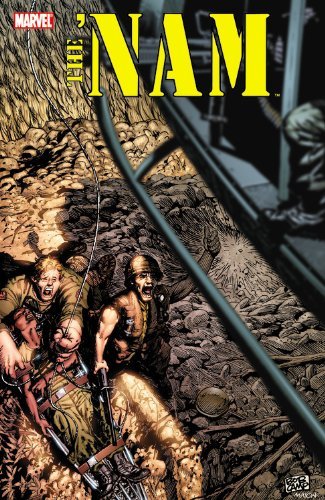
 Essential The 'Nam volume 1 would contain issues #1 to #21. These are otherwise available in two trade paperbacks that are Classics in all but name, released in 2009 & 2010 with the last issue in the third from 2011. (Be warned there were other trades with suspiciously similar names in the late 1980s and again in the late 1990s.) Additionally it would include a couple of brief stories from Savage Tales #1 & #4 that were a forerunner of the series and which can also be found in the third volume. Bonus material would include "'Nam Notes", a glossary of military terms and slang from each issue plus perhaps some of the covers from the special magazine that reprinted two issues at a time. All the issues are written by Doug Murray with an initial art run by Michael Golden who is succeeded by Wayne Vansant with one issue by John Severin. The Savage Tales stories were also written by Murray and drawn by Golden.
War stories have a long tradition in comics but by the mid 1980s they were largely dying out in the US market and were one of the genres that didn't really survive the transition to the direct market. So it's a surprise to see that Marvel launched not only a new title but on focusing on what was at the time the single most controversial conflict that the United States had been involved with. But The 'Nam is a far cry from the traditional war comic that shows soldiers performing incredible actions against a demonised foe. Indeed the first of the Savage Tales stories that act as a forerunner say it best when the narrator declares, "All in all, this ain't 'Sgt. Fury and his Howling Commandoes'." [sic] Nor does it set out to justify the conflict in retrospect. Instead, it tells the story of ordinary soldiers on the ground, showing what it was really like.
 My country was not (officially) involved in Vietnam. Had it been then it is quite possible my father and/or one of my uncles would have seen service there. Instead, the British mainly know the war only through exposure to its portrayal in US media. Consequently it doesn't have the same resonance here, nor is there an obvious equivalent conflict. The United Kingdom's confidence as a world power had been blunted in the 1950s by the Suez Crisis but that was very much a diplomatic and economic humiliation rather than a military one. Nor were tactics and methods known about and attacked back home in a way that split society and saw many returning soldiers attacked and shunned. The military did not go out of fashion in entertainment here - e.g. military toys did not have problems in the market so that whereas G.I. Joe shifted to become more of an adventurer, Action Man carried on in traditional military combat. More recently Iraq has seen bitter division over taking action and it has certainly had an impact on foreign policy since. Servicemen and women have been through an experience that nobody who wasn't there can ever truly understand. However, returning troops haven't been attacked as though they are the ones responsible for the invasion. The scars are deep but different from those created by Vietnam. As a result, the demonisation and rehabilitation of Vietnam veterans is something that is only understood indirectly here.
Doug Murray is a veteran of Vietnam and it shows in the writing. How much of it is autobiographical and how much comes from others is unclear, but there's a strong personal element and passion to the writing, as though he's finally getting the chance to tell how it really was. This stands out particularly with the depiction of some officers who are so callous about the men under their command that it's a surprise they don't get shot or fragged (murdered with a grenade) by their own side sooner, or with the fates of men as diverse as tunnel runners or the left behind. The language may be a little sanitised and there may be some subjects such as drugs that are steered clear of but that was a price worth paying to be able to get as much of the story out there to a wide audience - and in any case the series does get close with some of the swearing such as "Holy sh--" or "REMF" - the acronym for Rear Echelon Mother Fucker, meaning desk based staff who took decisions without being in the field themselves. There's a lot of army jargon in use and each issue carried "'Nam Notes" to explain the various acronyms, slang and technical terms used by soldiers at the time.
 At this stage, the series takes place in approximately real time, with the first issue starting in early January 1966 and issue #21 is set in October 1967. Each issue takes place roughly one month after the previous, with no grand cliffhangers. It's thus possible to dip in and out of any individual issue, making it extremely new reader friendly and helping the title to grow its audience once word of mouth came in. But it also provides a degree of rigid structure to the narrative, reflecting the rigidity of army postings, and preventing the title from getting bogged down with individual incidents. This also allows the series to rotate its cast, reflecting the way men were assigned for a thirteen month period and looked forward to the last months when they were "short" and could expect to not be sent out in the field then a wake-up and the freedom bird home. Of course not everyone was limited to thirteen months and the series does show some longer serving officers and NCOs as well as men who choose "re-up" for additional tours of duty in Vietnam, whether because they want better promotion prospects to help their careers, to leave the army sooner or to exploit the rule on only one family at a combat zone at any given time and thus keep younger brothers out of Vietnam. However even the last reason is questioned with the story of what instead happened to one brother.
The first issue gives a strong flavour of what is to come. Edward Marks is a young private who gets deployed in Vietnam in the 4/23d Infantry ("Mechanized, of course!") in January 1966. And nothing has prepared him for what he finds there. The art captures a young fresh faced soldier discovering just what war really means. There's confusion and corruption in the army when he arrives. When he goes out on patrol, he rapidly finds out how dangerous it is in the field. He sees bodies and kills for the first time and his reaction isn't triumph but to vomit. He meets fellow soldiers at various stages of their tour of duty, all slowly conditioned by what they have experienced and becoming ever more cynical. At the end of the issue the soldiers watch a war film and comment how it is nothing like reality.
 Marks is the primary character for the first thirteen issue and later on another devotes a large chunk to a letter from him about his experiences back in "the world" (which the "'Nam Notes" glossary tells us means the US - an interesting insight into perspectives) as he comes home. We don't learn too much about his background until the letter issue but it's clear he comes from a close knit family and is relatively naive of not only the world of Vietnam around him but even parts of the adult world in general. This is most notable early on when he's taken on leave to Saigon and is ignorant both about cinema snacks and about women, to the point where he's nearly mugged when he thinks he's getting off for the first time. However he's also supported by the camaraderie of the his fellow soldiers who are used to "greenie" new recruits who take time to learn. Service has a clear impact on Marks, most immediately apparent in his increased swearing as commented on by others who note how the "altar boy" is changing. Similarly, he slowly learns that shooting in action is not "a little John Wayne" but a much more brutal and inefficient experience. When he leaves and goes back to his hometown it becomes clear things have changed for both him and his friends. Wider public opinion has also shifted and he doesn't recognise the conflict portrayed in the media. As a result, he determines that someone has to tell the story of how it really is and opts to be that one, in one of the most explicit autobiographical moments.
Marks finishes his tour in issue #13 but we continue to follow the ever-rotating squad with attention shifting to Sergeant Rob Little and Specialist Andy Clark. Little is a long serving soldier who has been wounded twice and ended up on desk duty before the series began but befriends Marks when they're lost in the field on a special mission for a reporter. The action makes him want to go back to the field permanently and he gets a promotion. He serves as the main bridge between Marks and the next generation of soldiers until he's badly wounded by a grenade and ends up nearly losing a leg. Clark is nicknamed "Aesop" for the stories he tells and it's not always clear how much truth there is in them. He has already done one tour but is motivated to re-up both by his seeing an orphanage that he wants to help and by a desire to keep his two younger brothers out of the combat zone.
 The progress of time and action brings an ever-changing nature to the cast though the emphasis is nearly always on the 4/23rd. Some characters only appear in a single issue that focuses upon a particular aspect, whether it's defectors from North Vietnam, tunnel runners with one of the worst jobs of all or the air force providing cover. Others continue from issue to issue, making for a real poignancy when they're injured, killed or captured. This truly is a series where anyone can die and it doesn't pull its punches. Nor are the fates always glorious. Mike Albergo is the squad's comedian in the early issues, taking an ironic attitude to the war and becoming Marks's closest friend. Albergo is relaxing after a night's action and looking forward to an early discharge when he's suddenly shot dead by a sniper. It's a shocking moment that shows just how suddenly a man could be lost. Also of note is the platoon leader's letter to the parents, part of which is reproduced on the last panel showing how it gives a different impression from reality in order to disguise the senseless nature of it.
But the biggest anger expressed comes over two soldiers who are last shown alive. Frank Verzyl is a tunnel runner, one of the men sent into the underground tunnels and bases with limited weapons to sweep them clean. In what feels like an inventory story left over from Savage Tales we learn how he was freaked out when exploring a base and suddenly releasing two dozen hungry rats. He escaped only for a newly arrived greenie 2nd lieutenant to insist on sending him back down and the only way out was to shoot the lieutenant. There's a real sense of anger with the idiocy and callousness of such officers who took needless risks with other men's lives and sanity, with the result that Verzyl went insane. The story is told in narrative text rather than speech bubbles and it feels very much as though it's a name change telling of something Murray himself witnessed. There's also a clear sense of anger around the fate of Chandradat Ramnarain. An arrogant experienced soldier who mainly keeps himself to himself, it soon becomes clear he's a black marketer. But his fate is nevertheless undeserved when the incompetent Lieutenant Alarnick sends just three men to check out a village, then declines to send back-up when it becomes clear the Viet Cong are active in the area. Then when under attack and with the other two staggering in wounded, Alarnick writes off Ramnarain, in spite of protests by the sergeant, and orders an air strike. We last see the private alive and captured, watching the platoon being evacuated by helicopter. The issue of men missing in action who were believed by many to still be alive as prisoners of war abandoned by the army and US government has been a contentious one over the years and here we get a strong statement in support of that view.
 The depiction of NCOs and officers varies, showing both good competent commanders who will never take unnecessary risks through to foolish glory seekers, cold hearted blunt men of action and corrupt officials. Indeed right at the outset Marks learns about corruption the hard way when he doesn't realise he should have bribed First Sergeant J. Tarver to get a comfortable assignment and is instead placed with Sergeant Polkow, the "Top"'s nemesis. Eventually Tarver is set up and caught out. It's a more comfortable fate than that received by Lieutenant Alarnick, a brutal, callous, racist and arrogant officer who ignores entitlements, puts men onto stupid duties, takes risky action and abandons soldiers in the field. It gets to the point where Little is having nightmares about being dragged ever further into danger by Alarnick who then offers a place in a body bag. The line is crossed when he shoots an unarmed prisoner in the head and declares himself more worthy of medical attention than Little who has just shielded him from a grenade. It comes as no surprise when Alarnick is fragged - murdered with a grenade in his quarters with the strong implication that it was First Sergeant Rowland who planted it. Rowland himself may be a heavy drinker and a covert murderer but otherwise is portrayed as a more reasonable competent man who won't risk lives needlessly. The same is true of the initial commander, Lieutenant Fenelli, and Sergeant Polkow but such is the nature of rotation that both get replaced.
If there's one thing conspicuously absent from the series it's glorification. This is a warts and all version - literally so with even the fungus in wet boots covered. There's also a strong blast at the media coverage, with a television reporter appearing in an early issue and being given special treatment to the point that a helicopter's landing is altered just to get good pictures - with fatal consequences when it's shot down. A village is casually ordered to be napalmed, creating dramatic pictures. Later on Marks sees the typical coverage when he gets back home and is shocked by how different it is from his experience, portraying the Viet Cong as unstoppable and not explaining how important napalm drops and defoliant are to the troops. Marks's letter is written in March 1967, at an early stage in the anti-war momentum, but even at this stage there's a real sense of disconnect and outrage about the image of the war given to the public back home.
 But equally life is not all miserable men with many shown finding their own amusements and various official entertainments, including a popular visit by a female university choir. Clark forms an attachment with a nurse, but she is eventually overwhelmed by all the action and injuries and takes a posting in Japan. There are trips into Saigon, though even there the men have to dodge both explosions and crime. Christmas sees an attempt at a truce but it doesn't last with first rocket attacks and then a child brings a grenade into a party. But in spite of all the dangers and despair there's a strong resilience shown as the men do their best to enjoy their time away from the action, making each day easier to bear.
Being the story of ordinary soldiers on the ground, the series doesn't spend much time focusing upon the causes and background to the conflict. The domino theory is raised but only to explain the presence of troops from Thailand which has agreed to join the US action, with the troops taking part in a joint action to acclimatise them. The main background comes in an issue devoted to the story of Duong, a "Kit Carson Scout" who has defected the North Viet Cong. When asked his reason by Marks, Duong tells a personal tale through the events of the Japanese invasion, the French recovery, the French repression and expulsion, partition, the repression under Ngô Đình Diệm and the arrival of the Americans. It's a tale of successive brutal repressions in which the Japanese, the French Foreign Legion including ex Nazis, the Diệm government and the Viet Cong all committed atrocities to the point that Duong came to doubt his own side was bring freedom. It explains his motives but also the motivation of the Viet Cong and the North Vietnamese Army. And it's told in a way that's a far cry from classic wartime atrocity propaganda.
 Overall The 'Nam is a novel in comics form. It aims to give a voice to the ordinary soldier, men who did not take the decision to go to war with North Vietnam or decide what tactics to use. Instead, they found themselves deployed in a chaotic situation in the field and felt nobody back home ever truly understood what it was like. In their heyday many war comics where written and drawn by veterans, who often brought their own experiences and the tales they heard from others to the printed page. The 'Nam sits in that tradition but does so very differently. It's not glamorous. It doesn't set out to justify a controversial military action. It just tells it like it was for the ordinary guy caught in the thick of it. At once so simple and so complex, this is an incredible series that turns the genre on its head and finally delivers a voice. It's easy to see why this series was especially popular with veterans who found they could give it to their families to explain what they had been through. This series is a fine example of what can be achieved with comics.
Should it have had an Essential volume? DC have been much better than Marvel at getting their non-super-hero material into print in the black and white format and have reprinted a good number of war comics. Marvel tends to use other formats for reprinting material from this era so it's unlikely they would ever have done The 'Nam in the Essentials. But given the format of the narrative this is a series that deserves big chunky reprints rather than lots of smaller ones, with the most recent trade paperbacks only having reach issue #30. It's certainly a deserving series.
 Essential The 'Nam volume 1 would contain issues #1 to #21. These are otherwise available in two trade paperbacks that are Classics in all but name, released in 2009 & 2010 with the last issue in the third from 2011. (Be warned there were other trades with suspiciously similar names in the late 1980s and again in the late 1990s.) Additionally it would include a couple of brief stories from Savage Tales #1 & #4 that were a forerunner of the series and which can also be found in the third volume. Bonus material would include "'Nam Notes", a glossary of military terms and slang from each issue plus perhaps some of the covers from the special magazine that reprinted two issues at a time. All the issues are written by Doug Murray with an initial art run by Michael Golden who is succeeded by Wayne Vansant with one issue by John Severin. The Savage Tales stories were also written by Murray and drawn by Golden.
War stories have a long tradition in comics but by the mid 1980s they were largely dying out in the US market and were one of the genres that didn't really survive the transition to the direct market. So it's a surprise to see that Marvel launched not only a new title but on focusing on what was at the time the single most controversial conflict that the United States had been involved with. But The 'Nam is a far cry from the traditional war comic that shows soldiers performing incredible actions against a demonised foe. Indeed the first of the Savage Tales stories that act as a forerunner say it best when the narrator declares, "All in all, this ain't 'Sgt. Fury and his Howling Commandoes'." [sic] Nor does it set out to justify the conflict in retrospect. Instead, it tells the story of ordinary soldiers on the ground, showing what it was really like.
 My country was not (officially) involved in Vietnam. Had it been then it is quite possible my father and/or one of my uncles would have seen service there. Instead, the British mainly know the war only through exposure to its portrayal in US media. Consequently it doesn't have the same resonance here, nor is there an obvious equivalent conflict. The United Kingdom's confidence as a world power had been blunted in the 1950s by the Suez Crisis but that was very much a diplomatic and economic humiliation rather than a military one. Nor were tactics and methods known about and attacked back home in a way that split society and saw many returning soldiers attacked and shunned. The military did not go out of fashion in entertainment here - e.g. military toys did not have problems in the market so that whereas G.I. Joe shifted to become more of an adventurer, Action Man carried on in traditional military combat. More recently Iraq has seen bitter division over taking action and it has certainly had an impact on foreign policy since. Servicemen and women have been through an experience that nobody who wasn't there can ever truly understand. However, returning troops haven't been attacked as though they are the ones responsible for the invasion. The scars are deep but different from those created by Vietnam. As a result, the demonisation and rehabilitation of Vietnam veterans is something that is only understood indirectly here.
Doug Murray is a veteran of Vietnam and it shows in the writing. How much of it is autobiographical and how much comes from others is unclear, but there's a strong personal element and passion to the writing, as though he's finally getting the chance to tell how it really was. This stands out particularly with the depiction of some officers who are so callous about the men under their command that it's a surprise they don't get shot or fragged (murdered with a grenade) by their own side sooner, or with the fates of men as diverse as tunnel runners or the left behind. The language may be a little sanitised and there may be some subjects such as drugs that are steered clear of but that was a price worth paying to be able to get as much of the story out there to a wide audience - and in any case the series does get close with some of the swearing such as "Holy sh--" or "REMF" - the acronym for Rear Echelon Mother Fucker, meaning desk based staff who took decisions without being in the field themselves. There's a lot of army jargon in use and each issue carried "'Nam Notes" to explain the various acronyms, slang and technical terms used by soldiers at the time.
 At this stage, the series takes place in approximately real time, with the first issue starting in early January 1966 and issue #21 is set in October 1967. Each issue takes place roughly one month after the previous, with no grand cliffhangers. It's thus possible to dip in and out of any individual issue, making it extremely new reader friendly and helping the title to grow its audience once word of mouth came in. But it also provides a degree of rigid structure to the narrative, reflecting the rigidity of army postings, and preventing the title from getting bogged down with individual incidents. This also allows the series to rotate its cast, reflecting the way men were assigned for a thirteen month period and looked forward to the last months when they were "short" and could expect to not be sent out in the field then a wake-up and the freedom bird home. Of course not everyone was limited to thirteen months and the series does show some longer serving officers and NCOs as well as men who choose "re-up" for additional tours of duty in Vietnam, whether because they want better promotion prospects to help their careers, to leave the army sooner or to exploit the rule on only one family at a combat zone at any given time and thus keep younger brothers out of Vietnam. However even the last reason is questioned with the story of what instead happened to one brother.
The first issue gives a strong flavour of what is to come. Edward Marks is a young private who gets deployed in Vietnam in the 4/23d Infantry ("Mechanized, of course!") in January 1966. And nothing has prepared him for what he finds there. The art captures a young fresh faced soldier discovering just what war really means. There's confusion and corruption in the army when he arrives. When he goes out on patrol, he rapidly finds out how dangerous it is in the field. He sees bodies and kills for the first time and his reaction isn't triumph but to vomit. He meets fellow soldiers at various stages of their tour of duty, all slowly conditioned by what they have experienced and becoming ever more cynical. At the end of the issue the soldiers watch a war film and comment how it is nothing like reality.
 Marks is the primary character for the first thirteen issue and later on another devotes a large chunk to a letter from him about his experiences back in "the world" (which the "'Nam Notes" glossary tells us means the US - an interesting insight into perspectives) as he comes home. We don't learn too much about his background until the letter issue but it's clear he comes from a close knit family and is relatively naive of not only the world of Vietnam around him but even parts of the adult world in general. This is most notable early on when he's taken on leave to Saigon and is ignorant both about cinema snacks and about women, to the point where he's nearly mugged when he thinks he's getting off for the first time. However he's also supported by the camaraderie of the his fellow soldiers who are used to "greenie" new recruits who take time to learn. Service has a clear impact on Marks, most immediately apparent in his increased swearing as commented on by others who note how the "altar boy" is changing. Similarly, he slowly learns that shooting in action is not "a little John Wayne" but a much more brutal and inefficient experience. When he leaves and goes back to his hometown it becomes clear things have changed for both him and his friends. Wider public opinion has also shifted and he doesn't recognise the conflict portrayed in the media. As a result, he determines that someone has to tell the story of how it really is and opts to be that one, in one of the most explicit autobiographical moments.
Marks finishes his tour in issue #13 but we continue to follow the ever-rotating squad with attention shifting to Sergeant Rob Little and Specialist Andy Clark. Little is a long serving soldier who has been wounded twice and ended up on desk duty before the series began but befriends Marks when they're lost in the field on a special mission for a reporter. The action makes him want to go back to the field permanently and he gets a promotion. He serves as the main bridge between Marks and the next generation of soldiers until he's badly wounded by a grenade and ends up nearly losing a leg. Clark is nicknamed "Aesop" for the stories he tells and it's not always clear how much truth there is in them. He has already done one tour but is motivated to re-up both by his seeing an orphanage that he wants to help and by a desire to keep his two younger brothers out of the combat zone.
 The progress of time and action brings an ever-changing nature to the cast though the emphasis is nearly always on the 4/23rd. Some characters only appear in a single issue that focuses upon a particular aspect, whether it's defectors from North Vietnam, tunnel runners with one of the worst jobs of all or the air force providing cover. Others continue from issue to issue, making for a real poignancy when they're injured, killed or captured. This truly is a series where anyone can die and it doesn't pull its punches. Nor are the fates always glorious. Mike Albergo is the squad's comedian in the early issues, taking an ironic attitude to the war and becoming Marks's closest friend. Albergo is relaxing after a night's action and looking forward to an early discharge when he's suddenly shot dead by a sniper. It's a shocking moment that shows just how suddenly a man could be lost. Also of note is the platoon leader's letter to the parents, part of which is reproduced on the last panel showing how it gives a different impression from reality in order to disguise the senseless nature of it.
But the biggest anger expressed comes over two soldiers who are last shown alive. Frank Verzyl is a tunnel runner, one of the men sent into the underground tunnels and bases with limited weapons to sweep them clean. In what feels like an inventory story left over from Savage Tales we learn how he was freaked out when exploring a base and suddenly releasing two dozen hungry rats. He escaped only for a newly arrived greenie 2nd lieutenant to insist on sending him back down and the only way out was to shoot the lieutenant. There's a real sense of anger with the idiocy and callousness of such officers who took needless risks with other men's lives and sanity, with the result that Verzyl went insane. The story is told in narrative text rather than speech bubbles and it feels very much as though it's a name change telling of something Murray himself witnessed. There's also a clear sense of anger around the fate of Chandradat Ramnarain. An arrogant experienced soldier who mainly keeps himself to himself, it soon becomes clear he's a black marketer. But his fate is nevertheless undeserved when the incompetent Lieutenant Alarnick sends just three men to check out a village, then declines to send back-up when it becomes clear the Viet Cong are active in the area. Then when under attack and with the other two staggering in wounded, Alarnick writes off Ramnarain, in spite of protests by the sergeant, and orders an air strike. We last see the private alive and captured, watching the platoon being evacuated by helicopter. The issue of men missing in action who were believed by many to still be alive as prisoners of war abandoned by the army and US government has been a contentious one over the years and here we get a strong statement in support of that view.
 The depiction of NCOs and officers varies, showing both good competent commanders who will never take unnecessary risks through to foolish glory seekers, cold hearted blunt men of action and corrupt officials. Indeed right at the outset Marks learns about corruption the hard way when he doesn't realise he should have bribed First Sergeant J. Tarver to get a comfortable assignment and is instead placed with Sergeant Polkow, the "Top"'s nemesis. Eventually Tarver is set up and caught out. It's a more comfortable fate than that received by Lieutenant Alarnick, a brutal, callous, racist and arrogant officer who ignores entitlements, puts men onto stupid duties, takes risky action and abandons soldiers in the field. It gets to the point where Little is having nightmares about being dragged ever further into danger by Alarnick who then offers a place in a body bag. The line is crossed when he shoots an unarmed prisoner in the head and declares himself more worthy of medical attention than Little who has just shielded him from a grenade. It comes as no surprise when Alarnick is fragged - murdered with a grenade in his quarters with the strong implication that it was First Sergeant Rowland who planted it. Rowland himself may be a heavy drinker and a covert murderer but otherwise is portrayed as a more reasonable competent man who won't risk lives needlessly. The same is true of the initial commander, Lieutenant Fenelli, and Sergeant Polkow but such is the nature of rotation that both get replaced.
If there's one thing conspicuously absent from the series it's glorification. This is a warts and all version - literally so with even the fungus in wet boots covered. There's also a strong blast at the media coverage, with a television reporter appearing in an early issue and being given special treatment to the point that a helicopter's landing is altered just to get good pictures - with fatal consequences when it's shot down. A village is casually ordered to be napalmed, creating dramatic pictures. Later on Marks sees the typical coverage when he gets back home and is shocked by how different it is from his experience, portraying the Viet Cong as unstoppable and not explaining how important napalm drops and defoliant are to the troops. Marks's letter is written in March 1967, at an early stage in the anti-war momentum, but even at this stage there's a real sense of disconnect and outrage about the image of the war given to the public back home.
 But equally life is not all miserable men with many shown finding their own amusements and various official entertainments, including a popular visit by a female university choir. Clark forms an attachment with a nurse, but she is eventually overwhelmed by all the action and injuries and takes a posting in Japan. There are trips into Saigon, though even there the men have to dodge both explosions and crime. Christmas sees an attempt at a truce but it doesn't last with first rocket attacks and then a child brings a grenade into a party. But in spite of all the dangers and despair there's a strong resilience shown as the men do their best to enjoy their time away from the action, making each day easier to bear.
Being the story of ordinary soldiers on the ground, the series doesn't spend much time focusing upon the causes and background to the conflict. The domino theory is raised but only to explain the presence of troops from Thailand which has agreed to join the US action, with the troops taking part in a joint action to acclimatise them. The main background comes in an issue devoted to the story of Duong, a "Kit Carson Scout" who has defected the North Viet Cong. When asked his reason by Marks, Duong tells a personal tale through the events of the Japanese invasion, the French recovery, the French repression and expulsion, partition, the repression under Ngô Đình Diệm and the arrival of the Americans. It's a tale of successive brutal repressions in which the Japanese, the French Foreign Legion including ex Nazis, the Diệm government and the Viet Cong all committed atrocities to the point that Duong came to doubt his own side was bring freedom. It explains his motives but also the motivation of the Viet Cong and the North Vietnamese Army. And it's told in a way that's a far cry from classic wartime atrocity propaganda.
 Overall The 'Nam is a novel in comics form. It aims to give a voice to the ordinary soldier, men who did not take the decision to go to war with North Vietnam or decide what tactics to use. Instead, they found themselves deployed in a chaotic situation in the field and felt nobody back home ever truly understood what it was like. In their heyday many war comics where written and drawn by veterans, who often brought their own experiences and the tales they heard from others to the printed page. The 'Nam sits in that tradition but does so very differently. It's not glamorous. It doesn't set out to justify a controversial military action. It just tells it like it was for the ordinary guy caught in the thick of it. At once so simple and so complex, this is an incredible series that turns the genre on its head and finally delivers a voice. It's easy to see why this series was especially popular with veterans who found they could give it to their families to explain what they had been through. This series is a fine example of what can be achieved with comics.
Should it have had an Essential volume? DC have been much better than Marvel at getting their non-super-hero material into print in the black and white format and have reprinted a good number of war comics. Marvel tends to use other formats for reprinting material from this era so it's unlikely they would ever have done The 'Nam in the Essentials. But given the format of the narrative this is a series that deserves big chunky reprints rather than lots of smaller ones, with the most recent trade paperbacks only having reach issue #30. It's certainly a deserving series.


