Showing posts with label Avengers. Show all posts

Thursday, 25 November 2021

Avengers 300 - Inferno

Kang manipulates the Avengers into reforming.

Avengers #300

First story: Inferno²
Writing: Walter Simonson
Layouting: John Buscema
Finishing: Tom Palmer
Lettering: Bill Oakley
Coloring: Becton & Siry
Editing: Mark Gruenwald
Editing in Chief: Tom DeFalco

Kang of Earth 123488.23497 is caught on a time bubble and sees the demonic invasion which he realises will alter the timelines and cause him to cease to exist. Thus he sees the importance of bringing the Avengers together again to deal with the demons and then in the future enter the time bubble as is their destiny. He timejumps into New York in the present day and starts fading out of existence. Meanwhile Mr Fantastic, the Invisible Woman, Captain America and the Forgotten One manage to free Franklin from the hold of Nanny by threatening her other helper, Orphan Maker. Nanny escapes and the Forgotten One adopts the name "Gilgamesh" that he was known by during one of his many long adventures wandering the Earth. Franklin is still trapped in the armour Nanny put him in when one of N'astirh's demons identifies him as a source of power and his master realises the boy could be useful. N'astirh captures the boy and takes him to his lair. The four heroes pursue but cannot easily trace him so as Kang finally fades away he activates the Growing Man to bring the heroes together to reform the Avengers. The heroes discover Thor returning to New York and then a disguised Growing Man gets them to pursue him to N'astirh's lair at the World Trade Center. There they fight off the demons and rescue Franklin when the portal closes up. They then see off the Growing Man, with Reed managing to reverse his power so he shrinks every time he is hit. With the demons gone the five heroes take Franklin home to the Richards' house where they agree to reform the Avengers.
And there came a day unlike any other, when Earth's mightiest heroes found themselves united against a common threat. On that day, they became The Avengers!
So runs the traditional introduction to the series. For a 25th anniversary 300th issue spectacular in the midst of Marvel's biggest crossover event to that time what could be more appropriate than the re-formation of the team to battle the menace? The arrangement is so obvious and all the pieces are in place but there's a flaw. Inferno is ultimately an X-Men event. It originated in that family of titles and will ultimately be resolved there. Other series tackle events on the periphery and the impact of the changes on their own world of characters but they aren't able to take on and defeat the main demons. At most they can deal with a back-up plan if that. So there's a clear limit here and awkward ways to resolve it.

Adding to the complications is the amount of time the events of Inferno take. When read all together the impression given is that this issue takes place over an inordinate amount of time from before N'astirh absorbed the techno organic transmode virus through to the end of the demonic invasion. That suggests the new Avengers took forever in rescuing Franklin and by the time they did so the wider threat had been averted. This was a way of explaining why they didn't make it to the main action but it also makes their rescue efforts looking exceedingly slow.

As a result it's a very small scale affair that brings them together - the kidnapping of a single child. Even more astoundingly the protection of Franklin is not the reason why Reed and Sue agree to join the team even though spending more time with their son was the reason they left the Fantastic Four. Thus rather than coming together to deal with some great emergency the Avengers are re-formed from such a small affair.

To add to the disappointment there had already been a great world-threatening emergency that a team of Avengers had formed to defeat. Avengers Annual #17 had featured a team of reservists and associates pulled together to save the world. Might that not have worked better as the story of the Avengers' re-formation? It also has a more interesting line-up. Although it's clear that the Hulk and the Beast would not have been available for the long term because of other series, the other five Avengers provide a wide mix of powers, skills and history with the team that would have made for a good ongoing line-up. Here the new team presents its own problems.

Captain America is fine. He's the quintessential Avenger and with Steve about to formally reclaim the role having him at the forefront of the team would only enhance the character. But the rest all pose problems, not least because of duplication. There are two traditional leaders. There are two mythological strong men. Duplication and conflict is built in without obvious resolution. To be blunt it feels ridiculous that half the traditional line-up of the Fantastic Four would become regular members of another superhero team. It undermines their reasons for leaving their own team and Mr Fantastic especially is just not an easily transferable hero or someone who can easily take orders from another. It's also awkward to have two strong men from mythology on the team at the same time. In general Hercules's regular membership of the team has been in periods when Thor is absent so there isn't the precedent that one might expect. It also brings up the complication that whereas Thor is presented as the character from mythology straight, the Eternals are presented as different beings who inspired the stories told about them (a point that it's not too clear the script understands when the Forgotten One recalls his friendship with Enkidu or knowing the flying horse Pegasus) which is part of the wider problem of the Eternals never really being meant to be part of the mainstream Marvel continuity. Overall this is a team that cannot really work for the long-term.

Or indeed the short-term. The letters page announces Simonson's departure from the title which he since said was in part because of editorial orders to return Mr Fantastic and the Invisible Woman to Fantastic Four. So we get an awkward team put together by a writer who won't be around the direct it. Looking back it's now clear that Avengers was now into a rut that lasted for nearly sixty issues between the departure of Roger Stern and the full-time arrival of Bob Harras with a lot of writer turnover and fill-ins combined with a massively unstable membership as new writers and/or editors kept inheriting a line-up they weren't happy with and making more changes. Simonson's whole run has been one massive deconstruction and reassembling of the team so it's a pity it all came to very little.

As a result this is a disappointing main story. It's trying to do something spectacular but constrained by the circumstances of the wider crossover and ultimately presents a small scale adventure that brings together an unworkable version of the team. The Avengers really needed their own crossover to star in but that would come another time.

(P.S. The appearance by Kang here is its own source of confusion so here's an attempt to sort it all out. Back in Avengers #267-269 Kang had encountered a small council of his counterparts from across alternate timelines and also his future incarnation Immortus. At the end of the story he appeared to be the sole surviving Kang. Issue #291 onwards featured what appeared to be the same Kang who was stated as being from the timeline designated "Earth 123488.23497" which it transpired was the regular Marvel Universe - this was before all that "Earth 616" stuff had taken off. This Kang, who took the unique name "Fred", joined the Council of Cross-Time Kangs made up of far more counterparts and others who had bested them and taken on their identity and discovered a plot by a female Kang called Nebula who was portrayed very differently from the existing Avengers villain Nebula. "Fred" Kang and two other Kangs set off to prevent Nebula's plans which tore the Avengers to pieces but in the process the three Kangs fell onto a time bubble.

The implication in the Fall of the Avengers is that "Fred" Kang is the regular Kang and there's nothing here to contradict this. However over in Fantastic Four #323 the Kang there explicitly declares that the one in Avengers is not him and it seems the real Kang has stood apart from the Council. And to add to the complications an earlier Fantastic Four story had established Kang as coming from a parallel universe that had been visited by a dimension hopping Nathaniel Richards (Reed's father) who became Kang's ancestor which makes it hard for there to be a Kang from the regular Marvel timeline. The result is a confusing mess with two different Kangs who both have a claim to be the "real" one. I lose track of just how many times Handbooks, history sagas and flashback issues have tried to untangle this one, often with different answers. But it doesn't actually affect Avengers #300 itself.)


Second story: The Coming of the Accursed Avengers!
Storytellers: Ralph Macchio and Walt Simonson
Letters: John E. Workman Jr
Colors: Gregory Wright
Editor: Mark Gruenwald
Editor in Chief: Tom DeFalco

Loki makes his annual pilgrimage to the Isle of Silence and recounts how he inadvertently created the Avengers as part of a plan to get revenge on Thor by framing the Hulk and arranging for the thunder god to receive a call for help, only for other heroes to receive it as well. Thor came to the island and subdued his brother then took him to Earth where Iron Man, the Wasp and Ant Man had found the Hulk. Loki was defeated and the five formed the Avengers. Ever since this has horrified Loki.

This is a retelling of the team's origin with the unusual perspective of the villain who caused it all to happen. It's fast paced and by focusing on Loki it manages to avoid some of the odder moments such as the Hulk disguising himself as a robotic clown in a circus. But it can't disguise the sheer awkwardness of his original plan to lure Thor to the Isle. Why did he need to go through an elaborate charade to frame the Hulk when he could have simply sent an illusion to pester Thor in his Donald Blake form and lure him in that way?

As is now known Avengers was a rush commission when the first issue of Daredevil was delayed and part of the way to get a replacement book together in a hurry was to use existing characters including the villain who would not need to be designed anew. Unfortunately the plot was also rushed and it showed. But was there anything that could be done after the event? Marvel has gone through phases of different attitudes to its continuity. There have been times when they've done major revamps with retellings of the early years that change a lot (and cause fans to scratch their heads about subsequent stories that are effectively negated with nobody seeming to notice). At other times they've held firm with the original material adhered to and relied on convoluted retcons navigating around some of the early oddness. In 1988 the existing continuity was a clear selling point at a time when DC had recently pressed a big reset switch and a back-up story in a double anniversary issue (especially one edited by Mark Gruenwald) was not the place to tell a new version of the origin that made more sense.

So this stands as a straightforward revisiting the origin for the benefit of (primarily) newer readers with the twist of viewing it through the perspective of one of the characters involved. It's an interesting perspective to take and it helps confirm Loki continues to harbour anger about the team's existence but ultimately it isn't able to sort out the mess. But that was a mess made in 1963 not 1988.


Bonus material includes some Official Handbook of the Marvel Universe style entries. There's a two page entry on Edwin Jarvis that doesn't hide his unfortunate moments though it makes him seem far weaker than he appeared in issue #298.

There's a listing of all the members of the Avengers over time and the issues they appear in but it's a bit confused. The first problem comes with the long-standing argument about whether the Avengers are a single whole divided into East Coast and West Coast teams or if the West Coast is a franchise spin-off of an operation based on the East Coast. Whilst the various members who've only joined in West Coast Avengers are shown on the chart of faces, the accompanying text list ignores all issues of the series. It also can't make up its mind if it's listing appearances as team members or almost any appearance in the title and notably ignores listing any appearances by anyone who was a member of the West Coast team at the time. In addition there are some other mistakes such as mixing up appearances by the original Iron Man and his mid 1980s replacement or skipping a substantial chunk of appearances by the Wasp when she was the team's leader. There are some characters whose precise membership status has always been a bit unclear and much debated amongst fans and this shows on the chart with Hellcat listed as "Applied Avengers #144", Jocasta has no issue number shown at all and others are displayed as "Active" whilst the list skips around. Notably Nebula is not listed at all, doubtless because of the nature of how she joined through mind control and was lost only a few pages later.

Also included is a chart of support staff with a paragraph noting Captain America is expanding the team's administration. Not everyone shown here would necessarily make it into an Avengers issue but all are pre-existing characters with their first appearances noted. There's also a page devoted to Avengers Park, the site of the original mansion with a map of the open space replacing it and the statue of the early Avengers at the centre. The Avengers annual that year was notably short on features so it's good to see the anniversary issue providing some that feel stronger as information pieces rather than humorous side tales that can be very hit or miss.

Overall this issue is trying to present a strong anniversary package with a landmark story but ultimately a crossover centred on another family of titles is not the best place to relaunch the team. It would have been better for Avengers to have left the crossover an issue earlier and done its reassembling in its own story.

Tuesday, 23 November 2021

Avengers 299 - Inferno

Captain America seeks help from Reed Richards but instead finds Franklin has been kidnapped.

Avengers #299

Writing: Walter Simonson
Layouting: John Buscema
Finishing: Tom Palmer
Lettering: Bill Oakley
Coloring: Max Scheele
Editing: Mark Gruenwald
Editing in Chief: Tom DeFalco

The real Captain America returns to New York as demons come through the portal and finds the New Mutants dealing with them so he sets off to find more help. Elsewhere in Olympia the Eternal known as "the Forgotten One" is told of the demons and sent to New York to deal with the threat. In Connecticut Nanny has detected a powerful mutant and sends the Orphan Maker to kidnap the child and kill the parents; however the child is Franklin Richards and his parents survive because of a force shield around their bed. Captain America arrives and joins them in pursuing the ship to New York. Nanny's ship is brought down in the park where all four heroes converge but Nanny has a second helper in armour - Franklin.

There is still no team of Avengers put back together and only a few steps towards one. There's a strong hint that the Eternal called "the Forgotten One" will be joining (and also taking a name that will make my prose easier) but otherwise this issue feels more like it should be billed as "Captain America Team-Up" as he briefly works with the New Mutants and then two retired members of the Fantastic Four rather than seeking out new members.

The sequence in Times Square serves to bring Cap and the reader up to speed on the basics of the Inferno crossover as well as showing just how pointless it is to pretend to be anything but Captain America with Cannonball easily working out who he is. More surprising is the sudden use of Nanny from the pages of X-Factor even though Walter Simonson was drawing that book.

Nanny continues to have an unclear motivation but also there's some strange lapses in logic. Franklin is sleeping with his parents when he's kidnapped but for some reason the Orphan Maker is able to spread a sleep dust and lift Franklin out of the bed yet when he fires a gun there's a forcefield in the way. There's nothing indicating Sue Richards has heard Franklin's cries or that it's somehow automatically triggered and the result is the Orphan Maker has done a kidnapping but failed to live up to his codename. All the problems with Nanny continue here and make for some rather uninteresting scenes. However it does result in one of my all time favourite lines in comics as the Forgotten One shouts out:
He is not my son, egg with a voice. But if he tries to slay his own parents, he is a monster! And slaying monsters is why I am here!
Nanny is not too pleased.

Overall this issue feels stunted. Nanny just isn't that interesting a villain and with both the Avengers lacking a team and New York facing a demonic invasion this whole plot feels like a needless sideshow.


Tuesday, 2 November 2021

Avengers Annual 17 - The Evolutionary War

The High Evolutionary's genetic bomb is ready to detonate - and the Avengers have disbanded.

(Once again we have an annual with a lot of creators so some of the labels are in a separate post.)

Avengers Annual #17

1st story: Prometheus Mutans!
Writing: Walter Simonson
Penciling: Mark Bright
Inking: Mike & Valerie Gustovich
Lettering Oakley, Heisler, Parker
Coloring: Evelyn Stein
Editing: Mark Gruenwald
Editing in Chief: Tom DeFalco

The Avengers' Hydrobase receives an emergency call from the resurrected Jocasta about the imminent detonation of the High Evolutionary's genetic bomb. But the team has disbanded so the computers summon as many reserve Avengers as it can contact. Thus Captain America, the Falcon, Hercules, the Beast, the Hulk and the second Yellowjacket come to the island to deal with the emergency. First they travel to a base on Long Island where they rescue Jocasta and discover the detail of the Evolutionary's plans. They then head to the Pacific where they find a war breaking out between the undersea kingdoms of Lemuria and Atlantis due to false information supplied by the Evolutionary who sends in a weapon to sterilise the two opposing forces. Finally the three pursue the Evolutionary's submarine base to Krakatoa where the bomb will be detonated in the volcano to spread all over the world. The Avengers battle both the Evolutionary's forces and themselves but the cost is high.

As discussed when looking at Avengers #298 this was a period when the Avengers had disbanded and it would take a little time for a permanent new team to be put together. In the meantime that allowed Walter Simonson to have some fun and bring together a one-off team. Some have wished that this line-up could have become the new Avengers permanently but it's hard to see it working in the long run. For one thing no less than three of the characters were regularly appearing in other series (Captain America and the Incredible Hulk had their own titles whilst the Beast was a part of X-Factor) and if it was difficult enough to co-ordinate the appearances of traditional Avengers such as Captain America it would have been a nightmare to fit in with the continuity of the other books even if one of them was written by the Avengers' writer's spouse. But there's also a strong element of dysfunctionality built into the team. The Hulk is in his "Joe Fixit" era of an amoral mob enforcer who shows reluctance to get involved with saving the world, is no team player and also tries to steal power for himself. Yellowjacket is a criminal drawn in purely because the helmet she stole from the original picked up the summons; she was one of the Masters of Evil who occupied the Avengers Mansion beating up Hercules to an inch of his life and also torturing Captain America (although she herself was not one of the ones who directly did either of those) and both still have strong memories of that. Captain America is on the outs with the US government in this era (with a replacement using the name and costume) which would make it difficult for him to assume a role heading a formally accredited superhero team. Jocasta is highly vulnerable. Only the Falcon could easily stay around in such a line-up at this time.

There's also a question of superhero ethics. The traditions of heroes not killing were under strain by this time and some of the team have no qualms about leaving foes to go to their death or even sending them there. Others less so. But oddly this isn't dwelt on here even though the Hulk charges into the Long Island base and kills all but one of the Gatherers present (though the bodies are not shown on panel). Later the Beast and Captain America willingly implement an idea by the Falcon to set the Gatherers and New Men against each other by playing on the former's prejudices and the result is a lot of killing. Then Hercules battles the High Evolutionary until he is "discorportating". Finally the surviving Avengers flee the submarine as the self-destruct is activated but make no effort to take the surviving Gatherers and New Men with them. Superhero comics were getting ever more darker and just a few years later the regular Avengers series would see the heroes facing the question of whether or not to kill so some of these developments aren't too surprising. But it's odd that there's little acknowledgement here of what the Avengers have been forced to do.

The plot does meander a little and it's hard to escape the feeling that the scenes involving Lemuria and Atlantis were added simply to pad this story out to fill the entire annual (bar six pages for the saga chapter at the end). But it gives lots of good character moments with the Beast especially benefitting as he combines strength, science and humour. Yellowjacket has found herself dragged into all this against her will and is completely scared by the whole situation but comes to the fore first in finding the bomb and then in attacking the Evolutionary long enough to buy time for Hercules. Though unspoken it also gives her a moment of redemption for her past.

There's some dodgy science afoot. The Evolutionary's powers seem incredible here including being able to teleport the Hulk all the way out of the base to the Nevada desert and twice making special cages appear out of nowhere to hold one or more Avengers. The Avengers decide the only way to counter him is to come up with their own super being and so subject Hercules to the genetic accelerator to create their own superbeing. The two fight to destruction with the High Evolutionary blasted into particles and Hercules mutating beyond godhood and out of the plane of existence. For a story rooted around a scientist's grand vision the conclusion has at times felt almost too magical to work. There's also the continued misuse of the term "evolution" when the mutations are done to intelligent design - or intelligent accident as the case may be. Fortunately the ending feels more scientific as a dying Jocasta plugs herself into the submarine's systems and activates the self-destruct mechanism to destroy the genetic bomb before it can be detonated.

This is a harsh brutal showdown to a big event and it feels appropriate that it's a much smaller team who escape at the end compared to the one that arrived. The High Evolutionary's plans may have meandered all over the set of annuals but here the focus is all too clear and the stakes couldn't be higher. The Avengers line-up here is not one that could have lasted but makes for a good team with its own internal problems facing down a major threat to the whole world in the Marvel tradition. Although the story is overlong and could have done with the Lemuria and Atlantis element it nevertheless makes for a strong climax to what has been a rather disappointing crossover.


2nd story: The High Evolutionary: Beyond Life
Story: Mark Gruenwald
Breakdowns: Ron Lim
Finishes: Tony DeZuniga
Letters: M. Yee & J. Rosen
Colors: Gregory Wright
Editor: Ralph Macchio
Chief: Tom DeFalco

The final chapter recounts the High Evolutionary's last appearances before this event. It's a straightforward summary of how Counter-Earth was moved across space by a race of alien beings call the Beyonders and placed in a museum with the whole encounter convincing the Evolutionary that despite being the most evolutionary advanced human in existence he was not a god but merely insignificant. This led to despair as he sought to commit suicide but found himself trapped in his armour that prevented him from using his powers on himself. So he manipulated the Hulk into attacking him to rip open the armour then he devolved himself all the way down to a single celled organism. The final page shows how the armour restored both itself and its occupant, who now regained his confidence and concluded that humanity on its own would never evolve to the level of the aliens he had seen and instead the race as a whole needed a guiding hand which he would give.

This final chapter shows how the character had come back to life after what seemed to be a pretty conclusive death and uses the last stories to provide a convincing explanation as to how the character has expanded the scope of his vision to the scheme seen in the event. It also restores an element of dignity that was lacking in the final Hulk story. As a later chapter recounting ongoing comics rather than stitching together multiple backstories the result is invariably straightforward but it serves to bring readers up to date with the character and provide a springboard for the main event.


Because of the length of the main story there are no other back-ups or features in this annual. Instead the whole thing is devoted to the resolution of the big crossover. Space could have easily been found for features by trimming off the unnecessary part of the main tale but that raises the question of just what would have been contained in the features since there was no regular Avengers team at the time. Also with issue #300 on the horizon it was perhaps better to leave the features for that and instead here have an extended climax to ensure the whole event goes out with a bang.

Monday, 1 November 2021

Avengers 298 - Inferno

When all the Avengers are gone one man still stands - Edwin Jarvis!

Avengers #298

Writing: Walter Simonson
Layouting: John Buscema
Finishing: Tom Palmer
Lettering: Oakley Lopez
Coloring: Eliot R. Brown
Editing: Mark Gruenwald
Editing in Chief: Tom DeFalco

The Avengers have disbanded and their butler Edwin Jarvis has moved back in with his mother, living off his pension. Jarvis soon notices many strange things going on in New York and realises they are connected. He rescues a young woman, Glory Garsen, from falling out of a subway train when the doors suddenly open on the move and realises he must call in help. In a darkened computer room a mysterious man finds himself under attack from his own machines and realises they are linked. Later Jarvis saves Glory from being crushed by two cars but one car then becomes a giant metallic figure to attack when a round shield is thrown.

Inferno came along at a very unusual time in the Avengers' history. Over the course of the previous seven issues the team had been ripped apart first by Marrina turning into a giant sea monster and then by a women calling herself Nebula (let's not get into that continuity minefield here) seducing Dr Druid and using him to use his mental powers to manipulate the team into travelling into a time bubble with a falling out when several members of the Council of Cross-Time Kangs intervened and released the other Avengers from the mental control. By the end the Avengers were either dead, lost in the time vortex, resigned or departed for a struggle in Asgard whilst there were no reserve members available so Thor formally dissolved the team with Jarvis locking up the base. It was quite a brutal exercise in disassembling the team though there have been some even darker ones since.

This leaves the title with no team and just one supporting cast member. And instead of rushing to put together a new team we get a nice little tale of Jarvis doing his bit in the early stages of the strange happenings in New York. Time and again the butler shows himself to be a canny observer with a strong cunning streak in finding ways to deal with the various objects that have come to life, whether threatening a payphone with bolt cutters or realising that the way to drive off to cars is not through brute strength but by smashing a headlight "eye". But he's also realistic enough to realise greater help is needed and so turns to the natural source - Captain America.

(Well strictly speaking he was going by the name "the Captain" at this stage. This was in the period when Steve Rogers had resigned from the role rather than becoming an agent of the American government, arguing that he was actually a symbol of the American people. A replacement was appointed whilst Rogers had adopted a new identity as "the Captain" with a very similar costume albeit in black. In practice a lot of his friends and allies would call him "Captain America" anyway. As his own title was showing, Cap is not a costume but an ideal rooted in one man. And so these reviews will call him "Captain America" throughout.)

This is a strong issue that makes good use of the unusual situation to bring to the forefront a character so often on the margins of the series. It also doesn't rush the recreation of the Avengers, instead merely there's just a hint that Captain America could use some friends to help him deal with the situation. And Jarvis gets the girl despite his shyness and belief that there's no comparison to Cap - but Glory wants a man of courage and gentleness and thinks she's found him.

(It's just a pity that the car that becomes a humanoid looks nothing a Transformer. Perhaps Hasbro had had a word after an earlier issue had featured robotic dinosaurs and a red tank that brought to mind the Dinobots and Warpath.)

Monday, 4 February 2019

Avengers Annual 19 - Acts of Vengeance

Avengers Annual 19 came out the summer after "Acts of Vengeance" and contains the last word on the event. But that's only one of five stories contained within it and so first a look at the others.

Avengers Annual #19
Editor: Howard Mackie
Editor-in-Chief: Tom DeFalco

"Beat Me in St. Louis..."

Writers: Roy and Dan Thomas
Penciler: Herb Trimpe
Inker: Jeff Albrecht
Letterer: Rick Parker
Colourist: Paul Becton

The lead story is the fifth part of the crossover "The Terminus Factor" which ran through four other annuals. All five are listed on the contents page but out of context this chapter is a story of both Avengers teams plus the unofficial Great Lakes Avengers and various reservists or guest stars all converging on St Louis to fight off a much-enhanced Terminus. Meanwhile Thor has lost his hammer and is floating in space. There's too much unexplained here and way too many characters for this to work on its own and it just becomes a confusing fight. Marvel had just switched from running one single crossover over all annuals to multiple ones where the books naturally overlapped but it still produced complicated stories that are near impossible to understand on their own.

"Media Watch"

Story: Dwayne McDuffie
Pencils: Jim Reddington
Inks: Andy Mushynsky
Letters: Jack Morelli
Colour: Ed Lazellari

This is a short little piece looking at how a part of the media react to events like Terminus. It's presented in the form of "A Few Minutes with Andy Rooney", a satirical opinion piece from the real life 60 Minutes current affairs show. Having never heard of Rooney or his slot and being barely aware of 60 Minutes (to the best of my knowledge it's never been broadcast in my country) most of the intended effect is completely lost on me and the style is very different from This Week's "Take of the Week".

"Clowning Around"

Words: Gruesome Gary Barnum
Pencils: Starving Steve Buccellato
Inks: Mighty Mickey Ritter
Letters: Rowdy Rick Parker

This is a comedic piece as a group of Avengers visit the construction of their new mansion and a string of villains show up to attack them. The construction workers are terrified of the damage that such a battle would bring so work to take out each villain before the heroes even know they're there. As a result the visiting Avengers just assume the workers are being rather silly. It's a good fun little tale of the sort that only an annual back-up strip can do.

"The Day the Strangers Came"

Writer: Kurt Busiek
Artist: Richard Howell
Letters: Jack Morelli
Colours: Richard Howell

This is easily the highlight of the annual, telling of a young boy who lives in a Midwestern hotel and is a huge fan of the Avengers. When he spots the Sons of the Serpent are active in the area he duly reports it and soon discovers that the Avengers are in town, enjoying doing the right thing. Then he discovers who the local leader is and what he's planning to do. Written by Kurt Busiek some years before Marvels this does well to show how the heroes impact the world around them and the pain when duty demands doing the wrong thing.

"Acts of Vengeance Epilog"

Words: Mark Gruenwld
Pictures: Vince Mielcarek
Inks: Bob Downs
Letters: Janice Chiang
Colours: Dave Sampson

But this is the reason for this post. Mark Gruenwald was Marvel's keeper of continuity in this period, to the point that he wound up being depicted as the director of the Time Variance Authority which served a similar purpose in the comics, and would often write stories that would untangle major discontinuities. We've already seen Captain America #367 which sorts out the mess of Magneto's participation in the alliance in spectacular fashion and here Gruenwald takes on the central problem of "Acts of Vengeance" - the lack of a clear narrative structure to the crossover. Here we get an order, presented in the form of a debriefing by Captain America, Thor and the Vision making use of reports and testimony from the Wizard.

Questions like just where the rest of the Avengers were when Avengers Island was attacked and sunk, and again where the main team was during Freedom Force's attack, why only some of the androids help captive on the island escaped and how the Red Skull could attend the last few meetings despite having been locked away by Magneto are all explicitly answered here. There are a few additional moments added such as a battle between Captain Marvel and Klaw, or a final encounter with the remains of the villains' alliance. Though it has to be said that the depiction of the Wizard's capture differs significantly from that in Avengers Spotlight #29 which is especially surprising for a story seeking to untangle confused continuity.

This is setting out to sort out confusion first and foremost rather than tell a story in its own right and so the narrative is slightly bogged down through covering many of the individual battle sideshows. It's also over dramatic in suggesting this is the team's biggest setback when only one part-time reserve Avengers (Stingray) has been seriously injured and there have been other attacks that devastated Avengers' bases and left many injured including the referenced capture of the old mansion by the Masters of Evil. And the Vision's suggestion that the Avengers should be more proactive in future isn't taken up. The last panels see Gruenwald give Captain America the last word which is ultimately about how important co-operation is and how the villains' alliance failed because they couldn't do this. Overall this is a good attempt to fix things afterwards, but really the crossover should have been doing things better at the time.

This is a fairly typical annual for the era with the main feature really not something to be ventured into solo, but the back-up features offer a mixture of continuity, comedy, pathos and unusual takes on things around them. The "Acts of Vengeance" epilogue is only a small part of it but shows a dedication to making the big picture clear existed in at least some parts of Marvel at the time.

Avengers Annual #19 has been reprinted in:

Friday, 11 January 2019

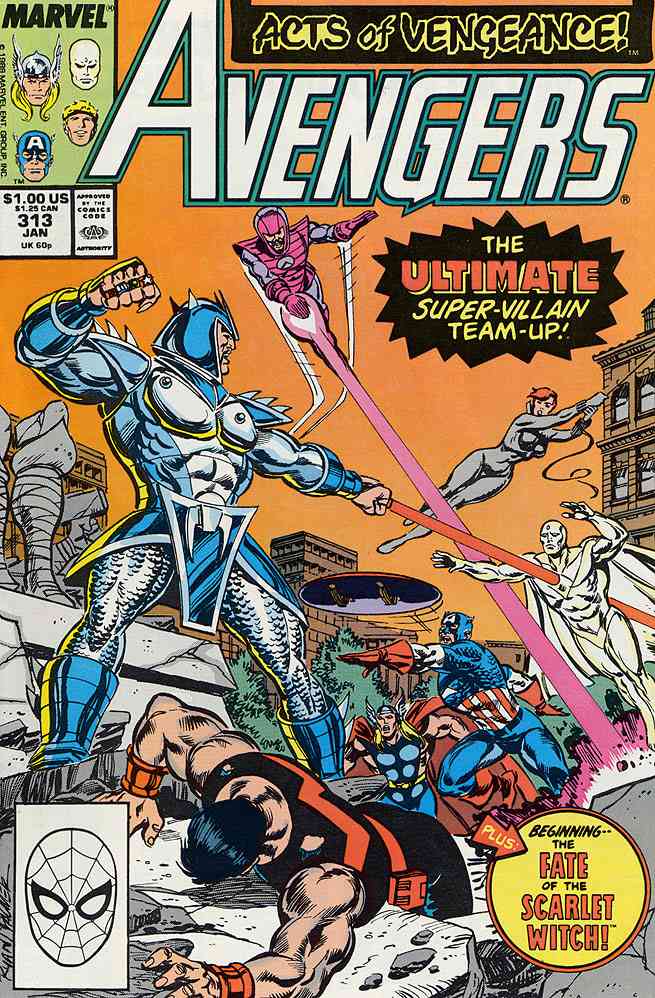
Avengers 313 - Acts of Vengeance

"The Ultimate Super-Villain Team-Up!" proclaims the cover. It's a phrase that many in Marvel have long wanted to use over the years, echoing the 1970s series, and here it makes an appearance in all its glory as the action heats up. But at times this is less of a team-up than a squabble.

Avengers #313

Artists: Paul Ryan and Tom Palmer
Writer: John Byrne
Letterer: Bill Oakley
Colourist: Mike Rockwitz
Editor: Jim Salicrup
Ed.-in-Chief: Tom DeFalco

This issue sees the Mandarin go on the direct attack. Outside of the X-Men issues, which have barely acknowledged the wider event, the Mandarin hasn't done a great deal in the crossover. For that matter the central alliance of villains hasn't made its major follow-up assault against the Avengers yet. Instead there's a lot of squabbling which comes to blows here as Doctor Doom and the Red Skull briefly fight before the Kingpin walks in and dismisses them as children. Meanwhile the Wizard has followed the Mandarin, hoping to seize the initiative. If the intended message is that super-villains ultimately can't work together for long because of their egos, conflicting interests and different ideologies then it's been presented subtly over a long period. Such is the lack of loyalty that the Mandarin thinks nothing of firing his rings at the Avengers when the Wizard will be caught in the crossfire, then fleeing to leave his ally to be captured. The Mandarin here may be dismissive of an onlooker's "petty racism", but he's coming as a modern-day wizard in armour and is much more of the traditional cackling villain here than he was in the X-Men issues.

The Avengers continue to struggle with collapsing public support for super heroes, but this aspect of the story would work so much better had it been more integrated into the crossover rather than largely serving as a sideshow in a handful of issues. Thus once the Avengers arrive to tackle the Mandarin the crowds disappear and there's no comment at all as to what effect this has on public opinion. Instead it's largely an action piece with the Mandarin and Wizard using their powers and weapons to provide a strong challenge.

The issue also sees Magneto capturing the Scarlet Witch, stealing an entire wooden house in the process. Although he's been part of the main alliance, that effectively ended with his attack on the Red Skull and these events are more progressing a storyline that will come to a climax in later issues of Avengers West Coast. Though having writer co-ordination between the two Avengers team books is a good idea, they're still by definition set in different locations and attempts to tell a single story across them don't work well outside of formal crossovers. And this is very much looking beyond the end of the event.

It's not the only one. The issue sees Doctor Doom shot by the Red Skull and eventually explode, revealing him to have been a Doombot, perhaps all along. This is a very well-established practice of Doom, with more than one writer retconning appearances of Doom into robots (making for difficulties in constructing a chronology, though it gets much worse with Kang), but it also neatly takes Doom out of the equation, as though he's bored of the whole thing. It's slightly surprising that the Red Skull is shocked given the recent revelation that he too has an army of identical robots.

There's a real sense of things hotting up with this issue, and not just the Doombot. It's easy to forget that "Acts of Vengeance" ran over only three months, as the large number of issues can make it seem so much longer, but here in the core of the crossover things are now heading for what looks like a spectacular climax.

Avengers #313 has been reprinted in:

Monday, 3 December 2018

Avengers 312 - Acts of Vengeance

With this issue of Avengers we see the central core of the crossover pulling together ever more. Significantly most of the Avengers seen here are from the west coast team (the Wasp, the Scarlet Witch, the Vision and Hank Pym) or reservists called up (the Falcon), a sign of how the attacks are continuing to occupy and cripple the Avengers' operational ability. So now would be a good time for a major attack by the alliance of leading villains.

Avengers #312

Artists: Paul Ryan and Tom Palmer
Writer: John Byrne
Letterer: Bill Oakley
Colourist: Christie Scheele
Editor: Jim Salicrup
Editor-in-Chief: Tom DeFalco

Instead the alliance is squabbling. With this issue we get to see a meeting of the alliance in depth for the first time. And it's not going too well. One of the biggest criticisms of the whole alliance is that it is composed of villains with huge egos and some very different perspectives on the world. The panel showing the opening of the meeting is a glorious piece that conveys just how little the six like each other, with only the mysterious stranger holding them together, and there's a particularly nice touch in the way Magneto is staring at the Skull with undisguised hatred. Here the tensions spill over with the Red Skull and Magneto especially showing their hatred of each other and contempt for everyone else and most of the others pile in to refute the Skull's dismissal of them as "common criminals". Only Doctor Doom stands above it all. But the meeting is also a wonderful parody of the real-life world of organisations and corporations where everyone is expected to gather together in person merely to receive reports they could have been sent in writing. Absolutely nothing is achieved in this meeting though later in the issue we see the alliance watching the Avengers on monitors where it's confirmed they had nothing to do with an attack by Freedom Force and suggest taking a more active role. Luckily, we don't witness the processes of someone coming up with a motion, formally tabling it, entering in a row because of the very different meaning of the term "to table" in meetings on either side of the Atlantic, then eventually discussing the proposal etc... But overall the implication is that the limited central action is largely because of squabbling egos.

Consequently the Avengers face a group of villains who have been manipulated by the mysterious stranger without his allies' knowledge. The Blob, Pyro and Avalanche have actually fought the Avengers before in the annual that introduced Rogue and both the Vision and Scarlet Witch were on the team at the time but there's no acknowledgement of that here and instead the Avengers react like these three are an unknown quantity. Given the high profiles disagreements between the creators, one does have to wonder if John Byrne simply blanked out anything written by Chris Claremont. What should be a simple fight proves anything but, with the three villains a strong match and clearly well briefed, forcing the Avengers to find some unusual ways to take them down, especially the Blob. And all the time the fight is leading to ever greater debate amongst the public about the value of super-heroes.

This issue works well in bringing the core threads of the crossover together with the leading villains' committee meeting an especial highlight. However the clues to the mysterious stranger's identity are extremely obvious.

Avengers #312 has been reprinted in:

Monday, 17 September 2018

Avengers 311 - Acts of Vengeance

We now come to the first issue written by the crossover's originator, John Byrne. Although there are multiple orders around for the crossover and some of the issues already looked at weren't published until after this one, it's still surprising to find so much of the event has already happened before its guiding hand has written their first issue. But then this isn't new - "Inferno" had a lot of build-up by Louise Simonson before Chris Claremont's first issue appeared.

Avengers #311

Artists: Paul Ryan and Tom Palmer
Writer: John Byrne
Colourist: Nelson Yomtov
Letterer: Bill Oakley
Editor: Jim Salicrup
Editor-in-Chief: Tom DeFalco

Despite Paul Ryan drawing both the cover and the story inside, the former is somewhat misleading as it features the current Avengers team when only Quasar appears in this issue. Instead the Avengers' support crew have to fight off an assault against Hydrobase, the team's current headquarters on an artificial island. Given the speed of the attack and the way that the island itself is targeted one has to wonder why the Avengers chose a base that has proven to be so vulnerable. It's also unclear from this issue (and indeed from the internet) whether the mansion on the island is the original one somehow transplanted from New York. If so then it's a rather ignominious end for the Avengers' original headquarters, destroyed with only the team's newest member and support crew to see it. But then this is from an extended period long considered one of the weakest in Avengers history. Over the course of about sixty issues between the departure of Roger Stern and the permanent arrival of Bob Harras the longest continuous run was Byrne's, at just a dozen issues (plus a plot on the next one) whilst the team line-up went through numerous changes. Bringing the Avengers low fictionally at the same time feels quite appropriate.

The assault comes from a squad of robots sent by one of the leading villains but for some strange reason the two of them shown here have their identities hidden. We've already seen some of the them without shadows and a leading villain who wears a green cloak, has a lot of scientific expertise, has lost a kingdom and is addressed as "Doctor" isn't exactly the hardest mystery villain to guess. Either the creative team aren't all singing from the same hymn sheet or else this is a homage to the paper-thin mysteries of the Silver Age. Dialogue here about many heroes having already been attacked confirms that this isn't a placing error and indeed just about all the full chronologies of "Acts of Vengeance" have issues showing at least some of the leaders before this one, so the mystery feels rather pointless. The green cloaked figure's co-conspirator's blue armour may not be as widely known but it also doesn't hide the identity from anyone who has seen it before. Meanwhile the mysterious strange who recruited the leaders of the conspiracy is shown in a setting that's somewhat suggestive of his identity, but it's probably best to wait for a full meeting of the leaders to discuss that.

As the first major part of the crossover this issue really should be doing more to anchor the overall narrative and introduce the set-up. Instead it feels like a middle chapter of an event which leaves the structure weakened. This also contains one of the biggest acts of destruction in the whole event and it's understandable that the attack happens whilst most of the Avengers are tied up elsewhere, but it might have been better to wait to first show them all caught up rather than making their absence here implied. All in all this is a stuttering start to the event.

Avengers #311 has been reprinted in:

Friday, 1 January 2016

What If... Essential Deadpool volume 1?

For a final look at a hypothetical Essential volume I turn to one of Marvel's biggest latter-day stars, the Merc with a Mouth in the days when he first became the Merc with a Monthly, the one and only Deadpool!

Woo hoo it's me!

Oh no! No! NO!

Hey I finally made it onto your blog!

Oh no you don't! Didn't you pay attention? You didn't know you were a comic character until the Writer of Death showed up and those issues aren't until later.

Yeah but you're inserting me into older material. And it wasn't quite Priest who...

Look let's stop this now. I'm the one with the keyboard, I'm the one who can type blanks into all your weapons - and I don't just mean your guns - and I'm not having another of these conversations. You have two choices - either p*** off and star in another film or I make like Fox and sew your f***ing mouth shut. GOT IT?!

Your funeral pal. See you in the funnier pages. Toodle-oo!

Now that that's over, back to normal service...

Essential Deadpool volume 1 would contain his first appearance in New Mutants #98, the two four-part limited series Deadpool: The Circle Chase and Deadpool: All New X-Men Limited Series (well that's what it says on the cover; it's also been called "Sins of the Past" in places) plus issues #1 to #11 & #-1 from his first ongoing series and the crossover annual Daredevil/Deadpool '97 as well as a guest appearance in the back-up story from Avengers #366 which ties in with the first limited series. That would make for a larger than usual volume but Deadpool's done this sort of thing before.

The bulk of the material can be found in Deadpool Classic volumes 1, 2 & 3 but the Avengers appearance is in Deadpool Classic Companion, an extra volume devoted to all those appearances sequential reprints often ignore. This doesn't include every early Deadpool appearance ever - in particular there are some X-Force storylines absent that would otherwise overwhelm any collected edition - but it catches his early years quite well. Otherwise, most of the earliest Deadpool limited and ongoing issues looked at here have been collected in a variety of editions, released in multiple countries and languages. The most complete source for the ongoing title is the Deadpool by Joe Kelly Omnibus.

(And for those wondering where the cover image has come from, it's a piece that did the rounds when the ongoing series was launched and is now probably best known as the cover for the trade paperback Deadpool: Mission Improbable which reprinted the first five ongoing issues back in 1998. Yes the standard practice for Essentials in the 21st century has been to use art from the original comics but since when did Deadpool ever conform to standard? And the obvious alternative image from New Mutants #98, as used on Deadpool Classic volume 1, is just hideous. It's unsurprising both the Italian edition and the British edition with just the two limited series went for the cover of the first issue of the second series, but this is a better option.)

Deadpool's first appearance in New Mutants is plotted & drawn by Rob Liefeld and scripted by Fabian Nicieza. The Circle Chase is written by Nicieza and drawn by Joe Madureira whilst the second limited series is written by Mark Waid and drawn by Ian Churchill, Lee Weeks and Ken Lashley. The ongoing series, including the "Flashback" and annual, is written by Joe Kelly with help from Pete Woods on one issue and contributions of a different kind from Stan Lee on another. The art on the series is mostly by Ed McGuinness with some issues by Kevin Lau, Shannon Denton and John Fang whilst John Romita contributes in a way on one issue whilst the "Flashback" issue #-1 is drawn by Aaron Lopresti and the annual by Bernard Chang. The Avengers story is written by Glenn Herdling and drawn by Mike Gustovich. Invariably this means there's a separate labels post. And I see someone has already done the dialogue for it. Grr...

This volume would cover an interesting and turbulent period in the comics market with Marvel and its travails often at the centre of the storm. During the early 1990s there was a massive rise in overall sales accompanied by a huge increase in the volume of titles and many characters received their own limited or ongoing series, with Deadpool amongst them. But it was notable that very few of Marvel's new titles lasted any length of time outside of the X-Men and Spider-Man families. (Exactly how few is subject to a few myths so worth checking in detail.) After a flurry of lasting successes launched in 1990 such as Namor the Sub-Mariner, Ghost Rider, Guardians of the Galaxy, New Warriors and even Barbie and Barbie Fashion, Marvel entered a long run of misses. Over the next six years many titles were launched but outside the Spider-Man and X-Men families only six series lasted more than three years - Darkhawk, Warlock and the Infinity Watch, Punisher War Zone, Spider-Man 2099 (counting that as a 2099 family title rather than a Spider-Man one), The Ren & Stimpy Show and Doom 2099. The last of these launched in early 1993 and all of these had gone by late 1996.

Meanwhile the various Marvel companies and divisions got involved in some complicated chaotic financial dealings that led to actions that exacerbated problems in the North American comics market, contributing to a massive crash, roughly around the time of Deadpool's second limited series and over the next few years Marvel lurched through a series of crisis decisions that saw many titles axed and several long running superhero titles farmed out to Image creators. The bleakest moment came in late 1996 with the announcement that Marvel had filed for bankruptcy protection. It seemed as though the creative edge had gone out of Marvel and few expected any new series to last.

Yet out of that winter came two series that did manage to last for a good number of years and show that Marvel had now got its mojo back. The second of these titles was Thunderbolts. The first was Deadpool.

But reading Deadpool's first appearance from some six years earlier there's nothing that hints at this. He may be the most prominent character on the cover of New Mutants #98 (with the element later lifted for the first of his Classic series) but within the story he's a one note character whose primary purpose is to establish the skill of another new character, Domino. Deadpool fights Cable and the other New Mutants before being overcome upon Domino's arrival and is then mailed to his employer with the implication that will be the end of him. As first appearances go it's extremely underwhelming though it establishes Deadpool as a rather chatty mercenary who just won't shut up. He would pop up again and again in the replacement title X-Force before benefiting from the massive explosion in the number of titles in the early 1990s in which even the most obscure character could get a limited series.

With the great explosion of came some titles came some not so great product and that's apparent here. The Circle Chase is primarily a quest series with Deadpool and a whole range of other characters hunting for an ultimate weapon mentioned in the will of the unseen Mr Tolliver. The quest spills over into a back-up story in the 30th anniversary Avengers issue which otherwise focuses on the Black Knight's battle with his squire turned evil, the Blood Wraith. The appearance here of Deadpool, and indeed the one-off Plug-Uglies - Flame and Foam - also searching for the weapon, provides a wider conflict to ensnare the Blood Wraith but otherwise is mainly incidental to the story, though there's a scene where Victoria Bentley is confused for Deadpool, something that can't happen that often. Even Deadpool's dialogue is tame, showing how difficult a character he is to write for.

Back in the regular series we're reintroduced to other elements of Deadpool's life such as his technician "Weasel", his artificial healing factor, his personal history with the mutant Copycat aka Vanessa and so forth. But the storyline itself is lame, consisting of a series of fights around the globe with the likes of Weapon X, Slayback, the Juggernaut, Black Tom Cassidy and various lesser foes, before a climax in which the weapon is revealed to be the least offensive tool imaginable and Deadpool saves himself through logic and selflessness in acting to heal Copycat. Overall this limited series just isn't anything to set the world on fire and is an unfortunate start to Deadpool's solo tales.

The US comics market was starting to go into freefall by the time the second limited series came along, but that may have been to the title's effect by increasing the talent available. This limited series is far more personal to Deadpool, focusing upon his history with the Weapon X project and as a mercenary plus his friendship with the X-Force member Siryn under the disapproving watch of her father Banshee. The story deals head on with one of the character's biggest problems, namely that his healing factor is so powerful that it removes any real sense of danger for the character. Here he has to come to terms with the factor failing and find a way to restore it, as well as a repeated encounter with the Juggernaut and Black Tom Cassidy, the latter now needing some healing of his own. It's a good little personally focused story, of the kind that the limited series format is best for. The only new character of any significance is Dr Killebrew, the geneticist responsible for Deadpool's healing factor in the first place and thus has good potential for recurring appearances over the years. Otherwise we get a movement of the lead character towards the more wacky side that would come into full force with the ongoing series.

Deadpool's ongoing title began in late 1996 and it's easy to forget now just how revolutionary or niche it often was. This series began before the regular South Park series launched, before the first Austin Powers movie had come out and indeed before much of the explosion of cartoony style adult humour series. Indeed at times it seems to be setting the trends. Marvel had done humorous titles before but never a mainstream universe superhero title with such a bizarre wackiness to it. This is a very experimental title that does its own thing, with a character highly different from the norm.

It's also easy to forget, especially now with such a major movie about to come out, that this was a title that was constantly fighting to survive and at times only holding on by the skin of its teeth. From memory Marvel announced its cancellation more than once and there was a big "Save Deadpool" campaign, trying to increase the number of subscribers to secure extra sales in advance. Marvel's then-recent track record on cancelling titles was not encouraging. Few honestly expected the series to last at all and expected Deadpool to then drop into obscurity. To predict the character's present day popularity and sales would have marked one as mad as the character. And yet somehow the book managed to last so long.

It's probable that Deadpool primarily survived because the series was so different from everything else the company was putting out and thus probably bringing in readers that Marvel otherwise couldn't reach. And the cancellation threat itself was oddly beneficial to the series, allowing the creators to experiment as much as they did because they had nothing to lose. The result was something truly amazing.

Now sure the issues contained here, covering the first year of the title, include some typical Marvel superhero comic clichés. There are the guest appearances, both by characters Deadpool has a history with and those with no previous connection. There's an encounter with a superhero team, allowing the Avengers logo to appear on the cover. There's a whole issue devoted to a Spider-Man encounter. There's some exploration of the character's past and origins. There's a supporting cast established, including an over helpful sidekick role, a recurring antagonist in day to day business and an elderly lady. And the storylines vary in length from done in one tales to multi-part sagas that try to go into more detail.

But it's the whole approach that is so different. It's best to think of the series as like an adult cartoon, with a foulmouthed anti-hero as the protagonist and some quite wacky and offbeat situations encountered along the way. The conventions are rarely conformed to but instead often sent up in their own wild and wacky way. Deadpool is slowly drifting towards herodom but it's a long journey for Wade Wilson, in spite of the hopes of Landau, Luckman and Lake in a long running subplot. Early on the healing factor is toned down, allowing for more tension. There's also a very unusual guest cast.

Weasel continues to help Deadpool from time to time, playing a pivotal role in the last issue as we learn more about his past and just how long an influence Wade has had on him. He makes for a likeable supporter who sticks by Deadpool in spite of everything and it works. More curious is Blind Al, an elderly woman who lives with Deadpool and we slowly discover she is his prisoner who has become accustomed to her situation despite all the crap she has to deal with. The exchanges between the two makes for a tricky relationship with each unable to admit how much they are dependent on the other. It can also set Deadpool back in the field, especially when Al sabotages his weapons.

As well as Deadpool's own home he also spends a lot of time at the "Hellhouse", a sort of community centre for mercenaries to hang out, collect assignments from the runner Patch and maintain tense relations with one another. Deadpool's main recurring rival in the series is the mercenary T-Ray, though the antagonism is not fully explored at this stage. There aren't too many new foes introduced at this stage with the main new one being Deathtrap who captures Deadpool and subjects him to a highly surreal situation. Otherwise the foes are drawn from a variety of other Marvel titles with appearances by the likes of Taskmaster, Vamp (one of the more obscure Captain America foes), Typhoid Mary and Kraven the Hunter.

The potential list of guest stars was not great if the title was consciously trying to avoid encounters with the X-Men family at this stage. A good chunk of big name heroes were absent because of the transfer to the Heroes Reborn pocket universe, but that proves advantageous in forcing a more experimental approach with those that are left. The first issue features Sasquatch, between stretches in Alpha Flight, with the traditional misunderstanding, fight and then team-up. Later on we get an appearance by Siryn which sets out just what Deadpool actually means to her. The handling of his rather creepy stalking her and hovering outside her bedroom window is a bit tame though. There's a tense encounter with the Hulk, at this point in his most inhospitable with Bruce Banner having been torn out of him. But the most memorable tales come with three other guest stars.

An extended story with Typhoid Mary leads to a crossover with Daredevil in the annual but this is different from what has come before. Although many a prior annual has contained a guest star joining the regular hero (and some have forgotten which is which), this one is the first to give joint billing to both stars. It was a successful experiment that led to nearly every annual the following year being such a team-up book. The story itself provides a strong contrast between Deadpool's wackiness and the traditional darkness of Daredevil, adding in a twist from the latter's past as he discovers just how responsible for Typhoid Mary's life he really is. Meanwhile Weasel and Foggy Nelson go out on the town, with the consequence that Deuce the Devil Dog changes owner and titles. A dog companion is part of old comics silliness that feels totally at home in Deadpool's title.

But two other guest appearances at the end of the selection are even more amazing. First come, wait for it, the Great Lakes Avengers. Sorry, a correction. At this point they had brought out of the Avengers franchise (the actual team being disbanded and presumed dead can't have helped) and were now "the west coast adjunct to the Thunderbolts... the Lightning Rods! Attracting malignancy away from those it would see electrocuted in its negatively charged grip of evil!" This was the first time the team changed their name, although the cover of issue #10 retains the original. On their few prior appearances the GLA Lightning Rods have been treated as a joke aspiring to Avengers membership and here they encounter Deadpool at an aquarium resulting in total chaos as they fight. By this stage the series has settled into a fantastic alternate cartoon approach and this works incredibly well.

Before we get to the final issue though, a quick word about the "Flashback Month" issue. And frankly #-1 is an example of where the gimmick completely failed. It was published in the middle of the Typhoid Mary storyline (and thus has had to be relocated to before it for collected editions), apologies for the interruption but doesn't really tie into anything in the ongoing series beyond the interest in Deadpool by Zoe Culloden of Landau, Luckman and Lake. And here her investigations only bring her into indirect contact with Wade, instead focusing upon Vanessa when she worked the streets. A character called Montgomery is created for the story seemingly only to allow a cover image of a terribly burned face. Overall we have the mess of trying to create a Silver Age retro feel for the most Modern Age of characters, made worse by the issue not actually focusing upon him at all. To top it off we now have to accept that the Landau, Luckman and Lake interest in Deadpool has been going for at least a decade, which may be a commentary on how long some subplots last but feels more like a product of trying to come up with anything that could tie in with the current title. Going by the issues in this selection alone, one could easily skip #-1 and miss nothing at all.

A much more successful attempt to create a Silver Age feel yet apply it to Deadpool comes in issue #11, a triple sized issue that is the inevitable Spider-Man issue but comes in a very different form. Rather than a fight or a team-up we get a wonderful time travel story in which Deadpool and Blind Al find themselves thrown through time and arrive in 1967 just in time to take part in the events of Amazing Spider-Man #47. The original issue is reprinted at the end and is a somewhat typical example of the middle period of Stan Lee's run on the title with John Romita's art really coming to the fore in a tale focused on Flash Thompson's leaving party with a gatecrashing by Kraven. But it's also an example of the innocence of the Silver Age comics and the weird slang that can sound utterly incomprehensible at times. And that becomes the beauty of it.

Deadpool and Blind Al find themselves impersonating Peter Parker and Aunt May respectively as they wander through the events of the issue, often drawn into the original comic pages in a Forrest Gump manner. Pete Woods's new art is highly sympathetic to the original, helped by veteran inkers Al Milgrom and Joe Sinnott recreating a classic feel. However the script is mocking in all its glory as Deadpool and Al brings their own sensibilities to it, commenting on the mad slang, the Osborn hair, the sexual undertones to what was originally written as fairly innocent material and so forth. Against all this the fight with Kraven is even more of an afterthought than in the original issue. Overall this is a wonderful contrast of the classic and modern approach with wonderfully biting satire to boot, making for what is easily the best issue in the whole selection.

As a whole this is a series that knows it's allowed to be different and revels in it. There had been anti-hero leads in comic series before but never any quite like Deadpool. His earlier appearances had shown some potential but also a lot of extraneous moments that have to be waded through. But the ongoing series finds a strong niche and runs with it as a comic form of adult sitcom cartoon, sending up the situations and presenting a wacky lead with incredible dialogue and few inhibitions. Based on this selection alone, Joe Kelly is the best Deadpool writer so far, really nailing the character. There are some individual poor issues but there are also some incredible ones, with #11 a contender for one of the absolute best Marvel issues of the 1990s.

So should Deadpool have had an Essential volume? Absolutely! Deadpool is a character who has transcended all other rules so recentism is no problem. There's a lot of material out there - the Classic reprints are already up to volume 14! - and a good cheap bulky volume would be a good primer. The Classics suffer from the first volume having to contain the two limited series so an Essential volume would get deep into the main run.

Yay! Now to time travel once more and sort it out.

Sigh... Oh well, he's someone else's problem now.

Friday, 23 October 2015

What If... Essential Champions volume 1?

Another look at a series as if it had been collected in an Essential volume, including all the additional issues included in other collections. This one is otherwise found in Champions Classic volumes 1 and 2.

Essential Champions volume 1 would contain all seventeen issues of the 1970s series plus the crossover issue Super-Villain Team-Up #14, the guest appearances in Iron Man annual #4 and Avengers #163, and also the epilogue in Peter Parker the Spectacular Spider-Man #17 to #18. (This is also the combination of the forthcoming Masterworks edition.) That would be a slim volume but there are some Essentials this thin. Bonus material, if it were needed, could include some unused covers - the Classics include one for issue #7 that had only minor changes - and also entries from the Official Handbook of the Marvel Universe. The writing on the main series is initially by creator Tony Isabella who is succeeded by Bill Mantlo with one issue by Chris Claremont. The art on the main series is by Don Heck, George Tuska, Bob Hall and John Byrne with most making at least one return during the run. The Iron Man annual is written by Mantlo and drawn by Tuska, the Avengers issue is written by Jim Shooter and drawn by Tuska, the Super-Villain Team-Up one is written by Mantlo and drawn by Hall, and the Peter Parker the Spectacular Spider-Man issues are written by Mantlo and drawn by Sal Buscema.

1975 was a big year for team titles at Marvel. As well as the ongoing exploits of the Avengers, Defenders and Fantastic Four it also saw the launch of the All New All Different X-Men, the debut of the Invaders and the start of the Champions. But whereas all the other titles would last for several years, Champions would limp along for just over two years, confined to the odd eight-issues-a-year format that would make multi-part stories take ages to resolve and never really breaking out into a big hit. In the years since there has been little in the way of revivals bar a one-off reunion to work with X-Force in one of the 1998 team-up annuals. Otherwise the team has been mostly forgotten and treated as a joke when remembered, with Iceman once bemoaning "Do you have any idea how hard it is to find a major super-villain in Los Angeles?" (We'll find out in this review.) The nadir must surely have been when the right to use the name was won in a poker game by the team usually known as the Great Lakes Avengers but even they didn't make much of a mark with it before finding yet another name. And so the Champions have languished in obscurity.

Part of the problem may be the sheer difficulty of getting the original team back together under the title "Champions" - after the original series ended a different comic company adapted a role playing game property by the same name and at least twice Marvel has been rebuffed in attempts to reobtain the trademark. (The X-Force/Champions '98 annual was probably part of one of these attempts.) But also the team members are a pretty disparate bunch normally found spread across very distinctive parts of the Marvel universe and it can't be the easiest task to obtain the whole set for even a one-off reunion.

The team itself is initially comprised of five heroes, with another joining midway through. Leading the group is the Black Widow, who has recently left Daredevil and is developing ever more into a strong independent character in her own right. She's also one of the first women leaders of a Marvel team and also brings to the team both her adoptive father Ivan Petrovich and demons from their past in the Soviet Union. Bankrolling the team is the Angel, fresh out of the X-Men, now that newer members have taken over, heavily enriched through inheritance and ditching his secret identity in favour of being open and free with the world. Also recently having left the X-Men, but maintaining his secret identity for now, is Iceman. The youngest team member, he initially feels he wants to get on with his life and plans on dropping aside as soon as the team is fully established, but finds himself staying around to the point that this plan gets forgotten, especially under a new writer. The team's muscle is provided by Hercules, who proves to be the catalyst around which the group is initially drawn together, and he stays around for the adventure. The most distant is all the five is the Ghost Rider, seen here in the early years of his career when Johnny Blaze had full control over his flaming alter ego, who often feels distrusted and out of place amongst his teammates. Midway through the run the team is joined by Darkstar, a new hero from the Soviet Union with dark energy powers and a mysterious past. The main supporting cast member is Richard Feinster, a recently sacked lecture agent at UCLA who becomes the team's business manager.

The Champions are based in Los Angeles and have as their aims to help the "common man" with more down to earth problems, in contrast to the more global and intergalactic threats faced by other teams. It's a worthy aim, as is setting the series away from the New York norm of the Marvel universe. But in practice the team wind up facing quite a number of established larger than life super-villains and take on global and even universal threats. It looks harder to escape the conventions than it seems.

With very little pre-existing ties to bring the team together the series starts by creating a set of coincidences to get all of them to the campus of UCLA in order to get caught up in the same menace. Iceman is starting studies there and is visited by the Angel whilst Hercules has been appointed a visiting lecturer on the reality behind Greek myths. The Black Widow is applying for a post as a Russian language teacher and the Ghost Rider's alter-ego of Johnny Blaze happens to be motorcycling through the campus. The initial menace is the arrival of Pluto the Greek god of death who seeks to force Hercules and Greek god turned little remembering Atlas era hero turned new lecturer in humanities Venus to marry his allies, Hippolyta, queen of the Amazons, and Ares, god of war, so that they will be unable to battle against Pluto's planned take-over of Olympus. The opening adventure takes up the first three issues with a journey to Olympus itself thrown in and results in the five working together and realising how well they mesh as a team. It's hard to disguise that most superhero teams have had awkward origins precisely because they rely on cautious loner heroes suddenly discovering how well they work together, but the Champions seem especially forced given the ongoing distrust of Ghost Rider and the initial reluctance of Iceman. It's as though they were thrown together by dictat rather than emerging as a natural combination.

The team takes a few more issues before it's fully constituted, complete with its own transport in the form of the Champscraft and a headquarters in a Los Angeles skyscraper. However both get assembled by dodgy contractors and a minor recurring theme are the problems with equipment failure though it doesn't come to the forefront until the epilogue in Peter Parker the Spectacular Spider-Man. The team's public relations are also a bit of a mess, with their official launch coinciding with an adventure such that only the Angel and Hercules are available for the press conference which gets attacked by the Crimson Dynamo, the Griffin, and the Titanium Man, whilst a photoshoot of the dissolution of the team is an equal damp squib with only the Angel still around when Peter Parker arrives.

When one looks at the foes encountered by the Champions it rapidly becomes clear just how easy it is to find supervillains in Los Angeles including some quite major ones. As well as the initial clash with Pluto there are encounters with a group of Soviet foes including the Titanium Man, a new Crimson Dynamo whose real identity is a shocker for the Black Widow and Ivan, and the Griffin. This group also includes the first appearance of Darkstar but she soon defects. Then there's an encounter with Warlord Kaa of the shadow-people with guest appearances by Hawkeye and the time-displaced Two-Gun Kid. The team's most wide-ranging adventure initially seems to be up against the Stranger but he is in fact looking to save Earth and the real threat comes from Kamo Tharnn (later better known as the Possessor) who seeks to recapture the Runestaff that can save the day. The Avengers appearance sees conflict with the Greek Titan Typhon who forces battle between the two whilst the Iron Man annual brings them up against Modok and AIM. The crossover with Super-Villain Team-Up involves a strange contest between Doctor Doom and Magneto in which the latter must find a way to stop the ruler of Latveria from taking over the world with a special neurogas, forcing the Master of Magnetism to seek out allies, finding them in the form of first the Beast and then the Champions. The final issue sees an attack by the Vanisher, utilising both the Sentinels and the mutants the Blob, Lorelei and Unus the Untouchable. The biggest new foe introduced here is Swarm, a collective sentient hive of bees with the mind and skeleton core of a Nazi scientist. There are a few lesser foes such as new ones like Dr Edward Lansing, a scientist abusing a care home in order to perform experiments, or Rampage, an inventor hurt by the economic downturn who dons an exo-skeleton to initially rob banks. Rampage is the most recurring of the team's foes, being used by the Soviet foes in an action that leaves him paralysed and then coming back for an act of revenge at the very end. There's also an encounter with Stilt-Man that's so forgettable he's left in the hands of the guest-starring Black Goliath whilst the Champions deal with the Stranger's problem.

The series ultimately lasted only seventeen issues and ends on a mini-cliffhanger as the Champions wonder about Darkstar's true nature. But this goes unresolved and the team is unceremoniously disbanded in a flashback in the pages of Peter Parker the Spectacular Spider-Man which otherwise serves as a straightforward team-up with the Angel (in fact it's a surprise this story wasn't told in the pages of Marvel-Team-Up) as they face down against the Champions' old foes Rampage and the shoddily constructed building. And that was the end of the Champions' story, bar one very brief reunion many years later.

So is Champions a title that should have had an Essential collected edition? The existence of the Classic reprints is the most obvious argument against but there are certainly other titles in the Essentials that have been collected elsewhere in colour. And the bar for inclusion in the Essentials was not actually that high - several short-lived 1970s series such as Godzilla, Ms. Marvel and Super-Villain Team-Up all qualified for a single Essential volume so not lasting long was clearly no barrier. Nor is the series anywhere near as mediocre as some material included in the Essentials. It may not be the most memorable of titles and the team suffers from feeling like it was assembled to fit arbitrary criteria, but there's a sense of trying and purpose to these tales that hold together reasonably well. A single collected edition would be thin without much obvious extra stuff to include - very maybe the X-Force/Champions '98 annual but that would be a much later pick and otherwise that's pretty much it as a contemporary appearance in Godzilla would be a monster of a rights issue. But there's just about enough already. This is a series that certainly does deserve reappraising as whilst it's not the greatest team title ever it's certainly a lot more credible than the dismissive comments and jokes of later years would suggest. I don't know how the trademark situation would have been an issue, though it clearly didn't stop the Classics doing two volumes. All in all the Champions is a good little series that would certainly have earned a place amongst the Essentials.