Showing posts with label Official Handbook of the Marvel Universe. Show all posts

Wednesday, 9 September 2015

Essential Official Handbook of the Marvel Universe Master Edition volume 3

Essential Official Handbook of the Marvel Universe Master Edition volume 3 collects the entries for Professor Power through to Zzzax from across the thirty-six issue run of the series. Additionally it includes another printing of the single page guide to power levels, the single page special glossary and an index to which issue each entry originally appeared in. Once again the entries are mainly drawn by Keith Pollard and researched & written by Len Kaminski, Jamie Tost, Mark Gruenwald, Glenn Herdling, Murray Ward and Peter Sanderson. The whole thing is edited successively by Mark Gruenwald, Kelly Corvese and Tom Brevoort.

The standard entry for a character has a full-page shot of the character from the front, side and rear. Then there's a page of text with the following pro forma:
  • Biographical Data
  • Real name
  • Other current aliases
  • Former aliases
  • Dual identity
  • Current occupation
  • Former occupation
  • Citizenship
  • Legal status
  • Place of birth
  • Marital status
  • Known relatives
  • Known confidants
  • Known allies
  • Major enemies
  • Usual base of operations
  • Former base of operations
  • Current group membership
  • Former group membership
  • Extent of occupation
  • Physical Description
  • Height
  • Weight
  • Eyes
  • Hair
  • Other distinguishing features
  • Powers and Abilities
  • Intelligence
  • Strength
  • Speed
  • Stamina
  • Durability
  • Agility
  • Reflexes
  • Fighting skills
  • Special skills and abilities
  • Superhuman physical powers
  • Superhuman mental powers
  • Special limitations
  • Source of superhuman powers
  • Paraphernalia
  • Costume specifications
  • Personal weaponry
  • Special weaponry
  • Other accessories
  • Transportation
  • Design and manufacture of paraphernalia
  • Bibliography
  • First appearance
  • Origin issue
  • Significant issues
Occasionally a section will be followed by a "Note", clarifying some point or other. Sometimes there is no space left for "Significant issues". The entries and art are all printed in landscape format. The first appearances for characters who originated in the Golden or Atlas Ages include both a "historical" and "modern" entry. A few characters get second entries with new looks and updated information, including Sabretooth, whose entries show just how much more of his past was revealed in such a short space of time, and Wolverine, whose ones show how it was all much the same.

Usually the entries are in the correct order give or take some errors such as placing Union Jack III before the combined entry for Union Jack I & II. However there are some odd placements with characters who have no codename and are listed by surname. Thus "Rahn, Tamara" is listed under T but "Stone, Tyler" is listed under S. Some high profile heroes such as She-Hulk get a second page with brief entries for the supporting casts, with the image page showing the hero in action. Spider-Man's cast is so big that he gets a third, with the image page nominally devoted to his webshooters in action. The entries for each cast member list:
  • [Name]
  • Current occupation
  • Relationship [to the hero]
  • First appearance
As ever the Punisher is different and his second page is instead given over to his arsenal in the following format:
  • [Type of gun]
  • [Name of gun]
  • Caliber
  • Action
  • Capacity
  • Weight
  • Note
There are a small number of entries for races such as the Skrulls, presented in the following format:
  • Home world
  • Origin world
  • Habitat
  • Gravity
  • Atmosphere
  • Physical characteristics
  • Type
  • Eyes
  • Fingers
  • Skin color
  • Average height
  • Special adaptations
  • Unusual physical characteristics
  • Superhumanoid powers
  • Intelligence
  • Strength
  • Speed
  • Stamina
  • Durability
  • Agility
  • Reflexes
  • Society
  • Population
  • Government
  • Technology level
  • Cultural traits
  • Leaders
  • Names of other representatives
  • Major allies
  • Major enemies
  • Bibliography
  • First appearance
  • Origin issue
  • Significant issues
Groups and organisations are listed differently with this pro forma:
  • Organization
  • Full name
  • Purpose
  • Modus operandi
  • Extent of operations
  • Relationship to conventional authorities
  • Base of operations
  • Former bases of operations
  • Major funding
  • Known enemies
  • Known allies
  • Membership
  • Number of active members
  • Number of reserve members
  • Organizational structure
  • Known officers
  • Known current members
  • Known former members
  • Known special agents
  • Membership requirements
  • History
  • Founder
  • Other leaders
  • Previous purpose or goals
  • Major campaigns or accomplishments
  • Major setbacks
  • Technology and paraphernalia
  • Level of technology
  • Transportation
  • Standard uniforms
  • Standard weaponry
  • Standard accessories
  • Bibliography
  • First appearance
  • Origin issue
  • Significant issues
The big name teams such as the X-Men have a Membership Roster running over multiple additional sheets that detail each member's time with the team as follows:
  • [Identity]
  • Real name
  • Current status
  • Membership record
  • Note
The index at the back isn't the most useful as the entries are not reproduced in their original issue packs and an alphabetical ordering makes it redundant, with the small number of placement errors just adding to the problem. Otherwise this volume just comes to an end with no reproduction of the concluding editorials that instead appeared in the first volume.

It has become incredibly repetitive to state just how boring and inessential these volumes are but the reproduction of no less than three incarnations of the Handbook has been repetitive in and of itself. The Master Edition is thinnest on actual narrative information and feels like an overblown set of trading cards with the format of landscapes and static images just failing to inspire. There is a clear advantage in having the sheets collected in the intended order but this just doesn't outweigh the fact that in the internet era where it's easy to produce a regularly updated encyclopaedia of characters a paper series from many years ago just doesn't need to be collected at all. These volumes are easily the least essential of all the Essentials.

Wednesday, 29 July 2015

Essential Official Handbook of the Marvel Universe Master Edition volume 2

Essential Official Handbook of the Marvel Universe Master Edition volume 2 collects the entries for Garokk through to Proctor from across the thirty-six issue run of the series. The only addition material is another printing of the single page guide to power levels. Once again the entries are mainly drawn by Keith Pollard and researched & written by Len Kaminski, Jamie Tost, Mark Gruenwald, Glenn Herdling, Murray Ward and Peter Sanderson. The whole thing is edited successively by Mark Gruenwald, Kelly Corvese and Tom Brevoort.

The standard entry for a character has a full-page shot of the character from the front, side and rear. Then there's a page of text with the following pro forma:
  • Biographical Data
  • Real name
  • Other current aliases
  • Former aliases
  • Dual identity
  • Current occupation
  • Former occupation
  • Citizenship
  • Legal status
  • Place of birth
  • Marital status
  • Known relatives
  • Known confidants
  • Known allies
  • Major enemies
  • Usual base of operations
  • Former base of operations
  • Current group membership
  • Former group membership
  • Extent of occupation
  • Physical Description 
  • Height
  • Weight
  • Eyes
  • Hair
  • Other distinguishing features
  • Powers and Abilities
  • Intelligence
  • Strength
  • Speed
  • Stamina
  • Durability
  • Agility
  • Reflexes
  • Fighting skills
  • Special skills and abilities
  • Superhuman physical powers
  • Superhuman mental powers
  • Special limitations
  • Source of superhuman powers
  • Paraphernalia
  • Costume specifications
  • Personal weaponry
  • Special weaponry
  • Other accessories
  • Transportation
  • Design and manufacture of paraphernalia
  • Bibliography
  • First appearance
  • Origin issue
  • Significant issues

Occasionally a section will be followed by a "Note", clarifying some point or other. Sometimes there is no space left for "Significant issues". The entries and art are all printed in landscape format. The first appearances for characters who originated in the Golden or Atlas Ages include both a "historical" and "modern" entry.

There are a small number of entries for races, presented in the following format:
  • Home world
  • Origin world
  • Habitat
  • Gravity
  • Atmosphere
  • Physical characteristics
  • Type
  • Eyes
  • Fingers
  • Skin color
  • Average height
  • Special adaptations
  • Unusual physical characteristics
  • Superhumanoid powers
  • Intelligence
  • Strength
  • Speed
  • Stamina
  • Durability
  • Agility
  • Reflexes
  • Society
  • Population
  • Government
  • Technology level
  • Cultural traits
  • Leaders
  • Names of other representatives
  • Major allies
  • Major enemies
  • Bibliography
  • First appearance
  • Origin issue
  • Significant issues

Such entries are very rare,

Groups and organisations are listed differently with this pro forma:
  • Organization
  • Full name
  • Purpose
  • Modus operandi
  • Extent of operations
  • Relationship to conventional authorities
  • Base of operations
  • Former bases of operations
  • Major funding
  • Known enemies
  • Known allies
  • Membership
  • Number of active members
  • Number of reserve members
  • Organizational structure
  • Known officers
  • Known current members
  • Known former members
  • Known special agents
  • Membership requirements
  • History
  • Founder
  • Other leaders
  • Previous purpose or goals
  • Major campaigns or accomplishments
  • Major setbacks
  • Technology and paraphernalia
  • Level of technology
  • Transportation
  • Standard uniforms
  • Standard weaponry
  • Standard accessories
  • Bibliography
  • First appearance
  • Origin issue
  • Significant issues

None of the teams included in this volume have a Membership Roster that details each member's time with the team.

Some high profile heroes such as Ghost Rider get a second page with brief entries for the supporting casts, with the image page showing the hero in action. The entries for each cast member list:
  • [Name]
  • Current occupation
  • Relationship [to the hero]
  • First appearance

The format gives limited opportunity to establish too much information but occasionally an entry will surprise. It's nice to see Marvel Boy I's entry (under his traditional name instead of "Crusader") acknowledge his membership of the 1950s Avengers when the team had then only been seen in an issue of What If? that was of uncertain canonicity. More odd is that the entries for both Hellstorm and Mephisto suggest that the latter is the father of the Son of Satan, just reopening the mess surrounding all the different depictions of the Devil. Otherwise some entries make reference to confused details as mistakes such as the question of Mordred's parentage or whether or not Karnak has hair.

Once again there are some errors of ordering with Grizzly II appearing before Grizzly I and the same thing happens with Nova II & Nova I whilst "Guardian" (Heather Hudson) precedes "Guardian I" (James Hudson). It's also all too clear when some entries were written - the two Guardian entries come from very different periods of Alpha Flight whilst the Goddess's entry stops halfway through the events of Infinity Crusade, Proctor's entry only goes part of the way through the Gatherers storyline in Avengers and so reflects how much of a mystery he remained right up until the end whilst the entries for the Human Torch II (Johnny Storm) and Lyja are notably out of sync. The Bibliography is also often cut short, such as the Green Goblin's career seeming to cut out on only his second appearance.

Second entries for a character are rare and limited to cases where the subject received a new costume after their original entry appeared; characters so blessed include Hercules, Iron Man, Jack of Hearts and Nebula. At the other end of the scale there are some rather random cases getting even a first entry such as the Kangaroo, a forgettable Spider-Man foe who only made a couple of appearances before dying.

The images can get repetitive after a while so it's a relief when some variation comes along such as Lord Chaos or Master Order who each have just a head and we're given them only face on and in profile. One character who could benefit from some variation is the Living Tribunal, whose image doesn't depict the little-seen rear of his head very well.

Because of the way these volumes have been assembled it's hard to track any changing policies throughout the series's original release run. Once again we get all the entries in alphabetical rather than release order and it's good to see both the original and updated entries where relevant. But this is still awkward to read due to the landscape format of the entries, whilst the text doesn't contain a great deal of substance and it's all timelocked to the early 1990s. This volume continues the trend of the Handbooks being far from essential to reprint.

Wednesday, 17 June 2015

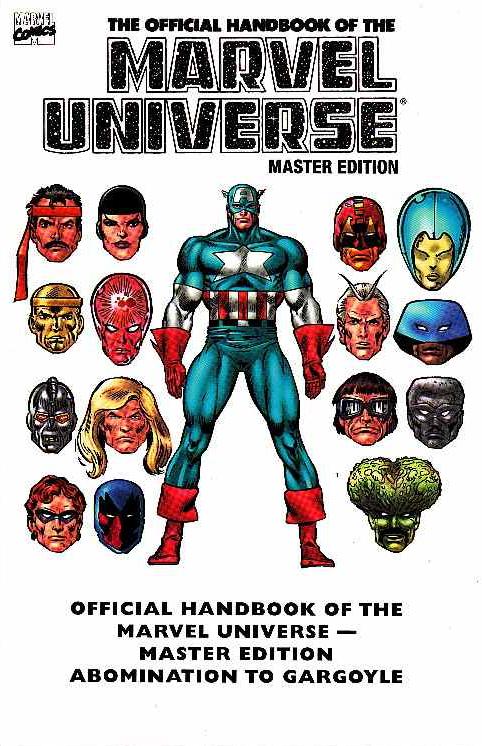
Essential Official Handbook of the Marvel Universe Master Edition volume 1

Essential Official Handbook of the Marvel Universe Master Edition volume 1 collects... entries in a different manner from before. The Master Edition opted for a loose-leaf partwork format with individual issues containing entries to be inserted into a binder in alphabetical order. For this collected edition, the entries from across all thirty-six editions have been included for the Abomination through to the Gargoyle. Where relevant the volume also includes the action sheet and supporting cast page for big name characters and team action sheets that were included in later issues. Also included in this volume are the covers of all thirty-six issues plus some of the original introductions. The entries are mainly drawn by Keith Pollard and researched & written by Len Kaminski, Jamie Tost, Mark Gruenwald, Glenn Herdling, Murray Ward and Peter Sanderson. The whole thing is edited successively by Mark Gruenwald, Kelly Corvese and Tom Brevoort.

The standard entry for a character has a full-page shot of the character from the front, side and rear. Then there's a page of text with the following pro forma:
  • Biographical Data
  • Real name
  • Other current aliases
  • Former aliases
  • Dual identity
  • Current occupation
  • Former occupation
  • Citizenship
  • Legal status
  • Place of birth
  • Marital status
  • Known relatives
  • Known confidants
  • Known allies
  • Major enemies
  • Usual base of operations
  • Former base of operations
  • Current group membership
  • Former group membership
  • Extent of occupation
  • Physical Description
  • Height
  • Weight
  • Eyes
  • Hair
  • Other distinguishing features
  • Powers and Abilities
  • Intelligence
  • Strength
  • Air speed
  • Stamina
  • Durability
  • Agility
  • Reflexes
  • Fighting skills
  • Special skills and abilities
  • Superhuman physical powers
  • Superhuman mental powers
  • Special limitations
  • Source of superhuman powers
  • Paraphernalia
  • Costume specifications
  • Personal weaponry
  • Special weaponry
  • Other accessories
  • Transportation
  • Design and manufacture of paraphernalia
  • Bibliography
  • First appearance
  • Origin issue
  • Significant issues
Occasionally a section will be followed by a "Note", clarifying some point or other. Sometimes there is no space left for "Significant issues". The entries and art are all printed in landscape format. The first appearances for characters who originated in the Golden or Atlas Ages include both a "historical" and "modern" entry.

The partwork nature of the original means that from time to time the order is wrong. Most notably the entry for Deathlok III precedes that of Deathlok I. Sometimes a character gets two entries such as Crystal, who changed her costume during the original release run. Each entry displays a different costume and the later one adds in a few recent key issues but otherwise the two are much of a muchness, with errors repeated such as listing Quicksilver as her "cousin by marriage" instead of as her husband.

Groups and organisations are listed differently with this pro forma:
  • Organization
  • Full name
  • Purpose
  • Modus operandi
  • Extent of operations
  • Relationship to conventional authorities
  • Base of operations
  • Former bases of operations
  • Major funding
  • Known enemies
  • Known allies
  • Membership
  • Number of active members
  • Number of reserve members
  • Organizational structure
  • Known officers
  • Known current members
  • Known former members
  • Known special agents
  • Membership requirements
  • History
  • Founder
  • Other leaders
  • Previous purpose or goals
  • Major campaigns or accomplishments
  • Major setbacks
  • Technology and paraphernalia
  • Level of technology
  • Transportation
  • Standard uniforms
  • Standard weaponry
  • Standard accessories
  • Bibliography
  • First appearance
  • Origin issue
  • Significant issues
Teams usually have a Membership Roster that details each member's time with the team as follows:
  • [Identity]
  • Real name
  • Current status
  • Membership record
  • Note
The entries for the Avengers and the Avengers West Coast operate on the principle that the New York based team are THE Avengers and the Los Angeles based team is a spin-off rather than the alternate position that they were respectively the east coast and west coast branches of the organisation on an equal footing. The exact status of the west coast team in relation to the east coast was a live issue for many years but here the Handbook comes down on the side that effectively dismisses the west coast team as inessential.

As well as the teams there are also occasional entries for the supporting casts of high profile characters such as Daredevil or Captain America, with the image page showing the hero in action. The entries for each cast member list:
  • [Name]
  • Current occupation
  • Relationship [to the hero]
  • First appearance
Some of the entries stop short in covering a character's history, such as the one for Captain Marvel II. The significant issues listed only covers the first few years of her career and feels the need to include a Marvel Team-Up story which left her temporarily trapped in her energy form, but conspicuously absent are the issues covering her tenure as chairperson of the Avengers, her massive energy loss in battle and her subsequent recovery with altered powers. It's as if a longer list was prepared but it became clear there was insufficient space for all of it and so it was simply chopped short rather than carefully edited down. Another odd case is Dazzled, whose early battles with Lightmaster and the Hulk wind up as being presented as more significant than Dazzler: The Movie. At the other end of the scale some characters have such brief entries for the rest of the form such that it makes Fandral appear to be the most active character included here.

There's still the occasional attempt to use entries to "correct" information given in stories such as the declaration that Ego the Living Planet does not meet the criteria of the Elders of the Universe and thus cannot be considered to be one of them despite having been shown to be part of one of the most exclusive groups in all the Marvel universe.

At the rear of the volume is a collection of covers, introductions and guide pages. Some of the introductions use the same text and the pages chosen seem to be used only because some of the credits are reused. The single page guide to power levels and the single page special glossary are both useful but would have been better place at the start of the volume. Otherwise the introductions talk about the philosophy and vision of the series, addressing a number of comments from readers. Big debates were held about whether the covers should also be printed on durable pagestock for binding; eventually they were but at the expense of a character sheet in each issue. The action shots proved unpopular for being out of line with the project and were dropped. Otherwise the later introductions also carry a number of corrections, plus a few extended bibliographies for characters whose entries ran short.

"Its modular nature will enable us to update this indefinitely without having to start all over from the beginning of the alphabet" claims the first introduction. It's clear the project had vision to go on for a long time with regular updates but after thirty-six issues it was cancelled due to low sales and the introductions admit as much.

This edition of the Handbook has the best format for mapping an ongoing fictional universe prior to the growth of the internet with online updates for encyclopaedias and downloadable updates for file based ones. It's a sensible move to reprint it in alphabetical order rather than recreating the disparate order of thirty-six separate packs. However the format has some failings. To read this the volume has to be turned on its side and there's an emphasis on lots of art and brief information at the expense of extended detailing of the story. In a way it's very representative of some of the worst trends in early 1990s comics. The Master Edition is now timelocked to the early 1990s and so it is no longer current; nor does it have the benefit of being a historical curiosity that the original is. With very few of the Essential series having reached this period there is little need for a supporting guide from the era. Once again it is hardly necessary to reprint.

Wednesday, 29 April 2015

Essential Official Handbook of the Marvel Universe Update '89 volume 1

Essential Official Handbook of the Marvel Universe Update '89 volume 1 collects all eight issues of the series. As a bonus it also includes a chunk of corrected, updated and additional entries from the first reprint of the Deluxe Edition. Peter Sanderson remains the main writer but on this occasion the editors are Gregory Wright followed by Terry Kavanagh.

As the initial editorial explains, this series arrived a year later than originally planned due to the scale of the project. By and large it focuses upon characters who didn't get entries in the Deluxe Edition whether due to being too new, having only subsequently risen to prominence or being simply omitted the first time round. There do seem to be rather a lot of supporting characters suddenly given entries such as Aunt May or Ben Urich or Wong, almost as though extra entries were deliberately sought to pad the series out to eight issues. There is no separate "Book of the Dead" on this occasion with deceased characters instead incorporated into the main alphabetical sequence. The sole exception is an entry for Madelyne Pryor right at the end but this is presumably to make up for an omission within this series's own run.

The entries generally use the following pro forma:
  • NAME
  • Real Name
  • Occupation
  • Identity [secret or not]
  • Legal status
  • Other aliases
  • Place of birth
  • Marital status
  • Known relatives
  • Group affiliation
  • Base of operations
  • First appearance
  • History
  • Height
  • Weight
  • Eyes
  • Hair
  • Strength level
  • Known superhuman powers
  • (Other) Abilities
  • Weapons
  • Transportation

There are occasional variations such as "First modern appearance" for characters who debuted before the 1960s, with the later issues also listing the actual first appearances for such characters, whilst Captain Britain's entry includes both his first ever appearance in each costume and also the first appearance in Marvel US comics.

The entries continue to try to make sense of some more awkward pieces of comics history, such as the one for Gabe Jones acknowledging that US Army units were normally segregated during the Second World War but suggests Colonel Sawyer was ahead of his time. The entry for Master Menace, the Squadron Supreme equivalent of Lex Luthor, expresses disbelief that a lifelong enmity could stem from an incident that affected his hair growth (here accelerating it rather than the original story where Superboy accidentally made Luthor bald) but admits that no alternative explanation has been given and settles for speculation about a nervous breakdown that could also cover up inconsistent characterisation.

Early issues include more data corrections from the Deluxe Edition. Notably a number of them include the original first appearances for several Golden and Atlas Age characters, races and also mythical characters like Loki, showing the longstanding tension about just which comics from before 1961 actually are part of continuity. A correction for Ka-Zar does its best to explain how British peerage and courtesy titles work and that "Lord Firstname Surname" is inaccurate. (In fairness to Marvel titles and styles are complex and difficult grasp, though certain peers themselves have no excuse for getting their titles wrong.) There's also a quick rectification made when the wrong entry for the Chameleon was printed; the correct text is printed a couple of issues later.

Later issues include mini-updates for entries in the Deluxe Edition that haven't been replaced; however these stop midway through with the Ms at the end of issue #7 with the final two pages of issue #8 given over to corrections from this series. Also absent once again is the long promised Appendix covering characters and concepts that don't merit full entries. By this point it has gone beyond a joke.

Going for a selective update rather than yet another full edition of the Handbook has kept this series to a single volume and is easier on readers' wallets, both in the 1980s and now. For these points these series deserves some credit. But it often feels that some of the entries here have not been chosen because the characters have sprung to prominence since the Deluxe Edition or that the previous round made a major omission, but rather they've been given an entry just to make up the page and issue count. Had it been truly confined to major updates, serious omissions and new characters then it could probably shed at least a couple of issues. This reprint is necessary to complement the rest of the Deluxe Edition but I am still to be convinced that any of it needed to be included in the Essentials.

Wednesday, 8 April 2015

Essential Official Handbook of the Marvel Universe Deluxe Edition volume 3

Essential Official Handbook of the Marvel Universe Deluxe Edition volume 3 collects issues #15-20 of the Handbook, covering the entries from Wonder Man to Zzzax, then an appendix for Alien Races and finally the Book of the Dead covering Air-Walker to Zuras. The main creative forces are still Mark Gruenwald and Peter Sanderson though Eliot R. Brown is only credited on issue #15.

The first issue contains the last few entries for living characters. One oddity is that Ymir the Frost Giant is given a full-page art shot. Of all the characters to receive this accolade, he would be very low on the list and it's clearly an emergency piece of padding. The entries are fairly standard though Zabu's does its best to reconcile what is known about real life sabre-tooth tigers with how artists have often drawn him. The Book of the Dead continues in much the same manner. There are attempts to explain away some of the stuff that went unremarked upon in the Silver Age such as the suggestion that the Kangaroo might actually have been a mutant rather than simply someone who trained hard enough amongst real kangaroos or speculation as to why Frederick Foswell/the Big Man was released from jail so quickly. More recent confusions are also subject to clean-up attempts, with the entry on the original Hobgoblin doing its best to weave motivation into the already confused backstory whilst the entry for the Purple Man struggles with a chronology that makes it difficult to explain his daughter having inherited his powers.

An interesting set of revelations here concern many of the villains killed by the Scourge of the Underworld. Reading through these entries it's clear just how lame most of them were and the whole storyline was clearly a useful way to clear out a weaker corner of the Marvel universe. Left ambiguous is whether or not there was more than one Scourge with the entry for Titania I questioning how the male killer could have convincingly disguised himself as the woman who killed her and if it was another Scourge who killed the first.

The Book of the Dead also includes some characters who existed in other time periods, most notably Kid Colt, the Rawhide Kid and the Two-Gun Kid, even though the circumstances of their deaths had not been revealed and the Two-Gun Kid's time travelling means he may be alive in the present day. Notably the Rawhide Kid's first appearance is given as issue #1 of his eponymous series; it's not clear if this is an error or a declaration that the Kid who appeared in the first sixteen issues was the same as the better known character from issue #17's relaunch. Also notable is that the Book of the Dead tries to include a panel of each character's moment of death.

The Alien Races Appendix consists of four entries a page depicting each alien race with the following information:
  • NAME
  • Origin Galaxy
  • Star System
  • Planet
  • Estimated population (Sometimes just "Population", presumably because specific data is available)
  • Physical Characteristics
  • Type
  • Eyes
  • Fingers
  • Toes
  • Skin color
  • Average height
  • Special adaptations
  • Type of government
  • Level of technology
  • Names of representatives
  • Note
  • First appearance
Initially the front and end pieces finish off the guide to other dimensions before running some other lists and tables. "Strength Levels in the known Marvel Universe" lists all the exceptionally strong characters by the tonnage they are able to lift. We then get "An alphabetical list of Marvel's publications with series set in the Marvel Universe (excludes Western, romance, barbarian, and non-series Marvel comics)" that sets out to provide a clear canon. In contrast to editorial comments in earlier volumes, both G.I. Joe and the Transformers are now excluded though other toy titles like Rom and Micronauts are included. Conversely the canon includes the Captain Britain Weekly published by Marvel UK, which probably wasn't easy to find on the back issue market then.

At the end there's a gallery that first combines each four set of covers to show the continuous image and then reprints the covers from the first set of collected editions - a ten part deluxe format that reprinted two issues at a time and actually began during the original release of this Handbook.

The editorials continue to list errors as well as discussing other matters such as the public awareness of aliens in the Marvel universe and the limitations of space technology, just how to determine whether or not a character is actually dead (and a number of characters listed in the Book of the Dead have since come back to life; a list of criteria is given but it ultimately comes down to editorial rulings), how accurately the comics depict the events that happened when it comes to internal contradictions, and an announcement that the next series will be a shorter "'88 Update" under the editorship of Howard Mackie. We'll see how that turns out. What is notably absent this time round is a general appendix despite many entries referencing it; the editorial in issue #18 states it will appear after the Update.

The Deluxe Edition of the Handbook seems to be the incarnation most favoured by many fans, possibly because of its size and scope, possibly because of the even more deluxe reprint editions. But in the Essential series it's actually the least essential, being neither the original nor the final version. I could endlessly rehash or reprint my dislike of these particular volumes but ultimately they can be safely ignored.

Wednesday, 4 February 2015

Essential Official Handbook of the Marvel Universe Deluxe Edition volume 2

Essential Official Handbook of the Marvel Universe Deluxe Edition volume 2 collects issues #8-14 of the Handbook, covering the entries from Magus (that's the father of Warlock not the future of, erm, the other Warlock) through to Wolverine. Again the main creative forces are Mark Gruenwald, Peter Sanderson and Eliot R. Brown.

There's not too much to say about this volume as it's the same format as the first volume and is still working through the main section of current living characters. The Appendixes in each issue are continuing to work their way through the various Other Dimensions. The editorials contain various errata under the heading of "Data Corrections". I don't know how much work it would have involved but it's to the edition's credit that each issue is reprinted as it originally was, mistake warts and all. Also surprisingly retained is the entry on Rom. The "Data Corrections" also explain why some assumed errors are not such as the first in-continuity issue to feature Firestar or whether Galactus's hair colour is known or not. In addition the editorials discuss policy and address some points from letters such as why some of the heights and weights have changed from the original edition, whether the strength levels given settle arguments about who would win in a fight, various details of editorial decisions and also explaining the decision to switch to bi-monthly frequency from issue #15 onwards.

A few entries are surprising in hindsight because some fundamental relationships of a character had yet to be revealed, resulting in histories that now feel like the writer had no idea what was to come. The entry for the Rose presents him as a standard middle ranking crimelord whose identity is unknown, in contrast to what was about to be established. More surprisingly Sabretooth and Wolverine's entries which merely state that they have known each other for a long time but doesn't elaborate. It's a reminder that Sabretooth had been around in comics for nearly a decade before he and Wolverine were first shown clashing.

Some characters are particularly complicated because of wildly differing portrayals and backgrounds that it becomes hard to determine if there is actually one single person involved. The entries for Merlin and Morgan Le Fay are good or bad examples of this. Merlin's entry struggles to reconcile up to three different individuals who were all originally presented as the character from Arthurian legend. Just to add to the problems some portrayals have been based on the popular version of the story generated by literature and screen, whilst others have gone back to the original legends. A similar problem has affected Morgan Le Fay, with some retellings having merged her with Morgause as well as the contradiction between her parentage and her half-faerie heritage, leaving a mess that has been copied into the Marvel stories.

Perhaps the ultimate example comes with the entries for Olympia and the Olympian Gods which are on facing pages. It's clear from both these overviews and the individual entries that the Eternals of Olympia are one of the biggest continuity headaches for Marvel, not least because when their series began it was never intended to be part of the mainstream continuity. The problem is that the series took an alternative approach to mythology by presenting the mainly Greek (but also other mythologies') myths as distortions of the exploits of the Eternals, rather than the Marvel norm of treating them as the straight-up histories of actual beings. When it was determined that the series actually was part of the mainstream Marvel continuity the result was massive confusion about which mythological events had involved the actual Gods and which had involved the Eternals. The various entries try to explain the situation away but it's a recipe for frightful confusion and the Handbook entries are unlikely to be the final word on the matter.

Just as confused are the entries for Thor and the Valkyrie due to attempts to establish them as having unknowingly had the identities of Siegfried and Brünnhilde in Norse and Germanic mythology, best known from the Nibelungenlied and the Völsunga saga and later from Der Ring des Nibelungen though there are variants within them all. Valkyrie's history had already been a mess due to major retcons but this hidden history just makes it worse and so the entries challenge the reliability of the source, a sentient disembodied eye of Odin.

Not every entry is so complex. The one for the second Spider-Woman reflects the fact that next to nothing about her background had been revealed at this stage and so the history is little more than a synopsis of her few appearances up until publication. The entry for Sunder is similarly hampered and so just offers up a very short paragraph and leaves it at that, doing a little bit to save ink.

My comments on the overall series from the first volume are reproduced below:
Back in the mid 1980s this series served a purpose in expanding on the original edition so quickly even if the timing of its appearance suggests that it was a response to the publication of Who's Who in the DC Universe rather than a pressing need to replace the original so soon. But today the value is very different. Even more than the original edition, I am unconvinced that this series is a particular priority for the Essentials. It comes from a period that isn't especially well served by Essential volumes and the series would have first an update and then yet another edition all within the next decade. Including Update '89 there are a total of four volumes to this edition with some characters having more than one entry. The sheer length of the whole thing may make the Essential format the obvious way to reprint it but it really doesn't need reprinting at all.
Reading this volume has not changed them.

Wednesday, 31 December 2014

Essential Official Handbook of the Marvel Universe Deluxe Edition volume 1

Essential Official Handbook of the Marvel Universe Deluxe Edition volume 1 collects issues #1-7 of the second version of the Handbook, covering the entries from the Abomination through to Magneto. This one began in 1985 and once again the main creative forces are Mark Gruenwald, Peter Sanderson and Eliot R. Brown.

The format is generally the same as before but with a much more flexible approach to entry lengths with the result that some characters have entries over two or even three pages, whilst others are small and fit onto only part of a page. The font sizes are now standardised. The character profile pro forma has been modified a bit and is now as follows:
  • NAME
  • Real Name
  • Occupation
  • Identity [secret or not]
  • Legal status
  • Other current aliases
  • Former aliases
  • Place of birth
  • Marital status
  • Known relatives
  • Group affiliation
  • Base of operations
  • First appearance
  • Origin (sometimes combined with the preceding entry)
  • Height
  • Weight
  • Eyes
  • Hair
  • Unusual physical characteristics
  • Strength level
  • Known superhuman powers
  • Abilities
  • Limitations
  • Weapons
  • Base of operations
As before there's a full frontal shot of the character but in addition there are now more pictures showing the character in action, with most or all lifted from past comics and not actually credited. The entries for places such as Asgard, races such as the Lava Men, concepts such as "Gods" and some cosmic entities such as "Death" are in a simpler essay form.

This time round some of the retired and depowered characters like Daimon Hellstrom the Son of Satan or Johnny Blaze (Ghost Rider) have been included in the main section though dead characters have been held back for the slightly renamed Book of the Dead which will come in volume 3. An editorial in issue #2 addresses the inclusion criteria and explains the rationale. It also explains that various licensed characters have been left out for legal reasons and makes one of the last known claims that the Transformers exist in the regular Marvel universe, along with the Micronauts and Shogun Warriors, even though they're not included here.

There's less in the way of Appendixes this time round, with the inside front and some of the back pages primarily given over to editorial commentary to address issues of inclusion, omission, the problems of ensuring information is up to date, and even introducing the main editorial team a bit better. One point that stands out is the involvement of most characters' then-current writer or editor on their entry, providing a strong authority to the ironing out of anomalies and the addition of any necessary information. However some writers clearly wanted to keep their options open and this is most obvious with the mini-entries for individual members of the Imperial Guard of the Shi'ar Empire. In several cases the "Known superhuman powers" entry reads "Unrevealed. It has been suggested that..." and detailing a possible power not yet seen but used by the character's equivalent in DC's Legion of Super-Heroes.

The earliest issues include a glossary and later there's a guide to Alternate Dimensions with brief text only entries in the following form:
  • Type
  • Environment
  • Usual means of access
  • Dominant lifeform
  • Prominent inhabitants
  • Comments
  • First appearance
It's annoying that the split between the inside front and back covers has been maintained here; it would have been useful to have reunited the separate sections rather than having editorials split by over sixty pages. Other than the covers there are no double-spreads and so this wouldn't have increased the page length at all.

There are some occasional omissions, and (jumping ahead slightly) not every one of these is redeemed in later volumes. An editorial in issue #7 explains that this is partially due to foreknowledge and partially a problem of space once the individual issues have had their contents drawn up. One of the most notable absentees is Iron Fist who should have appeared in issue #5, which come out between issues #122 & #123 of Power Man and Iron Fist. Another is Blade the vampire hunter, due to a lack of space in issue #2 but it stands out due to the inclusion of Hannibal King. The other big omission, and the one generating the most mail during the early issues, is the Beyonder. As explained in the editorial his final fate in Secret Wars II was known about in the Marvel office but had not yet seen print at the time the relevant Handbook issue was published and the decision was taken to hold him back for the Book of the Dead.

A few entries bring particular surprises such as the suggestion that in Secret Wars Doctor Doom only gained the Beyonder's power because the latter feigned defeat out of curiosity - and this is revealed in the entry for Klaw rather than Doom's own. The entry for "Ghost Rider" just adds to the ongoing confusion as it's for the Western character previously renamed the "Night Rider", plus his brother and his brother's descendant who both took up the mantle at various stages. The entry acknowledges the names "Ghost Rider", "Night Rider" and "Phantom Rider" as all having been used but sticks to the original (give or take a stray copy error). As this came out in a period when the demonic Ghost Rider was inactive it's easy to see why the name had been restored to Marvel's original character but it just adds to the confusion and worse was to come when a new demonic Ghost Rider came along a few years later.

Back in the mid 1980s this series served a purpose in expanding on the original edition so quickly even if the timing of its appearance suggests that it was a response to the publication of Who's Who in the DC Universe rather than a pressing need to replace the original so soon. But today the value is very different. Even more than the original edition, I am unconvinced that this series is a particular priority for the Essentials. It comes from a period that isn't especially well served by Essential volumes and the series would have first an update and then yet another edition all within the next decade. Including Update '89 there are a total of four volumes to this edition with some characters having more than one entry. The sheer length of the whole thing may make the Essential format the obvious way to reprint it but it really doesn't need reprinting at all.

Tuesday, 12 August 2014

Essential Official Handbook of the Marvel Universe volume 1

It's eighteen years to this day since Mark Gruenwald passed away. As a special tribute here's a look at one of his most personal of projects.

After avoiding it for a while, it's time to take a full look at the original Official Handbook of the Marvel Universe from 1983 to 1984. Originally intended as a twelve issue limited series looking at the-then active characters, it was extended during its run to include an additional three issues comprising the "Book of the Dead and Inactive" and the "Book of Weapons, Hardware, and Paraphernalia". All fifteen issues are gathered in Essential Official Handbook of the Marvel Universe volume 1 which, like all of the reference Essentials, forgoes the standard cover design of the day in favour of a recoloured version of one of the original covers. The editor and head writer was Mark Gruenwald, with the lead writers being Peter Sanderson and Eliot R. Brown though others also contributed, along with so many different artists that it won't be practical to do a standard set of creator labels beyond the trio themselves. Nor would it be wise to run a full list of every single character, team, place and piece of equipment covered.

The format is straightforward with an alphabetical roll of characters. Most get a full page, a few have two pages and several others share pages. There are also pages devoted to teams, albeit mainly just listing all the members, bases, locations and other critical points. Each issue has an appendix of brief text entries that list inactive, deceased and minor characters and races. Most character entries come in a pro forma with the following details:
  • NAME
  • Real Name
  • Occupation
  • Legal status
  • Former aliases
  • Identity [secret or not]
  • Place of birth
  • Marital status
  • Known relatives
  • Group affiliation
  • Base of operations
  • First appearance
  • Origin
  • Height
  • Weight
  • Eyes
  • Hair
  • Unusual features
  • Powers
  • Weapons
Additionally there's a full frontal shot of the character.

Not all entries carry every one of these details. It's notable that at first the entries are brief and the "origin" just does what it says on the tin. Later on the entries get longer and longer, with the pictures shrinking and the "origin" getting closer to a full "biography" entry. Notable deviations from the pro forma come with a number of artificial beings such as Ultron or the Supreme Intelligence, who instead get short essays. A similar approach is taken with locations. Teams are just described briefly before a table showing the faces of all members. At the end of each issue is a section devoted to alien races. There are four entries on each page with the following pro forma:
  • NAME
  • Origin Galaxy
  • Star System
  • Planet
  • Habitat
  • Gravity
  • Atmosphere
  • Population
  • Physical Characteristics
  • Type
  • Eyes
  • Fingers
  • Toes
  • Skin color
  • Average height
  • Special adaptations
  • Type of government
  • Level of technology
  • Cultural traits
  • Names of representatives
  • First appearance

There's no standard format for the "Book of Weapons, Hardware, and Paraphernalia", with some entries in text descriptive form accompanied by a picture whilst others have detailed diagrams, sometimes with cutaways.

Initially I thought this series had only been released in the direct market as it seems the perfect example of something that would appeal to the hardcore comics fan and survive in the print-to-order environment but would not have sufficiently wide appeal to make it viable in the sale-or-return format. However it's a revelation to discover that most of the covers have the telltale "CC" on them and the newsstand format cover box, though the cover art sometimes lacks the barcode box. I guess either it had broader appeal and/or Marvel was unwilling to shut out fans who didn't have a comic shop near them. (One of the first ever actual US comics I read, albeit a DC, was from around this time and included an editorial response to heavy complaints about the inaccessibility of direct market-only material.) Curiously the covers to #13 & #14 use the direct market versions even though it seems these issues were distributed on the newsstand as well.

Although the main sources for each entry are the original comics, there's also an attempt to tidy things up, particularly in the approach to describing powers with a degree of real science creeping in. I'm in two minds about this approach - on the one hand it does help to ground the characters in a greater deal of realism than hitherto, but on the other it's ultimately impossible to explain some of the most famous origins and powers in anything but fantastical terms, and so attempts to impose scientific common sense onto Silver Age and Bronze Age fantasy just feels like an attempt doomed to fail. It gets particularly silly when trying to impose rational scientific explanations upon vampires, treating them as a disease and trying to rationalise how the stake through the heart and sunlight bring grief to them. Fortunately the powers of more overt magical characters such as Doctor Strange are left as magic.

Given that some characters have appeared in a variety of stories from either different creators or the same forgetful creator, there are often contradictory depictions of origins and powers. The Handbook entries try to cut through the mess with comments such as "contrary to some accounts" to tidy up powers and occasionally rationalise the origins by adding explanations to cover multiple versions and differing details. However the entries don't always match one another - there are three separate entries for Rama-Tut, Kang and Immortus but the details don't always match up, most obviously in relation to just how long Rama-Tut's first reign lasted or whether or not they have any known relatives. Elsewhere the entries can't agree on the correct term for the relationship between the Sub-Mariner and Namorita (they are first cousins once removed). But some entries do their best to seek to explain continuity errors and a failure to learn from past mistakes such as the Kang et al ones noting that repeated time travel has resulted in numerous temporal divergents. It's one way to sort out differences in characterisation and more imaginative than the Kingpin's entry which just declares his personally taking part in a theft to have been out of character. There are some omissions in the tidying up - in particular there's a lot of confusion stemming from the Eternals being originally conceived as standalone characters in their own universe but then dropped into the Marvel universe where they heavily overlap with a lot of characters taken directly from Greek mythology. Oddly it's only the entries for Thena and Zeus that really tries to explain the relationship between the two.

The Handbook generally sticks to the position that the Marvel universe began with Fantastic Four #1, even giving this issue as the first appearance of "Earthlings" aka humans. Most of the Golden Age, Atlas Age and western heroes are given a "First modern appearance" entry, side-stepping whether or not their adventures happened. However I note that the Rawhide Kid's first appearance is given as Rawhide Kid #17, which came out over a year earlier than Fantastic Four #1. So this would make the Rawhide Kid the founding member of the Marvel universe. That'll make for a fun rewriting of the history books.

Some of the location pages are eye-openers such as the entry for Europe that shows most of the real world borders of the time, although someone forgot the UK-Ireland border, as well as where the various fictional countries such as Latveria slot in. Curiously Transylvania is shown as separate from Romania - had a Transylvanian separatist been using Marvel as a propaganda tool? Sometimes the diagrams show influences that have been less obvious on the comics themselves. For instance it was only when looking at its depiction here that I spotted just how blatantly the Guardians of the Galaxy's spaceship Freedom's Lady has the shape of an upside down USS Enterprise from Star Trek. Black and white only rarely makes things hard to follow but it's amusing to see panels showing the uniforms for all eight levels of S.H.I.E.L.D. agents and they're all identical uniforms; presumably colour is used to distinguish between them.

The changing plans for the series result in a handful of characters such as Dracula and Banshee receiving entries both in the main run and also in the Book of the Dead and Inactive. Usually the former entries are just a few lines in the appendixes, but Dracula has full page entries in both sections as the last few issues rapidly caught up with a major change in the status quo of not just Dracula himself but of all vampires on Earth.

Who gets an entry can be surprising at times - it's particularly odd to find the one-off Spider-Man foe Belladonna with a half page entry but I guess at the time there were plans to reuse her, especially as Spider-Man had so few recurring female foes. And the reprint offers its own surprise by including the entries for Rom, his armour and weapons - either nobody spotted them or someone at Marvel cut through the uncertain ownership & costs and shelled out for a licence just for those pages or else they found a good enough legal explanation to include the pages without it.

The "Book of Weapons, Hardware, and Paraphernalia" contains a wide variety of pieces of equipment, ranging from Spider-Man's Belt Camera to the Ultimate Nullifier. It's an odd addition for the final issue of the series and seems to have come from the fan enthusiasm of the likes of Mark Gruenwald. I can't imagine an equivalent appearing in most comic companies' or franchises' character guides but its presence here is a nice final touch for fandom. In general this whole volume serves hardcore fans best, offering a chance to get to know all the obscure details about so many different characters.

Back in 1983 to 1984 this series must have been amazing for Marvel fans. Today I'm less convinced about its usefulness, since there have been several subsequent editions and the rise of both computer databases and the internet has provided far more detailed information than paper encyclopaedia style books can ever hope to carry. Since this volume came out in early 2006 at the start of what turned out to be the most intense year for releases of the Essentials, it's doubtful that this one's release denied a story volume a slot so it can't be blamed for the failure to produce final volumes for some of the series. This is also not a volume that's best read continuously but rather one to dip in and out of as and when is needed which just increases the questions about its usefulness. There is an argument that this is a snapshot of the Marvel universe at the very end of the Bronze Age. But that's not the most necessary thing needed and so this still feels rather excess to requirements.

Wednesday, 25 July 2012

The Official Handbook of the Marvel Universe – Spider-Man related entries

(WARNING: This is a long, very dry listy post. You may wish to skip it if that’s not your sort of thing.) As we’ve seen when going through these reviews, there are a number of Essential volumes that contain entries from the various editions of The Official Handbook of the Marvel Universe. Whilst I don’t intend to review in full the eight volumes that contain the original, Deluxe and Master editions, it’s useful to at least note all the various Spider-Man characters who were considered significant enough to rate an entry at each stage. I’m using as my definition characters who either debuted in the Spider-Man titles or who debuted outside but are strongly associated with them (e.g. the Beetle who first appeared in the Human Torch’s slot in Strange Tales before regularly clashing with Spidey). Quite a few of the entries on these lists that this approach produces are characters who made their first appearances in an issue of Marvel Team-Up but are more associated with that issue’s guest star than with Spider-Man. But I felt it best to include all.

With that said here are the relevant entries in the original edition:
  • Arcade
  • Basilisk
  • Beetle
  • Belladonna
  • Black Cat
  • Captain Britain (His entry gives Marvel Team-Up #65 as his first appearance but I guess Marvel US weren’t explicitly including his Marvel UK stories)
  • Captain Marvel (Monica Rambeau)
  • Cloak & Dagger (combined entry)
  • Doctor Octopus
  • Electro
  • Fly
  • Frog-Man
  • Hobgoblin
  • Kingpin
  • Kraven the Hunter
  • Lightmaster
  • Lizard
  • Madame Web
  • Mysterio
  • Punisher
  • Rhino
  • Sandman
  • Scorpion
  • Silvermane
  • Speed Demon
  • Spider-Man
  • Swarm
  • Vulture
  • Will O’ The Wisp
And in the Book of the Dead and Inactive:
  • Green Goblin
  • Jackal
  • Man-Wolf
  • Morbius
  • Spider-Woman
  • White Tiger
Finally the Book of Weapons, Hardware, and Paraphernalia:
  • Doctor Octopus’s Arms
  • Hobgoblin’s Bat-Glider
  • Spider-Man’s Belt-Camera
The list has a lot of familiar names but also some surprises. Spidey’s camera is an interesting choice for the Book of Weapons et al (his web-shooters are covered in a section of his own entry), whilst I’m amazed that Belladonna merits an entry, even half a page – maybe someone had plans to make more use of her but she is rather limited by her motivation and that’s probably why she’s only appeared in one storyline. Otherwise most of the big name Spider-Man villains are there but some from the next tier like the Chameleon and the Shocker are absent. Morbius and the Man-Wolf may seem like other candidates for exclusion but both had prominent careers outside the Spider-Man titles, whilst the Speed Demon may have debuted in that form in Spider-Man but went on to become a more generic villain across the Marvel Universe. I presume Basilisk and the Lightmaster fall into this category as well.

The Deluxe Edition went for more detail with some characters getting a second page and also ran for longer, thus taking up many more Essential volumes. From the Spider-Man titles we get:
  • Arcade
  • Beetle
  • Black Cat
  • Captain Britain
  • Captain Marvel (Monica Rambeau)
  • Captain Universe
  • Cloak
  • Dagger
  • Daily Bugle
  • Doctor Octopus
  • D’Spayre
  • Jessica Drew
  • Electro
  • Enforcers
  • Frog-Man
  • Hobgoblin
  • Hydro-Man
  • Jack O’Lantern
  • J. Jonah Jameson
  • John Jameson
  • Kingpin
  • Dr. Michael Morbius
  • Misty Knight
  • Kraven the Hunter
  • Lightmaster
  • Lizard
  • Mysterio
  • Puma
  • Punisher
  • Rhino
  • The Rose
  • Sandman
  • Scorpion
  • Shocker
  • Silvermane
  • Silver Sable
  • Sin-Eater
  • Slyde
  • Speed Demon
  • Spider-Man
  • Spider-Woman (Julia Carpenter)
  • Tinkerer
  • Vulture
  • Will O’ The Wisp
And in the Book of the Dead:
  • Basilisk
  • Big Man
  • Carrion
  • Cyclone
  • Jean DeWolff
  • Green Goblin (despite the 2nd not actually being dead)
  • Hobgoblin 1 (his death and revelation came during the Deluxe Edition’s run)
  • Jackal
  • Kangaroo
  • Ben Parker
  • Gwen Stacy
  • Tarantula
  • Wraith
(There was no Book of Weapons, Hardware, and Paraphernalia this time with that information incorporated into the main entries.)

1989 saw the release of Update ‘89 which I’ll treat as part of the Deluxe Edition despite it not actually using those words in the title, since it built on the contents of the Deluxe rather than starting again. This one primarily carries new and previously omitted characters but also updates for those who’d had major changes in the intervening few years. The Spider-Man entries are:
  • Chameleon
  • Chance I
  • Foreigner
  • Hammerhead
  • Hobgoblin II
  • Betty Brant Leeds
  • Carlos Lobo
  • Madame Web
  • Harry Osborn
  • May Parker
  • Prowler
  • Razorback
  • Joe Robertson
  • Rocket Racer
  • Speedball
  • Swarm
  • Tarantula II
  • Flash Thompson
  • Tombstone
  • Venom
  • Mary Jane Watson-Parker
The Essential Update ‘89 volume also includes several entries that were modified for the first trade paperback collection. However none of them are Spider-Man related.

The larger length means more characters could be included, though in Spider-Man’s case this largely results in key supporting cast members getting entries. However it’s a surprise to see the likes of Slyde, the Kangaroo and Carlos Lobo getting entries. This probably suggests there were big plans for using them (and resurrecting the Kangaroo) but they never came to fruition. Some of the other entries may seem surprising but as I said they’re often characters who first appeared in Marvel Team-Up and went on to bigger things outside the Spider-Man titles.

The Master Edition rather skimps on actual biographical details, giving just a list of key issues and one line summaries of them. The format was completely overhauled so instead of purchasing complete comics containing entries, it was now a series of loose-leaf files which could be compiled and reordered in a binder. This time we get:
  • Answer
  • Arcade
  • Beetle
  • Black Cat
  • Captain Britain (His entry now acknowledges his first UK appearances but lists his US debut in Marvel Team-Up #65 as well)
  • Captain Marvel (Monica Rambeau)
  • Captain Universe
  • Carnage
  • Carrion
  • Chameleon
  • Chance
  • Cloak
  • Cutthroat
  • Cyclone
  • Dagger
  • Demogoblin
  • Doctor Octopus
  • D’Spayre
  • Electro
  • Foreigner
  • Gardener
  • Green Goblin
  • Grizzly
  • Hammerhead
  • Hobgoblin
  • Hydro-Man
  • Jackal
  • Jigsaw
  • Kangaroo
  • Karma
  • Kingpin
  • Misty Knight
  • Lightmaster
  • Lizard
  • Madame Web
  • Mirage
  • Molten Man
  • Mongoose (a shadowy appearance in Amazing Spider-Man before appearing in full in Thor)
  • Morbius
  • Mysterio
  • Orb
  • Princess Python
  • Prowler
  • Puma
  • Punisher
  • Razorback
  • Rhino
  • Rocket Racer
  • Sandman
  • Scorpion
  • Shocker
  • Silver Sable
  • Silvermane
  • Solo
  • Speed Demon
  • Speedball
  • Spider-Man
  • Spider-Man 2099
  • Spider-Woman (Jessica Drew)
  • Spider-Woman II (Julia Carpenter)
  • Tarantula
  • Tinkerer
  • Tombstone
  • Venom
  • Vermin
  • Vulture
  • White Tiger
  • Will O’ The Wisp
  • Wraith
(The original publishing format means this time there was no separate Book of the Dead.)

Once again it’s a mixture of the big names and those who made it elsewhere. The name that really shocks me this time is the Grizzly. Maybe one day the Gibbon will get an entry!

Tuesday, 5 June 2012

The Official Handbook of the Marvel Universe – an introduction

As we’ll see as we go through the various Essential volumes, a number of them include as page filler material various entries from various editions of The Official Handbook of the Marvel Universe. In an era before the internet developed to the point where there are endless fansites and encyclopaedias, series like the Official Handbook and DC’s Who’s Who were the main way that fans could refresh their memory or find out the key information about heroes they’d only heard about. Each of the major characters, along many minor heroes, alien races, hardware and more, would receive a dedicated entry in a standard form – a full picture of the character and text detailing their origins, powers and weapons, plus quick pro forma stats such as real names, places of birth, relatives, first appearances, heights and so forth. Click on the image of Captain America’s original entry for a full-sized example of the standard format. Spider-Man’s entry was atypical, running to two pages and including a section on his webshooters.

(The scans are from MARVEL™-Retro, specifically Captain America (The Official Handbook of the Marvel Universe V1-V2) & Spider-Man (The Official Handbook of the Marvel Universe V1).)

The first series came out between 1982 & 1984. Originally planned as twelve issues on current characters, the success of the series led to three extra issues. Two covered inactive and deceased characters, and the other weapons, hardware and paraphernalia. There have since been at least three further volumes – the “Deluxe Edition” which ran for twenty issues between 1985 & 1988 plus an eight issue “Update” series in 1989; the “Master Edition” which ran for thirty-six issues between 1990 & 1993 (and came in a partwork form to be completed in a binder); and the “All-New” edition of twelve issues in 2006 with a 4 issue update in 2007. The 2000s also saw various updates, collected editions that combined reprints with updated and new entries, and some series specific one shots but it all gets a bit confusing.

The Official Handbook is in a slightly grey area of continuity. Not only had a number of details (particularly the pro forma stats) not been explicitly set down in the actual Marvel comics but there was also a desire to tidy and clarify the origins – for instance Spider-Man’s entry tells us the demonstration was arranged by the General Techtronics Corporation, it was to demonstrate how nuclear laboratory waste could be safely handled, and used a particle accelerator. It also incorporates a number of details that were added to the origin in subsequent retellings in the likes of Spectacular Spider-Man magazine #1, Amazing Spider-Man #94, Peter Parker, the Spectacular Spider-Man #60, whereas nowadays it's more common to take a single telling of an origin as the definitive version, at least until someone explicitly retells it. Because some of the information had not been established in actual comic stories, not all writers felt bound to follow it. And in a few cases writers felt the Handbook had either ignored or misinterpreted a particular scene and went with what was “correct”, leading to quite a bit of confusion even in the internet years when many of the same questions came up time and again. (The precise metal that Captain America’s shield is made of proved to be a particularly confusing affair for many years, even after an Avengers annual devoted a back-up story to restating various facts in an attempt to clear up the most repetitive confusions.)

Despite such ambiguities, the Official Handbooks serve as a good guide to many characters, and the older series are especially helpful for summarising what had been revealed about a particular character up to that point – Jack-of-Hearts is a good example as shortly after his entry in the original series he had a limited series with some major new revelations about his history.

Perhaps because of this, the first three editions of the Official Handbook have all been released in the Essential series, although their front covers dispense with the actual Essential trappings. The original version is collected in a single volume; then the original Deluxe Edition comes in three volumes with the 1989 update a stand alone volume; then finally the Master Edition is in a further three volumes. The original and Deluxe volumes maintain the original series order but the Master volumes go alphabetical (reflecting how it was intended that fans would arrange their folders). In addition a number of Essential volumes, not just Spider-Man, reprint some individual entries.