Friday, 12 April 2013

Essential Defenders volume 1

The Defenders were very different from the teams that came before them. They weren't a formal gathering of heroes drawn together into a regulated organisation like the Avengers or the All-Winners Squad. They weren't a family of adventurers like the Fantastic Four. And they weren't an outgrowth of a school for training the powered like the X-Men. Instead they were a "non-team", a disparate group of individuals with no real organisation and no clear definition of membership, working together as needs be.

The original Defenders ran from 1971 until 1985, almost exactly matching the traditional dates for the Bronze Age of Comics. In a further twist the set-up stories included here cover the years 1969-1971 where the beginning of the Bronze Age is unclear, whilst at the other end of the run the last twenty-seven issues, running in 1983-1985 when the Bronze Age was winding down, saw the team heavily transformed into the "New Defenders". Few titles so perfectly match the period and show the various trends that ran through it.

Essential Defenders volume 1 reprints Defenders #1-14, plus Doctor Strange #183, Sub-Mariner #22 & #34-35, the Incredible Hulk #126, Marvel Feature #1-3 and Avengers #116-118 plus an extract from issue #115. The Doctor Strange, Sub-Mariner and Incredible Hulk issues feature first a crossover and then a team-up between different combinations of the three title characters and the Silver Surfer before they were made a regular team which was tested in the pages of Marvel Feature, one of Marvel's many try-out titles (later in its run it carried Ant-Man and then team-ups involving the Thing before the latter spun off into Marvel Two-in-One), before being given its own series. Early on in the run the Defenders clashed with the Avengers in what was at the time a lengthy crossover, and the issues from both series are included here.

The Marvel Feature issues are written by Roy Thomas and drawn by Ross Andru, then the Defenders issues are written first by Steve Englehart and then by Len Wein, and all drawn by Sal Buscema. The Doctor Strange issue is written by Thomas and drawn by Gene Colan, the Incredible Hulk issue is written by Thomas and drawn by Herb Trimpe, the Sub-Mariner issues are all written by Thomas and drawn by Marie Severin or Buscema, and the Avengers issues are all written by Englehart and drawn by Bob Brown.

So what precisely is a "non-team"? The Defenders differ strongly from most Marvel teams in that there is no real formal organisation. There's no home or base for the members, no formal rules of incorporation, no regular meetings replete with rigid meeting protocol, no clear definition of membership or criteria for who actually is and isn't a "member" and so forth. At this stage it's just a group of heroes drawn together when needed, who work with others they encounter in the course of such gatherings. But even here there's also the start of disagreements over just how organised the Defenders should be, with Namor being very firm until the end that there are no members whilst the Valkyrie wishes to join. Doctor Strange may see himself as the "leader" of the Defenders, but he commands far less authority over the others than the likes of Mr. Fantastic or Professor X over their respective teams.

Despite the protests of Namor and the traditional "non-team" status of the Defenders, it is possible to identify some clear members. At this stage the members are all amongst the heroes most commonly associated with the team. A popular image has built up of the Defenders having four founders, Doctor Strange, Namor the Sub-Mariner, the Incredible Hulk and the Silver Surfer. But this volume is a revelation of how that isn't quite the case as the four don't all appear together until Defenders #2, which is the fifth issue to go out under that title (Marvel Feature also included the individual strip's logo on the cover) and the tenth in the volume overall. It's questionable as to how far the Titans Three teaming of all bar Doctor Strange counts as a proto-Defenders story - they don't use the team name and, as we'll see, the good doctor is the initial keystone of the team. The initial Undying Ones crossover with Strange, Namor and the Hulk is on firmer ground here as it is revisited early on in the series. So the Surfer is really an add on, even if he has subsequently been included in many a founders' reunion, even within the original Defenders run itself (but that comes in much later volumes). The cover to this volume reuses that of Marvel Feature #1 and so we get just the other three heroes, thus doing a little bit to correct latter day revisionism. It's significant that all four heroes are strong loners, with Namor, the Hulk and the Surfer traditionally hostile to being pulled in to help others, a hostility that recurs throughout these issues making for some tense situations when the heroes are drawn together once more, with Namor in particular angry with the way he's drawn in. However over time Doctor Strange steadily works on developing a friendship with the Hulk to the point where at the end the Green Goliath is becoming more trusting and willing to stay around and work with the others. In contrast Namor is increasingly losing the battle against the Defenders becoming an ongoing team and being summoned against his will to help on missions, and so he withdraws altogether for the time being.

Several other heroes fight alongside the Defenders in these issues. The Valkyrie is a sort-of new character, the result of a fusion of an alter ego previously used by the Enchantress with a mad human woman. There's some initial discomfort amongst the others about this arrangement but the ethical side and any attempt to undo the spell are quickly forgotten and the Valkyrie becomes the first real committed recruit to the team who actually wants to be there. At the end of the volume Nighthawk works with the team and joins on the very last page, taking the place of Namor and showing the first signs of the Defenders becoming a slightly more coherent team. Namorita pops up but only for a single issue when her cousin is transported away and she helps find him. Hawkeye works with the Defenders for several issues, but his own comments at first place him clearly as a guest star rather than a "member" and when he departs he comments on having only stayed around for a specific job rather than anything permanent. That job involves the Black Knight who is even more firmly in the guest star category, encountering the Defenders on an adventure where he gets turned to stone. Later his spirit is sent back in time and the team go after him, but he opts to stay in the past and so never really becomes a Defender in any way. The volume also contains a couple of encounters with the Avengers, but the two groups are clearly delineated throughout.

The Defenders-Avengers conflict kicks off in earnest in Avengers #116, which starts with a note that it's the tenth anniversary of the start of the Avengers. It's an odd way to celebrate what is admittedly only a small milestone. The storyline itself was groundbreaking in being about the longest crossover to date in terms of both the number of issues and the publication time. Alongside the Undying Ones crossover that first brought Doctor Strange together with the other two founders, it was a sign of the way the comics industry would steadily develop to the stage where more and more storylines would require readers to buy additional issues from series they didn't normally read in order to get the whole story. It's great for providing extra material to fill collected editions decades later, but at the time it could lock out readers who for one reason or another didn't have access to the other title(s) on their local newsstands, and I don't know if subscribers got advance warning or special offers to receive the other issues as well. The storyline itself is relatively simple with one villain tricking the Defenders into a quest for a powerful item and another villain tricking the Avengers into fighting them, with each team assuming the others have impure motives. A significant chunk of the adventure is then taken up with fights between individual members of the team in different locations around the world before they realise they've been duped and team up to confront the villains and save the world. When summarised it does feel a bit like a standard Justice League of America plot. The emphasis is very much on the characters, with opportunities to see some clashes that hadn't been done for a while, such as Hawkeye against Iron Man or Namor against Captain America.

The Defenders face many villains in the course of these adventures. The Undying Ones debuted in Doctor Strange but in the final issue #183, which starts this volume off. The Nameless One and the Nightcrawler each debut in Sub-Mariner #22 and Incredible Hulk #126 respectively but these issues were tying up Doctor Strange's story after his own title was cancelled. The Titans Three story sees the trio fight first El General, the (oh what a surprise) military dictator of a Latin American country (also later on during the Defenders/Avengers clash there's a visit to an ex-Nazi's castle in a Latin American country) and then a clash with the Avengers in order to prevent a new device from inadvertently destroying the Earth. Once the Defenders proper get going, they fight a mixture of new and pre-existing foes. The New foes include Omegatron, a magical computer with a doomsday nuclear weapon attached, Necrodamus, a dark sorcerer, Calizuma, the leader of a group of warrior wizards, Cyrus Black, another evil sorcerer with a longstanding grudge against Doctor Strange, Chandu, a twelfth century mystic, and Nebulon the Celestial Man. Note just how many of these foes could easily have debuted in Doctor Strange had it still been running. Foes from other series include Yandroth and then Dormammu, both from the Doctor Strange strip in Strange Tales, Xemnu, who first appeared in Journey into Mystery in the pre-superhero era, the Giant Squids and later Casiolena, both having debuted in Avengers, the Enchantress, the Executioner and later Loki, all of whom are originally from the Thor strip in Journey into Mystery, Attuma and the Red Ghost, both from Fantastic Four, Mordred, from the 1950s Black Knight, and the Squadron Sinister, also from Avengers. The latter are evil copies of the Squadron Supreme and both are a deliberate erm... "homage" to DC's Justice League of America, allowing for substitutes for inter-company crossovers before they actually happened. The Squadron members shown here are Hyperion (based on Superman), Doctor Spectrum (based on Green Lantern) and the Whizzer (based on the Flash) plus renegade turned good Nighthawk (based on Batman). Overall there are rather fewer pre-existing Doctor Strange foes in this volume than I'd come to expect, but many of the new creations could have been cut from his series's cloth. Invariably with the Defenders initially consisting of two physically very powerful heroes and one of the most powerful magicians, the threats they face have to be similarly strong and this doesn't really change with the addition of extra members and guest stars. Instead, the team continues facing predominantly magical and mythical foes, with a smattering of other fantastical and cosmic types.

The threats the team face are a mixture of the small and personal as well as the grand scale to the Earth or even the entire dimension. At the end of the team's first story in Marvel Feature #1 Doctor Strange suggests the name "Defenders" - "A fitting name for such a grouping as we -- if we've need to meet again." The name is convincing, especially as it is initially picked for a team assembled just in emergencies. And the team may increasingly congeal as the series proceeds but there is still a lot of defending going on. On the smaller scale the members do look out for each other somewhat, with an ongoing plotline as Doctor Strange tries to find a cure for the Black Knight's stone form. This leads to a small personalised adventure in issue #11 as everyone is transported to the twelfth century Middle East during a Crusade. Unfortunately there doesn't seem to have been a great deal of research with both "King Richard the Lion Hearted" and Prince John out there, fighting the "Mohammedeans" or occasionally called "Arabs" - not the most sensitive terms to use. It's not the more nuanced and sensitive view of the Crusades that was emerging at the time.

As mentioned above, Defenders ran for the duration of the Bronze Age. Looking at just the early issues here there are some signs of the changes but others would come later. The team itself is structurally very different from the more grand and formalised teams established in the Silver Age. The crossover with Avengers began a trend that would grow over times. And there's a brief sign of some of the growing trend towards more socially aware comics, primarily in the form of the Valkyrie's feminism. But whilst she demonstrates her worth as a member of the team holding her own when she destroys the Omegatron early on, she's not the best representative of liberated women as after all she's one persona occupying another's body and was created by an Asgardian goddess (although that would get retconned later on) and so lacks actual experience of the human world. Otherwise much of the emphasis of the series is on fantastical adventures rather than on more down to earth affairs.

This is a volume that encompasses the team going through three different writers as one sets up the series, a second then has a year and a half long run (albeit only eleven issues as the series was initially bimonthly) before a third takes over for the last few issues. It surprising how the changing writers aren't particularly noticeable with the series maintaining its themes and not veering off in a new direction and having everything changed under a new regime. Consequently momentum is maintained and there's a good clear sense of what the Defenders are, even if there isn't a precise definition of membership, and how they carry out their objectives. The team contains quite a diverse set of individuals but manages to hold together and they're a believable force. The team was very different to much of what had come before, but that works to its advantage and it wasn't just another variation of already tried themes. It had a good strong start.

Friday, 5 April 2013

Essential Uncanny X-Men volume 1 aka Essential Classic X-Men volume 1

It's now time for Essential Uncanny X-Men volume 1. Or is that Essential Classic X-Men volume 1? This volume was first released in 1999 under the former title but in later years new editions, plus volumes 2 & 3 have instead used the latter title. Of course it contains material that wasn't printed under either the title "Uncanny X-Men" or "Classic X-Men". "What's going on?" some of you may ask. The rest of you can skip the next couple of paragraphs.

X-Men is a complicated series because not only did it have a gap in publication but also the title of the series shifted in later years and then a second series used the original title. Originally a comic was launched in 1963 entitled "X-Men" and this ran for 66 issues until 1970 when declining sales led it to be converted into an all-reprint title. Then in 1975, a new version of the X-Men was launched, dubbed "The All-New, All-Different X-Men" but that description wasn't used as an actual title at the time. They took over the reprint title with new stories from issue #94 onwards. Over time the adjective "Uncanny" was attached to the logo but I'm not exactly sure when the book was formally retitled "Uncanny X-Men". Then in 1991, a second title was launched, simply entitled "X-Men". Since then things have become even more confusing.

When the Essentials began in 1996, Marvel opted to start the Essential X-Men reprints with the All-New All-Different era, which probably made commercial sense when it was unclear if the volumes would be successful. Then in 1999, by which time Essential X-Men had clocked up three volumes, they launched a 1960s X-Men volume and opted to use the "Uncanny" adjective to distinguish the two series. Unfortunately "Uncanny" wasn't a term attached to the series back then so later on Marvel changed its mind (or its decision makers) and opted to instead use the term "Classic X-Men" for the 1960s volumes, with the new edition of the first one retitled accordingly. This in itself is not a perfect solution as "Classic X-Men" was actually the original title (it was later "X-Men Classics") of a comic in the 1980s & 1990s which reprinted old X-Men stories and in the early years created a few original strips to fill up the page count and expand upon events shown. However it focused exclusively on the All-New All-Different era. But I guess no other snappy titles were available. For listing this post I've opted for the original title because it's the first used and also that edition is in my collection.

Regardless of the title on the cover, this volume reprints issues #1-24 of the original 1963 series X-Men. Issues #1-19 are written by Stan Lee and #20-24 by Roy Thomas. #1-11 are drawn by Jack Kirby who then provides layouts for #12 through #17, with the finished pencils by Alex Toth on #12 and Werner Roth on #13 to #17, under the pseudonym "Jay Garvin". Roth then draws the remaining seven issues, using his own name from issue #23 onwards.

Exactly what the basic concept and core appeal of the X-Men is has been disputed at times, with one dispute spawning a spin-off series. From a modern perspective it seems that the series is primarily about mutants in a world that hates and fears them. But these first adventures don't show a great deal of that - there's one storyline driven by it that introduces the Sentinels, but otherwise it's largely confined to individual scenes. Magneto does occasionally talk about mutant superiority and ruling the Earth but is really just a generic villain seeking world domination. It's hard to see him at this stage as an analogy to Malcolm X or Professor Xavier as one of Martin Luther King. And there's no exploration of the basic contradiction as to why humans should be scared of the power of mutants yet hero worship other superheroes. Rather the concept of mutation is primarily used as a short cut to allow lots of new characters with a diverse set of powers without having to come up with lots of origins for them.

Rather more prominent at this stage is the other interpretation of the X-Men, that of being a private specialist school for young superpowered heroes. The five students are all teenagers, starting the series aged between 16 (Iceman) to 18 (the Beast). We don't see much in the way of actual teaching outside of learning how to use their powers but the dynamics are there and it provides a clear reason for everyone to be working together, a point that can be lacking with some other teams. Issue #7 sees all five students graduate but this must have been quickly realised as an over-hasty move and for the rest of the series they carry on with "post-graduate studies". It's only in issue #24, right at the end of this volume, that the dynamic is threatened when Marvel Girl's parents opt to transfer her to a more conventional college, though she comes back for a weekend visit.

It's fortunate that she seems to be staying around at the end because Marvel Girl (Jean Grey) is by far the best portrayal of a female member on any of the early Silver Age Marvel teams. She isn't a weak thing constantly being protected by her brother, or the least powerful frequently pushed into the background, or a silly girl who just floats about making flirtatious comments. There may be moments when one or other of the X-Men has a mildly sexist attitude to her, and her power may be on a slightly smaller scale to at least three of the others', but in general Marvel Girl is treated as an equal member of the five who holds her own in situations.

All the team contribute something different in both their powers and their personalities. We can feel for Cyclops (Scott Summers), an awkward loner scared to act on his feelings not least because of the terrible power of his eyes, yet appreciate his growing strengths to the point where Professor X makes him the deputy leader of the team. The Beast (Hank McCoy) surprisingly combines a well read intellect with the most brute force powers on the team. Iceman (Bobby Drake) carries the burden of being the youngest member but has perhaps the strongest power and is able to stand up alone against Magneto for long enough. If there's a weaker link I feel it's the Angel (Warren Worthington III) - the ability to fly isn't really that significant in and of itself, and there's not a great exploration of the problems of having huge wings sticking out of his back that have to be strapped down and covered for him to go about in the world. There also isn't too much exploration of the clashes that can often happen when people from very different backgrounds and limited understanding of other environments are thrown together. But overall this is a group of people who are reasonably happy working together for the same ends and who have a credible reason to be there.

Guiding them all is Professor Charles Xavier. He may have arrived three months after the similarly wheel-chaired Chief in DC's Doom Patrol, but there were limited options for a non-combat active mentor figure that could be shown in the comics at the time. Professor X gets the most background of any of the regulars, as we learn about his childhood and family, and about how he lost the use of his legs, with both stories serving to give the background to key foes. One thing that doesn't quite stand out is that Xavier appears rather younger here than he would later be portrayed. There are references to his parents having worked on atomic bomb tests and both he and his step-brother served in the Korean War when it was only about a decade old. In issue #3 there's a thought bubble in which Xavier privately admits to feelings for Jean, something which is never returned to. Some have found this very creepy, but if Xavier was originally intended to only be about thirty years old then there was less of an age gap intended than later interpretations of Xavier would imply.

On thing that does surprise me is just how easily Xavier resorts to his telepathic powers to resolve problems, wiping the memories of foes and witnesses. As well as a convenient solution to problematic plot points, it also raises severe issues of the ethics of tampering with other people's minds, even if it is supposedly for a noble purpose. Xavier is not the only one to charge through what could be a moral dilemma - the Beast's solution to how to deal with Unus the Untouchable is to invent a device that temporarily massively increases Unus's power to the point where it is so strong that he can't actually do anything, then threatens to repeat using the device to permanently increase the powers if Unus ever steps out of line again. Later generations of X-Men writers would find a lot to explore in such situations, but here there isn't even an acknowledgement of the dilemma surrounding these actions, no matter how strong the foes.

The villains used fall into a mixture of three categories - new mutant foes, new non-mutant foes and foes from other series. In the first category we have a few of the X-Men's best known foes such as Magneto and the Blob, plus Magneto's team, the Brotherhood of Evil Mutants which include the likes of Mastermind, the Toad, Quicksilver and the Scarlet Witch. The latter two are shown to have their misgivings about Magneto's methods, but feel honourbound to serve him for a time after he saved the Scarlet Witch's life, so their eventual decision to abandon him in issue #11, and subsequently to serve in the Avengers, comes as less of a surprise as it might seem. There are also some less well-known foes in the forms of the Vanisher and Unus the Untouchable, but after issue #8 mutation ceases to be the source of origins for new villains. Non-mutant foes include Lucifer, Dominus and the Ultra Robots, agents of yet another alien race that want to conquer the Earth, Maa-Gor and his Man-Apes, the Swamp Men, the mysterious Stranger, the Juggernaut, the Sentinels including their leader Master Mold, the Mimic and the Locust. Finally a handful of foes pop up from other series when Count Nefaria, a Maggia leader previously seen in Avengers, recruits a number of less remembered foes from various solo series including the Unicorn and the Scarecrow, both from Iron Man's strip in Tales of Suspense, the Eel and Plantman, both from the Human Torch's strip in Strange Tales, and the Porcupine from Ant-Man's strip in Tales to Astonish. It's an early example of various team-ups of sillier villains, though their appearance here is played straight rather than the more comical approach that has since become standard for such teamings.

Namor the Sub-Mariner also pops up in an ambiguous role when both the X-Men and the Brotherhood of Evil Mutants seek to recruit him. I think this is the first time "mutant" is used in relation to the character, beginning a long trend of on and off attempts that have tried to tie him into the success of the mutant books. There are some other guest appearances including the Avengers (consisting of Thor, Iron Man, Giant-Man, the Wasp and Captain America) and the Human Torch, plus various cameos of the likes of Daredevil. But whilst the Sub-Mariner and Captain America who appear in these pages are the originals, there's another new version of a Golden Age character in the form of Ka-Zar. In place of the African based savage with his lion sidekick Zar, we now get a new version in the Savage Land, a lost prehistoric world hidden under the Antarctic, and this Ka-Zar is accompanied by the sabre-toothed tiger Zabu.

Reading these issues there's something sluggish about them. The artwork at the start is competent but not amongst Kirby's all-time best, and it's as though having done so much work creating the Marvel universe in many other titles, Lee was starting to burn out when it came to developing X-Men and it's not surprising to see that he stopped writing the title at an earlier stage than most other books from this era. There are some good ideas and some interesting plots but often they're not too well developed. The overuse of Magneto and the Brotherhood of Evil Mutants in the first half of the volume doesn't help either. The move to multi-part stories offers a bit of development but it's still sluggish. The arrivals of Werner Roth and Roy Thomas show signs of improvement but it's only just beginning when this volume concludes. Ultimately the problem is that whilst the series is based on good ideas that are different from much of the rest of the Marvel line, the execution isn't the best and the series doesn't know what it wants to be.

It's a pity because X-Men really did offer some good prospects. Teenagers coming to terms with big changes sweeping over them, with finding out that they are more powerful than they realised and with facing a world of disapproval, fear and hatred are all themes that many can relate to and in later years have seen wonders performed with the series. And with the first issue coming out at the same time as the launch of Avengers it was a good contrast to a team of already established heroes to instead have a series of inexperienced heroes learning their way. And then there's the whole issue of persecuted minorities that was a live issue in the 1960s. It's temptingly easy to read more subtexts into fiction than may have been in the creators' minds, and I'm not sold on the idea of the X-Men as a deliberate analogy of the civil rights movement or of Magneto as an analogy of Malcolm X. Rather this is a relatively straightforward and frankly somewhat mediocre superhero series and very definitely neither early Silver Age Marvel nor the X-Men at their best.

Carmine Infantino (1925-2013)

Artist and editor Carmine Infantino passed away yesterday. He was 87.

Although best known for his work at DC Comics, including a stint as publisher during which time Superman vs. the Amazing Spider-Man was produced, he also drew many issues for Marvel and other companies. Amongst these were the first nineteen issues of the first Spider-Woman series, the second half of the original Nova series and individual issues of Ms. Marvel, What If? and Marvel Team-Up, all of which this blog has covered. All the relevant reviews can be found at the Carmine Infantino tag.

Friday, 29 March 2013

Essential Avengers volume 1

Essential Avengers volume 1 contains issues #1-24 of the original Avengers series. The issues are all credited as written by Stan Lee, bar issue #14 where he has just a plot credit and the script is by Paul Laiken and Larry Lieber. The art is by Jack Kirby #1-8), Don Heck (#9-15 & #17-24) and Dick Ayers (#16). The contents page on at least the first edition gives Kirby a co-plot credit for issue #14 but this doesn't appear on the issue itself where instead he did layouts. Is this a case of a contemporary acknowledgement of contribution being recorded in the files but not making it to the final printed issue, a latter day decision to give previously omitted credit or just an error by whoever compiled that page?

So why are the Avengers a team and what does the name signify? To be honest the latter signifies "first good sounding name plucked at random" for a title whose primary reason for existing at first was to counter DC's Justice League of America. Both teams were formed by bringing together existing characters from solo strips. There isn't much "avenging" carried out in these strips with even Baron Zemo coming after Captain America much of the time rather than the other way round. The team are brought together in bizarre circumstances - Loki is trying to lure Thor up to an island in Asgard so frames the Hulk to get Donald Blake to transform to Thor and join the action then get lured away. It doesn't seem the most well thought through of plans. In the process other heroes show up and work together to find and clear the Hulk then decide they could work together. It doesn't seem the most natural of origins.

Having banded together, the Avengers don't initially set out to tackle menaces as a united front. Instead all too often the menace comes after them. In the earliest issues their one clear aim is to find the Hulk but it's not really clear what they will do once they locate him. Otherwise they are frequently portrayed as a club of disparate members who get targeted for reasons of revenge or just to demonstrate a new foe's power. It gets even sillier after issue #16 sees a major change of line-up with only Captain America remaining, and yet the Moleman, the Enchantress and Kang all seek revenge on the team as though victory over the organisation means something that victory over the individuals doesn't. What is this, a football rivalry?

The institutionalisation is also demonstrated by the team's over rigid attachment to membership and meeting protocols, with issue #7 seeing Iron Man suspended for failing to turn up to a regular meeting and not giving a reason why because he can't divulge his secret identity - so if a crisis comes along are the team to put the world at jeopardy by cutting their strength to uphold the attendance rules?! Issue #11 opens with Iron Man absent once more and the remaining four members plus Rick conclude it's due to the apparent death of Tony Stark over in Iron Man's own strip (in Tales of Suspense) and go through the rigmarole of proposing, seconding, amending and then withdrawing a motion in favour of adopting the proposed amendment as an alternative motion. Considering there are only three voting members other than the chair this is overkill. Yes some real-life organisations do get hung up on rules and procedures (I've seen it happen quite a bit myself) but almost never when the membership is on such a small scale.

The team's initial line-up is largely dictated by which heroes happened to exist at the time and with solo series. It would have been foolish at the time to have any joint memberships with the Fantastic Four and so instead it's just the solo series that provide the numbers. However there are a few exceptions. Doctor Strange had only appeared in two issues of Strange Tales when Avengers launched, with his ongoing feature not starting until the following month so it's understandable why he was overlooked. Adding any of the Western heroes (Rawhide Kid, Kid Colt and Two-Gun Kid) would have been crossing both genres and time. Nobody had yet thought to give Patsy Walker a costumed identity so it would have been silly to include her or Millie the Model or Kathy. That just leaves one hero who was overlooked - Spider-Man. Was this decision made for scripting or artistic reasons? All the heroes in the initial line-up had had Jack Kirby involved in the creation of the finished product (although the extent to which he was involved with Iron Man remains a little unclear) but with Spider-Man his involvement had been abortive. But equally from a narrative point of point Spider-Man would not have been the easiest character to add to the team, given his ultra loner approach, ease of losing his temper, awkward relationship with the law and the difficulty a high school teenager would have in participating in many of the Avengers' adventures. Now obviously in later years there have been Avengers who have fulfilled at least one of those problem criteria, but in 1963 things were more restrained. It's notable that when Kang's robot Spider-Man tries to join the team in issue #11 he is told he must face tests and a trial period despite none of the other recruits in this volume going through anything so substantial.

What of the members we do get? The volume almost completely covers two key line-ups. The first are the founder members, with Captain America replacing the Hulk early on but otherwise the combination remains the same for the first sixteen issues and the five have often combined since in the key role of founding members. Then we get the bulk of the line-up sometimes known as "Cap's Kooky Quartet". Taking the line-ups in turn...

The team starts with a mixture of myth and science, weapons and brute force. Whilst the pool of potential members didn't leave much choice, Thor and Iron Man stand out well, each bringing their own elements and showing a strong willingness to co-operate. It's easy to dismiss Ant-Man as just making up the numbers, but in their first adventure he and his ants are the ones who take down Loki for the final count. Later on issue #12 seems almost to have been written to address head-on the criticisms of a hero who works with ants, even if he has now got another size as well, with all the other members at first dismissing the ants' warning but then realising that the menace is real and the others feel great remorse at their earlier treatment. The second issue onwards sees Ant-Man adopt the additional identity of Giant-Man and adds a lot of physical strength to the team and he's no pushover. This helps compensate for the loss of the Hulk, who frankly was almost as awkward a potential member as Spider-Man, having great difficulty working with others, often being a fugitive and frequently confined to one part of the country. It's therefore no surprise when he quits at the end of the second issue.

Unfortunately there is one member who doesn't contribute much at all. The Wasp is frankly fairly useless in the first nine issues, rarely doing anything more than buzzing about and admiring the various men. Occasionally she puts her buzzing to use in distracting opponents or fetching help, but otherwise she's not much more than a sidekick tagging along - indeed in issue #10 Iron Man says as much when suggesting that Rick Jones should be given membership on the same basis. Yes she didn't get her sting power until Tales to Astonish #57, but that came out before Avengers #6. Even when she does get it she doesn't go on the offensive very much and is all too often used as a bit part. Issue #14 is focused on the rush to save her after she's shot at the end of the previous issue, but from the way the other four members of the team operate, her absence does not in itself make much of a difference. Rick hangs around with the Avengers even after the Hulk has quit, but never makes it as a fully-fledged member. He does, however, bring his amateur radio skills and "Teen Brigade" to provide information and occasionally free the Avengers.

Issue #4 sees the revival of Captain America in probably the best known of all these issues. Coming on sale just six weeks after the assassination of John F. Kennedy (as ever I'm reliant on the entry in Mike's Amazing World of Comics for such dates), the story sees the existing heroes shot before a crowd, bringing darkness to America and the only hope of salvation is the revived symbol of the country. This was probably coincidental but it's a sign of the series managing to reflect the times. That's not to say that the story isn't without its faults. An alien has spent at least three thousand years wandering the Earth in search of help to free his spaceship. In just a few minutes Rick Jones is able to obtain all the photographs taken when the Avengers were turned to stone, even the bad shots of the crowd of photographers. And far too many people just rapidly accept anyone who happens to be wearing Captain America's costume as the man himself, despite him having been impersonated once already in the Human Torch's strip. There's also some very interesting geography - I'm particularly amused by the way Captain America leaps off a European pier and falls into the water off the coast of Newfoundland. Or how Namor the Sub-Mariner finds Eskimos on an ice-flow in the North Sea. Namor has lost his people again following the events in Fantastic Four Annual #1, a point explicitly recapped early in the issue, but suddenly rediscovers enough of them in time to lead an assault on the Avengers at the end of the issue. But the story does well in allowing Cap an extended sequence of solo action to introduce him to a new generation of readers and shows him easily slotting into the Avengers.

The portrayal of Captain America in his earliest days post revival is interesting and mixed. Issue #4 makes a real effort to show a man out of his time, with little details such as his amazement at his first encounter with a television set, a far from commonplace object in 1945. (A modern comparison is probably the world wide web - in many parts of the developed world even in 1993/4 the average person had no experience of it and would find its heavy almost obligatory use today a total shock.) Cap's past continuity isn't really explored either - he vaguely recognises the name "Sub-Mariner" but Namor doesn't recognise him in return. No attempt is made to explain away Cap's post-1945 adventures at this stage, or for that matter to reference Marvel's first ever attempt at teaming up its existing heroes, the All-Winners Squad on which both Cap and Namor served. Later issues do not forget Cap's roots and we see him brooding on his lack of a life outside the Avengers and being haunted by the memory of Bucky's death, hence his determination to avoid putting Rick into action. His age is a point brought up later on by Hawkeye, and his lack of powers surprises others but time and again Captain America proves his worth through his fighting skills, his tactical mind, his sheer courage in the face of immense odds and his charisma in rallying both the other Avengers and others around him. Even at this stage it's easy to see why he's considered the definitive Avenger.

Issue #16 sees the series take a very bold change of direction as Iron Man, Giant-Man and the Wasp step down to rest, and Thor has disappeared off to events in his own series (and doesn't return within these pages). In their place step forward Hawkeye, Quicksilver and the Scarlet Witch, all former villains, under the leadership of Captain America. Nowadays there are many heroes who started out as villains and reformed, and it's easy to forget Hawkeye's criminal career (although it's available once more thanks to Essential Iron Man - one of the beauties of the whole Essential programme is the way vast chunks of the Silver Age are all available at affordable prices, allowing modern readers to see how it all fits together). But at the time the idea of replacing some of the mightiest Marvel heroes with a collection of ex-crooks must have shocked readers. It was a bold move that took the Avengers away from being just a knock-off of the Justice League of America, even though the three characters' redemption is largely taken for granted, rather than being made an open question as would happen with later cases such as the Thunderbolts.

The three characters each have different powers and personalities. Hawkeye and Quicksilver may both think themselves better qualified to lead the time but they go about it in different ways. Hawkeye is brash and openly disrespectful whilst Quicksilver is more reserved, and it makes for a tense situation as Cap often has to assert his authority over them. Over time he slowly wins them over. The Scarlet Witch is more accepting of Cap and her main disagreements come when he pleads for special mercy for the female in the team but she wishes to face the same fate as any other Avenger. Although her power isn't used as spectacularly as her brother's, she does often hold her own and is notably more active than the Wasp. But there's still the hint that she's the token female on the team, though at times she wins the day, particularly against the Commissar.

One sign of repetitiveness in the plotting is that on no less than three occasions one villain or another sends an agent to seek to join the Avengers as part of a plot to destroy them in some way. Both Wonder Man and the Swordsman are actually accepted onto the team, though in the latter case not without prompting from an illusion of Iron Man. Both are gone by the end of their storylines, with both demonstrating greater nobility than had been expected by betraying their masters. It's a sign of repetitiveness in the plotting, even if the execution is somewhat different. The Spider-Man robot story is more original, but suffers from big plot holes, most notably the way Spider-Man is somehow able to follow his robot double when it's teleported from New York to Mexico.

There aren't a great many original foes introduced in these issues. Of the ones with potential we get the Space Phantom, Immortus, Count Nefaria, the Commissar and his puppet master Major Hoy, and Baron Zemo. Kang the Conqueror may debut, but he is presented upfront as being a new identity for an existing character, in this case Rama-Tut from Fantastic Four #19. Kang appears three times and is the main contender to be the Avengers' long-term arch-enemy. Whilst the basic concept of the team may be derived from the Justice League of America, the originality is further weakened by an arch-enemy who is quite open about being a descendent of Dr. Doom (at this stage the only point of uncertainty was whether Rama-Tut/Kang was a descendent or in some unclear way Doom himself). The other contender is Baron Zemo, but he's killed off within ten issues of his debut. It may seem cliched to have a Nazi war criminal who fled to Latin America, though it allows for a quick way to bring an "old" foe of Captain America's (in actuality he's a Silver Age creation rather than a revival of a Second World War era character) onto the scene. I'm also not certain just how often teams of villains had been assembled by this stage, but the Masters of Evil bring together a number of foes from the individual strips, with the membership variously including the Radioactive Man, the Enchantress, the Executioner (all Thor foes), the Black Knight (a Giant-Man foe) and the Melter (an Iron Man foe). In addition the Avengers face a number of other foes either from their individual series or from the pages of Fantastic Four include Loki, Namor, the Lava-Men, the Moleman and the Mandarin.

Of the other original foes there aren't any who really stand out at this stage - Nefaria is a crime lord and the Commissar is a stereotypical Communist, whose story serves to show readers that the inhabitants of a country in east Asia have suffered since the coming of Communism and are kept as ignorant as possible by propaganda, but never fear, American heroes can bring enlightenment. The anti-Communism in many Silver Age Marvel stories is rarely hidden, but this is a rare case of actually showing a country under Communism. American involvement in Vietnam was at a very early stage in mid-1965 and nowhere near as controversial domestically as it would later become, so it was possible to tell such tales without risking a backlash. The other new foes of note are both from the realm of Limbo, though it isn't itself shown. The Space Phantom is the advance scout of yet another alien race seeking to invade the Earth and is defeated when his powers fail to work on Thor and instead he sends himself to Limbo. Immortus's introduction is hampered by his interaction with Baron Zemo, with the result that the ruler of Limbo doesn't get much space to be explored. His power to move individuals back and forth through time is presented as almost magical, in a way that's very different from Kang's technological approach, and the issue even contains the much forgotten first appearance (at least until a retcon decades later) of Hercules in issue #10 when Immortus brings forth a variety of mythical and historical foes, others including Attila the Hun, Paul Bunyan, Goliath and Merlin. However don't expect historical accuracy - the issue also features the Tower of London as a tall thin tower which in 1760 was guarded by men in medieval armour.

The early issues of Avengers show a curious series. On the face of it, it just shouldn't work and at times almost descends to self-parody in the presentation of the team as a club for costumed heroes. And yet many of the individual stories offer a real tension, with ongoing themes such as the struggle between Zemo and Captain America and their respective teams, or the development of the Kooky Quartet. Perhaps the key distinction is that all four members of the Quartet were either revived or brought over the herodom to specifically serve as members of the Avengers, rather than just being whichever heroes from solo series were available. This also allows for a greater degree of character development and works to make the Avengers really credible as an ongoing team rather than just a club of disparate individuals. It's curious because the line-up of Giant-Man/Thor/Iron Man/Wasp/Captain America has gone on to become the definitive group of Avengers, albeit normally with some additional members, but in their original adventures they just aren't convincing as an overall team. There's a lot of early Silver Age silliness in their issues, especially with all the faffing about with formal meeting rules, but there are some ideas. However it's definitely the new line-up introduced in issue #16 that brings the series to life.

Tuesday, 26 March 2013

Omitted material: What If? Classic volume 5

Another look at issues from the original What If? series.

#30: "What If Spider-Man's Clone Had Survived?", written by Bill Flanagan and drawn by Rich Buckler, & "Untold Tales of the Marvel Universe: Moving Day!", written by Peter Gllis and drawn by Ron Wilson, both reprinted in What If? Classic volume 5

Once again we have a non-alternate reality back-up story, telling more of the history of the Marvel Universe and presumably filling in continuity gaps, but frankly it takes up pages needlessly. But as for the main feature...

It's impossible to approach this story without remembering the second Clone Saga from the 1990s. The scenario is thus familiar - Spider-Man fights his clone in battle when an explosion detonates. Afterwards one Spider-Man awakes and assumes he's the real thing. He disposes of the other and heads off to resume his life. But in fact this is the clone.

But there's one major starting difference from the way the story was told in the 1990s. The clone's memories stop short, only lasting until a genetic sample was taken from Peter. Consequently he can only remember as far as the start of his college days and finds much has changed in his life and the world around him. Visually the clone is drawn to resemble the late Ditko era Peter, with Betty Leeds even commenting on his haircut. He tries to make his way through life but soon realises the three year gap in his knowledge will prove fatal, especially after an encounter with the Kingpin. Finally he releases the original from suspended animation and they take down the Kingpin and his thugs. Then back in Peter's apartment the clone considers leaving and taking on a new identity, but the original suggests they instead work together and take advantage of the double situation, agreeing to alternate in both roles to avoid missed classes and dates. "I get the bed -- you get the couch. I get Mary Jane you get Doc Ock!"

I forget how the later Clone Saga precisely covered the point about the clone's memories not going all the way up to the original's, but this take on events is more in line with the original storyline where Gwen Stacey's clone had a shortfall in her memories, shown most vividly by her ignorance of the unexpected change of President in the meantime. It's interesting to see contrast as a Peter Parker from circa Amazing Spider-Man #35 explores the world after issue #149 and discovers how much his relationships with those around him have changed. It's also clear just how difficult it is for him to fit into this newer world because of all the experiences he's missed. At best the clone can be a help to Peter and an alternate hero. This story pretty much showed why the second Clone Saga couldn't work, a decade and a half before it happened.

As a story in its own right, this one is somewhat tame and limited, showing just the first few days after the clone takes over, rather than the approach of several other stories that rush through a more lengthy series of events. The idea of the original and clone Peters timesharing sounds good but could easily lead to tensions, plus as the clone is explicitly established as being about three years younger they may not always be able to convince. The scenario would probably have ended in spinning the clone off to another pair of identities. It also takes the clone rather a long time to realise that he is the clone, especially when confronted with so much change and he keeps assuming he just has partial amnesia. (One minor continuity error is that Betty Brant and Ned Leeds's wedding has already taken place in this reality when in the regular continuity it was still a few issues away.) But on the plus side it shows Spider-Man's investigative skills as he works out ways to discover just where he lives without giving the game away. This isn't the strongest of What If?s but by keeping the scope modest it succeeds in presenting the stating point of a realistic scenario.

Other stories in the volume include:
  • #27: "The X-Men Ask: What If Phoenix Had Not Died?" & "Untold Tales of the Marvel Universe: Kree Encounter"
  • #28: "What If Daredevil Became an Agent of S.H.I.E.L.D.?", "What If Ghost Rider Were Separated from Johnny Blaze?" & "Untold Tales of the Marvel Universe: New Life"
  • #29: "What If the Avengers Defeated Everybody?", ""Untold Tales of the Marvel Universe: ...The Search for the Great Refuge!" & "What If Sub-Mariner Never Regained His Memory?"
  • #31: "What If Wolverine Had Killed the Hulk?" & "What If the Fantastic Four Had Never Been?"
  • #32: "What If the Avengers Had Become Pawns Of Korvac?"
Issue #29 is a curiosity as it's an alternate take on an already distorted reality - the world where the Scarlet Centurion persuaded the original Avengers to neutralise all other super-powered beings in the world as seen in Avengers Annual #2. Spider-Man has a tiny cameo as one of the many defeated in the process. Issue #31's Fantastic Four story is based on the Thing angrily rejecting the others and rampaging through New York; the disruption caused results in Peter Parker never attending the famous demonstration and Donald Blake missing his flight to Norway; whilst Bruce Banner and Tony Stark are reassigned from bomb tests in the west and weapons work in the Far East respectively. The result is a world with far fewer heroes.

Saturday, 23 March 2013

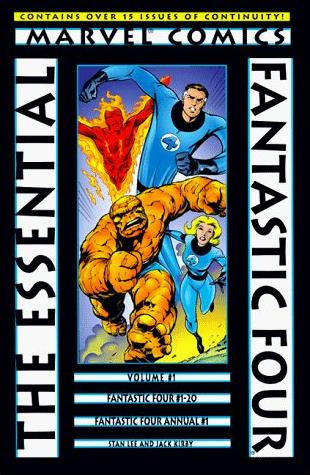
Essential Fantastic Four volume 1

I'm starting my look at the team books with none other than Essential Fantastic Four volume 1. This contains issues #1-20 & Annual #1 from the very original Fantastic Four series, right back at the start of the Marvel era of comics. Everything is credited to Stan Lee and Jack Kirby, with issue #9 onwards breaking down the credits as written by Lee and drawn by Kirby. Much ink has been spilled and many a keyboard hit in debate about just how much each contributed to the stories, not helped by both of them having poor memories and frankly not realising at the time just how much this was going to matter to some people. Forthcoming posts will feature more Lee/Kirby collaborations so please take it as read that this reflects the credits given on the original comics and/or in the contents pages of the volumes but doesn't drill into the finer detail on a murky matter.

It's no exaggeration to say that the issues in this volume are the foundation stone of the Marvel universe. The company may have been publishing comics since the late 1930s, and the Sub-Mariner might be a revival of one of their characters, and the Human Torch a reinterpretation of another, but it was here that Lee & Kirby rewrote the rulebook and presented a very different style of superhero comic from that which had gone before them. The success of this title led to many others, and the concepts would go on to fuel decades of creativity. It's also amazing that both creators lasted so long on the title and without any fill-ins - occasionally a writer or artist lasts on a title for over 100 issues but rarely completely uninterrupted and almost never two together (Brian Michael Bendis and Mark Bagley on Ultimate Spider-Man is the only other example I can think of). In some regards that could be a double-edged sword as Lee & Kirby left a very long shadow and many later eras did little more than rehash what the two had built. But that's a point for much later in the run. For now we're looking at the beginning of the house that Stan & Jack built.

From a perspective of over half a century later it's almost impossible to imagine what an impact this series had in 1961. Looking at Mike's Amazing World of Comics we can see the following other books were published by Marvel at this time. There were five monthly titles, all of which would later carry various superhero features:
  • Amazing Adventures (later Amazing [Adult] Fantasy)
  • Journey into Mystery
  • Strange Tales
  • Tales of Suspense
  • Tales to Astonish
And then there were eleven bimonthly books:
  • Gunsmoke Western
  • Kathy
  • Kid Colt Outlaw
  • Life with Millie
  • Linda Carter, Student Nurse
  • Love Romances
  • Millie the Model
  • Patsy and Hedy
  • Patsy Walker
  • Rawhide Kid
  • Teen-Age Romance
Science fiction, monsters, westerns, romance and teen comedy - it was a reasonable cross section of the wide industry though there were no war comics or funny animals, perhaps because of the limited number of titles due to the restraints of the distribution deal. Marvel's last real venture with superheroes had been a brief revival in 1953/4 when they brought back Captain America, the Sub-Mariner and the Human Torch but it was a difficult time for comics in general and superhero comics in particular with hysteria whipped up by a crusade against them. DC had kept the superhero flame alight through the lean years of the 1950s with Superman & Superboy, Batman and Wonder Woman continuing to headline titles and Green Arrow and Aquaman surviving in the back pages of one of them. Now they were advancing with several new characters and others reimagined. Marvel (in all its guises) had a history of following the latest trends and it would have been so easy to put out just another superhero book. But instead what came was somewhat different from before.

Reading Fantastic Four #1 at a distance of fifty-two years, it's easy to pick holes in the issue. The origin is firmly based in the space race, even if it slightly evades just what the target is beyond "the stars", and the Four's motivation for making such a risky flight is merely to get there before the "Commies". The idea that a scientist, his fiancée and her teenage brother would ever even consider going up into space with no training at all, or that an experienced pilot would contemplate taking them even if he does want to show he's not a coward, just doesn't ring true. Nor is the idea that a rocket can be so poorly guarded that four people can sneak aboard it, or that it would be launched and operated all by itself without any help from mission control. And then given what happens on that flight it's a wonder that Ben Grimm doesn't sue Reed Richards.

At its core Fantastic Four is about both the characters and the amazing adventures they have. Often attempts to imitate them fail precisely because they fail to understand the importance of both elements - it's not just about the Fantastic and it's not just about the Four. We are presented with a group of characters who were all tied together even before the fateful flight but who now function as a family, helping and caring for each other but also having many a petty argument and fight. It was probably this presentation of heroes as almost ordinary people that gave the series its edge at the time and has sustained it for so long. It's a further sign that they don't bother with secret identities and indeed both their names are often used almost interchangeable - Reed Richards or Mr. Fantastic, Sue Storm or the Invisible Girl, Johnny Storm or the Human Torch and Ben Grimm or the Thing.

Each of the Four has a different power and personality and they can't be easily swapped around to perform each other's function in the stories. They may be archetypes and they may resemble various characters who had existed before - not only was the Human Torch a complete reinterpretation of a character who had previously appeared in the Timely and Atlas eras (though here there is no mention at all about the earlier version), but heroes who can stretch and reform their own bodies had been around for twenty years, most obviously Plastic Man and then Elongated Man. But there aren't that many original ideas at all - the key is in the execution. In this regard Lee and Kirby succeeded quite well, creating three powerful distinctive individuals and strong banter between them. There's a real sense of how they each approach things differently, ranging from Mr. Fantastic's scientific approach to the Human Torch's joy at being an all powerful celebrity to the Thing's tragedy at being trapped in a deformed body. Well not actually trapped as quite a number of issues see him temporarily restored to human form, whether because Mr. Fantastic has developed a formula or because of a second exposure to the cosmic rays or because of the excess heat in Ancient Egypt - they quickly forgot about that one.

But there is a weak link in the chain and here it's the Invisible Girl. Whatever was done with the character and her powers in later years, at this stage she is very much window dressing, largely serving to ensure the team has at least one female member. Compared to the other three, her power to turn herself invisible - and that's all she can do with it at this stage - is frankly defensive and rarely crucial in winning the day. Indeed the second story in issue #11 sees the team addressing a number of points raised by readers (more on this below) including the perceived useless of the Invisible Girl. The response is given that she's a critical inspiration for the others and that at times she has been crucial, particularly in their first encounter with Dr. Doom. Later on in issue #17 Sue takes on Dr. Doom one on one and holds her own quite well, although again there's acknowledgement of her perceived weakness. However at other times she's all too often used as a hostage or someone to be lusted after - Namor the Sub-Mariner carries a torch for her whilst Rama-Tut tries to make her his queen. By the end of the issues in this volume the character still seems somewhat redundant and in strong need of an additional element to put her on a stronger footing for when the Four encounter their many foes.

The issues in this volume introduce many of the Four's famous villains including the likes of the Mole Man, the Skrulls including the Super Skrull, the Miracle Man, Kurrgo the Master of Planet X, the Puppet Master, the Wrecker (nothing to do with the later Thor foe), the Red Ghost and his Super-Apes, the Mad Thinker and his Awesome Android, Rama-Tut and the Molecule Man. Now not every one of these villains has aged well, with some of the powers and motivations seeming a little silly. There are some familiar concepts that would be recycled in many of the Silver Age Marvel superhero stories, such as an early encounter with an alien race who are trying to conquer the Earth but are tricked into thinking the humans are far more powerful than they actually are, or the rampantly evil Communist foes. There aren't too many of the latter but we also get occasional panels showing reactions to events in the Kremlin (with Kruschev himself appearing in shot, which is more than can be said for a scene with President Kennedy) and are left in no doubt that Communism Is Bad.

And of course there's Dr. Doom. His first two appearances demonstrate the flexibility of the character. In his first appearance he goes to tremendous efforts to capture the Fantastic Four and send them back in time to retrieve Blackbeard's treasure (in part because some of the jewels belonged to Merlin), then on his second appearance he uses his latest invention to pull the Baxter Building into space and send it into the sun with the Four and the Sub-Mariner all inside. In a later issue he starts threatening the United States with ruin unless... he's made a member of the President's cabinet. For a man with such resources his schemes seem quite limited at times.

Doom's rival as the Four's archenemy at this stage is none other than the Sub-Mariner, though the character is presented as a noble being with a different set of values to humans and with a good side, such as his obsession with the Invisible Girl. The character represented the first step in bringing back elements from the earlier era of Timely and Atlas comics, and it's surprising that this begins as early as issue #4. The Sub-Mariner's revival is incredibly simple. Johnny picks up an old comic from the 1940s and reads about him, then shortly afterwards the strong amnesiac in the hostel turns out to be the Sub-Mariner himself. There's no attempt to infodump two decades worth of continuity or even to explain just how and when he lost his memory. Nor are we given his origin. All readers need to know is given in just a few pages and it works.

The Sub-Mariner isn't the only pre-existing creation to appear in the series at this stage. Less well known is that mailman Willie Lumpkin had previously starred in a brief lived newspaper strip in 1960, though again the strip isn't referenced at this stage. And we also get a number of guest appearances by the stars of some other Marvel comics. Considering that not that many had actually been created by the time of Fantastic Four issue #20 we actually get rather a lot. One issue sees the team called in to deal with the Hulk, though it soon transpires the real menace is elsewhere. Another issue sees Ant-Man called in to help with shrinking (even though Mr. Fantastic has previously developed his own shrinking formula...) with the Wasp getting a cameo, whilst a back-up feature in the Annual presents an expanded version of the Four's encounter with Spider-Man from Amazing Spider-Man #1. That issue came out the same month as the Four's encounter with the Hulk and so between the two issues the concept of an integrated universe in which heroes regularly crossed paths beyond just specific team-up titles was being laid here. (Even at the lesser level we get other surprising introductions, with the newspapers the Daily Bugle and Daily Globe both first appearing in issue #2.)

We're also get the beginnings of the Four's widespread supporting cast, with Alicia Masters, the Watcher and the Yancy Street Gang all making their debuts within these issues. The Yancy Street Gang aren't too well developed at this stage but are recognisable as a gang of taunting bullies, though they have redeeming features such as when they help the Four hide while fleeing from the Molecule Man. The Watcher is deliberately kept limited and mysterious and there's no explanation given for why his race just observe the universe and rarely interfere. But by far the most important addition is Alicia. If you're ugly, the unspoken message of these stories is that you'll only be happy with a blind person. Alicia is introduced in issue #8 and it rapidly becomes clear she's drawn to Ben as the Thing and even prefers him that way (she's present when a formula of Reed's briefly restores Ben to his human form before wearing off), with the result that by issue #19 Reed is less concerned with finding a cure for Ben than with restoring Alicia's sight. The Mole Man has also found it impossible to live in society looking the way he does, with everyone rejecting him, and so withdraws completely in search of another civilisation, but Ben is luckier in this latter day rendering of the tale of Beauty and the Beast.

The series doesn't just introduce us to incredible beings but also takes the Four all over the Earth and beyond to many fantastic locations, ranging from the underground world of the Mole Man to the lost kingdom of Atlantis to the abandoned city on the Moon to the far off Planet X to the wonders of Ancient Egypt and more. All in all this series shows a strong degree of imagination compared to contemporary offerings from the likes of DC and even today there's a real sense of energy and excitement in these tales. There's the odd miss such as the introduction of the Impossible Man, an alien shapechanger with the mentality of a restless fun seeking child who is driven away from Earth by Reed successfully advising the whole world to simply ignore the creature - and remarkably everyone does. Luckily, the story only takes up half an issue.

As I said above, this volume is the foundation of the Marvel universe. That's not just because of the characters and locations introduced but also because of the whole style and approach. The heroes are presented as ordinary, fallible people who've had extra-ordinary powers thrust upon them, whilst the series doesn't operate in a vacuum but instead works with the other Marvel titles around it, giving a much greater sense of coherence to the whole line. But there's another step with the series acknowledging its position as ongoing fiction. Issue #10 has a daring scene featuring Lee and Kirby themselves (albeit with their features obscured), showing how they interact with the Four to bring their adventures to life. The following issue devotes half its space to the Four directly acknowledging their fan mail and answering many points and questions. Later on reader demand is explicitly given as the reason for redesigning the Fantasticar to look less like a flying bathtub. This was a bold move but it made the readers feel an involved part of the process and added to the overall sense of community that drew readers in and kept them coming back. Perhaps it became over familiar in later years when creative disputes spilled over into fan media and could damage the standing of titles, but at this stage it was a largely positive thing.

There's no point in denying that these adventures have their occasional lapses - for example what happens to the fourth Skrull in issue #2? Reed claims the Skrull is returning to another galaxy, but it looks like an attempt to cover up an oversight by the artwork. And from a modern perspective after all the food scares over the years one has to wonder if it was really a good idea to turn the other three into cows and leave them to produce milk and beef that would go into the human food chain. But it's the sort of thing that just didn't matter in the early 1960s. These stories are a product of their age but they are very much products that took that age and used it as a leaping pad, rather than just churning yet more generic adventures. For all their faults they show a real sense of dynamism and optimism, pushing at the boundaries of the convention of the genre and creating something new. That was why this series succeeded so well in 1961, that's why Marvel went on to become such a big player in the market but also that's why even today this volume is a highly enjoyable read.

Friday, 22 March 2013

Team Titles

Spider-Man has traditionally been a loner. Or so the legend runs.

In the last decade Spider-Man has found his way onto various teams, most notably the Avengers and the Fantastic Four. Some purists reacted with outrage but these were hardly unprecedented. After all the very first issue of Amazing Spider-Man saw him trying to join the Fantastic Four. Later in the 1960s he received invitations to join both the Avengers and the X-Men. The 1970s saw him sharing adventures with most of the Marvel Universe in the pages of Marvel Team-Up. In the early 1980s he hung around with the Defenders for a brief bit, long enough to qualify him as a "member" - the "non-team" status of the Defenders makes it impossible to say for sure who was and wasn't. Marvel Team-Up may have come to a close in 1984 but Spider-Man still found time to team up with many heroes in both his and their titles and he also served as part of ad hoc teams in various Marvel events such as Secret Wars. He came close to Avengers membership a couple of times in the early 1980s, but one time stopped himself and another time was vetoed be the government. Moving into the 1990s there were more events, plus he finally achieved Avengers membership only to resign it soon afterwards and subsequently became a reserve member. The same decade saw him as part of the brief lived "New Fantastic Four", then he went on a mission with the Secret Defenders (although that was even less of a permanent team, with groups selected for individual missions) and he even formed his own brief team, the Outlaws. Spider-Man might have ducked out of the 1997 relaunch of the Avengers and subsequently formally resigned his reserve membership but he kept on teaming up all over the place. Plus there was a brief return of the dedicated team-up book, first in the form of Spider-Man Team-Up and then a revived Marvel Team-Up which Spidey headlined for the first seven issues. The early 2000s saw the format tried again for Ultimate Spider-Man with Ultimate Marvel Team-Up. And then 2004 saw another Avengers relaunch, with Spider-Man a prominent part of the New Avengers, as was the original Spider-Woman. Looking back this wasn't such a break with the character's history as it might at first seem.

Team titles are reasonably well represented amongst the Marvel Essential output, with seven or eight volumes for each of the Avengers, Fantastic Four and Defenders, a whopping fourteen volumes for the X-Men (albeit split over two series titles) and even five for the 1980s team X-Factor. However some of the shorter running and/or less well-known teams from the 1970s & 1980s haven't yet been Essentialised such as the Champions, New Mutants, Alpha Flight, Avengers West Coast, Power Pack or Excaliber (in at least the case of the New Mutants this seems to be for technical reasons as the artwork on some of the early issues just doesn't convert to black and white at all well), though there are other trade paperbacks collecting some of their adventures. Of the Essential volumes out there, they generally haven't reached Spider-Man's memberships. But it's worth a look at the first volumes of each of the team series to see how they started out, whether the teams have a workable reason for even existing and just how suitable the members are. So over the next few weeks I'll be doing just that.

Friday, 15 March 2013

Essential Dazzler volume 1

Essential Dazzler volume 1 contains the title character's first appearances in X-Men #130-131, Amazing Spider-Man #203 and then issues #1-21 of her own series. Issue #1 was ground-breaking in its day as one of the first ever comics released solely in the Direct Market of print-to-order-no-return comic shops (as opposed to the newsstands that work on a sale-or-return basis), though later on the series appears to have been newsstand distributed as well.

The early Dazzler issues are written by Tom DeFalco who is succeeded by Danny Fingeroth for the rest of the volume. The first few issues are drawn by John Romita Jr, with help from Alan Kupperberg on one issue, before Frank Springer draws the rest of the run. The X-Men issues are scripted by Chris Claremont, co-plotting with artist John Byrne whilst the Amazing Spider-Man issue is written by Marv Wolfman and drawn by Keith Pollard.

The credits on her first issue include "Conceived by Alice Donenfeld, John Romita, Jr. and Jim Shooter with some help from Stan Lee, Al Milgrom, Roger Stern and Tom DeFalco." (Donenfeld was Marvel's in-house counsel and Vice-President of Business Affairs.) That's a lot of cooks around the broth. There are multiple accounts of the Dazzler's creation flying around on the internet and it's a little complex to work out which is correct, but Jim Shooter: The Debut of the Dazzler seems to be the account from the closest person available. The basic plan was to have a singer-superhero with a real-life singer doing promotional appearances. The tie-in failed to materialised and the character rested on the backburner whilst the disco scene started fading away, but there were a few guest appearances and eventually her own title materialised. I've previously written about the highly derivative nature of most female solo stars and it's a pleasing change to find one who isn't a female spin-off of an existing male character. However it's less satisfying that she's another mutant - Dazzler was an early example of an all too lazy approach to origins and powers whereby characters simply acquired them through the genes rather than more original means. By all means have many mutants as X-Men focused characters, but at this stage of her career (despite the location of her introduction) Dazzler was grounded in the wider Marvel Universe and deserved something more imaginative.

Judging by the slightly different cover designs used on issues #1 & #2, and the existence on the Marvel Comics Database wiki of a scan of the cover of issue #2 with the alternative design to the one reprinted here, I'm guessing that it was only the first issue which was released solely in the Direct Market and the series became available on newsstands thereafter. I'm in mixed minds about the way issue #1 was released, though the point is rather academic now. But in an era when large portions of comic readers did not have comic shops within easy reach of them, Direct Market only issues were thus out of their reach even if they had a good advance order and reservation arrangement with their newsstands. A pin-up in issue #2 carries at its base a notice of where to write off to in order to get a list of dealers who still had the issue in stock (which seems in incredibly slow and inefficient from the perspective of the internet era) - considering the huge numbers ordered for issue #1 (c420,000 according to some and the fact the series went to newsstands so quickly certainly suggests sales were high enough to support such a move) I'm sceptical that there was an actual shortage of copies in comic shops so perhaps Marvel quickly realised they had excluded a large portion of the fanbase? It was an early sign of the way that comics steadily became ever more inaccessible, selling to those dedicated enough and lucky enough to have access to a specialist comics shop, with many titles unavailable to the total audience base despite them being key issues for understanding crossovers and the like. Sometimes publishers would make an effort to keep the newsstands in the loop - there were some interesting one-shots that reprinted an issue of an otherwise Direct Market only title - but sometimes the readers there would be left with holes in the narrative. Oh sure there are all the issues about the economics of the two systems and the problems comics were facing on the stands, but there were times in subsequent years when it seemed the industry jumped too far in one direction. (I must admit to being a little biased as for most of my comic collecting days I have lacked a specialist shop in my hometown and it was only through the luck of having a season ticket for travel all over the nearby metropolis that gave me reliable access to shops and enabled me to really get into the habit.)

Dazzler has long been dismissed as a joke, a product of Marvel trying to leap onto a fad that was already fading by the time she debuted. Normally when it is noted that her series was outselling Superman, it's invariably to make a big point about DC's poor sales in the era rather than to highlight how well Dazzler was doing at Marvel. And when Essential Dazzler was announced there were many who joked that the title was a contradiction in terms. (In slight fairness the term "Essential" isn't the best for a series dedicated to long sequential runs of titles, but I guess that when the name was picked it was never realised the series would last for so long.) Others even declared their fear of embarrassment when buying the volume. Was this a remnant of the backlash against disco or was it a specific reaction to the character? Or was it perhaps the product of myths that had built up around her, often repeated by people who hadn't checked out the original series themselves?

In a way this volume is ordered almost by readership, or at least modern readership. The two X-Men issues are part of the Dark Phoenix Saga, one of the most celebrated storylines of this era of comics if not of all time, and amongst the most reprinted. Unfortunately whilst the artwork captures Dazzler's design pretty well and gives her prominence on the cover of #130, it's clear the writing brief was incredibly limited to "Disco singer with power to transform soundwaves into light". Nothing is given about the character's real name or background and she is ultimately rather incidental in two issues that are really focused on the steady development of Phoenix and the introduction of Kitty Pryde (who later took the identity "Sprite", then "Shadowcat"). The Amazing Spider-Man issue is slightly better as it's more standalone, though the villain is the rather forgettable Lightmaster and once again the writer hasn't really been briefed on the character, at times resorting to possession in order to cover the gaps in characterisation. The issue notably ends with Dazzler and Spider-Man in a very suggestive situation but it wasn't followed up. (This was the tail-end of probably Spider-Man's most crowded period with women, having in the space of a couple of years gone through a proposal & break-up with Mary Jane Watson, an affair with Betty Brant-Leeds, plus the introductions of Cissy Ironwood, the Black Cat, Debra Whitman and Marcy Kane. Maybe the time just wasn't right for Dazzler.) Instead the character faded away from the Spidey-scene, though she did later pop up in at least one issue of Marvel Team-Up.

But didn't I say above that Dazzler #1 sold 420,000 copies? That's the most common figure cited and whilst I don't know if that's an accurate report of the sales records or just a garden rumour passed around (though it's repeated by the-then Editor-in-Chief), it certainly seems impressive. But as a Direct Market only issue, it doesn't mean 420,000 people individually went and purchased an issue. Rather it means there were 420,000 sales at the wholesale level, on a no-return basis, including those that were over-ordered by retailers and just sat around gathering dust. And as an early DM only release (I'm not entirely sure if it was the very first - I've seen conflicting reports) it's possible that the comic shops mispredicted demand (or thought they had a potential investment from back issue sales at a significant mark-up) and over-ordered, as they did in later years with some of the record breaking issues. Nor do we know if there were many speculator collectors who purchased the issue and immediately stored it away in the expectation of its value increasing - again a common practice in later years. So I suspect the number of people who actually purchased & read the first issue at the time is somewhat lower than this headline figure suggests. And of course the comics industry has seen much turnover of fans so many since may have never read the first issue or any of the series at all. If they've encountered Dazzler's early days outside of this volume then it's most likely to have been through her X-Men appearances.

But even reading X-Men #130-131, Amazing Spider-Man #203 and then Dazzler #1-2 can still perpetuate one of the myths about the character. Because it's only really in these issues that the character is explicitly based around disco. (Fortunately the original plan to name the character "The Disco Dazzler" was dropped.) Afterwards she is a more generic singer who can and does take up work in all manner of genres. It's surprising that she doesn't change her stage outfit at any point in this part of her series, but her look had already been established by this time and visual continuity is often key in comics. Nevertheless there are often times when she doesn't stop to change and instead deploys her powers whilst in civilian clothes.

Dazzler's début story is split across two issues and full of guest stars. Is it really the best way to start a new series by having the lead character rescued from thugs by Spider-Man? Similarly in the fourth issue she doesn't escape from Doctor Doom at the end and it's only the arrival of the Human Torch that makes him flee. In the second issue the Enchantress strikes at a night club where Dazzler is singing and several pages are taken up with a battle between the Enchantress's demons and various members of the X-Men, Avengers, Fantastic Four and Spider-Man. It probably made commercial sense in 1980 to lure readers in with the established stars but it also means the title character is crowded out in her own book. She may not have a desire to go into the superhero profession - in the X-Men issues she turns down membership of the team after all - but that doesn't stop trouble finding her and we get other heroes either guest starring or cameoing in the following issues: #1, #2, #3, #4, #5, #6, #7, #9, #10, #11, #13, #14, #15, #16, #17, #18, #19, #20 & #21. The appearances range from brief scenes giving Dazzler help, such as the Beast doing some quick research for her in issue #5, to substantial interactions such as the two-part Hulk story in issues #6 & #7. (One particularly fun scene comes in issue #2 when chaos breaks out in a nightclub and Peter Parker races into the gents to change into his costume - only to find every cubicle taken by other heroes doing exactly the same thing!)

Similarly many villains from other Marvel series appear, including the Enchantress, Dr. Doom, the Enforcers (Fancy Dan, Montana and the Ox), Klaw, Terrax, the Grapplers (Titania, Screaming Mimi, Letha and Poundcakes), Dr. Octopus and the Absorbing Man. Throw in the presence of Galactus as well and it's a wonder there's any room to breathe. It's not until issue #8 that we get the first clear new villain (although there are generic gangsters and shady characters before that), the Techmaster. And although he's used twice, he falls into the trap of being motivated by revenge on an individual and it's often difficult to open out such characters into more general recurring villains. Unfortunately the next new villains, Johnny Guitar and Doctor Sax, are again seeking revenge upon members of the supporting cast and offer limited opportunities to be opened out into more general recurring foes. In spite of all this there's a concerted effort to keep Dazzler away from some of the conventions of superhero comics, with the real focus being on her developing her career as Alison Blaire and trying to keep her powers secret and away from the more standard heroics, but frequently this fails to stop many situations coming her way.

The aforementioned supporting cast is at least developed quite well into a rather diverse set as we meet the likes of record producer Harry S. Osgood, his secretary Cassandra Ferlenghetti, field manager Lancelot Steele, band members Beefer, Hunch and Marx, and young singer Vanessa Tooks. Away from the music industry there is Paul Janson, a doctor who meets Alison in hospital and dates her for a while before finding her disappearances too much, and Ken Barnett, a lawyer who successfully defends her from the charge of murdering Klaw. On the costumed front there's the Blue Shield aka Joe Cartelli, a crime fighter operating undercover within the New York rackets. Finally there's her family - her supportive grandmother Bella, and her hostile father, Cater Blaire, a judge who believes his daughter is wasting her life with music and should have followed him into law. It's nice to see a case of parental disapproval over two different career paths, instead of a career vs. being a housewife as seen with Ms. Marvel. Then at the end of the volume we meet Alison's long lost mother, Barbara London, in a touching story that explores the rifts in her family as Alison faces similar dilemmas that her mother did, but overcomes them differently.

At its core the series is about a young woman seeking to follow her own dreams and hopes, and not the expectations of those around her. Alison wants to entertain others, not follow her father into law or become a superhero in spite of her powers and the situations she regularly encounters. Consequently there's quite a bit of focus on her day to day struggles to raise enough money just to pay the rent and eat - with some hilarious results as she has to take what singing jobs she can get no matter how embarrassing - and her interactions with those around her. What's also noticeable is just how much of an independent woman Alison is and how little this has to be said explicitly. She's not clingy and dependent upon any man, expect perhaps her producer for signings, and nor is she constantly struggling to overcome expectations of her gender. She isn't a female derivative of an existing male character but is instead her own independent woman, defined by herself and no-one else. Despite the series being over thirty years old, this approach keeps the character fresh and the stories do not feel particularly dated for it. Some of the situations may be a little forced in order to bring Dazzler into contact with either the villains or guest stars, but she reacts like an ordinary person with extraordinary powers. This was the first ongoing solo series to headline a mutant character and we get some glimpses of the problems that would beset them in later years - the struggle to keep their powers secret from all around them despite the need to use them for safety, the hostile reaction of those they've saved and the difficulty in controlling their powers. This latter problem leads to a particularly dark moment when she confronts Klaw, a being composed of solid sound, and is unable to stop her powers from absorbing him completely. At a subsequent trial Dazzler is found not guilty but cannot expunge completely what happened. But the trial also brings the second of her three romances in the volume. In succession she dates Paul Janson, a doctor who bails out on her when he can't stand her disappearances - and he tries to avoid a confrontation by delivering the news in public at a restaurant - then Ken Barnett, the lawyer who successfully defends her and so who is aware of her powers from the outset. But then the Angel takes a shine to her and starts throwing his money around, as though he can simply buy his way into her affections. This leads to some tense moments, but his attempts to woe her do have their upside, as he becomes a strong support to her grandmother when Carter Blaire sinks into depression. The volume ends on a high note as Dazzler performs at Carnegie Hall, wins her father's approval, meets her mother again and finally dances away at a party afterwards.

When I first picked up this volume I wasn't sure of what to expect, given the longstanding mocking of the series. But the more I read, the more I felt that either the problems stem from material yet to come in the second volume (which collects not just issues #22-42 but also the graphic novel Dazzler: The Movie and the Beauty and the Beast limited series) or perhaps even from her later appearances after the series ended, or else Dazzler has been dismissed by generations of half-remembered points and myths. This series is not some over-ripe disco chasing nonsense but instead a good portrayal of a likeable and well developed character who aims to follow her dreams and not conform to the norms. Perhaps too many wanted her to conform to the norms and be a conventional superhero series, but instead we get something highly original. The artwork is good to even better, especially under Frank Springer, and the writing strong. Oh and her costume is a delight - it may have been dated even at the time, but it's a pity it was subsequently changed.

Sunday, 10 March 2013

Omitted material: Marvel Masterworks

As well as the Essentials, Marvel has two other major ongoing series of collected editions plus many standalone volumes. The oldest series are the Masterworks which have run on and off since 1987. These collect about ten issues on glossy paper in hardback and often have new masters created from the original comics (which has in turn allowed later collections access to high quality material that wouldn't otherwise be within the budget reach). So far there have been fifteen volumes of Amazing Spider-Man, taking the series up to issue #155, and two volumes of Marvel Team-Up, reaching issue #22. So far the Masterworks have taken a different approach to Giant-Size Spider-Man from the Essentials and would appear to be collecting it with Marvel Team-Up instead of Amazing Spider-Man, though this won't be fully confirmed until the release of a third Marvel Team-Up Masterworks.

However there is the odd other issue that the Masterworks include but the Essentials do not:

Marvel Super-Heroes #14 written by Stan Lee and drawn by Ross Andru, reprinted in Marvel Masterworks Amazing Spider-Man volume 8

Marvel Super-Heroes began life as Fantasy Masterpieces, a reprint title, but it for a brief period it evolved to add originated try-out features before reverting to all reprints. During this try-out period its best known launch was the original Marvel Captain Marvel. It also carried the odd piece from inventory...

A caption at the start informs us that this story was written and drawn as an emergency fill-in when it seemed that John Romita would be unable to meet a deadline due to a sprained wrist, however he managed to after all. Rather than just give the plot to another artist, an original story was devised, a reminder that the artists invariably contributed much more than just putting the actual pencil to paper. This story is something of an oddity, having been drawn relatively early in the Romita years to the point that some of the characters are a little off - Gwen Stacey's hair looks like it did in the #40s of Amazing rather than her more familiar straighter version and there's a touch of a Ditko homage in the look of Spider-Man. Ross Andru would later draw the character for a large chunk of the 1970s, and is in my opinion one of the most overlooked of Spider-Man artists, but here on the first attempt he had not quite captured the feel of the character. Perhaps that's why Spider-Man spends nearly all the story weakened by mental attacks and unable to move and fight in his usual manner.

The story itself would scream fill-in even without the caption at the start or the location of its publication. We get a battle against a rather forgettable villain with much of the setting away from the series's norm and with everything wrapped up by the final page. The tale sees a new villain called the Sorcerer deciding to test his power by destroying Spider-Man - "the most dangerous man of all". Using his honed mental powers and supporting electronic equipment he first weakens Spider-Man by imposing the thought of a mental illness on him, and then lures him to New Orleans for a battle with the Synthetic Man, a non-sentient creation controlled by him. However the Sorcerer was over clever and mailed a doll of Spider-Man to the post office in order to show who destroyed him, and it gets returned. The post man rings the doorbell during the fight and the noise alters the pitch, causing mental feedback which incapacitates the Sorcerer. The Synthetic Man abandons the fight and wanders into the sea, leaving Spider-Man wondering who was behind it all.

It's often all too easy to pounce on a fill-in issue and tear it to shreds when by definition it has to tread water and avoid making a lasting impact on the series. But this is a story rather detached from the Spider-Man norm in this era and it's something of a let-down that he never actually meets his foe. It may find a way to cover for a new artist's lack of familiarity with Spider-Man's movement and gestures but otherwise it's just the first in a long line of such stories that could so easily be ignored. This may be why it's been omitted from the Essentials (even though, as we've seen, later editions covering this era have added material overlooked the first time around) and given the higher price on the Masterworks this is not an issue to search high and low for.

Also in this volume are Amazing Spider-Man #68-77, which are in Essential Spider-Man volume 3 and volume 4.

Daredevil #103 written by Steve Gerber and drawn by Don Heck, reprinted in Marvel Masterworks Marvel Team-Up volume 2

This is to keep this listing complete as I've previously covered Daredevil #103 in both More non-essential Spider-Man Essentials and Essential Daredevil volume 5. It ties in with Marvel Team-Up #12 with both issues seeing Peter on assignment in San Francisco.

Also in this volume are Marvel Team-Up #12-22, which are in Essential Marvel Team-Up volume 1.

And that's all so far. At some point in the future I'll have a brief look at the Marvel Omnibuses.