Friday, 9 May 2014

Essential X-Men volume 2

Essential X-Men volume 2 originally contained X-Men #120-144. (The adjective Uncanny was formally added to the series's legal title from #142 onwards; however it had been present in the cover logo since #114 apart from the odd issue that skipped it, a practice that continued for many years afterwards.) Later editions have transferred Annuals #3-4 over from volume 3; however I'll continue the practice of looking at such material where it originally appeared. Chris Claremont scripts the entire volume with John Byrne drawing and co-plotting all but the final issue which is by Brent Anderson.

It's impossible to ignore the significance of the stories in this volume, representing the period when the X-Men broke out of being a niche cult title and became one of Marvel's biggest sellers. Much has been written about the "Dark Phoenix saga", which dominates all the different covers used for this volume, whilst this month sees the release of a movie version of "Days of Future Past". But there's a lot more than just those two tales within these pages. It's also a run in which there are a number of introductions, including a few that would go on to have their own series.

The volume kicks off with the debut of Alpha Flight, as the Canadian government (Pierre Trudeau appears on panel delivering orders to the now renamed Vindicator) tries to recover Wolverine through the deployment of its own team of superheroes. The team isn't explored in any great detail, but they show potential for future use, although how they explain the failure of their specially designed prison van to contain Wolverine isn't shown. Earlier they force the jet carrying the X-Men to Calgary, allowing John Byrne to draw his home city and show Canada as it really is, rather than cliched US stereotypes. Right at the end of the volume Alpha Flight (well half of them) reappear as Wolverine returns to Canada, with Nightcrawler in tow, in the hope of putting an end to their pursuit of him. They all battle the Wendigo in the northern Canadian wilderness - when has any hero gone there and not found the Wendigo? - before departing on good terms with Vindicator promising to get Wolverine's resignation accepted by the government. However upon returning to Ottawa, Vindicator is told by Trudeau that Department H and Alpha Flight are being disbanded, due to both costs and fears about superheroes. This serves as both closure to Wolverine's fugitive status but also opens up the possibility to use Alpha Flight as an independent team. (I'm also surprised that the comic managed to show Trudeau in person on this occasion as it was published just a couple of months after his surprise return to power. Imagine the mess if they'd drawn Joe Clark instead.)

Dazzler is introduced in issue #130 and I don't know whose idea it was to make her a mutant but it seems clear there was very little background developed for her beyond "singer who can project light" and her appearance here does little to flesh her out apart from establishing her as a mutant. It's not exactly a debut to set the world on fire. The preceding issue is more significant for the series in the long term as it introduces Kitty Pryde, an intelligent thirteen year old who is discovering the ability to become intangible. A young kid sidekick can go spectacularly wrong but here she brings a degree of optimism to the team as well as helping to restate principles as she learns them. However one problem comes from not nailing down a single standard name for her from the outset - she rejects the name "Ariel" (and so denies the opportunity to make endless jokes about washing powder) and instead adopts "Sprite" but she's just as likely to be called "Kitty Pryde" as anything else and the result can limit her ability to stay memorable. Still she is a breath of fresh air that reminds us of the ongoing mission to find and train mutants. Otherwise the cast broadly stays the same throughout these issues bar the formalisation of Phoenix's return and her subsequent death, the retirement of Banshee due to a throat injury, and Cyclops's decision to leave the team following Phoenix's death, though the final issue in the volume shows his continuous movements.

At the start the cast are still split, with Professor X, Phoenix and the Beast believing the others died in Antarctica and vice versa, and it takes several issues before they all finally discover they've all survived. In the meantime Cyclops is steadily coming into his own and also becoming more at ease with women, briefly dating Colleen Wing but when Scott and Jean discover each other is alive this doesn't cause too many problems. In the interim though I'm surprised Colleen puts up with Scott talking a lot about his ex, or for that matter she's one of several girlfriends captured by Arcade. The other romantic interests are less developed, with Colossus's feelings for Storm toned down to the level of adopted siblings, but Kitty develops a crush on him and in a glimpse of the future they are shown as married. At another level Professor Xavier and Lilandra find themselves on opposite sides when aliens from across the universe assemble to tackle the Dark Phoenix, and although it isn't spelt out they seem to have effectively separated.

Guest appearances are surprisingly limited here, and mainly confined to those from either previous Claremont-Byrne collaborations or earlier issues of the X-Men. Cyclops may briefly date Colleen Wing from Power Man and Iron Fist but otherwise there are few of note. Spider-Man turns up at the start of an issue to try and warn the X-Men that Arcade is back, having clashed with him during the Claremont-Byrne run on Marvel Team-Up, and the final issue, post-Byrne, sees an appearance by the Man-Thing, whose last solo stories had been scripted by Claremont. Meanwhile the Beast, Havok and Lorna Dane all show up for the duration of the Proteus storyline, and later the Angel gets caught up in the Dark Phoenix saga and never quite leaves. Ice-Man's sole appearance is at Jean's funeral.

With more epic length story telling the foes battled in this volume are limited but usually either new to the series or assembled in a new grouping. Early on the team battle Proteus, Moria MacTaggert's mutant son who can warp reality and take over bodies whenever his current one burns out, and then later they come up against the Hellfire Club, a fictionalised version of the real world club Its "Inner Circle" includes various foes including new ones such as Sebastian Shaw and Emma Frost and returning ones such as Mastermind, under his real name of Jason Wyngarde. Later on the X-Men fight a new incarnation of the Brotherhood of Evil Mutants. Led by Mystique, previously seen in Ms. Marvel, the team includes the Blob and three new mutants - Destiny, Pyro and Avalanche. Mystique offers further mystery when Nightcrawler finds her familiar but she just tells him to ask his mother. There's a couple of foes from other series, with both Arcade and D'Spayre brought over from the pages of Marvel Team-Up where they'd been introduced by the same creative team. And then there's Senator Robert Kelly, a potential Presidential candidate who is pushing towards legislation that would introduce controls on mutants, with the horrifying prospect of where that could lead. It's a reminder that not all threats come in costumed action form.

Nor do they always come from the opposite side. For by far the best known storyline in this volume involves one of the X-Men going rogue. The "Dark Phoenix saga" has been referenced many times and adapted for both television and film. It's easy to see why - it's a tale of an ordinary(ish) person gaining ultimate power and eventually going out of control with devastating consequences. At the time there hadn't been that much exploration of the ultimate danger inherent from superheroes but here we get a tale of corruption, redemption and sacrifice. The storyline is steadily built up with Jean slowly corrupted by the power of Mastermind, who has no idea of what he's unleashing. The resulting Dark Phoenix is a scary demonstration of all the worst potential, going on a destructive course, lashing out at those closest to her and even casually destroying a whole solar system. And just when it seems as though Jean has been saved and the Phoenix side of her locked away, the wider universe come to execute her, forcing the X-Men into a duel with the Imperial Guard in which it becomes clear that Phoenix is not as confined as thought. Ultimately Jean does the only thing she can to permanently end the threat and commits suicide, showing humanity triumphing over the corruption of power. She was by no means the first comic character to be killed off, but in the past this had usually happened at the end of a title's run or else when a character had been confined to limbo for years. To kill off such a key part of the team, one who'd been around almost continuously since the team began seventeen years earlier, was an incredible move. The impact on the rest of the cast is shown in subsequent issues as characters' thoughts frequently turn to Jean/Phoenix. In the wider industry it helped to put X-Men firmly on the map.

However it's "Days of Future Past" which is inevitably the storyline that will attract the most attention at this precise time. It follows the classic time-travel plot of going back in time to alter the future for the better. But here we get a dark vision of the future that in 1980 was much closer to reality than many may now realise. The United States has become a brutal police state, with most technology breaking down and civilisation slowly sinking into brutal primitivism. The population has been brutally classified into multiple groups, with strict controls on breeding. Mutants are set apart, mostly confined to designated areas, and are forced to endure terrible suffering. This may have been presented as a world 33 years into the future, but it has clear similarities to the contemporary situation in apartheid South Africa. The brief history that Kate Pryde tells the X-Men reinforces the metaphor with a number of subtle parallels to the history of how apartheid was steadily introduced and "justified" as a response to whipped up fear. The scenes really personalise the impact with moments such as a row of gravestones with familiar names, the desperate struggle of recognisable albeit aged faces, and the horror as they are rapidly cut down. And whilst Kate's mission was successful in preventing the assassination that is believed to have started the chain if events, we're never actually shown what the resulting future now is, just a single page in the present suggesting that the Sentinels will be revived and deployed anyway. That helps to reinforce the uncertainty and fear for the long term and helps to reinforce the elements of bigotry and oppression that have hitherto been underused in the series.

The following issue, #143, also feels like the inspiration behind a film, albeit a very different one. A decade before Kevin McCallister found himself Home Alone and had to fight off intruders in the house at Christmas, Kitty Pryde had to do exactly the same thing. The issue also feels like a homage to Alien with the N’Garai demon resembling the alien whilst Kitty herself resembles a young Sigourney Weaver, desperately racing through the mansion to find some way, any way to defeat the creature. In the process she causes no end of expensive damage, but it's a key rite of passage for the character.

And this volume represents a major passage for the series. Between the dynamic art of John Byrne and the intense, thoughtful scripts of Chris Claremont, the result is a complex series that maintains strong, well-defined characters at its core and puts them through a complex and varied set of situations that try and test them immensely. Some of the storylines are better known than others, but taken together they show good ongoing development, in which all the characters are steadily built up. Not all their pasts are revealed at once - in particular elements about Wolverine such as his adamantium skeleton and revelations from his past are only dropped in as and when they come up - but the overall result is that all the X-Men continue to feel like real people and the reader wants to keep reading to find out what happens to them. By the end of the volume Claremont has been scripting the series for fifty issues, a surprising achievement already, even before one considers how long he would go on for. Such long runs often give a title a good degree of stability that help to refine it when the original take on the concept has floundered or got lost in a sea of ever changing creative teams who each try to change everything before moving on. Here it works wonders and so finally X-Men was a title that was here to stay for the long run.

Thursday, 8 May 2014

Guest appearance omissions: Transformers #3

Today is the 30th anniversary of the launch of the Transformers. So let's take a look at the first time their path crossed with Spider-Man's...

For a particular group of fans, one of Spider-Man's best-known guest appearances was in the early issues of the original Marvel Transformers series. However it's very unlikely to ever appear in the Essentials, not least because a different company now hold the licence to the title property. But it has had several other reprints in this century, including Transformers: Beginnings from Titan Books a decade ago and more recently in the second edition of The Transformers Classics: Volume 1 from IDW Publishing.

(Unfortunately the vagaries of copyright and licensing have meant it hasn't always been possible to include it in Transformers reprint series. The Titan volume of about a decade ago had no problems, but IDW were initially unable to secure licences for Marvel-owned characters and so had to replace the issues with text summaries in their first edition.)

Back in 1984 the Transformers were a new toyline with Marvel the first to portray their adventures. A four-issue limited series was commissioned; however it proved so popular it rapidly converted to an ongoing series without even resetting the numbering and eventually ran for a total of eighty issues plus a few spin-off limited series. (Over here Marvel UK ran their own series, reprinting the US stories but in order to fill the faster schedule many new adventures were produced that weaved in and out of the continuity. There were also reprints of other Marvel series as "back-up strips"; one of these reprinted Amazing Spider-Man annual #19 albeit rebranded as Iron Man of 2020, reflecting the more prominent role of the guest star.) The third issue of the limited series saw a guest appearance to help boost the franchise's profile.


Transformers #3, written by Jim Salicrup and drawn by Frank Springer

(Although Salicrup is credited as the writer on this issue, by all accounts it was a very difficult series for writers to get to grips with, going through three writers in four issues and editor Bob Budiansky had to outline it all. When the ongoing series began he switched to become the regular credited writer; however he was effectively the uncredited co-writer of the earlier issues and deviser of much of the basic franchise mythology.)

This issue picks up on the kidnapping of human mechanic Sparkplug Witwicky by the evil Decepticons, who hope he can convert Earth fuel into a form the robots from Cybertron can use. Sparkplug is tortured into agreement. Meanwhile the presence of giant robots on Earth attracts the attention of both the army and the media, including Peter Parker. Changing into Spider-Man he discovers the heroic Autobot Gears who convinces him of the Autobots' good intentions. Spider-Man and the Autobots work together to first penetrate the military cordon around the Decepticons' fortress and then whilst the bulk of the Autobots create a diversionary attack, Spider-Man and Gears sneak into the fortress and take the remain Decepticons inside by surprise, rescuing Sparkplug. With a plane to catch, Spider-Man takes his leave as Gears reveals Megatron got what he wanted from Sparkplug...

On reflection this is one of the fastest paced issues of the original Transformers limited series, with the emphasis very much on action whether the battles between the Decepticons and the military or the Decepticons and the Autobots, or the desperate rescue mission. It's an odd choice to pick Gears as the Autobot Spider-Man spends most time with - true Gears is one of the few who can fly but he's also one of the smaller Autobots and not one of the strongest, making him an unlikely winner of the physical fights here, plus he's got a grumpy personality and a dislike of humans which doesn't make for the best of banter. Would it have been too much to use one of the more chatty Autobots like Bluestreak? Or for one-on-one physical combat a better choice for the rescue might have been Brawn. But the most logical choice overall would have been to have Spider-Man team up with the Autobots' leader, Optimus Prime. Gears and Spider-Man manage to overcome the Decepticons they encounter rather too easily for my liking, including encasing the Decepticon leader Megatron in webbing. This really does feel like a set of extremely unlikely victories, even if they do have surprise on their hands.

Spider-Man is written in classic form, though it's easy to envisage this story without his involvement. For this issue he was put back in his alien costume despite having relinquished it a few months earlier in his own titles - apparently this was to appease the Transformers' toy company Hasbro who were concerned about an appearance by a character whose toy was produced by a rival so they used the costume that the Mattel  Spider-Man Secret Wars toy didn't have. The need to win over Hasbro to include him probably explains why it's easy to imagine this story without his involvement. However he brings a sense of both fun and the wider Marvel universe to the series (and let's just ignore the continuity problems that Transformers would later brush over on this point). Spider-Man is also drawn well, but the Transformers suffer from a lot of art and colouring problems (yet another reason for a black & white reprint).

Broadly there are two ways to draw the Transformers - either as poseable versions of the toys or as stylised versions called "character models" devised for their fictional appearances that don't always resemble the toys too closely. This issue sees a big step towards the comics using the character models exclusively but some of the characters have been drawn or coloured using earlier versions of the models - Megatron's appearance on the cover is the most obvious example - and a few such as Frenzy and Rumble have moments when they look more like their toys. A lot of the characters are also drawn awkwardly with weird and variable proportions plus some over heavy inking. There are also many times when the colours are at variance with the most familiar versions even within the comics themselves, making it sometimes difficult to recognise which character is which. Just to add to the problems some of the characters would be consistently coloured with a different scheme from the toys and/or the cartoon - Ratchet, Skywarp, Soundwave, and Starscream are all noticeably off-colour sufficiently consistently in the issue for it to not be a colourist's error. Ratchet and Starscream would eventually switch to more familiar colours (although it took Starscream some years) but the other two would keep theirs, presumably because of the problems of printing black as a colour under Marvel US's system forcing a much greater use of blue than on the toys. And there's the earliest example of a background appearance of a character who shouldn't be there when Shockwave appears in a couple of panels.

Overall this is a good, if superfluous, Spider-Man appearance and a pretty fast paced Transformers story but it's rather let down by the poor rendering of most of the Transformers and the inability to keep the colours consistent on some of them.

Dick Ayers (1924-2014)

Artist Dick Ayers died this week. He had just turned 90.


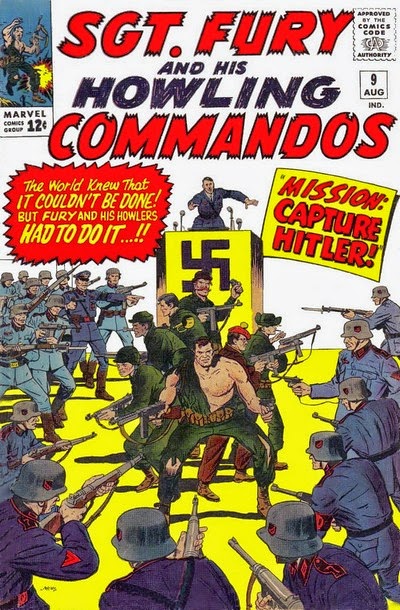
As well as often inking, most notably over Jack Kirby, he pencilled many issues of many different titles over many decades. His greatest work was probably Sgt. Fury and his Howling Commandos, which Corporal Ayers drew for ten years.
Reviews of various volumes containing his work can be found on the Dick Ayers tag.

Friday, 2 May 2014

Essential X-Men volume 1

This month sees the release of X-Men: Days of Future Past and so it's time for an extended look at the X-Men's most acclaimed era...

Essential X-Men volume 1 collects Giant-Size X-Men #1 and X-Men #94-119, featuring the early days of the X-Men's mid 1970s relaunch as the All-New, All-Different X-Men. (As we've already seen, issues #1-93 have since been covered by Essential Uncanny/Classic X-Men volumes 1, 2 & 3.) The initial Giant-Size issue is written by Len Wein and drawn by Dave Cockrum. Both carry forward onto the regular series but almost immediately Chris Claremont takes over the writing and continues for the rest of the volume (and over a decade more after that) with a few issues seeing Bill Mantlo give plot assistance. Midway through Cockrum is succeeded by John Byrne. There are a couple of fill-ins drawn by Bob Brown and Tony DeZuniga. The reprint of the Giant-Size issue includes three reprints of back-up features profiling Cyclops, Ice-Man and Marvel Girl written by Roy Thomas, Arnold Drake and Linda Fite respectively and all drawn by Werner Roth.

(It's a little known point but Giant-Size X-Men had a second issue as well, published some four months later. However by this stage the Giant-Size line had switched to all-reprint titles before being eventually phased out a couple of months afterwards. Giant-Size X-Men #2 reprinted X-Men #57-59.)

This was the very first Essential volume to be released back in 1996 and unsurprisingly it does several things differently from its successors. Most obviously it starts reprinting the X-Men from the 1975 relaunch rather than the original 1960s series; later Essential runs such as Doctor Strange, Man-Thing or Silver Surfer have started from the original series and collected subsequent revivals under the same banner. The cliffhanger ending from issue #119 was left out of the original printing but restored early on. And the reprinted material in Giant-Size X-Men #1 has been included whereas most subsequent Essentials have left out reprints unless they've been directly incorporated into the narrative. (On a much more minor note the first editions of the original 1996 volumes - this plus Essential Spider-Man volume 1 and Essential Wolverine volume 1 - have the name on the spine running upwards whereas all later volumes and editions use the more conventional downwards.)

Giant-Size X-Men #1 is one of the most reprinted of all Marvel issues and quite possibly the post-Silver Age record holder. (Mike's Amazing World of Comics lists ten complete reprints plus one truncated, and that's just in the North American market. Discounting one as a cover variant that's still an amazing haul and several reprints ahead of obvious rival contenders such as the first appearances of Thanos, the Punisher, Wolverine or Venom.) The story is to the point, if a bit low key, but does manage to successfully introduce all the new characters. Not much has changed since the ending of the earlier run bar the Beast going out into the world and Havok and Lorna Dane now being an integrated part of the original team and more clearly an item now. Otherwise things are pretty much where they were left. Wisely the story places the emphasis on the new characters and reintroduces the premise through them as Professor X takes an interesting journey around the world, recruiting both new and old characters to assemble a replacement team. With fourteen characters and just thirty-six pages there's not much space to detail them all, but it soon becomes clear that the team has some dysfunctionality. Oddly in light of where he'd go, Wolverine is rather subdued and it's Sunfire who fulfils the angry loner role. I do also find Banshee's dialogue to be overstereotyped and keep wondering when he's going to start getting drunk and rambling on about little people just to complete the role. All in all the issue succeeds in injecting new blood into the series but doesn't offer a great deal of excitement to suggest an ongoing series would be more dynamic than the last time around. That would come later.

The new X-Men are an interesting mixture of both existing and new creations, with a strong international mix. It takes some time for all their powers to be explicitly identified and highlighted and their backgrounds to be filled in, but the diversity is clear from the outset. We have Nightcrawler, a German circus performer with blue fur who can climb walls, teleport and even disappear in the shadows. A few of these elements are familiar from the portrayal of the Beast, but Nightcrawler comes with a very different personality, combining fun loving with great insight and loneliness. Storm is introduced as a Kenyan goddess who can control the weather but we subsequently learn of her upbringing from being the daughter of a transatlantic middle class marriage to being an orphaned street thief in Cairo to her long journey on foot to Kenya. Colossus is a Russian farm boy, loyal to his family, both his birth one and his new adopted one. Banshee had previously appeared as a villain in the series's original run but here the Irishman follows in the footsteps of the Mimic and becomes another to find redemption; despite being older than the rest of the team he still fits in. Wolverine is something of a cipher at first and only slowly is his background revealed; we know from the outset that he's a Canadian government agent from his battle with the Hulk but only gradually do we learn other things about him such as that his claws are part of his body and he has learnt to speak Japanese well, but there's no exploration of his family life and past the way there is with so many others. Sunfire doesn't last long though he pops up again at the end of the volume; his background had been sketched at the end of the original run where we saw a young Japanese man torn between his father and uncle representing the debate on the country's post war direction. Finally Thunderbird is a brash, self-confident Native American Apache who resents the direction his people have taken and seeks to prove himself as a tough fighter in the old tradition.

The X-Men's adventures continue from issue #94 onwards with new material rather than a brand new issue #1, a reminder of how the older practice of retaining numbering wherever possible was still prevalent. However the series rapidly puts itself in a forward direction, starting with the departure of all the original team bar Cyclops, leaving an almost all-new, all-different team. With Sunfire also leaving, having only ever agreed to perform a single mission and Thunderbird killed off at the end of issue #95, the team is reduced to a manageable six field members plus Professor X guiding and mentoring them; a size that allows for the individual characters to be developed and focused upon at a time when the series was bimonthly and had as little as seventeen pages an issue. The Beast, Havok and Lorna Dane (now using the codename Polaris) all make brief reappearances in subsequent stories (presumably the Angel and Ice-Man were too busy with the Champions of Los Angeles) and on two separate occasions the new X-Men face what appear to be the original team members, right down to the Beast's original look, but they are in fact constructs of one kind or another.

However it's Cyclops who is the one classic member to stay around though Marvel Girl drifts back into the team. Cyclops is very much his traditional self but gets some development as well, with his powers enhanced (most clearly symbolised by a new and larger visor) then later more of his past is revealed as we learn how he was orphaned and the revelation that Corsair of the Starjammers is his father, though Scott only guesses at this after their initial meeting is over. There are also steps forward in his relationship with Marvel Girl but then comes her great transformation that also changes how he relates to her such that when he believes her dead there is no great mourning. Marvel Girl's transformation into the Phoenix after she pilots a space shuttle back to Earth and acquires enhanced powers is one of the best remembered moments during the run and there are already signs of how the excess power is changing Jean Grey in multiple ways, making her the most powerful member of the team but also distancing her a little. Professor X also comes to believe his students have perished and this sends him into deep grief but at the same time he and the alien Shi'Ar princess Lilandra are developing their feelings. We also get more of Xavier's past as we learn of his youthful romance with Moira MacTaggart and then his travels around the world as he discovered not all mutants use their power for good. Whether new or old, every member of the team gets given some strong material that fleshes them out and makes the reader care about what happens to them.

The series has ambition, as shown with the Shi'Ar storyline that takes the team into outer space and introduces a large number of characters, but the emphasis is very much on characterisation. Combined with dynamic art that starts well with Dave Cockrum and hits amazing heights with John Byrne, the scripting by Chris Claremont brings to life each character, makes them distinct from one another but also makes the reader care about what happens to them. It's easy to see why the title soon became a cult favourite even if it wasn't engaging in the big crowd pleasers that could draw in a wider audience. Other than the Shi'Ar storyline most of the foes encountered by the X-Men are either return appearances or fairly mundane foes. Except for the Beast briefly returning to his roots there are no significant guest stars. And there's also less of the two big themes that have dominated X-Men in most other eras with only limited attention devoted to how society reacts to mutants whilst the school element is either downplayed or confined to off-panel events as Professor X and Cyclops work to mould the group into a coherent team who function together - a necessity driven home in their second encounter with Magneto when initially every charges in as an individual and gets beaten down in likewise manner.

These battles bring in a variety of foes amidst a period of creativity. The old foe list includes the likes of Magneto, the Sentinels (under a new controller), the Juggernaut, Sauron, Mesmero and Count Nefaria, all from the earlier X-Men issues. There's also the Ani-Men (from Daredevil), Firelord (from Thor), Warhawk (from Iron Fist), Garokk and Zaladane (both from Ka-Zar's strip in Astonishing Tales) and Moses Magnum (from Giant-Size Spider-Man). Amongst new creations are Black Tom Cassidy, Banshee's brother now working with the Juggernaut, the Entity, Professor X's dark side, and Kierrok the Damned and the N'Garai night demons. The Canadian agency Department H makes its first appearance as it dispatches Weapon Alpha (later the Vindicator then Guardian) to try to retrieve Wolverine. The Shi'Ar story introduces a variety of characters including foes such as the Emperor D'Ken, a new wearer of the Eric the Red costume and the Soul Drinker. And there's the Imperial Guard, a thinly disguised homage to the Legion of Super-Heroes (who had been drawn by Cockrum whilst at DC) and the interstellar pirates the Starjammers. These issues must have been a nightmare to drawn with so many new characters, and even more so as Byrne took over from Cockrum mid story.

The series may be highly dynamic but there are, however, some areas where the series feels dated, particularly some of the dialogue that exaggerates accents with Banshee suffering particularly badly though others got caught up as well, including a cameo by Jimmy Carter. The portrayal of Ireland also raised my eyebrows with everything from a post office sporting the crown symbol to passenger steam trains in the late 1970s and I kept expecting someone to start going on about the little people. Then a bunch of leprechauns showed up.

In spite of these odd moments the volume as a whole represents a triumphant return to form for the X-Men. Rather than merely bringing back the existing team for more of the same, a bold move was taken to transform the team for a new generation of readers and it works. Given strong characterisation and dynamic art and the result is a strong series that just grows and grows. This is a very strong volume and (leaving aside the issue of jumping over the Silver Age run) it's truly worthy of having been the very first Essential volume to have been released.

Friday, 25 April 2014

Essential Hulk volume 6

Essential Hulk volume 6 consists of the Incredible Hulk #201-225 & Annual #6. Bonus material includes Official Handbook of the Marvel Universe entries for Jarella and the Constrictor. The writing on the regular series sees the end of Len Wein's run and the start of Roger Stern's plus scripting contributions by Gerry Conway and Chris Claremont and plots from Herb Trimpe and Jim Starlin. The art is mainly by Sal Buscema with individual contributions by Herb Trimpe, George Tuska, Keith Pollard and Jim Starlin. The annual is written by David Anthony Kraft and drawn by Herb Trimpe.

When going through the previous Essential Hulk volumes I had concluded that Herb Trimpe is the best Hulk artist yet, but here Sal Buscema more than gives him a run for his money and I may have to reassess the accolade after seeing the rest of the latter's run. As well as handling the ever diverse cast and settings with ease, Buscema captures the full range of the Hulk's emotions from angry brute to kindly, sympathetic child. The Hulk is a tormented soul, often just trying to find peace and tranquillity, and he can be very kind and caring to those he had befriended. It's a tricky task to depict the diverse characterisation of him but Buscema achieves it quite well. The writing is on an upswing, bringing a number of adventures that give both Bruce and the Hulk some strong character moments as well as providing excitement and action.

The greatest tragedy comes early on when the Hulk and Jarella are finally reunited, first in her world where they're set to be married. However they then get transported back to Earth and the slide now containing the atom upon which Jarella's world is located is destroyed. The couple seem set for a life of happiness on Earth, with Jarella used to the transformations between Bruce and the Hulk, and the monster in turn more responsive. But it's not to be as in a battle with the Crypto-Man Jarella dies saving a young child's life. This sends the Hulk into an even more angry rampage than usual, leading to a fight with his fellow Defenders, before Doctor Strange tries and fails to restore Jarella to life. In spite of the comfort offered by the other Defenders, the Hulk has never seemed more alone as he walks away crying.

Whether as Bruce or the Hulk, subsequent encounters with women fail to fill the gap left. Bruce tries to settle some more permanent roots by renting a flat in New York where he attracts the attention of his flirtatious landlady April Sommers who helps him find a job in construction. However April gets ever more suspicious of Bruce, with the complication of the return of the flat's previous tenant, magician Kropotkin the Great. Eventually Jim reveals that Bruce is the Hulk, but April is nearly won over by Bruce's assurances that he has the Hulk under control - until the transformation is triggered. Elsewhere the Hulk encounters a group of circus performers who have escaped the Circus of Crime, and especially befriends a sea nymph called Meriam; however she cannot survive long out of water and eventually he agrees to return her to the sea. It seems that the Hulk will never get the peace and companionship he desires.

And another couple find that the ever after isn't always so happy. Glenn Talbot has now had his mind restored but is a changed man who feels guilty about the grief he's brought to Betty and wishes to find himself. Consequently he and Betty split and go away separately. She decides the time has come to step out of the shadow of the various men in her life and to establish herself as her own woman, settling in a distant unnamed city and undergoing an extreme makeover. Meanwhile her father continues his military work, aware of how often things have gone round and round with the Hulk and other monsters, but still persisting in his mission.

The series has a rather odd time travel story in issue #204 where Bruce's attempt to cure himself of the Hulk results in his being sent back in time, seemingly taking the place of his younger self. This time he made it to a protective shield and so escaped the gamma bomb, going on to a life married to Betty - but Rick died in the blast and Bruce is haunted by both this memory and his time as the Hulk. Eventually his guilt overwhelms him to the point where he opts to go back in time and restore things to how they were. As with many time travel stories there are huge questions over just how the process works and just what memories of the past are retained. Early in the story Bruce and Jarella seem to be under the impression they will still be together in spite of removing the Hulk, but this doesn't come to pass in the resultant future. Nor is it clear whether Bruce has possessed his younger self's body, Quantum Leap style, or if he's somehow removed his younger self from the picture. And as in many a tale, the time traveller retains his memory of the original timeline when he arrives in an altered future. The whole story feels like a rushed filler, which it may well be as it's drawn by a returning Trimpe instead of the regular Buscema, and doesn't really reinforce the long term concept that Bruce will sometimes accept that getting rid of the Hulk isn't always the most important goal. Indeed at the end of the volume when it seems Bruce has been cured purely by means of a natural burn off of his body's gamma radiation, it's Doctor Samson who ultimately turns Bruce back into the Hulk to fight the leader, rather than Bruce himself succumbing to the argument for this course of action. However Samson may come to regret both this and his calling the monster stupid to provoke the right reaction as the very last panel of the volume shows, now that now the Leader is seemingly destroyed, an angry Hulk turns on Samson.

There's a good mixture of foes throughout this volume with some new creations. Although only one has had much impact in the Marvel universe, another may have had an influence elsewhere. The new foes start off with Kronak the Barbarian, a thinly disguised knock-off of Conan the Barbarian, the ruler of a sub-atomic world the Hulk passes through en route to Jarella's world. Then there's the Quintronic Man, a giant robot controlled by five different men (maybe the forerunner of the Transformers Special Teams). And there's a horrific encounter with "Billy", a human child mutated by radioactive waste into a cannibal, who lives in a cave with his brother and sister and consumes other humans. But the biggest new creation is the Constrictor, another in the long line of supervillains with a battle suit and a gimmick weapon, here the use of electrically charged adamantium cables. 

As well as the new creations, there is a horde of foes from other series, starting with Dragonus, a warlock previously seen in Werewolf by Night. The Crypto-Man had made just one previous appearance in Thor and so it seems rather unworthy that such an obscure foe should be the one to (indirectly) cause Jarella's death. A team-up with Doctor Druid brings conflict with Maha Yogi, previously the "Merlin" who fought both Thor and the X-Men in the Silver Age; this story also affords the opportunity to establish him as a phoney who impersonated the real Merlin. Maha Yogi is now accompanied by his henchman the cosmic gladiator Mongu, previously seen in Fear. Later at sea the ship Bruce is on is attacked by the pirate Captain Barracuda, first seen in the Human Torch's strip in Strange Tales. And of course there are return appearances by established foes such as Psyklop, the Absorbing Man, the Rhino and the Leader. There are also encounters with other heroes, albeit from the less well-known end of the Marvel universe. As well as the Defenders, consisting of Nighthawk, Valkyrie, the Red Guardian and Doctor Strange, and Doctor Druid already mentioned, there are appearances by both the Jack of Hearts and Stingray. Meanwhile the annual brings a one to one team-up with Doctor Strange to battle the Hive, originally seen in Fantastic Four, and their new creation Paragon, a product of the same cocoon that birthed Adam Warlock.

Although the writing shows an uptick in maintaining excitement and momentum, there's also the curse of the long running subplot that takes forever to be resolved. In issue #208 an ill and amnesiac man is found in the desert near the now-renamed Gamma Base. Over subsequent issues he fails to recover his memory but instead sneaks into a key laboratory. It's not until issue #223 that the man is revealed to be the Leader, infiltrating the base in order to launch his plan to conquer the world. Though the story itself is strong and makes for an exciting climax to the volume, the subplot drags on for far too long given just how much actual development it contains and tellingly is not actually resolved until a new writer has taken over.

The last handful of issues in this volume coincided with the launch of The Incredible Hulk television series, Marvel's first, and to date the longest lasting success with live action television. Running for five seasons and then three latter day "reunion" television movies, plus no end of reruns, The Incredible Hulk brought the character to much wider public attention for many, many years, However there were some notable changes to the origin, the character's name and the absence of his traditional supporting cast. The television series did have a slight impact on the comics by spurring the creation of She-Hulk, whose debut issue showed signs of the television influence, but in the main series there's no sign at this stage of any changes to match the screen - no change of the name to "David Banner" or any appearance by Jack McGee, although the reporter's quest simply wouldn't work in a comic book series where Bruce's survival and identity as the Hulk is publicly known. Nor is there any sign of the classic line "don't make me angry. You wouldn't like me when I'm angry."

At this stage the main sign in the comics world of the Hulk's growing profile would come in ever more appearances on the newstand, thanks to a mixture of his second title Rampaging Hulk (although its launch predated the television series by some months) plus appearances in Defenders, Marvel Team-Up (where he occasionally displaced Spider-Man as the lead star), Marvel Two-in-One (where the Thing was luckier) and the occasional Marvel Treasury Edition, plus various reprints. He wouldn't be the first or last character to be spread all over the racks, but rather than the multiple ongoing current titles Spider-Man now had, the Hulk was diversified with past set series, team appearances, guest appearances and one-offs. Consequently the character was not being excessively used in the same way as the wallcrawler and so a single creative team controlled his direction and fate.

And one development is a slight uptick in the Hulk's intelligence level, remembering more names and forming more complete sentences in order to better interact with those he encounters. It's to the comic series's credit that it didn't mimic its television counterpart and switch to an inarticulate version of the monster, but instead developed him a little more to open up the story possibilities. It's a subtle process with no great event causing a transformation, but the result is definitely an improvement for the better. So too is the general trend of the series, as ever putting the Hulk through a wide variety of situations but also emphasising the character in both human and monstrous form. The result is one of the better Essential Hulk volumes.

Friday, 18 April 2014

Essential Hulk volume 5

Essential Hulk volume 5 contains the Incredible Hulk #171-200 & Annual #5. The first eight issues are written by a mixture of Roy Thomas, Gerry Conway and Tony Isabella, before Len Wein begins a lengthy run, also plotting the annual with Chris Claremont scripting. The art covers the end of Herb Trimpe's long run and the start of Sal Buscema's, with the latter drawing the annual. Bonus materal includes the Official Handbook of the Marvel Universe entry for Hammer and Anvil, and an early version of issue #174's cover.

The series has by now settled into a clear pattern for the long run with a string of generally rather flat adventures as the Hulk wanders from location to location, with occasional exceptions either because of a particularly strong situation or antagonist, or else because of a good ongoing storyline, usually involving Thunderbolt Ross and/or Betty. This volume features some spectacular highs but also some more turgid moments. It also shows an ever greater use of the wider Marvel universe.

There are quite a number of guest appearances by both heroes and foes from other series, as well as some big developments for a few of them. Early on, the Hulk briefly teams up with the Juggernaut and crosses path with Professor X, Cyclops and Marvel Girl as they search for the missing X-Men. Then in an story actually entitled "Anybody Out There Remember... The Cobalt Man?" a long forgotten X-Men foe reappears before the series moves on to another encounter with the Inhumans. Following that, issues #176-178 are the conclusion to the first Warlock saga, another example of using the Hulk's series to resolve storylines from cancelled titles, but one consequence is that the Hulk himself feels like a guest star in his own series, a situation not really changed by a few pages showing the continuation of one of his subplots or by issue #175 setting up his return trip to Counter-Earth. However, it does contain a surprising moment when, in a storyline culminating in an issue cover dated August 1974, two intrepid individuals investigate corruption in the White House. At the end an unassuming man finds himself President, an office he did not seek and having to both prove himself and bring hope to the nation. Soon life imitated art. Meanwhile the Hulk returns to our Earth and soon has probably the best known encounter in this volume.

Issues #180-181 see the Hulk in the Canadian wilderness, once more fighting the Wendigo at a time when it had not yet become a cliché that this is all that ever seems to happen in the Canadian wilderness. But then at the end of issue #180 comes a new combatant, Canada's first superhero - Wolverine. Reading his appearance here I'm amazed that he went on to such fame as there's not much sign of the character traits that would make him so popular. Rather he's just a plucky little fighter who holds his own with his skills and agility against two giant forces of nature.

The Hulk goes on to encounter some of the foes from Marvel's pre-Silver Age "Atlas" monster era, beginning with Kaa, a warlord from a parallel dimension previously seen in Strange Tales who now briefly possesses the Hulk's shadow. Later on the annual sees duplicates of Diablo (from Tales of Suspense), an alien made of smoke, Taboo (from Strange Tales), a monster made of muck and mud, Groot (from Tales to Astonish), a being comprised of living wood, Goom (also from Tales of Suspense), a renegade alien from Planet X, and Blip (also from Tales to Astonish), a being comprised of electricity. Also present is the real Xemnu, first seen in Journey into Mystery. Between the regular series and the annual we get one of the first clear incorporations of the Atlas monster era into the regular Marvel canon. Meanwhile S.H.I.E.L.D. make increasingly frequent appearances in the series, culminating in the assignment of Agent Clay Quartermain as a permanent liaison to the Hulkbuster Base. Elsewhere the Hulk encounters the angelic Glorian from the Fantastic Four, the Locust, another forgotten foe from the early days of the X-Men, then meets both the old Avengers foe the Collector and the Man-Thing.

New foes are slighter on the ground but include Hammer and Anvil, two escaped convicts bound together by an alien, with the added tension that one is a racist white and the other a black man. Then there's the Devastator, a Soviet agent of the renegade Gremlin, but he gets killed off in his first full appearance. The Gremlin has a less human agent in the form of Droog, his pet monster. On a smaller scale is Jaimie Macawber, a Scottish laird trying to protect a beast in the local loch because of the tourist income it brings, but in the end both he and the monster are turned to stone and continue to generate the income.

Issues #184 to #186 are partially familiar to me from an aborted reprint run in Marvel UK's The Incredible Hulk Presents back in 1989. This weekly series was a courageous attempt at an anthology and combined 1970s Hulk stories (as well as these, #133 & #134 were also reprinted) with an adaptation of Indiana Jones and the Last Crusade then Indy's Marvel US series, Action Force/G.I. Joe the Action Force reprints from G.I. Joe Special Missions, and brand new adventures of Doctor Who. I guess the series must have made sense to someone at the time but looking back it was a very odd combination of strips, coming out as Doctor Who was about to go off the air for an extended period (and rather than trying to lure in the Doctor Who Magazine readership, the plan was instead to reprint the Hulk adventures there until the DWM editor vetoed this as he felt the stories were the wrong tone and would interfere with attempts to give the DWM strip its own direction), whilst Marvel UK seemed to run Action Force in so many different places it was as if they'd were stuck with a licence that was either so over-expensive that they needed every chance to recoup their money or else on that mandated a quantity of toy promoting appearances that the market just couldn't support. The adaptation of a hit adventure movie should have been a strong selling point for the series but it was given rather less publicity than one might expect, leaving the title with a rather limited appeal and poor publicity drive. It only lasted twelve issues, ending partway through the reprint of #186. Consequently readers were left with a cliffhanger of the Devastator about to go into action, and it took over two decades to see the resolution.

The main storyline the issues show part of is rather long winded, starting back in the previous volume and not being fully resolved until the final issue in this one. Major Glenn Talbot had been lost in the Soviet Union when on a mission to rescue Thunderbolt Ross, but subsequently escapes and makes it back to the States. Everything seems fine except Colonel Armbruster thinks something is wrong and eventually discovers the truth - Talbot is a living bomb sent to assassinate the visiting President. Armbruster dies and Hulkbuster Base is subsequently destroyed by the Devastator, but then it's discovered that Talbot's body was an impostor with a mind transfer. The real Talbot is recovered in a further mission into the Soviet Union but has the mind of the Soviet agent whose body was used for the aborted assassination. The Gremlin destroy the mind and so Talbot returns home catatonic, his mind seemingly lost forever. Eventually it's restored by probing his brain to destroy a mental block in one of the silliest issues of all in the volume.

Issue #200 starts with the encephalo-helmet, which is one of the biggest plot conveniences imaginable. It simply appears in the series as a way for Bruce's mind to control the Hulk, with no prior mention. As it gets destroyed midway through its first appearance it cannot disguise its purpose as a narrative shortcut rather than an actual plot development that will allow for Bruce to control the Hulk. The issue is a very weak ending to the volume as the Hulk is sent into Glenn Talbot's brain to remove a mental block and restore his mind. By this point the saga of Talbot has well and truly worn out its welcome and it's a relief just to see it finally resolved in any way at all, but the ideas involved seem ludicrous. The mental block is manifested as a physical creature inside Talbot's brain, with antibodies forming themselves as copies of various past foes and tense allies. Being both the 200th issue (even though it's in number only) and the fourteenth anniversary of the Hulk's debut, there's an attempted celebration of the whole run, also shown by the cover which is used for this volume as a whole. But the pseudo-appearances are so fleeting that they become little more than name checks. This issue came out a couple of years before Marvel began the practice of increasing the size of anniversary and/or special issues, and so there are just eighteen pages to accommodate everything. Perhaps it was simply too ambitious in trying to pack so much into such a small amount of space, but the result is deeply unsatisfactory.

Despite the dragged out and poor ending, the main parts of the storyline are amongst the best issues in the volume, showing how to do the Hulk well and they were a worthy choice for The Incredible Hulk Presents all those years later, regardless of that title's wider problems. Elsewhere there are less successful showcases for the series. The annual comes from 1976, a year that saw Marvel restore both the format and original material after some years of reprints and/or Giant-Size quarterlies. Unfortunately it shows all too well why many are critical of them. The story is completely inconsequential and forgettable, simply pitching the Hulk against a succession of five duplicates of Atlas era monsters before a showdown with the real Xemnu, also from the Atlas era but previously revived in the pages of Defenders. We get not much more than a series of fights in which each monster's weakness is quickly exposed. Both plotter Len Wein and scripter Chris Claremont have produced some fantastic material in their time but here is evidence that every great creator has some off days. Even Sal Buscema's art feels under par, despite normally producing magic no matter how pressing the deadline; this is perhaps a consequence of Jack Abel inking rather than the regular series's Joe Staton.

The Hulk himself has slightly evolved by this volume, retaining his classic childlike persona but showing a greater degree of innocence and willing to help those who have never threatened him. Throughout these issues he is shown to befriend and help a number of non-threatening individuals, either when he stumbles across them or else because they actively ask his help. This shows some signs of the character developing but at the same time he is restricted by his poor memory, having problems remembering in detail his past encounters with foes such as Xemnu or the Abomination. At the same time there's a sight softening of Thunderbolt Ross's attitude to the Hulk, realising that the monster has at times been of help and yet the military are still hostile to him, particularly Armbruster. However this only goes so far and Ross often finds himself in situations where there is no option but to take action.

All in all this is yet another middling volume, with occasional flashes of greatness amidst a more general continued run. I've said so many times what I think the core problem is so I won't repeat it, but it does show itself once more here. The main excitement comes in the middle of the volume and coincides with the early part of Len Wein's run, but the volume sinks back as that run continues, suggesting all the good ideas were used at once. The result is a rather average Hulk run.


Friday, 11 April 2014

Essential Hulk volume 4

Essential Hulk volume 4 is made up of the Incredible Hulk #143-170. The writing is in a period of transition with the end of Roy Thomas's run, then runs by Archie Goodwin and Steve Englehart, with other issues plotted and/or scripted by Gary Friedrich, Len Wein, Gerry Conway, Steve Gerber and Chris Claremont. The art is mostly by Herb Trimpe with some contributions by Dick Ayers. Bonus material includes the Official Handbook of the Marvel Universe entry for the Shaper of Worlds.

Whilst the art throughout this volume continues to be strong, cementing Trimpe's reputation as one of the greatest Hulk artists, if not the greatest of all. However the writing meanders a lot, not helped by the high turnover of scripters, and the result is a somewhat turgid volume even though there are some developments. A key strand in the early issues is the Hulk's quest to be reunited with Jarella and they do briefly achieve it twice, first when she's transported to the full-size world and later when the Hulk journeys back to her world with the help of both an experimental version of Ant-Man's shrinking formula and the mysterious Shaper. This in turn helps drive a final wedge between Bruce Banner and Betty Ross, with the result she turns fully to Glenn Talbot and marries him. Betty and Talbot's wedding is a rare one in superhero comics in that it's not interrupted by villains and monsters. Instead it proceeds smoothly whilst the Hulk is on Counter-Earth, where his counterpart is married to Betty and they have a son. It's a glimpse at what might have been had Bruce made the trench and not been exposed to the gamma rays all those years ago.

Counter-Earth and Jarella's world are two of a number of locations visited by the Hulk on his travels throughout the volume. Others include the depths of the ocean, a city in the sky and Canada. The latter is depicted primarily as a wilderness in which a monstrous beast roams. Curiously it takes the strip a while to realise that sur Québec, la principale langue parlée est le français ni l'anglais. So the Mounties all speak English mais un groupe de bûcherons parlent français. Still it helps to emphasise that the Hulk is abroad.

Meanwhile back in the States there are a variety of developments surrounding Thunderbolt Ross and the military. A dedicated military base and unit is established for the purpose of tackling the Hulk. Initially named "Project: Greenskin" it is subsequently renamed "Hulkbuster". General Ross is generally a subdued rational man throughout the volume but can succumb to his own anger at times. But at other points he's realistic enough to realise the Hulk isn't always the greatest threat. Indeed at one point when both he and Bruce are captured it's Ross who realises that the only way to escape is for Banner to become the Hulk. However the plan only partially works as the Hulk hates Ross too much to stop to free him. As a consequence Ross is subsequently transported to the Soviet Union and only subsequently freed by a covert operation. However in the process Major Talbot is shot and assumed dead, though actually survives as a prisoner behind the Iron Curtain. His assumed death has a devastating impact on Betty, who believes she's gone from being a bride to a widow in the space of a mere month, and she succumbs to anger and more.

There's less material for Jim Wilson beyond a scene where his girlfriend confronts him about trying to hide the Hulk at her house and makes it clear she expects to be married to Jim, a level of commitment that he wasn't prepared for. It seems to be a way of phasing Jim out of the series but it does succumb to the cliché of depicting young women as just waiting to be married and only giving them independence in so far as they force the issue. Of the other supporting cast, Doc Samson is also phased out as loses the gamma radiation that has enhanced his body and strength. However another recurring character is introduced in the form of Colonel Armbruster, who takes over the command of Project: Greenskin during first the absence and then enforced vacation of Ross.

There are a number of new foes encountered in these pages but few have had much lasting impact. Amongst the less remembered are the Horusians, aliens who have replaced with champion conflict by giant creations on Earth and their creations include the Sphinx and a stone Colossus. Then there's Fialan, an assassin from Jarella's world sent after her to Earth by Visis, or the Inheritor, another of the High Evolutionary's creatures, this one having evolved from a cockroach. In an initially more human form is Senator Morton Clegstead, the main political backer of Project: Greenskin, who believes the Hulk's blood can cure his cancer but it instead mutates him into a gigantic blob. There's a surprising for its time (and writer) use of Soviets as enemies, although the strip does take subsequent steps to establish the main villains as rogue elements with the regular authorities only acting once their hands have been forced. The main rogue element is the Gremlin, the revenge-seeking son of the Hulk's very first foe, the Gargoyle. Out at sea the Hulk comes across Captain Omen and his gigantic submarine that is a self-contained world. The homage to Captain Nemo and the Nautilus in the Jules Verne novel Twenty Thousand Leagues Under the Sea is all too obvious. But there's an element of horror, both in the form of the half-man half-fish monster Aquon who has been created by Omen, but also in the fate of the second generation crew who have evolved to work at the deep pressures of the oceans' depths and who find their bodies exploding at the surface pressures. Elsewhere the Hulk fights Zzzax, a living energy being whilst a visit to Sky Island, the former home of the Bird People, leads to a clash with the Bi-Beast, a living monument left to commemorate the race now it has passed on. The final issue sees the Hulk and Betty on a strange island inhabited by giant aliens.

Amongst the foes who would have a more lasting impact is the Shaper (of Worlds), a being with the power to alter reality but without the imagination to create for itself who has instead given reality to the dreams of Nazi scientist Otto Kronsteig, giving a glimpse of a New York overrun by Nazis and where Kronsteig is eventually transformed into the Nazi ubermensch "Captain Axis". On another level is the Wendigo, the first fictional use of the beast from Algonquian legend who will go on to be a regular feature of many Marvel stories set in the Canadian wilderness. But by far the nastiest of foes is the Harpy, the mutated form of Betty Banner Talbot after she succumbs to anger at the apparent death of her husband, blaming both her father and Bruce Banner for the Major's death. She succumbs to the suggestions of Modok and is exposed to gamma radiation, transforming her into a vicious creature resembling the harpies of Greek legend. I forget just how many times the main romantic interest in a series has been transformed into a monster to fight the lead character, but here there's a real sense of hurt and pain driving the fight, and Bruce finds he has no choice but to sacrifice a chance to rid himself of the Hulk once and for all in favour of curing Betty.

There are also a few first appearances in this series by foes from elsewhere, most notably Doctor Doom who encounters the Hulk for the first time in the opening issue. Later the Hulk makes his first visit to Counter-Earth where he clashes with Kohbra, another of the High Evolutionary's creatures previously seen in the pages of Warlock. Back on Earth, he fights with Tiger Shark from the pages of Sub-Mariner. The series also sees return appearances by familiar foes such as the Leader, the Abomination, the Rhino, the Chameleon, Hydra, Visis, Modok and A.I.M.

There also a number of appearances by other heroes, including the aforementioned Ant-Man. When the Hulk is captured in New York, by a combination of Nick Fury and S.H.I.E.L.D., Captain America and the Fantastic Four, he is soon put on trial with his lawyer none other than Matt Murdock (Daredevil), with various Avengers called as witnesses and Mr Fantastic supplying what seems to be a way to turn the Hulk back into Bruce Banner so as to give evidence but which actually empowers the Hulk enough to escape. Issues #150 & #161 continue the practice of using the series to tie up loose ends from cancelled titles. The former issue spotlights Havok and Lorna Dane from X-Men as Havok discovers the hard way he needs more training for his powers whilst the romantic triangle between the pair and Ice-Man is seemingly settled in Havok's favour. It's a brief tale that manages to tie into the ongoing storyline as the Hulk's search for Jarella draws him to Lorna as a green-haired woman. Later on issue #161 is part of the Hulk's adventures in Canada and ties in with the conclusion to the Beast's exploits from Amazing Adventures, as the latter's journey northwards concludes with an encounter with the Mimic, whose powers are getting out of control.

But whilst other adventures are being wrapped up, the Hulk's are ongoing and the pattern for them has now been largely settled as he wanders the Earth, and occasionally the rest of the universe, in search of peace and tranquillity, whilst Bruce Banner searches for a way to cure his other self. The military search for the Hulk in an attempt to restrain or destroy him whilst various villains seek to use him for their own purposes. Looking at this more and more, I think the basic core problem is the over-simplistic nature of the Hulk's personality that results in some rather stilted interaction with those around him, whilst Bruce Banner's role is often minimalised either by the short period between transformations or by the limited resources around him. Consequently the series is often weak when it's unable to get much great action out of the Hulk himself. The problem is further compounded by the changing writers with the results that the character's motivation can change at times - he's willing to help save a woman's brother from the Wendigo because he doesn't want to be blamed for things he hasn't done, yet at other times he just doesn't care what the world around him thinks so long as he's left alone. His memory is weak such that he can't always recall the details of his past encounters with various foes. Add in the very child-like dialogue and the result is a character that's hard to enjoy at times. It would be much better to give the Hulk a strong degree of intelligence and memory, allowing for much greater character interaction and development, or else to shift the focus to the Hulkbusters' pursuit of him and present events through their eyes. Alternatively a sidekick who actually goes all over the place with him would allow for development to take place in another way. But the approach here of focusing on the Hulk in such an oversimplistic depictment just hampers the character and at times makes the series tough to wade through.

So in spite of having some developments amongst the Hulk's supporting cast, this volume is a return to what has been all too typical of the series so far - a great idea squandered by inconsistency and uncertainty as to how to depict and develop it in practice. And it's surprising just how easy it is to pinpoint the problem. There have been times when this can be made to work - so far the best has come under Roy Thomas - but it requires a dedicated writer who lasts for a good while. When left to a fast turnover of writers the result is all often too formulaic adventures that expose the problems inherent in the formula. This is not one of the best Essential volumes.


Friday, 4 April 2014

Essential Hulk volume 3

The Hulk reviews have been especially popular so all this month I'll be looking at further volumes.

Essential Hulk volume 3 consists of the Incredible Hulk #118-142 plus Captain Marvel #20-21 and Avengers #88. The first couple of issues are written by Stan Lee who gives way to Roy Thomas who writes everything else in the volume, with Harlan Ellison plotting the Avengers crossover. All the Incredible Hulk issues are drawn by Herb Trimpe, with the Captain Marvel issues by Gil Kane and the Avengers issue by Sal Buscema.

Of all the Essential Hulk volumes reviewed so far, this one does the best job of taking what can be a highly restrictive format and finding ways to make it work. We have the basic traditional theme of Bruce Banner wandering the country and world, changing into the Hulk when stressed, and pursued by the military but there's a good diverse mix of story types, augmented by more nuanced characterisation, particularly of Thunderbolt Ross. There are also some interesting attempts to expand the Hulk's universe with some key first appearances. And there's a concerted approach as Bruce Banner makes numerous attempts to cure himself of the Hulk once and for all with mixed results.

In the process we get brief glimpses of many of the combinations of mind and body that would appear over the years. As well as the standard Bruce/savage Hulk combination we also get a period when Bruce's mind and body have been totally suppressed by the Hulk leaving just the beastly form. Then there's a brief point when the reverse happens and Bruce has seemingly conquered the Hulk for good, though it doesn't last for long. Indeed at one point it seems that Bruce willingly reverses a cure out of desperation at seemingly losing Betty Ross to a rival, though the exact moment of restoration isn't shown leaving it open to speculation Bruce gains control of the Hulk's body at times, most notably in Jarella's world. And there's even one story when Bruce and the Hulk are separated, though it soon becomes clear they can't survive independently for long. The only obvious absentee from this line-up is the Hulk's mind in Bruce's body but the reasonably fast pace of these tales means that this is only noticeable when tallying up the various incarnations.

Just as diverse are the locations in the series, with the Hulk turning up in multiple places across the world and even elsewhere in time and space. As well as many part of the United States, from the south western deserts to California to New York and Florida, we also see Atlantis, the kingdom of Namor, Subterranea, the underground realm of Tyrannus and the Mole Man, Morvania, a poverty stricken Mediterranean country run by a dictatorship (it makes a change from some in Latin America), outer space to tackle a comet and later to battle an energy creature, inner space where the Hulk enters the sub-atomic world of Jarella, the Dark Dimension, and the Western Front of the First World War. It makes for a good mixture of adventures that put the Hulk into many different situations and show just how diverse and flexible the character can be in the right hands. This creativity can also be seen elsewhere in these issues.

This rune see the introduction of a number of new foes, although many of them haven't risen to great heights of fame, including Mistress Fara, an Atlantean trying to replace Dorma in Namor's affections, the Glob, a monster created by the spillage of toxic waste in the swamps and one who predates many other swamp beasts and/or toxic origins, Mogol, an agent of Tyrannus whom the Hulk befriends before discovering he's a robot, Raoul Stoddard, a university contemporary and rival of Bruce's who now tries to seek the fame of killing the Hulk, Draxon, the dictator of Morvania, Klaatu, an energy creature in space, Xeron the Star-Slayer, an alien sent to destroy Klaatu, Cybor, the captain of Xeron's vessel, Psyklop, an insectoid scientist, Visis, a rival for Jarella's throne, Doc Samson, a psychiatrist who tries to steal the Hulk's gamma energy and also wins Betty's hand, and a new incarnation of the Valkyrie, based on feminist socialite Samantha Parrington. There are also first encounters with several foes from other series including the Absorbing Man, Hydra and Kang the Conqueror, plus return battles with the likes of the Leader, the Abomination, Tyrannus, the Sandman, the Rhino and others.

Amongst the existing supporting characters developments are somewhat mixed, with Major Glenn Talbot being much the same as ever, loyally supporting his seniors and secretly bemoaning how the prospect of curing Bruce of the Hulk will end any chance Talbot has with Betty Ross, but he never particularly acts on this. Betty gets a bit of material as at one stage she and a seemingly cured Bruce are to wed in her family home, with Bruce believing he has the Hulk under full control. However Betty winds up being effectively jilted when the intervention of the Leader and the Rhino cause the full savage Hulk to return. Later on she is subject to horror when the Sandman is seeking a cure for a crystallisation process and forces a doctor to perform a full blood transfusion with Betty which leaves her turning into glass until she is cured by the Hulk's gamma radiation. But it's the portrayal of General Thunderbolt Ross which stands out the most. There is little of the Hulk-hating caricature he can sometimes descend to and instead he's portrayed as a determined but reasonable man who seeks to deal with the threat of the Hulk with as little collateral damage as possible. He is quite civil and sincere in his dealings with Bruce, recognising the scientist is often the best hope and also has Betty's heart, and the preparations for the aborted wedding go well. Even Jim Wilson is treated reasonably, suggesting the old general is mellowing.

The aforementioned Jim Wilson is one of a couple of interesting new supporting characters introduced here. Jim is a streetwise teenager from Los Angeles living in the burned out remains of an apartment block where his parents died, and he befriends the Hulk as a fellow outsider, rapidly taking on the Rick Jones role as Rick is now busy as the alter-ego of Captain Marvel. Jim is highly resourceful, especially when it comes to sneaking through military cordons or sabotaging the Leader's mental projection equipment to turn a weapon on its user, and there's strong potential whilst his background is sufficiently different that he doesn't come across as just Rick Jones Mk 2 with black skin. Meanwhile issue #140 sees the Hulk enter a sub-atomic world where it seems he is trapped forever but he soon finds romance with the ruler of the green-skinned people Jarella. By fighting off the monsters attacking the city the Hulk is hailed as a hero and Jarella takes him as a consort. A spell to grant him the power to understand her language has the side effect of giving Bruce's mind control over the Hulk. In the space of less than an issue it seems as though Bruce has at long last found peace and tranquillity, settling in a world where he can control his monstrous form and is respected, and Jarella makes for an interesting contrast with Betty, a strong ruler in her own right. However Bruce is soon pulled back to his own sized world, and the again savage Hulk is left with memories of Jarella, little realising the sub-atomic world exists on a particle of dust on his trousers.

The Hulk is also still part of the wider Marvel universe and has many encounters with other heroes throughout his wanderings. As well as the crossover issues with Captain Marvel and the Avengers, the Hulk's own series sees him encounter Namor, the Fantastic Four, the Avengers (here consisting of the Black Panther, the Vision, Quicksilver, the Scarlet Witch and the second Goliath), Iron Man on his own, and the Phantom Eagle. Issue #126 begins the practice of using the series to finish off storylines from other series that had been cancelled; a role later taken on by some of the team-up titles and other books. Here we get the finale of Doctor Strange's struggle with the Undying Ones and the Nameless One, with the introduction of the Nightcrawler for good measure. The story ends with Doctor Strange retiring (temporarily as it turns out), adding to the sense of closure. Though the partnership of the Hulk and Doctor Strange would prove highly important in the long run, not least because the pair would go on to be the core of the Defenders, at the time this storyline feels something of an intruder from another series. As we've seen with some other Essential reviews, the Incredible Hulk would prove a popular choice for resolving storylines from cancelled series. Meanwhile the epilogue to another partnership comes in the crossover with Captain Marvel as Rick's new ally battles the old one. The Avengers crossover is more spurious, merely serving as a means to project the Hulk into Jarella's world but not really justifying itself - any distraction could have caused the Hulk to shrink far more than expected and the Avengers are teleported away with no memory of their recent battle so it doesn't seem likely that the crossover was of much significance to that series either.

The crossover is, however, plotted by Harlan Ellison, one of the earliest cases I'm aware of where comics recruited a big name writer from outside the medium. This is also a very early example of creator promotion both Avengers #88 and Incredible Hulk #140 bill Ellison's involvement on the cover. However the former issue has the credit as "Story by Harlan Ellison (That means he conceived the plot!)" and "Adaptation by Roy Thomas (That means he wrote the dialogue!)". I doubt there was a strong need to educate readers about how the writing credits on comics are broken down so was this perhaps trying to reconcile a more traditional screen credit with the comic format or was this perhaps trying to paper over disputes that might have arisen if a big name writer had failed to write something appropriate for the series brief? I'm not aware of the circumstances of the story's creation but Ellison has had some other high profile disagreements over the years. Whatever the reasoning the result is another injection of ideas into the series. The main regular writer, Roy Thomas, also comes up with a lot of good ones and seems to have got a strong grasp on how to handle both Bruce and the Hulk to maximum effect. Stan Lee's final few regular issues come at the start of the volume but they're fairly mundane, featuring repeat clashes with Namor and Maximus. They're not the best note to go out on, but often long runs limp to the end. Meanwhile Herb Trimpe's art is amazing. This volume covers much of the first half of his lengthy run on the series and of the three volumes so far he's been easily the best artist on the series. He may be the definitive Hulk artist of all time - his main rivals' work is yet to come - and is certainly an obvious contender for such an accolade.

Given the combination of two strong talents for such an extended run, the result is that the Hulk is finally getting an extended classic run. It's often been asserted that the Hulk was never regularly interesting before Peter David came along and did things completely differently from how they'd been handled before (and that didn't start until issue #331) but in the case against that charge this volume is easily Exhibit A. The issues in this run don't have any obvious stinkers but instead display a strong level of dynamic imagination vividly brought to life. This is the classic way to do the Hulk properly.

Friday, 28 March 2014

Essential Captain America volume 5

Essential Captain America volume 5 comprises Captain America and the Falcon #187-205 plus Annual #3 and the Marvel Treasury Edition special Captain America's Bicentennial Battles. The early issues see writing by John Warner, Tony Isabella, Frank Robbins, Bill Mantlo and Marv Wolfman, and art by Frank Robbins and Sal Buscema. Then from issue #193 onwards everything, including the annual and special, is written and drawn by Cap's co-creator Jack Kirby in his mid 1970s return to Marvel. Bonus material includes Kirby's original pencils for the covers of issues #197, #198 & #199.

The first six issues show the book in a state of extreme creative mess. Frank Robbins's artwork is poor and at times veers into caricature, whilst the high turnover of writers results in no clear direction. Just to add to the mess the issues are trying to mop up after the ridiculous revelations about the Falcon at the end of the last volume that showed him to have been a gangster transformed by the Red Skull into the ultimate sleeper agent. Following a rather unusual form of shock therapy the result is that he remembers both his gangster and hero days but he feels as though he is two persons in a single body. The exact ramifications of this are not explored as well as they should be, so it's unclear just whether he now has a split personality or else the two personas have somehow merged or if one has triumphed over the other but retained both sets of memories. The result is an awkward and unsatisfactory arrangement that's at risk of falling into a mess with future writers unfamiliar with what's planned or just how Sam has reconciled the two sets of memories. His criminal status is addressed more head on with a trial that gives him a suspended sentence with Nick Fury serving as his parole officer. Given the turnover of writers it's hard to identify just who took the wrong decisions but even the option of dismissing the Red Skull's claims as false is dangled yet rather than take such a natural way out of this mess the series instead decides to go with them. But the result is deeply unsatisfactory and shows the dangers of changing writers too quickly at a critical point for the series.

The foes in these issues aren't too memorable either. There's the Druid, previously seen in the S.H.I.E.L.D. strip in Strange Tales, who has Cap whisked away to an arena for no particular reason but it helps to mark time. Back at S.H.I.E.L.D. headquarters acting director Jeff Cochren forces Cap to take pat in a weird fight designed to snap the Falcon out of his comatose state; it turns out to be a plot by Nightshade to take control of S.H.I.E.L.D. and conquer the world. Subsequently the Falcon's trial is interrupted by an assassination contract undertaken by old Daredevil foe Stilt-Man. Then in a fill-in issue Dr. Faustus plots to steal millions from New York City; the issue is notable as the first ever appearance of Karla Sofen, the future Moonstone, but here she's little more than a gangster's mole. It is possible that John Warner thought he had been assigned the series for the long run rather than the fill-ins he wound up doing, and Tony Isabella seems to have fallen into the same trap whilst Marv Wolfman's issue has all the signs of a one-off fill-in and there's also artist Frank Robbins contributing to the writing plus Bill Mantlo scripting the last of Isabella's plots, but this really is a classic example of how too many cooks really can spoil the broth.

"King Kirby is BACK -- and greater than ever!" proclaims the cover of issue #193, though the effect is somewhat lost here because both the annual and the Treasury edition are placed before it. This was the start of Kirby's return to Marvel after an absence of about five years. Or perhaps a partial return. Over the next few years Kirby would produce a number of titles including The Eternals, 2001: A Space Odyssey, Machine Man, Devil Dinosaur, Black Panther and this one, but only the last two were pre-existing series (and even then Black Panther was renumbered with "Jungle Action" dropped from the title). And there was very little interaction with either the wider Marvel universe or what had come before. Indeed The Eternals was even intended to be in its own continuity, years before such standalone projects became widespread. As I've noted before, Kirby's Black Panther feels somewhat like a 1970s version of Heroes Reborn, such is the disconnect from what had come before. With Captain America and the Falcon the jump is less jarring but it still feels like a big side step.

Part of this comes from the very limited use of pre-existing supporting characters and villains. Captain America and the Falcon may have worked with S.H.I.E.L.D. a lot, but it was a generic S.H.I.E.L.D. shorn of all its most familiar agents. Sharon is only seen twice in this run of issues, but seems to have been reduced to a generic superhero girlfriend who knows her boyfriend's identity but is tired him always going off on missions. This doesn't feel like the ex-S.H.I.E.L.D. agent who not only knows the score from her own experience but has often been the absent one herself. Other than the two leads, the only pre-existing character to make any significant appearance is the Falcon's girlfriend Leila, and she's a pale shadow of her former self with little of her fire and determination on display. Beyond that Captain America's Bicentennial Battles features brief appearances by Bucky and the Red Skull, plus some historical figures, but that's about it. Was Kirby, whether consciously or unconsciously, trying to cut out as much of the influence of Stan Lee as possible? Or was he just aiming for as much creative control over the series as possible? And using as few characters originated by others as possible was one way of doing this.

One of the most obvious practical consequences is a total failure to sort out the mess with the Falcon's personality and memories. Instead the whole plot point is completely ignored at the precise moment it needed tidying and the character is presented somewhat generically. Now I'd be perfectly happy to get to a situation where the whole mess is never mentioned ever again, but it's not helpful in the long term to be continuously wondering about the character and/or successive writers taking different approaches to how his past is presented. It needs a straightforward resolution that clearly establishes just who the Falcon now is and so he can easily go forward with the whole mess forgotten. Instead it's bypassed, just adding to the sense of reboot. Oddly, given the Heroes Reborn comparisons flying around, the situation feels rather like that of Iron Man who, just before the reboot, was revealed to be a long term sleeper agent of an old foe and whose resultant new status quo and background was never fully addressed before Onslaught and Heroes Reborn, and indeed for some years afterwards a traditional take on the character was presented without covering his two different pasts.

Also noticeable by its absence is any particular sense of political influence on the series. Henry Kissinger pops up at the end of issue #193 (although in accordance with a semi-observed Marvel tradition of not explicitly identifying politicians he's not actually named on panel bar telling the duo they can call him "Henny") to brief the duo but he could be any senior government figure to emphasise the severity of the situation - indeed it's more of a surprise that it's the Secretary of State rather than the President. The 200th anniversary of American independence was marked by both the Treasury Edition Captain America's Bicentennial Battles and the regular series in a storyline conveniently culminating in issue #200, but without wading into contemporary debate about just what the United States stands for or the country's role in the world; questions that were much debated in that post Vietnam era. It seems clear that, unlike Steve Engelhart or some of the series's later writers, Jack Kirby had no particular desire to use Captain America to explore contemporary questions about patriotism and politics, let alone take an actual side in such debates, but rather presented him as a figure who served all of his country, a unifying figure on a par with Uncle Sam. Indeed the final page of the Treasury Special depicts Captain America shaking hands with Uncle Sam in front of a birthday cake.

Captain America's Bicentennial Battles is itself rather inconsequential, but as the equivalent of a graphic novel that's for the best. It introduces the dubiously named "Mister Buda", a sorcerer who has since been renamed "the Contemplator", one of the various Elders of the Universe. Mister Buda sends Cap on a trip throughout American history, including the future, so as to see what America is all about. Cap sees a succession of incidents both at home and abroad, but grasps the fundamental underlying point that all are striving no matter the odds. As he explains to a group of children at the end:
That's America! A place of stubborn confidence -- where both young and old can hope and dream, and wade through disappointment, despair and the crunch of events -- with the chance of making life meaningful!
It may seem twee but then most attempts to sum up a country's civic national identity often wide up producing such general concepts that can frankly be found to work in many other countries (just think of the various attempts to bottle and distil "Britishness" that get tied in knots on this). But it's a good way to take Cap on a tour of American history as part of the general celebrations. At the Treasury Edition size the artwork must really look amazing but even in reduced form it shows Kirby's talent immensely.

Whilst the special is about celebrating what makes America, the regular series shows Cap protecting it. The Madbomb storyline is frankly a few chapters too long and somewhat unfocused. I don't actually find Kirby's dialogue as clunky as many others do, but it often seems more routine than spectacular and can dull the effect of an extended storyline. The tale takes Cap and the Falcon on an extended trip, including a visit to the hidden world of the Elite, a group of aristocrats seeking to overturn the American Revolution and install themselves in power. The climax comes as the Elite's leader, William Taurey, aims to detonate a giant "madbomb" to send the country into chaos, but there's also a personal element that he's smarting over his ancestor's defeat in a duel with an ancestor of Steve Rogers. The ideas are good but the execution isn't the best, making the showdown less amazing than it might otherwise have been.

The other adventures in this volume are also a little underwhelming. The annual is placed as the first Kirby created issue but is a total one-off tale of Cap getting caught up with two groups of aliens as an escaped prisoner is pursued and crashes on Earth; it has the revelation that Cap has backed the wrong side but is a little too black and white for the era rather than a more nuanced presentation that shows both sides with shades of grey. Meanwhile in the last few regular issues the Falcon and Leila get captured and brainwashed by the Night People, the inmates who have taken over an asylum in another dimension. Once back on Earth Cap manages to cure the Falcon through battling a corpse animated by a being from the future, though by the volume's end there's no sign of Leila having been cured.

All in all these adventures feel rather generic and awkward. Apart from the bicentennial celebrations they could frankly feature any superheroes for all the difference it makes. Captain America may have been under the full control of one of his co-creators but the result just doesn't feel as special as it was made out to be. This was one of the first times Marvel trumpeted the presence of an individual creator and so invariably expectations rise in such circumstances. But the result feels as though the baby was thrown out with the bath water, cutting out nearly all the pre-existing elements beyond the title characters, and the result is almost its own universe of rather generic characters and villains. The issues immediately before Kirby's return showed what a mess the title had already descended into so he was actually an improvement and brought stability but the result is less than exciting and not the series at its best.

No more Essentials... but not here

Just a quick note to comment on the news that after several months of speculation, Marvel has now announced that the Essential line is over, citing a belief that the material should now be in colour. It's a pity but, with the disappearance of new volumes since December, unsurprising.

There are various other ongoing reprint lines, most obiously the Epics, so in the long term we'll see where both collectors and this site go. However for now there are still Essential volumes left to cover and I'll be looking at as many of them as I can first.