We've now reached the end of the issues in this oversized hardcover collection. Earlier I wrote:
"(We'll see as we go how much this collection can legitimately be called X-Men: Inferno Prologue as opposed to X-Men: Collected issues from a period between big storylines that we've slapped the title of a popular crossover onto.)"
It is certainly true that this volume contains every issue of Uncanny X-Men, X-Factor and New Mutants between the Fall of the Mutants and Inferno (give or take a few issues of X-Factor that lack the crossover banner but which are in the main collections). And that includes some irrelevant material. There are some irritating fill-in issues that get in the way of big story developments. All three series' annuals are included, even the chapters of the history of the High Evolutionary that are of marginal concern here. And there are some multi-issue stories that have been dragged out over more issues than they can really sustain in order to mark time.
But there's also a strong sign of developments for both Illyana Rasputin and Madelyne Pryor as Limbo descends into chaos and S'ym asserts his control. The main Inferno collected editions include a good number of pages showing the subplots and it's been good to follow the full development of them as well as seeing how all three teams have been coming towards this big event. So this is a collection that can justify itself as a complete link from one big event to the next.
Wednesday, 27 October 2021
New Mutants 70 - Inferno Prologue
The New Mutants try to escape Spyder and rescue Gosamyr's parents.
New Mutants #70
Writer: Louise Simonson
Penciler: Terry Shoemaker
Inker: Al Milgrom
Letterer: Joe Rosen
Colorist: Glynis Oliver
Editor: Bob Harras
Editor in Chief: Tom DeFalco
Magneto fights two battles in New York, one against a fire escape that has come to light and another as the leaders of the Hellfire Club start manoeuvring against each other. Meanwhile the New Mutants have been captured and imprisoned by Spyder, only escaping when Gosamyr sacrifices her power to influence those around her. Rushing to rescue Lila and Gosamyr's parents they find the latter have been used by Spyder as silk worms at the cost of a shortened hibernation that brings them to life as solar system destroying monsters. Only a sacrifice can save the day.
This story arc is finally over and it says a lot that the subplots about the takeover of Limbo, strange happenings in New York City and machinations in the Hellfire Club are far more interesting than the main material in this issue. There's an attempt to redeem Gosamyr by having her seemingly lose her powers when she undergoes a change known as "minor death" to flee her bonds and release the New Mutants from an electric cage but though she's explicitly acknowledged as acting in a less selfish way and developing it does little to endear the character. Nor does the horrific fate of her parents who have been forced out of their cocoons thousands of years early and so emerge as ferocious giant monsters instead of peaceful beings. However it's hard to believe that two creatures their size can eat their way through to the core of a planet and destroy it so when Lila Cheney uses her powers to teleport them and herself into the planet's sun her sacrifice doesn't seem particularly spectacular.
Instead it's just a relief to be at the end of this wretched story. It could easily have been cut to two issues or even better ignored completely. Gosamyr looks set to stick around for now which is a pain but excitement looms as the New Mutants teleport into Limbo to discover S'ym has conquered it.
Tuesday, 26 October 2021
New Mutants 69 - Inferno Prologue
The New Mutants make their way to Spyder's parlour as they discover the truth about Gosamyr.
New Mutants #69
Writer: Louise Simonson
Penciller: Bret Blevins
Inker: Al Williamson
Letterer: Ken Bruzenak
Colorist: Glynis Oliver
Editor: Bob Harras
Editor in Chief: Tom DeFalco
Spyder arranges for the New Mutants to land safely on his planet but Gosamyr's powers continue to wreak havoc amongst them with Dani (Mirage) running off the ship at the first opportunity to get attack by thugs whilst Illyana (Magik) retreats into depression and the others get ever more tense with each other. Only Warlock seems immune and he eventually realises what Gosamyr is and how her powers have affected the others. Rushing to rescue Dani the New Mutants pass through Limbo where Illyana transforms into the Darkchilde and back on Spyder's world she finds she cannot change back. Back on Earth Magneto is also descending as he reflects on how he thought he had found a better way to the old days but his students refuse protection and so he must protect them in the way he knows best. The New Mutants come to Dani's rescue but Illyana's sword turns a robot into a monstrous demon and then she attacks Gosamyr revealing a monstrous true self. Gosamyr comes to realise that not every being acts the way her culture has brought her up and they head for Spyder's lair to rescue Lila.
This is a more action packed chapter than the previous ones but there's still far too much emphasis on the effect Gosamyr has on those around her. It's meant to parallel how a group of friends can be broken up by a single attraction but here it struggles as the script is trying to make Gosamyr both sympathetic and devious and it doesn't always succeed. Of more interest is Illyana's continued breakdown, being unable to change back out of her Darkchilde form and getting ever angrier and bloodthirsty. The contrast with the way Magneto is calmly drifting back into his old ways, shown most vividly by the way he dons his old helmet, out of frustration at his failures to keep his students safe is striking. Otherwise Spyder's world is not a terribly interesting environment and the alien inhabitants are completely forgettable.
Once again we have a slow chapter of a story arc with more issues than it can really sustain based around a character who's been terribly thought through. This arc is easily the worst story in the whole of X-Men: Inferno Prologue and it's a relief there's only one more issue to go.
Monday, 25 October 2021
New Mutants 68 - Inferno Prologue
The New Mutants head in to space to pursue Spyder's ship but find the influence of Gosamyr causes them to got through strange things.
New Mutants #68
Writer: Louise Simonson
Artist: Bret Blevins
Letterer: Ken Bruzenak
Colorist: Glynis Oliver
Editor: Bob Harras
Editor-in-Chief: Tom DeFalco
The issue starts out in Limbo as Illyana (Magik) seeks to recreate her Scrying Glass from the shattered fragments. She manages to identify Spyder's ship before the glass explodes again and as it will have moved the team teleports to Gosamyr's ship to pursue it. On board the power of Gosamyr soon becomes clear as she seduces Bobby (Sunspot) and encourages Rahne (Wolfsbane) to indulge her feelings then tricks Dani (Mirage) into creating a solid illusion of Rahne's desire - a gallant Sam (Cannonball) who courts her. The illusion disappears when Dani has to create another to trick officials on the planet they have pursued Spyder's ship to and this causes the team to start lashing out at each other. Worse still when Dani created what the official wanted to see it turned out to be not authorisation papers but a bribe - and a superior has discovered this.
This story arc is incredibly slow and decompressed with the issue taking an unnecessary detour into Limbo to once again show how Illyana's powers over it are breaking down and something dark is on the horizon then spending an extended period on the ship in which Gosamyr's powers and tricks are disrupting the team's dynamics. As well as seducing Bobby she plays upon Rahne's feelings for Sam, even dressing her up and giving her a wig to resemble Lila. Of the boys only Warlock seems immune whilst the manipulation turns Rahne against Dani and then Dani against Gosamyr.
It's hard to escape the feeling that this story arc has been given more issues than necessary in order to tread water before the upcoming crossover. The problem is that it results in an extremely slow pace that's compensated for by a focus upon characters - and when the key character is an unlikeable silly cliche like Gosamyr that's not a good move. Taking the team into space could have opened up many good ideas but so far it's wallowed in bad ones.
Sunday, 24 October 2021
New Mutants 67 - Inferno Prologue
Cannonball goes to a concert but finds his promise to not use his powers was rash.
New Mutants #67
Writer: Louise Simonson
Artist: Bret Blevins
Letterer: Ken Bruzenak
Colorist: Glynis Oliver
Editor: Bob Harras
Editor-in-Chief: Tom DeFalco
Sam secures permission to go to a Lila Cheney concert but promises to not use his powers. However the concert also attracts the interest of an alien slave owner called Spyder who regards Lila as his "property" through forcing her previous owner into bankruptcy. He sends his monstrous "accountants" to retrieve her at the concert with the rest of the New Mutants rushing to try to save Lila. Meanwhile Gosamyr, a slave of Spyder's, escapes and makes her way to Earth where she pleads to the New Mutants for help to save her family. She soon has Sunspot enthralled with her. Elsewhere Limbo continues to get worse and Illyana comments on how this reflects her own descent.
This is a relatively slow paced issue to kick off the last storyline before Inferno. And it introduces one of the worst conceived characters in the whole run of the series. Gosamyr is an alien with empathic powers and combined with the way she is drawn as a sexy young alien the result is an intergalactic seductress which is a highly dodgy approach that would almost certainly not be followed today. Spyder is a little better, an intergalactic businessman whose holdings include living beings and whose business methods including forcing bankruptcies to acquire assets. It's easy to see him as a parody of real life businessmen whose methods could leave chaos in their wake (something Marvel itself would experience in the next decade).
Otherwise we have a continuation in the seemingly endless pattern of the New Mutants being placed under restrictions by Magneto and getting round them one way or another. This situation cannot endure indefinitely any more than the deterioration of Limbo. Overall this issue is relatively relaxed to build the characters for the story arc but as one of the key ones is so ill conceived it dargs the whole thing down.
Saturday, 23 October 2021
West Coast Avengers Annual 3 - The Evolutionary War
The West Coast Avengers have split in two as the High Evolutionary's plans step up a gear.
West Coast Avengers Annual #3
This annual is unusual in that instead of one big story focused on The Evolutionary War followed by some shorter back-ups it has two separate stories from the war. This is because it came out at a point where the West Coast Avengers had split with Mockingbird, Tigra and Moon Knight leaving the others amidst the break-up of Mockingbird and Hawkeye's marriage. It's notable that all three of Steve Englehart's annuals are set very specifically between issues of the relevant ongoing titles which helps continuity and those constructing chronologies but it can also present a slightly confusing status quo. Here the details of the split are not gone into and instead we have two tales of the separate factions that both end with the same scene of Hawkeye's team discovering a hole in the Savage Land.
1st story: Head you lose --!
Story: Steve Englehart
Layouts: Al Milgrom
Finishes: Gerry Talaoc
Letters: Bill Oakley
Colors: Marc Siry
Editor: Mark Gruenwald
Chief: Tom DeFalco
The first story focuses on the High Evolutionary's attempts to steal a supply of vibranium from the Black Panther's kingdom of Wakanda. One of his technicians turns out to be Bill Foster, the former second Giant Man, who hides a note on one of the Gatherers who are easily defeated by the Wakanda forces. The note informs the Panther there is a much bigger scheme afoot and to call in Hank Pym. Pym himself is unavailable but the rump of the West Coast Avengers arrive and face down another squad of the Evolutionary's called the "Sensors" - Sight, Touch, Sound, Smell, Taste and Intuition - who battle the team whilst the vibranium is stolen.
This story is particularly notable for making use of previous chapters and we see there was a purpose to the High Evolutionary's restoration of the Savage Land back in X-Men Annual #12 as he is now operating out of a base there so it's good to see later chapters of the saga building on earlier events. It's also notable for the odd way Mantis is written with very little dialogue even in panels when she is the main focus and clearly drawn to be speaking. This was reportedly another effect of the breakdown in relations between Englehart and his editors with Mantis at the centre of the storm.
Unfortunately the short length of this story combined the initial scenes set in the Evolutionary's base and the battle between the Gatherers and the Wakandan forces means the official West Coast Avengers are only seen for eleven pages of their own annual. The split nature of the team and the story may have created such a constraint but the outcome is a rather slight contribution by one side.
2nd story: Tales you win!
Story: Steve Englehart
Layouts: Al Milgrom
Finishes: Chris Ivy
Letters: Bill Oakley
Colors: Marc Siry
Editor: Mark Gruenwald
Chief: Tom DeFalco
The breakaway team have travelled to the Savage Land for reasons not given here and spend the first part of the story meeting with Kazar and learning how the Savage Land was restored before deciding to investigate the Evolutionary and his base. They just knock on the door and are surprised to be let in and taken to the Evolutionary himself who calmly announces his plan as, "I'm building a bomb which, when detonated, will mutate everyone on Earth!" He subdues them with gas and puts them into a hi-tech maze to test their suitability for genetic experiments. All three quickly overcome the respective robot sent to deal with them but Tigra and Moon Knight seem to spend too much time interested in each other's company to advance far through the maze and so only Mockingbird reaches the Evolutionary who expands in size. But so do does Bill Foster who resumes his role of Giant Man (although not the costume despite what the cover shows). With the vibranium captured in the other story the Evolutionary opts to relocate to build his bomb and so abandons the base, blowing it up.
The return of Giant Man is clearly meant to be a big thing in the annual with both stories quickly summarising his origin (and his original risky name of "Black Goliath) and also how he contracted cancer but was cured by a transfusion from the original Spider-Woman; however his body could no longer stand the strain of size changing. However he infiltrated the Evolutionary's operations to use the equipment to develop a serum to restore growth and use the gained mass to cleanse his body. There's a bit too much technobabble about how it works but the result is that a real life terminal disease is cured through fantastical elements which is a bit insensitive (although up to the transfusion the detail was first shown in earlier comics rather than here).
This chapter is more focused on the series's actual characters and provides some good action scenes. Unfortunately it fails to explain just why they happen to be in the Savage Land in the first place and the way Tigra and Moon Knight seemingly hook up in the middle of the maze does neither character any favours. But it does take a strong step forward to advance the Evolutionary's plans rather than being yet another side element in the overall scheme. The split narrative allows for different elements of the story to be given equal weight but it comes at the effect of atomising the individual strands so that neither feels too satisfactory. This is an innovation in story telling that doesn't work.
3rd story: The High Evolutionary: The Final Frontier
Story: Mark Gruenwald
Pencils: Ron Lim
Inks: Tony DeZuniga
Letters: Ken Lopez
Colors: Gregory Wright
Editor: Ralph Macchio
Editor-in-Chief: Tom DeFalco
The saga has now reached the original stories featuring the High Evolutionary. Curiously very little of his first appearance in the pages of Thor is retold here and instead the chapter opens with the Citadel of Science launching for the stars at the end of his encounter. Then we see how out in pace the Evolutionary found a new planet and settled there with the New Men, mutating more animals to provide them with wives and leaving them to build the world whilst he continued with his experiments. But instead the New Men devolved into savagery and he had to find a being to bring order to the planet - who turned out to be the Hulk. But the Evolutionary was mortally wounded in battle and could only survive by submitting himself to the genetic accelerator becoming a being of pure thought.
There's less to say about this chapter as it's recounting mid Silver Age stories that had the same writer and a greater element of consistency compared to the massive accumulation of back story the first eight chapters had to wade through. It's a pity the Evolutionary's first appearance is not recounted in more detail as it would be interesting to see how readers first encountered him. Also omitted is an explanation as to how he managed to stay looking so young when he would have been in his 60s or even older at the time of these tales. Instead we get the first big sign that the Evolutionary has made mistakes with his New Men not proving the successful new race he hoped for and the first sign of how he would repeatedly have to turn to outside help to get the products of his experiments under control.
Also included is a pin-up gallery which takes a more whimsical approach than most. There's also the unused cover for issue #14 (which was replaced by the line-wide 25th anniversary format of a headshot of a single character in a uniform frame).
Overall this annual is aiming high but rather misses the target. It's trying a different formula for telling the story but it results in two separate chapters that each feel in substantial when a combined single tale could have felt much stronger. This also pushes out any back-up stories that could have enhanced the overall feel of the special and the result is a bit of a disappointment.
Friday, 22 October 2021
Alf Annual 1 - The Evolutionary War
There's an alien life form on Earth and meeting the High Evolutionary could be the least chaotic thing to happen to him.
Marvel wasn't just publishing superhero comics in 1988. One of their lasting series was Alf, based on the popular sitcom of the time and its spin-off cartoons. I have to admit to barely remembering the series. Some of the live action episodes were shown here in ITV before it got transferred to Sky which we didn't have. I don't think the cartoons were ever shown here. And I completely missed both the US comic and its UK reprints (both under its own title and in the Marvel Bumper Comic) so this annual is the only time I've ever encountered the comics.
I'll say upfront - this is a comedy comic not a superhero adventure one and so should be approached as such. It's also got many more stories than the average annual so let's see how much they pack in and how comprehensible it is.
Alf Annual #1
1st story: The Return of Rhonda
Story: Michal Gallagher
Pencils: Dave Manak
Inks/Colors: Marie Severin
Letters: Rick Parker
Editor: Sif Jacobson
Editor in Chief: Tom DeFalco
The first story is a sequel to an episode from the live action series in which Alf (or Gordon Shumway to give him his real name but "Alf" is how he's usually referred to) got in contact with his old girlfriend from Melmac and nearly went away with her to found a new planet. Now Rhonda has crashed on Earth and wants Alf to come with her. He takes time to make up us mind and in the meantime the Tanner family have to put up with having another Melmacian about.
Visually the characters seem to be based on the cartoon rather than the live action show and Dave Manak has a good cartoony style that works well for such an unconventional sitcom. This story has the right idea of introducing the basic set-up through a visiting character but then fumbles by making it a sequel to a specific television episode that not everyone may have seen and threatening a change to the dynamic. Although Alf was a massive it back in the day it's not too wise to make a special too impenetrable.
There are some good moments in the story, particularly Brian Tanner's reaction to the prospect of Alf leaving or the culture clash as Rhonda inflicts her cooking on Kate, perfume on Lynn and car engineering on Willie. It soon becomes clear how this series conforms to the stock sitcom family of well-meaning father, nurturing mother, teenager, precocious child and eccentric live-in (sort of) relative though it's not so obvious as to just why the Tanners are so attached to Alf such that they have taken him in and are happy to see him stay.
This story is a fun wacky sitcom piece but as someone coming to the series effectively cold it doesn't do the best job at introducing the set-up.
2nd story: Back to Human Nature
Gallagher/Manak/Severin
(The credits for each remaining story are just three surnames with no specific roles given.)
This is a tale of the Tanners and Alf going on a camping trip in Yosemite National Park. On the first night Alf goes chasing after a bobcat and he and Willie then find themselves lost in the dark and having to deal with the local wildlife. It's quite a simple plot that lends itself to some good situation moments such as Alf chasing after the bobcat without realising how dangerous it is or the moment where Willie grabs what he thinks is Alf in a cave and runs out only to find he's picked up a bear cub - with the parent following him. It's just the sort of tale a classic summer special should have.
3rd story: Safe at Home
Gallagher/Manak/Severin
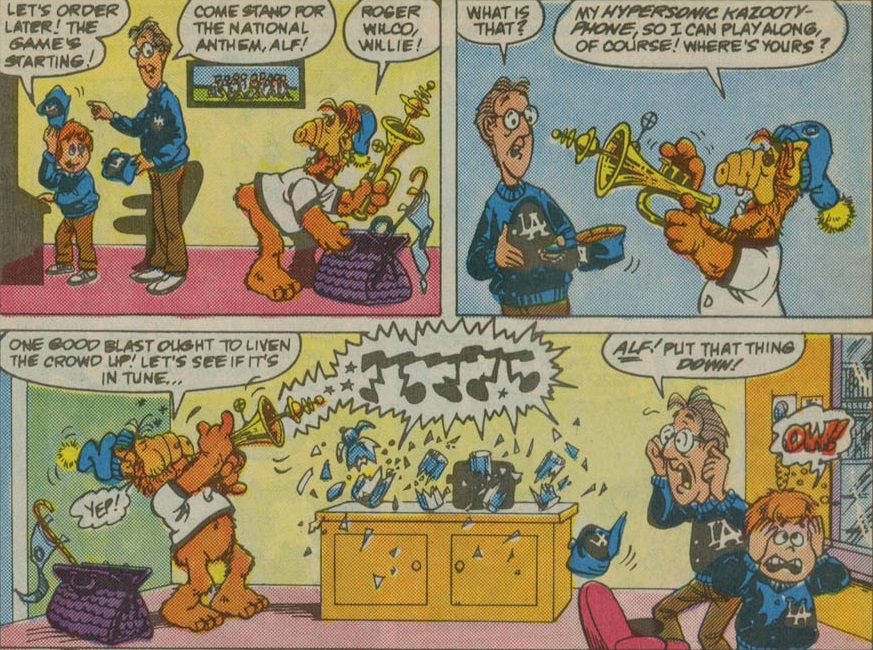
Willie takes Brian and Alf to watch a baseball game from a private box where the alien can't be seen. But Alf is used to a very different audience etiquette and when he gets excited his nose lights up very brightly...
As someone who doesn't understand baseball it's fortunate that this strip is based around the situation in the viewing box rather than the details of the game and the critical moments are easy to understand. The comedy as Alf starts playing a trumpet to the national anthem or using a repulsor to interfere with the ball make for good culture clash moments whilst Willie and Brian's reaction to the moment when the game is lost is understandable for any sports fan no matter what the sport.
4th story: You Give Me Fever
Gallagher/Manak/Severin
Alf is taken ill with a strange Melmacian disease - influence-a in which he acts out delusions brought about by media and the Tanners have to indulge him whilst keeping him in the house. First he thinks he's General Patton putting them through training, then a sleazy reporter revealing Willie and Kate's secrets then finally Robin Hood tying them up and preparing to give away their things. It's a one joke story that just about avoid outstaying its welcome though some of the delusions are especially silly particularly the reporter.
5th story: A Campy Approach
Gallagher/Manak/Severin
Brian is going away for summer camp and looking forward to it. But Alf is from a world where summer camps are punishments and he becomes convinced that this is what Brian has been sent to. So he devises a plan to travel to the camp and liberate Brian.
This is another culture clash story with Alf's misunderstanding and determination to save Brian from a terrible fate having hilarious consequences. There's a fun scene when Willie is phoned up to be asked a trivia question about a movie and Alf assumes the conversation is about other horrific camps. Later Alf disguises himself as a gorilla and Willie has to set minds at ease. But the best fun comes at the end as Kate gives Alf the most appropriate punishment. This is the highlight of the annual as a good extended comedy situation that explores the scenario fully.
At on point a projection of the High Evolutionary's head appears and demands to question Alf but it's not a convenient time so he agrees to come back in a couple of days. It's an odd interlude leading into the final story.
6th story: You Say You Want an Evolution?
Gallagher/Manak/Severin
This final two page strip sees the Evolutionary materialise in the Tanner house one night to talk to Alf and determine that he is not a threat to human development before cleansing Alf's memory of the incident. Alf declares the whole thing a nightmare and the consequence of reading eleven Marvel annuals before going to bed.
It's a fun little trailer for the whole event and it maintains a good ambiguity about whether Alf is in the Marvel universe or not. The High Evolutionary spoke at Alf's graduation and is in character but Alf is also aware of the existence of Marvel comics telling the story. But then many a comedy strip has broken the fourth wall in such a manner. It's also notable that the eleven annuals seen include ones for Daredevil, Thor and (seemingly) Alpha Flight. Did the final cut come late in the day or was this just an acknowledgement of series left out?
Overall this is a nice little link to Marvel's big event without descending into parody or overwhelming a comedy title. It's surprising more wasn't made of this as it's a good way to draw readers in to try some variation.
There's no bonus material as such in the annual but oddly there is an advert for itself that reproduces the cover and curiously notes it's from "Star Comics" when that imprint had now been wound up and in any case was never used for the series. There's also a two-page strip advert for the Bullwinkle and Rocky series.
It's a pity that the cover has a limited relationship to the contents. It's apparently based on a dream sequence in the television series but out of context it just looks like a crazy moment. Also there's not as much holiday content (let alone Alf draining Willie Tanner's savings) as promised.
As a whole this annual is very different from the other ones I've been looking at. There are far more stories but they're all focused on the core characters. Comedy series often rely heavily on gags and incidents rather than extended plots so it's unfair to criticise the story structures. It's a pity the first story is a direct sequel to an episode of the television series as it would have been better to introduce things for readers less familiar with every episode. I'm not sure how many readers actually were brought in by The Evolutionary War tie-in - it's prominent on the cover but this annual is not mentioned in the others or on the standard list so many could easily overlook it. But it's a good comedy piece and a reminder of a time when Marvel reached out to a broader range of readers. For that it's worth seeking out.
Thursday, 21 October 2021
Web of Spider-Man Annual 4 - The Evolutionary War
Spider-Man finds a book tour takes him into chaos in the Everglades.
Web of Spider-Man Annual #4
1st story: Sweet Poison
Writer: Steve Gerber
Artist: Cynthia Martin
Letterer: Rick Parker
Colorist: Janet Jackson
Editor: Jim Salicrup
Editor in Chief: Tom DeFalco
Peter Parker is on a tour promoting his book of Spider-Man photographs and gets caught up in the attempts by the Slug's men to secure a reserve supply of drugs for New York, following up on the supply problems established in the Punisher and Amazing Spider-Man chapters of The Evolutionary War. Meanwhile the High Evolutionary has sent his Eliminators and Purifiers to the Everglades to find the Nexus of All Realities in order to locate alien genetic pollutants that make it through and bond with human hosts, seeking the eliminate both the host and its offspring. The host turns out to be Cecilia, a maid at Peter's motel who has a double life as the being Poison with a second entity inside her. Poison confronts and destroys the Purifiers when they come to her home to eliminate her and her son, then the alien inside her separates off to return home. Meanwhile Spider-Man finds a hidden reserve supply of cocaine in the swamp which leads to a battle between him, the Slug's men, the Eliminators and the Man-Thing.
If this sounds chaotic it's because it is. The cover promises Spider-Man will be battling the Slug (an existing foe previously seen in Captain America) but the Miami drug lord only actually appears on a couple of pages in phone conversations with the Kingpin and demonstrating his ability to use his own fat to asphyxiate a man and he never encounters Spider-Man directly. It's a sign of the problems with this annual as it doesn't really know what it's about.
This story sees the return of Steve Gerber to mainstream Marvel books after many years (and an abortive lawsuit) and a few strips in Marvel Comics Presents but it's not a particular triumph. Far too many elements have been thrown into this story and they don't all meet up. Gerber was never the most conventional of writers but sometimes this could work against him. Web of Spider-Man was a title that still had a reputation for an inability to get a lasting permanent creative team and frequently functioned as little more than a set of fill-in issues though Alex Saviuk was now half a year into what would turn out to be nearly a seven year run so it's unsurprising that the annual wound up being written by an irregular writer. However Gerber doesn't seem to be especially interested in Spider-Man who is used only sparingly with a lot of attention instead devoted to his own new creation Poison, of whom more in the second story. All in all this is easily the worst chapter in The Evolutionary War so far.
2nd story: Night Stalking
Writer: Steve Gerber
Artist: Alex Saviuk
Letterer: Rick Parker
Colorist: Janet Jackson
Editor: Jim Salicrup
Editor in Chief: Tom DeFalco
This is the origin story for Poison, telling how Cecilia was one of the Cubans who came to the US in the Mariel boatlift. A university student who got pregnant by Vassily, a Soviet diplomatic attaché, she found her world crumbling around her when she was discovered and Vassily blamed her. Then when giving birth she was visited by the extra dimensional being Ylandris who merged with her and gave her power that remains even now they are separated. Poison is now hunting Vassily for revenge and searching the streets for him.
If this story was setting out to make Poison a viable recurring character to use it fails heavily. Already succumbing to the cliche of an immigrant Hispanic maid and giving her a costume that makes her look like a prostitute, she is now shown walking the streets on a mission of vengeance. There's very little to this story to open the character up for a viable ongoing use and so it's unsurprising that for many years her only other use was a multi-part story in Marvel Comics Presents by Gerber. The origin does make her sympathetic but does nothing to explain why she expects to find Vassily on the streets of Miami.
3rd story: The High Evolutionary: All My Children
Story: Mark Gruenwald
Pencils: Ron Lim
Finishes: Tony DeZuniga
Letters: Ken Lopez
Colors: Gregory Wright
Editor: Ralph Macchio
Editor in Chief: Tom DeFalco
This is a relatively sedate chapter, focusing upon the aftermath of the battle with Cthon as the High Evolutionary finally accepts the existence of the supernatural and that his partner really is possessed by a sixth century sorcerer. But the main focus comes with various children around the mountain. Jessica Drew is released after decades in suspended animation to be raised by the New Man Bova with no real mention of where her father is now that his body has been restored to him. But it's the twins Pietro and Wanda who get the highest turnover of parents. Their birth mother Magda disappears without an explanation given here and so the Evolutionary commissions an aid to find a couple to raise them. The first candidates are Robert and Madeline Frank, whose thoughts touch on their heroic past but they are not explicitly identified here. Madeline is pregnant and the plan is to present all three children as hers which seems a little fanciful. However she dies in childbirth with her own baby stillborn. The twins are presented to Robert as his own but upon news of his wife's death he runs away at super speed. Eventually the twins are given to a Romani couple Django and Marya Maximoff who lost their children in the Second World War with a caption telling us they will grow up to be Quicksilver and the Scarlet Witch.
If this seems convoluted it's because there had already been two retcons of their parentage over their years, first to make them the children of the Golden Age heroes the Whizzer and Miss America and then to make them the children of Magneto. The original stories had sought to explain why each set of parents had been absent from their childhood whether through death, desertion, ignorance or a desire to hide the children's existence from their father out of fear of him (this version predated Star Wars). As a result each version wrote one explanation on top of another and now this saga recounts it all. This is also one of the chapters that could do with more narrative captions to establish the context, particularly of just who the Franks are. It also highlights an inadvertent theme of absent parents as no explanation is given as to where Jonathan Drew now is when his daughter is finally revived even though his possessed body has only recently been at the mountain.
This chapter does its best with what was already a huge continuity mess (and which has been since changed yet again) and manages to present a coherent narrative out of the order of events but can't hide the difficult nature of it. Normally Mark Gruenwald can be given a pass in this saga as he was working with what others had come up with but he was one of the co-plotters of the Avengers issue that introduced Magda to the story and so bore at least some responsibility for what he was working with. What's also surprising is the way that the Maximoff's own children are explicitly identified as having died in the Second World War. Although no date is given for when this chapter is set (beyond Magnus having been there for a decade) even in 1988 chronological problems with linking characters' personal histories to the war were clear and also the original telling of these events didn't mention it. Fortunately the chapter works to present everything in an understandable order but it can't hide the mess it's working with.
Other material includes "The Year in Review!" which is a series of pin-ups by artists including Arthur Adams, John Romita Sr & John Romita Jr, Mike Zeck & Bob McLeod, Cynthia Martin and others not explicitly credited. It's hard to escape the sense that at least some of these are from inventory and were intended as covers and/or promotional pieces rather than being specifically drawn for this annual. Still it's handy to have a catch-up on one of the most intense years in Spider-Man's life which included his wedding, the introduction of one of his most popular foes, the abandonment of his black costume and one of the contenders for his most popular story of all. However this might have been better placed in the first of the three Spider-Man annuals to come out that year instead of the second.
Web of Spider-Man was a title that was still struggling even in its fourth year, having not yet found a writer that would last more than half a dozen issues or so and this annual was at the point where its longest lasting artist had only just reached that particular milestone. So it's natural to expect this annual to be a forgettable tale by a fill-in writer even before coming to the contents. However the main story is just utterly unfocused in trying to balance numerous different elements and the needs of the title character against the desire of the author to push his own creation. The second story doesn't redeem it being the origin of a new character instead of a tale from the regular series's world whilst the saga chapter is a recounting of what was already one of the most convoluted parts of the whole origin. This is a highly disappointing entry in the event.
Wednesday, 20 October 2021
Uncanny X-Men 238 - Inferno Prologue
Fire erupts inside Madelyne amidst a showdown with the Genoshan magistrates.
Uncanny X-Men #238
Writer: Chris Claremont
Penciler: Marc Silvestri
Inker: Dan Green
Colorist: Glynis Oliver
Letterer: Tom Orzechowski
Editor: Bob Harras
Editor in Chief: Tom DeFalco
The story concludes with this issue but we continue to see the dark side of the Genoshan miracle. Wolverine and Carol Danvers explore a camp where the mutates live and show Philip Moreau a side to his country that he just never thought about. Once again the parallels to real life leap out, in this case with the Bantustans where the South African state tried to put the black population away in little statelets, out of sight and out of the concern of the white population. It has been a fast journey into reality for Philip and it seems there is no chance to put it all right with his fiancée Jennifer having already started the transformation into an obedient slave mutate though at this point she still retains her memories and ability to reason. Philip also tries reason but faces officials who take the attitude that argument is pointless because it validates a question over whether what they do is right or not.
The X-Men attack and ultimately liberate their comrades, with Wipeout forced to restore Wolverine and Rogue's powers, but other than Philip there is no great enlightenment and no liberation. Wolverine wants to wipe out the state's leadership but Philip argues that in time the people can be made to see the wrong of their society and set it right. It's the classic revolution versus reform argument and it is highly depressing that there seem no prospect of the mutates themselves ever rising up and winning their freedom but instead their fate will be determined by the decisions of the current ruling race. It's a problem that the long term needs of the series to have Genosha as a place to return to clash with the needs of the story to bring liberation but ultimately it is the series that has to win out with the X-Men limited to threatening the Genoshan leadership with a destructive alternative future if they do not listen to Philip's mutant rights movement. This remains a bleak vision at a time when it could not have been foreseen that apartheid would fall in just the next few years.
Madelyne Pryor gets a lot of development in this issue as we see a telepath's experience of her mind. At first we see Madelyne as a little girl picking flowers when she's attacked by the Genengineer and the Magistrates who fire on her only for her to rise again in flames and bring destruction down upon the capital city. In the ruins the Genengineer is now wearing the costume of Mr Sinister and attacked by Madelyne in a costume vaguely reminiscent of the Black Queen's as she warns that lighting a match may ignite "an inferno". It's quite a striking piece in setting out the threat to come. It's also interesting for the way some of the imagery is lifted from the famous "Daisy" election advert from the 1964 US Presidential election which began with a shot of another girl with flowers before a nuclear explosion. Back in reality Madelyne claims ignorance of what happened even though the psionic explosion killed all those examining her and offers rational debate and support but there are hints this is a front. Later she confronts the Genengineer in person and implies she can bring destruction down upon him even as he prepares to shoot her. At the end it's almost sinister as she answers a question about a baby's whereabouts with "Not to worry. That's all been taken care of." This story has also seen Havok expressing ever more concern for his sister-in-law and the way they embrace at the end is highly suggestive. Although she's been on the side-lines for most of the previous chapters this story arc has shown strong signs of Madelyne's descent into something quite dark and truly sewn the seeds for what is to come.
Although the ending is stilted by the inability to bring down the whole regime, in spite of Wolverine's wishes, and the need to give a lot of focus on Madelyne's descent for future tales, all in all this has been a good story that hasn't run for more issues than it can sustain. Instead it's built up the situation steadily over each chapter and this conclusion resolves all the key strands satisfactorily.
Tuesday, 19 October 2021
Uncanny X-Men 237 - Inferno Prologue
The rest of the X-Men arrive in Genosha as Wolverine and Rogue seek to regain their powers and Madelyne proves harder to mind read than expected.
Uncanny X-Men #237
Writer: Chris Claremont
Penciler: Rick Leonardi
Inker: Terry Austin
Letterer: Tom Orzechowski
Colorist: Glynis Oliver
Editor: Bob Harras
Editor in Chief: Tom DeFalco
Much of this issue is focused on the flight of Wolverine and Carol Danvers (Ms. Marvel) in control of Rogue's body as they seek to evade the Genoshan magistrates for long enough until the rest of the X-Men arrive. In the process they come across Philip Moreau getting into a drunken fight with magistrates in a bar and coming off the worse for it. Seeking revenge upon his father the magistrates throw him on the "Mute train" that takes mutants away to a camp beyond the island's mountains out of sight and out of mind. Once again the parallels to the real world are all too clear and it's a strong contrast to the propaganda video Wolverine watches whilst waiting. The video instead tells the story of a success story that has conquered poverty and built a thriving industrial and agricultural economy that is the envy of the world. Wolverine comments on the omission as he turns to see a mutate collecting rubbish and treated like it by a pair of magistrates. Later as he admits that without his healing factor he'll soon be dead he determines to take down the whole country.
Elsewhere we get a very human encounter as Dr David Moreau, the Genengineer, meets with Jennifer Ransome who was going to marry his son before it was discovered she was a latent mutant and her test results had been switched. It's a chilling sign of how the oppressive society destroys even families as he sadly but calmly tells a woman who would have become his daughter-in-law that the whole country is based upon the use and conversion of mutants and that everyone has a duty to the state. Despite her please he calmly orders her to be sent for final processing. This issue is titled "Who's human?" The answer from this scene is not Dr David Moreau.
The other X-Men arrive on the island and face down a squad of magistrates when there is a massive psychic shock caused by a telepath's attempts to probe Madelyne. Throughout this story arc there have been further hints that there is more to Madelyne than it seems and the attempts to find out present great danger.
This chapter of the arc is more focused on the individuals as they seek to deal with the true nature of the supposed miracle of Genosha. Wolverine and Carol Danvers make for a highly resourceful team as they continue to outwit the magistrates and explore deeper whilst the presentation of the mutate process through how it affects and destroys one individual family really reinforces the horror of it all. This continues to be one of the strongest X-Men story arcs in quite some time.
Subscribe to:
Posts (Atom)